
Tight deadlines, high client expectations, and resource constraints can turn even the most enthusiastic event management student’s day into a whirlwind of stress. For those balancing coursework, internships, and team projects, learning to spot and handle pressure triggers becomes crucial for staying productive and healthy. This guide offers practical steps and proven strategies for recognising stress patterns, setting priorities with confidence, and building habits that protect your well-being as you start your career.
Table of Contents
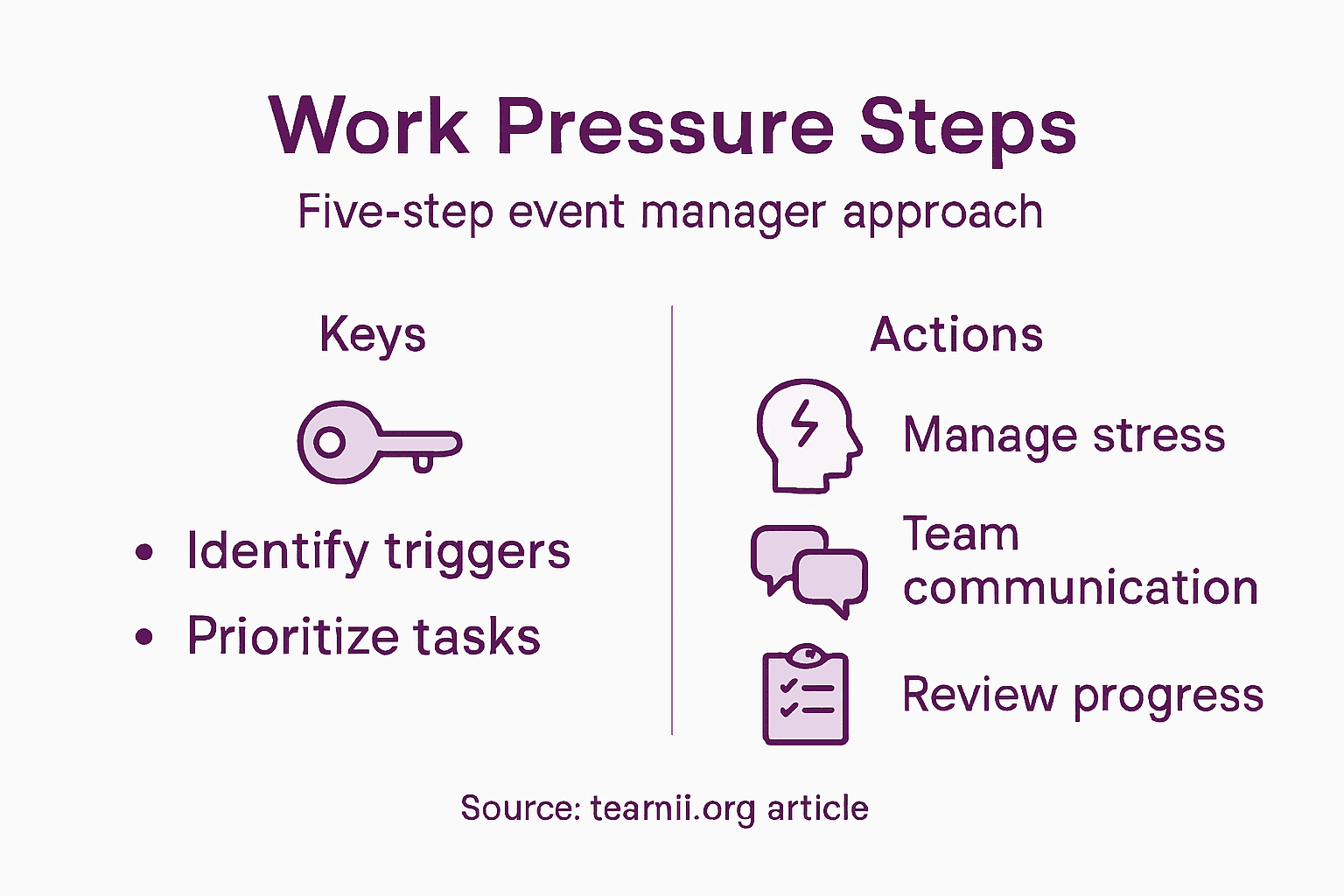
- Step 1: Identify Key Pressure Triggers At Work
- Step 2: Establish Effective Prioritisation Techniques
- Step 3: Implement Stress Management Strategies Daily
- Step 4: Communicate Proactively With Your Team
- Step 5: Evaluate Progress And Adjust Your Approach
Quick Summary
| Key Point | Explanation |
|---|---|
| 1. Recognise Key Pressure Triggers | Identify specific workplace stressors to create tailored coping strategies for better performance and well-being. |
| 2. Use Effective Prioritisation Techniques | Implement methods like the Eisenhower Matrix to manage multiple tasks, ensuring that the most crucial activities are addressed first. |
| 3. Practice Daily Stress Management | Engage in mindfulness, physical activity, and structured breaks to enhance resilience and manage stress consistently. |
| 4. Communicate Proactively with Your Team | Establish clear communication channels and regular check-ins to foster collaboration and address potential issues early. |
| 5. Continuously Evaluate and Adapt | Regularly assess performance and gather feedback to refine strategies and improve future event management effectiveness. |
Step 1: Identify key pressure triggers at work
Event managers face numerous workplace stressors that can dramatically impact performance and well-being. Understanding these key workplace triggers helps professionals develop targeted coping strategies.
Key pressure triggers in event management typically include:
- Project deadline constraints: Tight timelines and multiple simultaneous event preparations
- Client expectations: Managing varying and sometimes unrealistic client demands
- Resource management: Limited budgets and personnel constraints
- Logistical complexities: Coordinating multiple vendors, venues, and technical requirements
- Performance pressure: Maintaining high standards while managing unpredictable event dynamics
Professional event managers must systematically analyse their specific workplace environment to recognise individual stress points. This involves conducting a personal audit of recurring challenges, documenting patterns, and understanding personal emotional responses to workplace demands.
Recognising your unique pressure triggers is the first step towards developing effective stress management techniques.
Pro tip: Maintain a weekly stress journal to track specific situations that trigger heightened emotional responses and identify recurring patterns.
Step 2: Establish effective prioritisation techniques
Event managers must develop robust strategies to manage multiple competing responsibilities efficiently. Strategic time management techniques are crucial for maintaining productivity and reducing workplace stress.
Key prioritisation techniques include:
- Eisenhower Matrix: Categorise tasks into four quadrants
- Urgent and important (do immediately)
- Important but not urgent (schedule)
- Urgent but not important (delegate)
- Neither urgent nor important (eliminate)
- Time blocking: Allocate specific time slots for different project components
- Critical path method: Identify tasks that directly impact project completion
- Weekly review: Reassess priorities and adjust task management strategies
Authentic assessment strategies suggest simulating real-world scenarios to enhance prioritisation skills. This involves understanding stakeholder expectations and developing flexible task management approaches that adapt to changing event requirements.
Prioritisation is not about doing everything, but about doing the right things at the right time.
Pro tip: Use digital task management tools with colour-coded priority levels to visually track and manage your event workflow effectively.

The following table offers a comparison of prioritisation techniques for event managers:
| Technique | Best Use Case | Key Advantage | Limitation |
|---|---|---|---|
| Eisenhower Matrix | Handling varied task urgency | Clear visual organisation | May oversimplify tasks |
| Time Blocking | Maximising focus blocks | Reduces multitasking | Inflexible for emergencies |
| Critical Path Method | Complex projects with dependencies | Identifies bottlenecks | Requires detailed planning |
| Weekly Review | Ongoing adaptive planning | Encourages reflection | Dependent on regularity |
Step 3: Implement stress management strategies daily
Event managers require consistent and structured approaches to manage workplace stress effectively. Effective occupational stress management demands a proactive and holistic strategy that addresses both psychological and physiological well-being.
Key daily stress management techniques include:
- Morning mindfulness: 15-minute meditation or breathing exercises
- Physical activity: Regular exercise, even short walks or stretching
- Structured breaks: Implement the Pomodoro technique with deliberate rest periods
- Communication protocols: Regular check-ins with team and supervisors
- Boundary setting: Clear demarcation between work and personal time
Mental resilience practices suggest creating a personalised toolkit of relaxation and cognitive restructuring techniques. This involves developing individual strategies that suit your unique work environment and personal stress responses.
Consistent small actions create significant long-term stress management results.
Pro tip: Create a digital stress management dashboard tracking your daily well-being metrics, allowing you to identify patterns and proactively adjust your coping strategies.
Step 4: Communicate proactively with your team
Successful event management hinges on crystal-clear communication strategies that anticipate challenges and align team objectives. Effective communication techniques are fundamental to creating cohesive and responsive event management teams.
Key proactive communication approaches include:
- Daily huddle meetings: Short, focused check-ins to discuss progress and potential roadblocks
- Clear communication channels: Establish preferred communication platforms and response time expectations
- Transparent reporting: Regular status updates with specific, measurable information
- Active listening: Encourage team members to share concerns and suggestions openly
- Conflict resolution protocols: Develop standardised approaches for addressing team disagreements
Workplace communication strategies emphasise the importance of knowing your audience, maintaining appropriate tone, and using ‘I statements’ to foster open dialogue and prevent misunderstandings.
Proactive communication transforms potential challenges into collaborative opportunities.
Pro tip: Implement a digital communication dashboard that tracks team interactions, response times, and resolution rates to continuously improve your communication effectiveness.
Step 5: Evaluate progress and adjust your approach
Continuous improvement is the cornerstone of successful event management, requiring systematic evaluation and strategic adaptability. Performance tracking methods enable event managers to transform challenges into opportunities for growth.
Key evaluation strategies include:
- Quantitative performance metrics: Track specific, measurable outcomes
- Stakeholder feedback collection: Gather comprehensive input from team and clients
- Retrospective analysis: Conduct detailed post-event reviews
- Benchmarking: Compare performance against industry standards
- Adaptive planning: Create flexible frameworks for continuous improvement
Innovative event management approaches emphasise the importance of incorporating technological tools and feedback loops to refine future event planning and execution.
Effective evaluation is not about perfection, but about consistent and intentional improvement.
Pro tip: Develop a standardised digital dashboard that automatically aggregates performance data, allowing real-time insights and rapid strategic adjustments.
This table summarises how digital dashboards enhance stress management and team communication in event management:
| Dashboard Type | Main Function | Example Metrics | Business Impact |
|---|---|---|---|
| Stress Management | Track personal well-being | Mood trends, triggers | Early burnout detection |
| Team Communication | Monitor interaction effectiveness | Response times, messages | Improved team responsiveness |
| Performance Review | Aggregate event success data | KPIs, feedback scores | Faster improvement cycle |
Master Effective Stress Management with Expert Training at teami.org
If you are an event manager struggling with high-pressure deadlines, complex logistics, and demanding client expectations as discussed in the guide, you are not alone. The key to overcoming these challenges lies in mastering prioritisation techniques, proactive communication, and daily stress management strategies. At teami.org, we understand the emotional toll these pressure triggers can take on your career and well-being. Our specialised certification programmes are designed to equip you with practical skills and industry insights that directly address these pain points.
Join our comprehensive courses that offer hands-on projects, internships, and real event participation, all while benefiting from our 24 years of industry experience and esteemed partnerships like DNA Entertainment Networks. Take control of your event management career by developing resilience and strategic skills that help you manage work pressures effectively. Ready to transform stress into success Why wait to improve your prioritisation and communication skills Visit teami.org now and explore how our training can empower you to thrive under pressure. Get started today by connecting with us directly at Start Your Journey.
Frequently Asked Questions
How can I identify key pressure triggers at work as an event manager?
Recognise your key pressure triggers by conducting a personal audit of recurring challenges in your work environment. Document patterns and your emotional responses to workplace demands to better understand what stresses you.
What prioritisation techniques can I use to manage multiple event tasks effectively?
Utilise the Eisenhower Matrix to categorise tasks by urgency and importance. This method helps you focus on what truly matters while reducing overwhelming workloads by ensuring you tackle high-priority tasks first.
What daily stress management strategies can I implement to cope with event pressures?
Incorporate techniques like morning mindfulness, regular physical activity, and structured breaks into your daily routine. Even small actions, like a 15-minute meditation or a short walk, can significantly reduce stress and improve your focus.
How can I enhance communication with my event management team?
Establish clear communication channels and hold daily huddle meetings to align team objectives. This proactive approach encourages open dialogue and ensures everyone is aware of their roles and responsibilities.
What evaluation methods can help me assess my event management progress?
Use quantitative performance metrics and stakeholder feedback collection to evaluate your event management efforts. Conduct detailed post-event reviews to identify areas for improvement and adapt your strategies for future events.
How can I create a stress management toolkit as an event manager?
Assemble a selection of relaxation and cognitive restructuring techniques tailored to your unique work environment and personal stress responses. Include practices such as deep breathing exercises or journaling to create a personalised resource you can turn to in stressful times.
Recommended
- Master Stress Management Techniques for Event Professionals – team I
- 7 Essential Work Life Balance Tips for Event Managers – team I
- Mindfulness for Professionals: Reducing Stress and Enhancing Focus – team I
- 7 Essential Tips for Event Manager Part Time Success – team I
Thinking about a career in event management?
team I is Bangalore’s only EEMA-certified event management institute, running for 24 years, where students work on real live events with real budgets and real deadlines rather than classroom simulations. See the full range of event management courses in Bangalore, or go straight to the flagship Certificate Program in Event Management (CPEM).