
Most people hear “event management” and picture someone holding a clipboard at a birthday party. That picture is wrong. An event management course, formally known as an events management qualification, is a structured programme that trains you in the full professional discipline of planning, producing, and evaluating events at scale. Think Sunburn Festival in Goa. Think a 500-person corporate summit in Hyderabad. Think a destination wedding in Udaipur with 20 vendors, a live orchestra, and a guest list that cannot afford mistakes. Event management courses cover logistics, budgeting, marketing, PR, and risk management. This guide tells you exactly what to expect.
What an event management course actually teaches you
No shade to chalkboards, but the best event management training is less about memorising definitions and more about learning to think on your feet when the AV system fails at 7 PM and 300 guests are seated.
Course content spans concept development, feasibility assessment, venue selection, logistics, risk management, staffing, budgeting, marketing, sustainability, and post-event evaluation. That is a serious range. Each subject connects directly to a real decision you will make on the ground.
Here is what a well-structured course covers:
- Event concept and feasibility: You learn to assess whether an idea is actually executable, financially and logistically. This is the filter that separates good ideas from disasters.
- Logistics and operations: Crowd flow, vendor coordination, load-in timelines, and contingency planning. Miss any one of these at a college fest in Bangalore and the night falls apart.
- Budgeting and finance: Not just writing numbers in a spreadsheet. Negotiating vendor contracts, managing float, tracking spend in real time.
- Marketing and public relations: Filling seats and managing reputation. For a corporate product launch in Mumbai, this is as critical as the event itself.
- Risk management: From weather contingencies at outdoor concerts to security protocols for large gatherings.
- Event technology: Modern courses include tools like Eventbrite, Cvent, virtual conferencing platforms, and AI-driven attendee engagement software.
Practice is the theory here. The best programmes send you into live events, not just simulations. You learn by being thrown into controlled chaos and finding your way out.
Pro Tip: Before enrolling, ask specifically whether the course includes live event participation or just theoretical projects. Real on-ground hours matter far more to employers than a distinction grade on a written paper.

Qualification levels and course durations
Not all event management qualifications are equal, and understanding the range helps you choose what fits your situation right now.
Degrees typically run three years full-time for a BA (Hons), while postgraduate certificates can be completed in 12 months or less. At the other end, short courses can be as brief as 40 hours, offering an affordable and fast entry point for anyone wanting to test the field before committing.
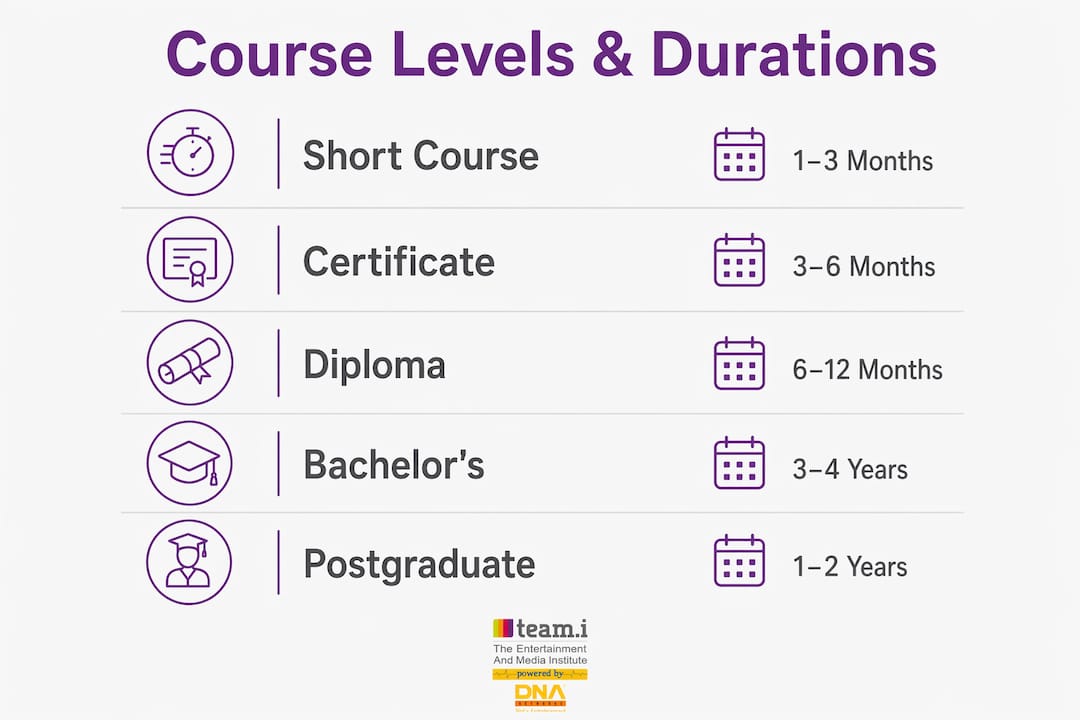
Here is a clear comparison of what is available:
| Qualification level | Typical duration | Best suited for |
|---|---|---|
| Short course or certificate | 40 hours to 3 months | Quick upskilling, career changers |
| Diploma | 6 to 12 months | Post-school entry, focused training |
| Bachelor’s degree (BA/BSc) | 3 years full-time | Deep preparation, graduate-level roles |
| Postgraduate certificate or MBA | 12 to 24 months | Professionals seeking senior roles |
In the Indian context, diploma programmes are particularly popular because they balance depth with speed. A motivated student coming out of Class 12 in Delhi or Bangalore can complete a rigorous diploma and be working on real events within a year. For those wanting to read the diploma vs degree breakdown in detail before deciding, that comparison is worth your time.
The right level depends on your existing background, your target role, and honestly, how long you can afford to be in full-time study before earning.
Career paths after your qualification
Completing an event management course qualification is not the end. It is the starting pistol.
Graduates move into roles across event planning, festival management, wedding coordination, corporate event production, sports event management, venue management, and experiential marketing. The Indian event industry is one of the fastest-growing sectors in the country, with cities like Mumbai, Delhi, Hyderabad, and Bangalore generating demand for trained professionals year-round.
Here are the career directions open to you after completing your course:
- Wedding planner or coordinator: India’s wedding industry is enormous. Understanding wedding planning logistics and vendor management at a professional level puts you in serious demand.
- Corporate event manager: Handling product launches, annual conferences, and brand activations for companies across Bangalore’s tech corridor or Mumbai’s financial sector.
- Festival and concert production: Working on live music events, college festivals, and mega IP productions where crowd management and production logistics are non-negotiable skills.
- Sports event coordinator: India’s appetite for cricket, kabaddi, and football events creates genuine career opportunities in this niche.
- Experiential marketing specialist: Brands now spend heavily on live experiences. This is one of the fastest-growing roles for event management graduates.
Practical experience drives employability more than any grade. Employers in India want to know what events you have actually worked on, not just what you studied. For a detailed look at specific roles, the jobs after event management breakdown covers seven concrete paths worth exploring.
Choosing the right course for your goals
There are hundreds of options out there. Most of them will not get you where you want to go. Here is how to choose without wasting time or money.
- Check the qualification level against your goals. A short certificate will not carry the same weight as a diploma or degree if you are targeting senior production roles. Be honest about where you want to be in three years.
- Look for industry connections and placements. Courses connected to industry that offer real placements and live projects build the skills and networks that actually get you hired.
- Account for the full cost. Tuition fees are not the only number. Budget carefully for specialist materials, field trips, professional memberships, and travel costs that can add up significantly across a course year.
- Assess the practical component. Ask for a breakdown of class hours versus live event hours. Theory without practice is not preparation for this industry.
- Verify accreditation. A recognised event management course qualification from an accredited institution carries weight with employers. An unaccredited certificate from an unknown provider does not.
Pro Tip: When you contact any institute, ask them directly: “Can I speak to a placement coordinator or recent graduate?” If they hesitate, that tells you something. If they connect you immediately, that tells you something better.
If you are just starting out and want to explore before committing financially, there is a solid list of free online courses that can give you a taste of the content without the price tag.
My honest take on event management education in India
I have seen students come through with textbook-perfect answers and crumble the moment a vendor does not show up on the day. I have also seen students who barely passed their exams become brilliant event professionals because they said yes to every live opportunity they were given.
The truth is this: the qualification opens the door. What you do inside the room is entirely on you.
The Indian event industry moves fast. Weddings in Jaipur with 800 guests and five-day programmes. Corporate launches in Bengaluru where the client changes the brief 48 hours before go-live. Outdoor concerts in Mumbai where weather, permissions, and crowd safety all collide at once. No course can simulate all of that. What a great course can do is give you the frameworks, the vocabulary, and the nerve to handle it.
My advice to anyone researching event management training right now: stop asking which course looks impressive and start asking which course gets you on the ground fastest. The independent study and practical assessments that happen outside class time are what build real competency. Treat every live event hour as more valuable than three classroom hours. And never stop networking. The Indian event industry is smaller and more connected than it looks from the outside.
— Teami
Start your event management career with Teami
Teami has 24 years of industry experience training the next generation of event professionals in India. The programmes are built around real events, not case studies written in a conference room. From diploma courses to online event management programmes for learners who need flexibility, every option comes with hands-on training, industry connections through DNA Entertainment Networks, and a placement record that speaks for itself. If you are serious about entering this industry and want a course that puts you on a stage rather than a bench, explore the full course details and see what fits your goals and timeline. The industry is growing. The seats in this programme are not unlimited.
FAQ
What does an event management course cover?
An event management course covers planning, logistics, budgeting, marketing, public relations, risk management, and event technology. Most quality programmes also include hands-on experience through live events, internships, or industry projects.
How long does an event management course take?
Duration ranges from 40-hour short courses to three-year bachelor’s degrees. Diplomas typically take six to twelve months, making them a popular choice for students entering the field directly after school in India.
What qualification do I get from an event management course?
Depending on the level you study, you can earn a certificate, diploma, bachelor’s degree, or postgraduate qualification in events management. Accredited qualifications from recognised institutes carry the most weight with employers.
Is event management a good career in India?
Yes. India’s event industry spans weddings, corporate events, concerts, sports tournaments, and experiential campaigns, creating strong demand for trained professionals in cities like Bangalore, Mumbai, Delhi, and Hyderabad.
Do I need prior experience to enrol in an event management course?
Most diploma and undergraduate programmes require only a Class 12 pass. Some postgraduate programmes prefer candidates with a degree or relevant work experience. Check the eligibility requirements for the specific course you are considering.
Recommended
- Blog – team I
- Event management lifestyle: a practical guide for 2026 – team I
- Event management course costs in India: 2026 guide – team I
- BLOG – team I – Page 11
Thinking about a career in event management?
team I is Bangalore’s only EEMA-certified event management institute, running for 24 years, where students work on real live events with real budgets and real deadlines rather than classroom simulations. See the full range of event management courses in Bangalore, or go straight to the flagship Certificate Program in Event Management (CPEM).