
You finished 12th. Somebody told you event management is “fun”. Somebody else told you it is “not a real career”. Both of them are guessing.
Here is the honest version, from an institute that has been putting students on live event floors in Bangalore for 24 years, and that will tell you the uncomfortable parts too.
First, the thing most people get wrong
Event management is not party planning. It is logistics, budgeting, vendor negotiation, crowd safety, client servicing and crisis management, performed under a deadline that does not move. The show opens at 7pm whether you are ready or not.
That is exactly why it suits some people after 12th and not others. If you like solving problems in real time, being on your feet, and being judged on whether the thing actually happened, you will thrive. If you want a predictable desk and a fixed calendar, this is the wrong industry, and it is better you know that now than after you have paid a fee.
Do you even need a degree first?
No. At team I there is no specific prior degree required to join the Certificate Programme in Event Management. What matters is real intent to build a career in events.
That surprises people, so it is worth being precise about why. Employers in this industry hire on evidence. They want to know how many events you have actually worked, in what role, and whether you held your nerve. A three-year qualification with no live events on it is weaker evidence than ten months with twenty-five real shows behind you.
What CPEM actually involves
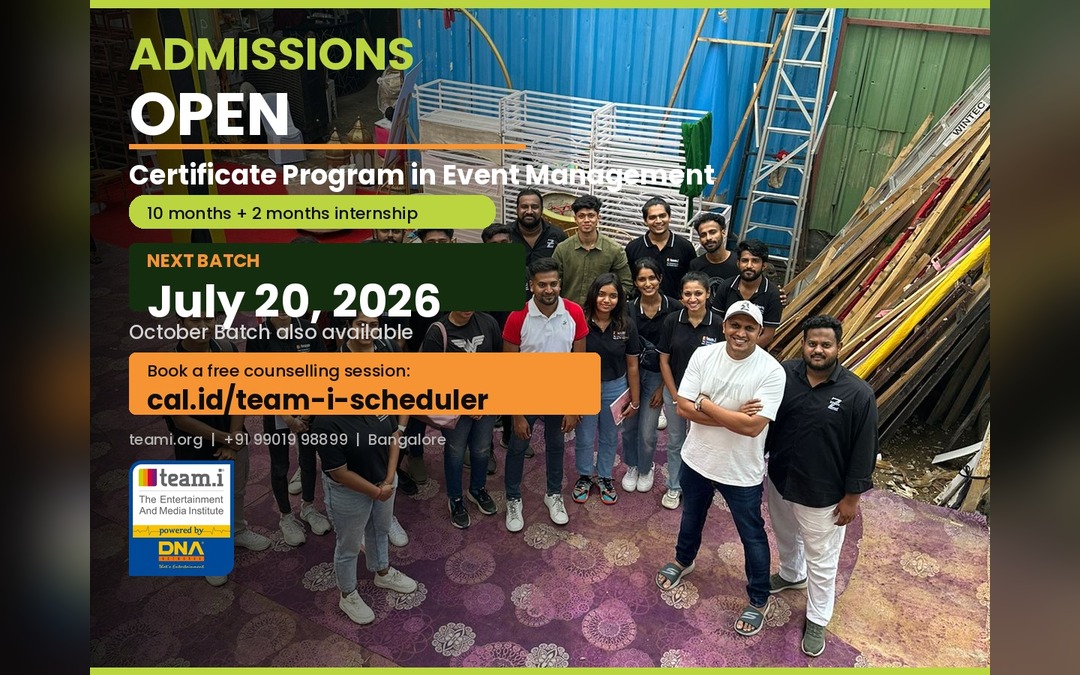
The event management course runs 10 months with 2 internships built into the programme. Twelve live events are mandatory. In practice students work on 25 to 35 real events, with real vendors, real budgets and real deadlines, not classroom simulations. Intakes are small, around 30 students, and there are four a year: January, April, July and October. You can do it on-ground, online, or hybrid.
What you actually study
The teaching is built around four working disciplines, not a list of subjects invented to fill a timetable:
- Conceptualisation and creativity. Turning a brief into an idea that can actually be built for the money available.
- Marketing and sponsorship. Where the money comes from, how sponsors are sold to, and what they expect back.
- Production and operations. Sound, light and AV, DJ and VJ, set design, artist management, the floor itself.
- Event finance. Budgets, margins, costing, and why events lose money when nobody is watching.
Every student covers all four. Because intakes overlap, you sit in class with students from other batches, which is deliberate. You learn faster next to someone who worked a show last weekend.
If you want a degree as well
CPEM is the flagship and most students start there. team I also offers a BBA and an MBA in Event, Media and Business Management, for people who want a full degree alongside the practical training. If you are 18 and want to be earning inside a year rather than three, CPEM is the reason why. If your family wants the degree certificate as well as the skills, the degree route is the honest answer.
What it costs, plainly
The fee is ₹2,95,000 in instalments, or ₹2,50,000 if you pay in one shot, which saves you ₹45,000. Both figures are inclusive of taxes. The full breakdown, including the monthly option, is on our course fees page.
We put those numbers in writing because a lot of institutes will not. If a website will not show you a fee before it takes your phone number, ask yourself why.
One more thing worth knowing: internships in the programme are paid, in the range of ₹15,000 to ₹20,000 per month while you are interning and working live events.
What the job actually pays
Starting salaries in the industry run around ₹2.4 lakh to ₹4 lakh a year. Freelance work ranges from ₹5,000 to ₹50,000 per event depending on the role you hold. We have written up the detail on our event management salary page.
That first number is not glamorous and we are not going to dress it up. What changes the trajectory is what happens in years two and three, once you have a real portfolio and the industry knows your name. Our alumni are now at George P. Johnson, Wizcraft, LiveFix Events, Acme Experience Marketing and Arkaaya Events, among others, and some have started their own companies. You can read their stories rather than take our word for it.
The one question to ask any institute
How many live events will I personally work on, and can I speak to a student who is on the floor right now?
If the answer is vague, walk away. Classroom-only training in this industry produces graduates who have never handled a vendor who did not show up, and that is the entire job.
What you actually need to start
Working English, a laptop, basic Excel and PowerPoint, and basic familiarity with AI tools. Everything else we work around. There is no written entrance exam and no specific stream requirement, so commerce, science and arts students all come through the same door.
Is it a good career, honestly?
India’s event industry is worth over ₹10,000 crore and is still massively under-professionalised. That is the opportunity and the warning in one sentence. Under-professionalised means there is room for someone trained to move up fast. It also means you will meet plenty of people doing it badly, and you will have to be better than them.
If you want a career where nobody can bluff about whether you are good, because the event either worked or it did not, this is a good career.
Frequently asked questions
Can I do an event management course right after 12th?
Yes. There is no specific prior degree requirement for the Certificate Programme in Event Management and no written entrance exam; admission is decided at a counselling session that includes an interview and a small aptitude test. Commerce, science and arts students all join the same programme.
How long is an event management course after 12th?
The CPEM runs 10 months and includes 2 internships. team I also offers a 3 year BBA and a 2 year MBA in Event, Media and Business Management for students who want a degree alongside the training.
What is the fee for an event management course in Bangalore?
At team I the CPEM fee is ₹2,95,000 in instalments, or ₹2,50,000 if paid in one shot, which saves ₹45,000. Both figures are inclusive of taxes.
Can I study event management online?
Yes. CPEM can be done on-ground, online, or hybrid. Students outside Bangalore do the programme remotely and still work live events.
How many events will I work on as a student?
Twelve live events are mandatory. In practice students work on 25 to 35 real events a year, with real vendors, real budgets and real deadlines, not classroom simulations.
What salary can I expect after an event management course?
Industry starting salaries run around ₹2.4 lakh to ₹4 lakh a year, with freelance event work between ₹5,000 and ₹50,000 per event depending on your role. Earnings rise quickly once you have a portfolio and a reputation.
When is the next intake?
There are four intakes a year: January, April, July and October. The next one is October.
Next step
The next intake is October. If you want to talk it through, book a counselling call and ask us the hard questions. If you would rather see the place first, come and visit the campus at 578 Magadi Main Road, Sunkadakatte, Bengaluru 560091, and watch a class. More answers are on our FAQ page.
Either way, do not sign up for an event management course anywhere until somebody has told you what the first year actually looks like.