

Event planning university education is defined as a structured academic pathway that combines event design, marketing, logistics, risk management, and production into a formal credential recognised by employers across the events industry. Whether you are eyeing a corporate gig in Bengaluru, managing a destination wedding in Udaipur, or producing a college fest in Delhi, the right programme separates you from the crowd before you even walk into an interview room. The Indian events industry is growing at pace, and hiring managers now actively distinguish between candidates who have studied the craft and those who simply attended a few events. This guide breaks down what these programmes actually contain, how to choose between them, and where hands-on experience fits into the picture.
What does an event planning university programme actually cover?
The core of any event planning degree or certificate programme sits across five subject areas: event marketing, budgeting and financial management, risk management, sponsorship strategy, and production logistics. These are not abstract concepts. In practice, they translate directly to skills like negotiating a vendor contract for a 500-person corporate dinner in Mumbai or building a contingency plan for an outdoor concert in monsoon season.
The SIU Event Planning Certificate at Southern Illinois University is an 18-credit undergraduate certificate covering marketing, sponsorship, risk management, entertainment production, and virtual events. That breadth reflects what the industry actually demands, not just what looks good on a syllabus. Meanwhile, Kansas State University is launching a 15-credit certificate in Fall 2026 open to all undergraduates, with nine hours of core content and six elective hours, and no entrance requirements.

Full degree programmes, such as the Event Management major at Florida State University, go considerably deeper. They require approximately 120 credit hours and integrate specialised modules in hospitality operations, event technology, and strategic management. The depth of a full degree builds the kind of analytical thinking that moves you from coordinator to director level within five years.
Here is what a well-structured event management course typically includes:
- Event design and concept development covering theme creation, spatial planning, and audience experience
- Marketing and digital promotion including social media strategy and sponsor pitch decks
- Budgeting and financial controls with real-world scenarios involving vendor negotiations
- Risk management and crisis planning covering crowd flow logistics, safety protocols, and legal compliance
- Virtual and hybrid event production reflecting the post-pandemic shift in how events are delivered
- Internships and live project work as graded components, not optional extras
Pro Tip: When evaluating any event management course, check whether risk management and virtual events are standalone modules or just footnotes in a broader subject. The Indian market demands both, especially after the rapid growth of hybrid corporate events in cities like Hyderabad and Pune.
| Programme | Credits | Key modules | Practical component |
|---|---|---|---|
| SIU Event Planning Certificate | 18 | Marketing, risk, virtual events | Approved electives toward full degree |
| K-State Event Management Certificate | 15 | Marketing, risk, virtual events | Applied projects |
| FSU Event Management Degree | ~120 | Full hospitality and event management | 1,000 hours field study |
Certificate or full degree: which one is right for you?
The honest answer is that it depends entirely on where you want to be in three years. A certificate gets you into the room. A degree gives you the credibility to run it.
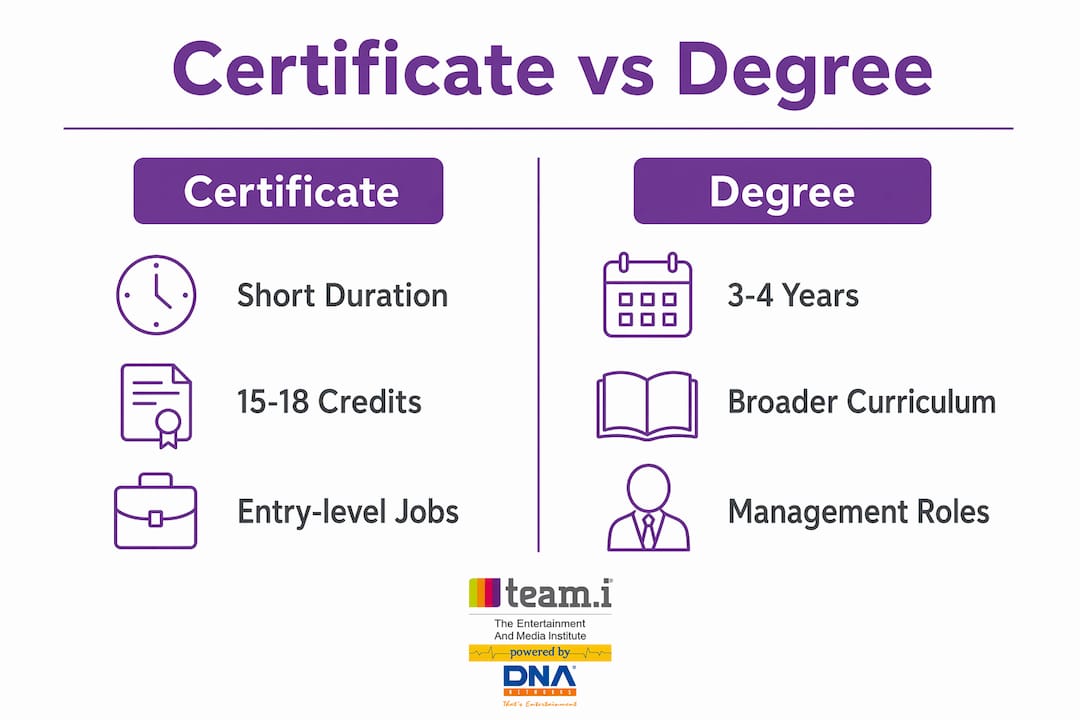
Certificate programmes typically run for one to two semesters and require 15 to 18 credit hours. They are designed for people who want to enter the workforce quickly or add a formal credential to existing experience. In the Indian market, a certificate from a recognised institute signals to a hiring manager at an event company in Bengaluru or a production house in Mumbai that you have studied the fundamentals in a structured way. That matters more than most students realise.
Full degree programmes require a significantly larger time and financial commitment, typically three to four years and upwards of 120 credits. The payoff is a much deeper skill set and, critically, the management-level credibility that opens doors to senior roles. If your goal is to eventually run your own event company or head the events vertical at a major brand, a degree-level qualification positions you for that trajectory far more effectively.
Pro Tip: If you are already working in events and want to formalise your skills without stepping away from the industry, a certificate programme is the smarter short-term move. You can always pursue a degree later. What you cannot easily recover is two years of lost industry experience.
A few practical considerations when choosing:
- Time commitment: Certificates can be completed in one year; degrees typically require three to four years
- Cost: Certificate programmes carry significantly lower tuition fees and opportunity costs
- Career entry point: Certificates suit coordinator and assistant roles; degrees suit management and director tracks
- Flexibility: Many certificate programmes, including those offered online, allow you to study alongside part-time work in the events sector
- Indian employer perception: Large event companies and corporate event teams in Delhi and Mumbai increasingly value formal credentials at any level, but senior roles almost always require degree-level education or equivalent professional experience
How do certifications and short-term training fit into the picture?
Professional certifications are not a replacement for university education. They are a precision tool for a specific job. The Certified Meeting Professional designation, administered through the Events Industry Council, is the gold standard for corporate and conference event planners globally. It signals a level of professional mastery that a university certificate alone does not convey.
Meeting Professionals International runs a 9-week virtual CMP bootcamp costing between $170 and $220, structured around participant-led weekly sessions and exam preparation. That price point makes it genuinely accessible for Indian professionals, particularly those working in corporate event roles in Bengaluru or Hyderabad who want international recognition without the cost of a full overseas programme. The MPI bootcamp format works best for participants who already have basic event vocabulary and engage actively throughout, rather than cramming at the end.
Short-format certifications like the 2-Day DC Event Planner Certification include 8 hours of education and a formal assessment leading to a Certified Event Planner designation. These are useful for very specific skill gaps, not as a primary credential. Think of them as the equivalent of a masterclass, not a degree.
Here is when to pursue a professional certification:
- You already hold a university qualification and want to specialise in corporate or conference events
- You are targeting international clients or multinational companies operating in India
- You want to demonstrate commitment to professional development during a career transition
- You are preparing for a senior role where a recognised designation adds credibility to your proposal or pitch
- You want structured exam preparation with peer accountability rather than self-study
You can explore top certification options that complement formal university education and build practical specialisation.
Why hands-on experience is non-negotiable in event education
Theory without practice in event management is like a showflow without a timeline. It looks organised on paper and falls apart on the day. The programmes that produce genuinely job-ready graduates are the ones that treat practical experience as a core requirement, not an optional add-on.
Florida State University’s Event Management major requires 1,000 hours of industry work experience as a formal degree requirement, registered as Field Study coursework. That number is not arbitrary. It reflects the reality that event management competence is built through repetition, problem-solving under pressure, and learning from experienced professionals in live environments. In the Indian context, 1,000 hours translates to roughly two full wedding seasons, a dozen corporate events, and several college fests. That is the kind of exposure that builds real confidence.
What counts as valuable practical experience in the Indian events sector:
- Corporate events: Product launches, annual conferences, and award ceremonies in cities like Bengaluru, Mumbai, and Delhi
- Wedding events: Multi-day destination weddings requiring vendor coordination, logistics, and on-ground management
- College festivals: Large-scale student-run events that demand crowd management, sponsorship activation, and live production
- Concerts and large productions: Crowd flow logistics, artist management, and technical production coordination
Pro Tip: When applying for internships, target event companies that work across multiple event types rather than specialists. The broader your exposure in your first year, the faster you build the judgement that experienced event managers rely on.
It is worth noting that work experience documentation matters as much as the hours themselves. Universities and certification bodies require that experience meets defined criteria around industry sector, level of responsibility, and supervision. Keep a detailed log from day one.
What we have learnt after 24 years of training event professionals
Choosing a programme based on its name or its fee is the most common mistake we see. The students who build genuinely strong careers are the ones who chose their programme based on what it demanded of them, not what it promised them.
The Indian events industry does not reward passive learners. A Sunburn Festival production or a large-scale corporate event in Hyderabad does not pause for someone who only knows the theory. The programmes worth your time are the ones that put you in front of real problems, real vendors, and real deadlines before you graduate. Networking built during a university programme, whether through faculty connections, industry visits, or live projects, often determines your first three job opportunities more than your grades do. Prioritise programmes that connect you to working professionals, not just visiting lecturers.
— Teami
Start your event management career with Teami
Teami brings 24 years of industry experience to every course it offers, with direct connections to DNA Entertainment Networks and a placement record built on real industry partnerships. Whether you are looking for a structured online programme that fits around your schedule or a full-immersion course that puts you on the ground at live events across Bengaluru and beyond, Teami’s programmes are built for the Indian events market. You will not just study event management. You will practise it. Explore Teami’s event management courses to find the programme that matches your career goals and gets you industry-ready from day one.
FAQ
What is an event planning university programme?
An event planning university programme is a formal academic course covering event design, marketing, budgeting, risk management, and production. It leads to a certificate or degree credential recognised by employers in the events industry.
How many credits does a university event management certificate require?
Most university event management certificates require between 15 and 18 credit hours. The SIU certificate requires 18 credits, while the K-State certificate launching in Fall 2026 requires 15 credits.
Is a full degree better than a certificate for event management careers?
A full degree opens doors to management and director-level roles, while a certificate suits entry-level coordinator positions. Your choice should align with your career timeline and the seniority level you are targeting within three to five years.
How much work experience do event management students need?
Florida State University requires 1,000 hours of industry experience as a formal degree requirement. The specific hours, industry sector, and level of responsibility must meet the university’s defined criteria to count toward graduation.
Are CMP bootcamps worth it for Indian event professionals?
The MPI Virtual CMP Bootcamp costs between $170 and $220 and runs over nine weeks with a participant-led format. For Indian professionals targeting corporate or international event roles, the CMP designation adds credibility that domestic certificates alone do not provide.