
You are three minutes away from addressing a room of fifty people. Your heart is hammering, your notes feel slippery in your hands, and your mind has gone suspiciously blank. Sound familiar? If you are an aspiring event manager or a student building your career in India’s booming events industry, this moment will come for you repeatedly. The good news is that 85% of people fear public speaking, which means you are in very good company. Better news: a handful of research-backed tactics can genuinely change everything.
Table of Contents
- Understanding public speaking anxiety
- Laying the foundation: Preparation that reduces anxiety
- Power moves: Breathing and physiological regulation
- Smart exposure and cognitive reframing strategies
- Mistakes to avoid and what to do post-speech
- A fresh perspective: The secret value of controlled vulnerability
- Take the next step: Empower your event career
- Frequently asked questions
Key Takeaways
| Point | Details |
|---|---|
| Preparation is crucial | Short, daily practice and focusing on message delivery make public speaking anxiety manageable. |
| Breathing regulates nerves | Cyclic sighing and other controlled breathing techniques reliably lower anxiety before and during speeches. |
| Gradual exposure works | Start small, use virtual or friendly audiences, and steadily increase your speaking challenges. |
| Reframe anxiety | Label nervousness as excitement and use it to boost your energy on stage. |
| Post-speech reflection | Evaluate your performance after each event to learn and reduce future anxiety. |
Understanding public speaking anxiety
Public speaking anxiety, sometimes called glossophobia, is not a character flaw. It is a cluster of fear responses, physiological reactions, and avoidance behaviours that emerge when you feel judged in front of others. Your palms sweat. Your voice tightens. Your brain replays every possible way things could go wrong.
For event managers and students in India, this matters enormously. The role demands constant communication, whether you are pitching a concept to a client, briefing a vendor team on the showflow, or hosting a live corporate event with a thousand eyes on you. When anxiety wins, career advancement stalls.
The scale of the problem is significant. Research confirms that 85% of people fear public speaking, and this is particularly acute for those aspiring to roles that require presentations or hosting. The public speaking essentials for event professionals go far beyond casual conversation, which is why a structured approach is essential.
| Common symptom | Potential career impact |
|---|---|
| Racing heartbeat | Visible discomfort on stage |
| Shaky or dry voice | Loss of client or audience confidence |
| Mental blanking | Missed key talking points |
| Avoidance behaviour | Fewer leadership opportunities taken |
| Negative self-talk | Declining willingness to take on visible roles |
Recognising these symptoms as manageable physiological reactions, rather than proof of incompetence, is the critical first shift. The rest follows from there.
Laying the foundation: Preparation that reduces anxiety
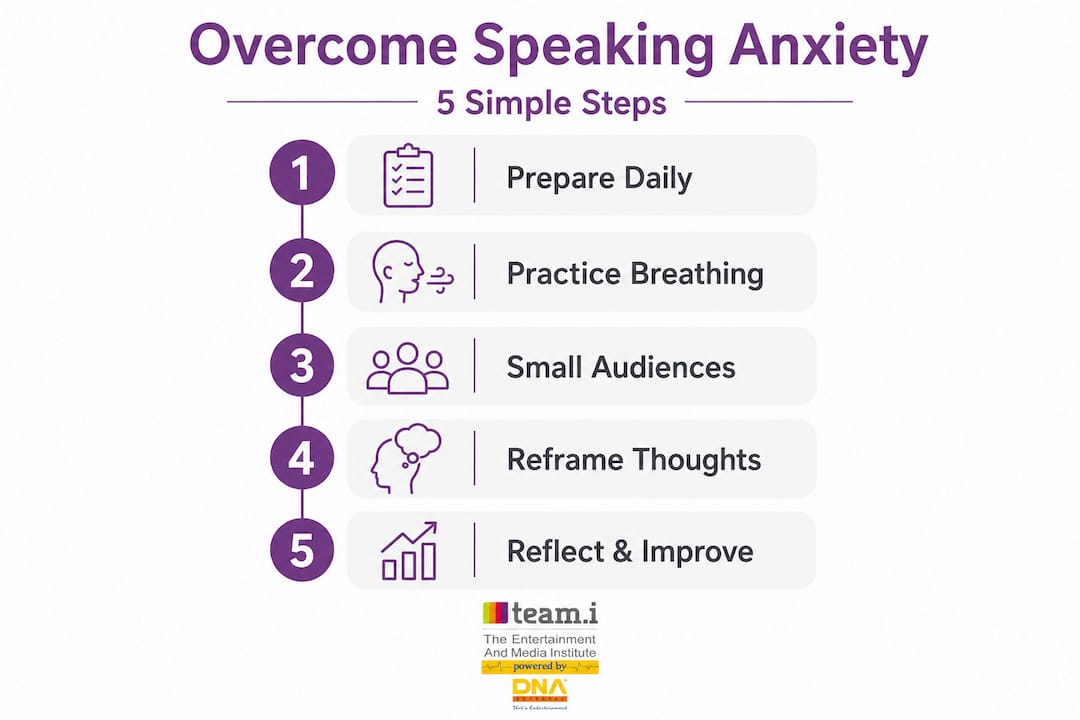
Preparation is not glamorous. But it is genuinely the most powerful tool you have. Effective anxiety reduction typically combines structured preparation, repeated practice in small doses, and shifting attention to delivery rather than perfection.
Here is a step-by-step approach that actually works:
- Understand your audience first. Before writing a single word, ask yourself who is in the room and what they need to walk away with. An event client in Bangalore wants outcomes, not jargon.
- Structure your content in three parts. Opening hook, core message with two to three supporting points, and a clear close. Keep it lean. Over-stuffed presentations breed anxiety.
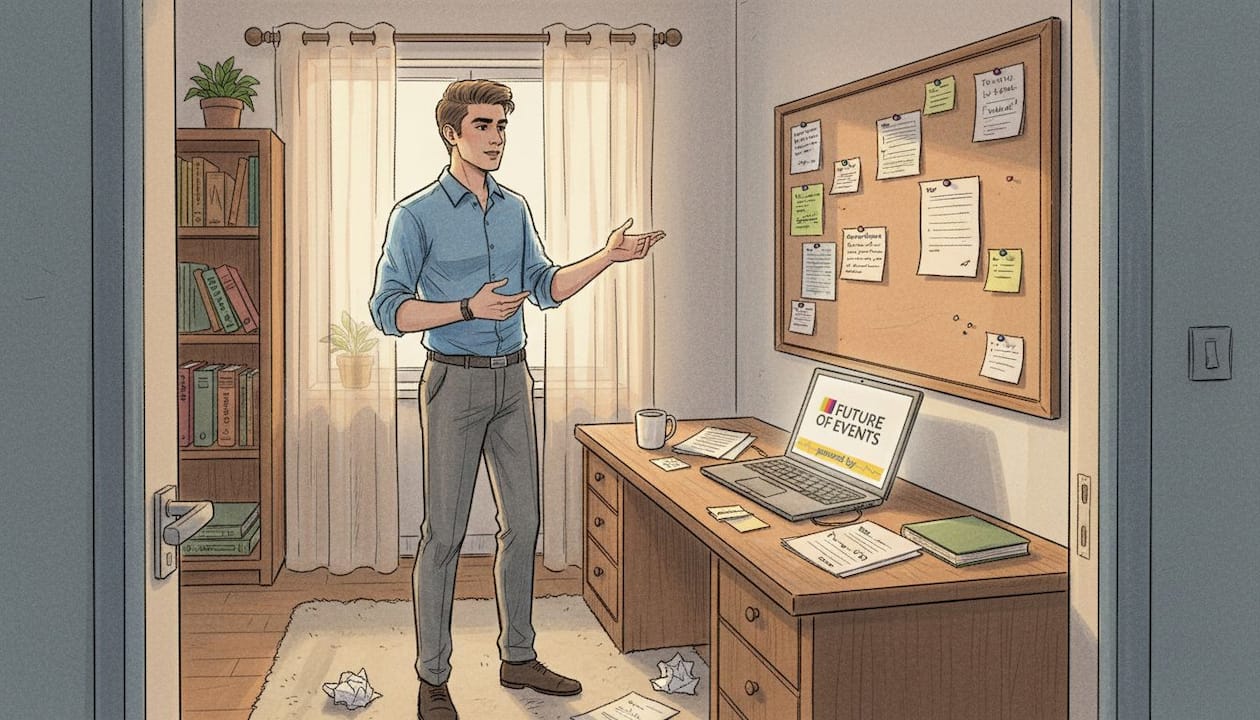
- Practise in micro-doses. Ten minutes of daily out-loud rehearsal beats a three-hour panic session the night before. Your brain builds familiarity incrementally, and familiarity is the enemy of fear.
- Build a micro-audience. Practise in front of one friend, then two, then a small group. Each step builds real confidence faster than rehearsing alone in your room.
- Record yourself once. Watch it back critically but kindly. You will discover that you are better than your anxiety tells you.
“The goal is not a flawless performance. The goal is a meaningful connection with your audience. Shift your focus there, and perfectionism loses its grip.”
Improving your presentation skills is an ongoing process, not a one-time fix. Treat each opportunity, big or small, as a rep in the gym.
Pro Tip: Daily short practice beats marathon sessions every time. Even five minutes of speaking aloud from bullet notes, while getting ready in the morning, builds the muscle memory that carries you through high-pressure moments.
Power moves: Breathing and physiological regulation
Your body does not know the difference between a threatening tiger and a judgmental boardroom. Both trigger the same alarm system. The practical solution is to intervene at the physiological level before anxiety takes control.
Cyclic sighing, which emphasises longer exhalations, significantly reduces anxiety and can be practised in as little as five minutes per day with proven benefits. Here is how to do it:
- Inhale fully through your nose.
- Take a second, shorter sniff at the top of that inhale to fully expand your lungs.
- Release a long, slow exhale through your mouth, taking roughly twice as long as the inhale.
- Repeat for five minutes, ideally in the morning and again before a presentation.
This is not meditation mumbo-jumbo. It is stress management backed by Stanford research. The extended exhale activates your parasympathetic nervous system, directly countering the fight-or-flight response.
| Breathing technique | Duration | Anxiety reduction outcome |
|---|---|---|
| Cyclic sighing | 5 minutes daily | Significant reduction in physiological anxiety |
| Box breathing (4-4-4-4) | 5 minutes | Calms heart rate, improves focus |
| Diaphragmatic breathing | 5-10 minutes | Reduces cortisol, steadies voice |
| Simple slow exhale | 2 minutes | Quick on-the-spot composure recovery |
Combine breathing practice with mindfulness for professionals and you will notice results within days, not months.
Pro Tip: Do not reserve breathing techniques for presentation day only. Use them daily, on the commute, before client calls, during setup chaos at a live event. When the routine is familiar, it fires reliably under pressure.
Smart exposure and cognitive reframing strategies
Once you have the physical regulation in place, it is time to systematically face the fear itself. This is where the real transformation happens.
CBT and exposure therapy, which involve identifying specific fears, challenging negative predictions, and planned, progressive exposure, are proven approaches for severe public speaking anxiety. But even without a therapist, you can apply the core logic yourself.
Key techniques to build into your routine:
- Start in low-risk settings. Speak at a college fest committee meeting. Offer to present in a class tutorial. Each small win is real data against the fear.
- Use virtual formats deliberately. Virtual public speaking studies show that altering the audience, whether a friend on a video call or an avatar in a simulation, can measurably influence anxiety signals and build confidence.
- Challenge your negative predictions. Write down your worst fear. Then ask: how likely is this, really? Most feared outcomes are either unlikely or recoverable.
- Reframe nerves as readiness. Reframing anxiety as excitement and starting small increases both confidence and performance quality. The physiological state is nearly identical. You choose the label.
- Plan for recovery, not perfection. What will you do if you lose your place? Have a one-sentence recovery line ready. Knowing you have an escape hatch removes enormous pressure.
| Approach | Best for | Effort level |
|---|---|---|
| DIY gradual exposure | Mild to moderate anxiety | Low to medium |
| Peer support groups | Building social confidence | Medium |
| CBT or therapy | Severe or career-critical anxiety | Higher, but highly effective |
If your anxiety is stopping you from accepting speaking roles entirely, or affecting your daily professional life in significant ways, speaking with a trained CBT therapist is a genuinely powerful step, not a sign of weakness.
Managing work pressure and public speaking anxiety together is a real skill. Treat both as learnable. Neither is fixed.
Mistakes to avoid and what to do post-speech
Here is where most people quietly sabotage their own progress. The actions you take after a speech matter just as much as the ones before it.
Common mistakes that keep anxiety locked in place:
- Over-preparing the script. Memorising word-for-word creates fragility. When one word goes missing, the whole structure can collapse.
- Avoiding the next opportunity. This is the single biggest confidence killer. Each avoidance reinforces the idea that you cannot handle it.
- Negative self-talk loops. Replaying every stumble without acknowledging what worked keeps the threat signal alive.
- Ignoring audience feedback. Feedback, even critical feedback, is data. Data is useful. Drama is not.
- Skipping the reflection step. Reflection after the speech, specifically checking whether your fears actually came true, is vital for desensitisation and long-term progress.
Pro Tip: Immediately after every public speaking moment, grab your phone and jot down three things that went well and one thing to improve. Then reality-check your fears. Did people actually walk out? Did the client actually laugh? Probably not. That written record becomes your most powerful confidence-building tool over time.
Success as a new professional in events depends on your willingness to keep showing up, even imperfectly. Every stumble is a rep. Every rep builds the version of you that commands a stage.
A fresh perspective: The secret value of controlled vulnerability
Here is something the standard advice rarely tells you. The goal is not to eliminate nervousness. It is to work with it.
Some anxiety keeps you sharp. It raises your attentiveness, sharpens your timing, and signals to your audience that this moment matters to you. Experienced event managers know this. The professionals who walk onto a stage radiating total, robotic calm often connect far less deeply than those who carry a visible thread of energy and authentic engagement.
The event industry in India rewards relatability. Clients, guests, and vendor teams are humans first. When an MC briefly stumbles over a word and recovers with a genuine smile, the audience relaxes. They trust the room more, not less. The thrill of event management is precisely this controlled chaos, and your authentic presence within it is a feature, not a bug.
Striving for flawless delivery is often a trap. It shifts focus from connecting with people to performing for their judgement. The event managers who build strong reputations over careers are not the ones who never stumble. They are the ones who recover with confidence and keep the energy moving. Embracing imperfection, strategically and consciously, is genuinely advanced public speaking.
Take the next step: Empower your event career
Knowing the tactics is one thing. Practising them in real, high-stakes environments is what actually builds the career. At team.i, with 23 years of industry experience behind every course, you do not just read about public speaking under pressure. You live it, through live event participation, hands-on projects, and real client exposure from day one. Explore what a structured event management course looks like, or discover flexible online event management courses that fit your schedule. If you want to fast-track your confidence, event management work experience placements put you in rooms where the skills you have just read about become second nature.
Frequently asked questions
What are the quickest ways to calm nerves before a public speaking event?
Practising cyclic sighing for five minutes daily and focusing on your message rather than perfection are the fastest, most evidence-backed methods available.
How can I practise public speaking if I do not have a live audience?
Virtual public speaking with friends or avatars modulates anxiety effectively, so recording yourself or rehearsing over a video call are both solid gradual-exposure strategies.
What professional help is available for severe public speaking anxiety?
CBT and exposure-based programmes tailored specifically to speaking fears are highly effective and widely available in India through qualified therapists and counsellors.
Should I try to completely eliminate nerves before speaking?
Rather than eliminating nerves, reframing them as excitement is the evidence-based approach, combined with controlled exposure and consistent pre-speech routines.
How can I learn to handle post-speech self-doubt?
Use a brief written reflection routine after each speech to check whether your feared outcomes actually occurred and to identify what genuinely went well, rebuilding confidence systematically over time.