
Event management demands more than textbook knowledge. You need to master budgets, coordinate vendors, and think on your feet while managing real deadlines. Yet many aspiring event managers struggle with ineffective study habits that leave them unprepared for industry demands. This guide reveals proven study strategies that combine theory with practical application to boost retention, sharpen skills, and accelerate your career readiness in India’s growing event industry.
Table of Contents
- Prerequisites: What You Need Before You Start Studying
- Step 1: Active Recall And Spaced Repetition Techniques
- Step 2: Integrate Practical Project-Based Learning
- Step 3: Time Management And Structured Study Scheduling
- Step 4: Self-Assessment And Troubleshooting Common Mistakes
- Step 5: Balancing Online And Hybrid Learning Modes
- Expected Outcomes: Measurable Benefits And Career Impact
- Enhance Your Learning With Team.i Event Management Programs
Key Takeaways
| Point | Details |
|---|---|
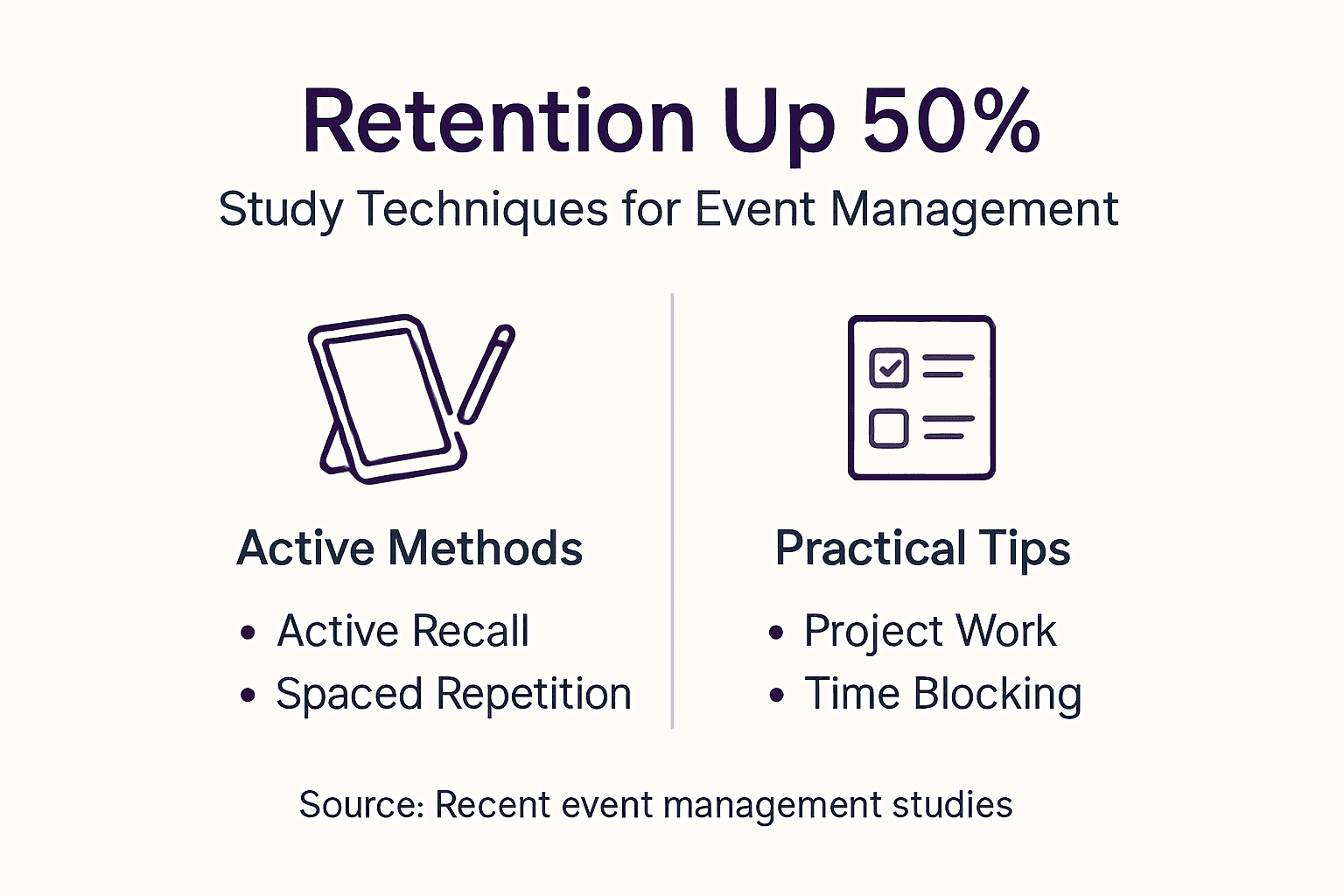
| Active recall and spaced repetition | Increases retention by up to 50% compared to passive review methods. |
| Project-based learning | Improves practical event management skills by approximately 60%. |
| Structured time management | Boosts focus by 40% and increases course completion rates to 70%. |
| Avoid common mistakes | Passive rereading reduces exam performance by 25-35%. |
| Hybrid learning modes | Enhance knowledge retention by 25% over online-only approaches. |
Prerequisites: What You Need Before You Start Studying
Before diving into advanced study techniques, you need the right foundation. Setting up your environment and gathering essential tools makes everything that follows more effective.
Start with a dedicated study space. Choose a quiet area free from distractions where you can focus for extended periods. Your brain associates specific locations with specific activities, so maintaining a consistent study spot signals your mind it’s time to concentrate.
You’ll need basic foundational knowledge in event management or at least orientation about the industry. This baseline helps you connect new concepts to existing frameworks. Without it, you’re building on sand.
Digital tools amplify your efficiency. Apps like Anki or Quizlet let you create flashcards that adapt to your learning pace. Research shows these digital flashcard tools enhance memorization efficiency by approximately 30%. Pair them with a planning calendar to track deadlines, revision cycles, and project milestones.
Your mindset matters as much as your toolkit. Adopt clear, measurable goals for each study session. Instead of “study event marketing,” aim for “complete three case studies on wedding marketing strategies.” Specificity drives action.
Essential setup checklist:
- Quiet study space with minimal interruptions
- Digital flashcard app installed and configured
- Planning calendar or scheduling tool
- Baseline event management knowledge or orientation materials
- Clear weekly and daily learning goals
Pro Tip: Schedule study sessions during your peak focus hours. Most people concentrate best either early morning or late evening. Experiment to find your optimal window, then protect that time fiercely. This simple adjustment can boost your retention by leveraging your natural cognitive rhythms. Apply these productivity strategies consistently for best results.
Step 1: Active Recall and Spaced Repetition Techniques
Passive reading feels productive but produces minimal long-term retention. Your brain needs to struggle with information to store it permanently. That’s where active recall enters.
Active recall means deliberately retrieving information from memory without looking at your notes. Instead of rereading a chapter on event budgeting, close the book and write everything you remember. This effortful retrieval strengthens neural pathways far more effectively than passive review.
Spaced repetition takes this further by reviewing material at strategically increasing intervals. You might review new vendor negotiation concepts after one day, then three days, then one week, then two weeks. This pattern combats the forgetting curve that normally erases up to 70% of new information within 24 hours.

Research demonstrates active recall increases retention rates by up to 50% compared to passive review methods. That’s the difference between forgetting half your course material and remembering most of it months later.
Implementation steps:
- After studying a topic, close all materials immediately
- Write or speak everything you recall about the subject
- Check your notes only after exhausting your memory
- Create flashcards for concepts you struggled to remember
- Review those flashcards using a spaced repetition schedule
- Gradually increase intervals as recall becomes easier
“The testing effect shows that retrieval practice produces better long-term retention than repeated studying. Students who test themselves retain information up to 50% better than those who simply reread materials.”
Digital flashcard apps automate spacing calculations, but paper cards work too. The key is consistency. Set aside 15 minutes daily for active recall practice. This small investment compounds dramatically over weeks and months.
Combine active recall with your study balance strategies to maintain sustainable learning without burnout. The effort feels harder initially, but results appear faster and last longer.
Step 2: Integrate Practical Project-Based Learning
Theory explains how events work. Practice teaches you how to make them happen. You need both, but practical application cements theoretical knowledge in ways passive study never can.
Hands-on projects improve practical event management skills by approximately 60%. When you plan a mock corporate launch or budget a wedding on paper, you encounter real decision points that force deeper thinking. Should you allocate more budget to venue or catering? How do you handle vendor delays? These questions don’t have textbook answers.
Start small with manageable projects. You don’t need actual clients initially. Create fictional scenarios based on real events you’ve attended or read about. Document every decision and its rationale.
Practical project ideas:
- Design a complete event timeline for a 200-person conference
- Create a detailed budget breakdown for a destination wedding
- Develop vendor coordination checklist for a product launch
- Plan marketing strategy for a music festival
- Build risk management protocol for outdoor events
Seek internships or volunteer positions with local event companies. Nothing replaces real-world exposure where stakes exist and mistakes have consequences. Event management internships provide invaluable learning that accelerates your practical skill development.
Even observing events as an attendee becomes educational when you analyze them critically. Notice how staff handle guest flow, troubleshoot technical issues, or manage unexpected problems. Take mental notes you can apply to your projects.
Pro Tip: Document each project thoroughly with photos, notes, and reflection summaries. This serves dual purposes: reinforcing your learning through reflection and building a portfolio that demonstrates capabilities to future employers. Write what worked, what didn’t, and what you’d change next time. This metacognitive practice solidifies lessons far beyond the project itself.
Step 3: Time Management and Structured Study Scheduling
Consistent study beats marathon cramming sessions every time. Your brain consolidates information during rest periods between study sessions, making regular, structured schedules more effective than sporadic intensity.
Time blocking divides your day into dedicated chunks for specific activities. The Pomodoro technique structures these blocks into 25-minute focused sessions followed by 5-minute breaks. After four cycles, take a longer 15-30 minute break.
This approach delivers measurable benefits. Structured scheduling improves focus by approximately 40% and increases course completion rates to 70%. The breaks prevent mental fatigue while maintaining momentum.
Creating your study schedule:
- Identify your weekly available study hours realistically
- Block fixed commitments first (work, classes, family time)
- Assign remaining time slots to specific study topics
- Use the Pomodoro technique within each block
- Schedule regular revision periods weekly
- Include buffer time for unexpected disruptions
- Review and adjust your schedule monthly based on results
Front-load challenging subjects when your energy peaks. Save lighter review tasks for times when focus naturally wanes. This matches task difficulty to cognitive capacity.
Digital calendars with notifications keep you accountable. Apps like Forest or Toggl track your actual study time versus planned time, revealing gaps between intention and execution. This data helps refine your scheduling over weeks.
Build in weekly review sessions where you consolidate the week’s learning using active recall. These reviews prevent knowledge decay and highlight areas needing more attention.
Pro Tip: Use physical timers or apps to stay disciplined during Pomodoro sessions. The ticking creates gentle pressure that enhances focus. Track completed sessions daily to build momentum and visualize progress. Small wins accumulate into major capability gains. Master time management principles specific to event management contexts for maximum career impact.
Step 4: Self-Assessment and Troubleshooting Common Mistakes
Even dedicated students sabotage their progress through ineffective practices. Recognizing these mistakes early prevents wasted effort and accelerates improvement.
Passive rereading tops the list of ineffective techniques. Studies indicate passive rereading leads to 25-35% lower exam performance compared to active learning methods. Your eyes move across words, creating an illusion of learning, but information doesn’t stick.
Procrastination compounds this problem. Delaying study sessions until deadlines loom forces cramming that produces short-term recall but minimal long-term retention. You might pass the exam but forget everything within weeks.
Neglecting practical tasks creates another gap. Event management requires hands-on skills that theory alone can’t develop. Students who skip project work struggle when entering real workplace environments.
Corrective strategies:
- Replace rereading with active recall and self-testing
- Set SMART goals (Specific, Measurable, Achievable, Relevant, Time-bound)
- Schedule study sessions as non-negotiable appointments
- Incorporate at least one practical project weekly
- Use accountability partners or study groups
- Take regular self-assessment quizzes
| Common Mistake | Impact | Solution | Performance Gain |
|---|---|---|---|
| Passive rereading | 25-35% lower exam scores | Active recall practice | 40-50% improvement |
| Procrastination | Incomplete courses, cramming stress | Time-blocking schedule | 70% completion rate |
| Skipping projects | Poor practical skills | Weekly hands-on work | 60% skill boost |
| No self-testing | Overconfidence, knowledge gaps | Regular quizzes | 30% better retention |
Regular self-assessment reveals your actual knowledge versus perceived understanding. Take practice quizzes weekly under exam conditions. Time yourself, avoid notes, and grade honestly. This exposes weak areas while reinforcing strong ones.
Mock exams simulate real test pressure, helping you build confidence and identify time management issues before stakes matter. Schedule at least one full mock exam midway through your course.
Adjust your study methods based on assessment results. If certain topics consistently trip you up, allocate more active recall sessions to those areas. Let data guide your effort distribution. Combine these insights with proven productivity approaches for sustained improvement.
Step 5: Balancing Online and Hybrid Learning Modes
How you access education significantly impacts learning outcomes. Online, offline, and hybrid approaches each offer distinct advantages for event management students.
Online-only learning provides maximum flexibility. You study when and where it suits you, fitting education around work and personal commitments. Digital platforms deliver video lectures, readings, and forums accessible 24/7. This works well for theoretical content and self-paced learners.
Offline classroom learning offers face-to-face interaction, immediate feedback, and structured accountability. You benefit from instructor presence and peer collaboration. However, it demands fixed schedules and physical attendance.
Hybrid learning combines both, delivering approximately 25% better retention than online-only approaches. You gain theoretical foundation through online modules while building practical skills through in-person workshops, site visits, and live event participation. This mirrors real industry practice where you coordinate remotely but execute physically.
| Learning Mode | Pros | Cons | Best For |
|---|---|---|---|
| Online-only | Flexible schedule, lower cost, self-paced | Limited hands-on practice, requires high self-discipline | Working professionals, theory-heavy subjects |
| Offline classroom | Direct interaction, structured accountability, immediate feedback | Fixed schedule, location-bound, higher cost | Students with flexible time, those needing structure |
| Hybrid | Best retention (25% boost), practical skills, flexibility | Requires managing multiple formats, moderate cost | Comprehensive skill development, career-focused learners |
Balancing multiple learning modes effectively:
- Designate specific days for online versus offline activities
- Complete online modules before attending practical sessions
- Use online time for theory and solo projects
- Reserve in-person sessions for collaborative work and hands-on practice
- Maintain separate calendars for each mode to avoid conflicts
Hybrid formats particularly benefit event management students because the field demands both planning skills (learned remotely) and execution capabilities (practiced physically). You can study vendor management theory online, then apply it coordinating actual suppliers at a workshop event.
Choose your learning mode based on career goals, schedule flexibility, and learning style. If job readiness matters most, hybrid programs offer superior practical preparation. Explore online event management courses that integrate practical components for balanced skill development.
Expected Outcomes: Measurable Benefits and Career Impact
Applying these study techniques produces concrete improvements you can measure and employers recognize. Understanding realistic outcomes helps maintain motivation through challenging periods.
Exam performance improves dramatically with active recall methods. Students using these techniques score 40-50% higher than peers relying on passive study. This translates to better grades, stronger transcripts, and increased confidence.
Course completion rates jump to 70% when you follow structured schedules compared to roughly 30% for unstructured learners. Finishing what you start demonstrates persistence that employers value.
Practical projects completed during study become portfolio pieces showcasing real capabilities. Instead of claiming you understand event budgeting, you present actual budgets you created with detailed rationales. This tangible evidence differentiates you in job interviews.
Career readiness improvements:
- Enhanced problem-solving skills from project-based learning
- Stronger time management proven through consistent study completion
- Portfolio demonstrating practical event planning capabilities
- Confidence handling real-world scenarios and pressure
- Industry-relevant skills matching employer requirements
Job placement rates improve significantly for students who combine strong theoretical knowledge with practical experience. Employers seek candidates who can contribute immediately rather than requiring extensive training. Your study approach directly impacts how quickly you become productive.
Long-term career advancement accelerates when you build solid foundational knowledge early. Concepts mastered during certification study become building blocks for advanced techniques later. You tackle complex projects more confidently because basics are second nature.
Networking opportunities expand when you participate in hybrid learning and internships. The connections you build during practical training often lead to job referrals and mentorship. Event management remains a relationship-driven industry where who you know matters.
Apply these success principles consistently to maximize both immediate learning outcomes and long-term career trajectory in India’s expanding event industry.
Enhance Your Learning with team.i Event Management Programs
Transform these study techniques into career success through team.i’s comprehensive event management programs. Our courses integrate active learning methods, structured schedules, and extensive hands-on projects that mirror real industry demands.
With 23 years of industry experience, we’ve refined our curriculum to balance theoretical depth with practical application. You’ll master concepts through our structured event management courses while building skills through live event participation and internships.
Our online and hybrid programs provide flexibility without sacrificing practical exposure. Digital learning modules cover theory while in-person workshops develop hands-on capabilities. This combination delivers the 25% retention boost hybrid learning provides.
Gain real-world experience through our internship pathways partnered with DNA Entertainment Networks. You’ll coordinate actual events, solve genuine problems, and build a portfolio that demonstrates job readiness to employers across India.
What are the best study techniques for event management students?
What makes active recall effective for event management learning?
Active recall forces your brain to retrieve information effortfully, strengthening neural pathways far more than passive review. Combined with spaced repetition at increasing intervals, this technique boosts retention by up to 50%. For event management content involving procedures, budgets, and coordination steps, this retrieval practice ensures you remember critical details when you need them under pressure.
How does project-based learning improve event management skills?
Hands-on projects improve practical skills by approximately 60% because they require applying theoretical concepts to realistic scenarios. When you plan a mock event, budget actual expenses, or coordinate fictional vendors, you encounter decision points that textbooks can’t simulate. This experiential learning builds problem-solving capabilities and confidence that employers immediately recognize.
Why is structured time management crucial for certification success?
Structured scheduling using techniques like time-blocking and Pomodoro boosts focus by 40% and increases course completion rates to 70%. Event management demands juggling multiple tasks simultaneously, so developing strong time management during study directly translates to workplace effectiveness. Consistent study sessions also allow your brain to consolidate information during rest periods, improving long-term retention.
How can I create an effective study environment for event management courses?
Choose a quiet, distraction-free area that your brain associates specifically with focused work. Use digital tools like flashcard apps that enhance memorization efficiency by 30% and planning calendars to track revision cycles. Schedule study sessions during your peak focus hours, whether early morning or late evening, to leverage your natural cognitive rhythms for maximum retention.
What are common mistakes to avoid when studying event management?
Avoid passive rereading, which reduces exam performance by 25-35% compared to active learning methods. Procrastination leads to cramming that produces short-term recall but minimal lasting knowledge. Neglecting practical projects creates skill gaps that hurt job readiness. Instead, use active recall daily, set SMART goals, and incorporate hands-on work weekly for balanced development.
Is hybrid learning better than online-only for event management students?
Hybrid learning improves retention by approximately 25% over online-only approaches by combining theoretical flexibility with practical hands-on experience. Event management requires both planning knowledge and execution skills. Hybrid formats let you master concepts through online modules while developing practical capabilities through in-person workshops and real event participation that online-only programs can’t provide.