
Balancing coursework, hands-on training, and industry placements is a daily reality for most event management students in Bangalore. The pressure to excel in both classroom theory and real-world event roles often leaves you wondering how to actually make progress. Today, quality over quantity defines effective productivity—aligning every task with your long-term career goals rather than just ticking off assignments. This guide offers practical strategies to help you work smarter, stay focused, and build a solid foundation for a future in event management.
Table of Contents
- What Productivity Means For Students Today
- Balancing Study, Training, And Placements
- Essential Time Management Strategies In Events
- Leveraging Digital Tools And Apps Effectively
- Common Pitfalls And How To Avoid Them
- Building Habits For Long-Term Success
Key Takeaways
| Point | Details |
|---|---|
| Focus on Quality Over Quantity | Prioritise meaningful engagement with coursework that directly correlates to career aspirations. |
| Integrate Theory and Practice | Align academic study with practical experiences to enhance understanding and skill retention. |
| Effective Time Management is Essential | Employ deliberate planning, prioritisation, and task organisation to navigate competing demands successfully. |
| Leverage Digital Tools | Utilise technology to streamline communication, registration, and task management for better event coordination. |
What Productivity Means for Students Today
Productivity for event management students isn’t simply about ticking off a list of assignments and moving on. Modern academic productivity centres on something much deeper: aligning your daily tasks with what actually matters to your career and development. You’re not just studying event management—you’re building a professional foundation for a competitive industry.
The shift from quantity to quality defines current thinking about student productivity. Rather than grinding through countless hours, quality over quantity emphasises intellectual engagement with your coursework. This means actively engaging with case studies from real Indian events, thinking critically about how venues in Bangalore operate during peak seasons, and understanding why certain vendor relationships matter more than others in your network.
At team I, this translates into a different kind of productivity altogether. You’re not just completing assignments in a classroom; you’re balancing theoretical learning with hands-on exposure. One day you’re analysing event logistics on paper. The next, you’re standing backstage at an actual event, watching those theories play out in real time. This dual engagement demands a new approach to time management and focus.
Effective academic productivity requires three core elements working together: deliberate time management, sustained focus during learning, and goals that actually connect to where you want your career to go. For you specifically, this means scheduling study sessions that don’t conflict with internship opportunities or live event participation.
Here’s a summary of how core academic productivity elements map to career relevance for event management students:
| Element | Academic Benefit | Career Impact |
|---|---|---|
| Deliberate time management | Better course outcomes | Reliable event execution |
| Sustained focus | Deeper concept understanding | Informed, confident event decisions |
| Career-aligned goals | Motivation to excel | Clear professional development path |
| Integration of theory & practice | Skill retention through exposure | Readiness for industry placements |
The reality of your situation is unique. You’re preparing for placements whilst maintaining coursework. You’re juggling theoretical exams whilst potentially coordinating logistics for real events. Productivity, then, becomes about making every hour count—whether that’s in a lecture theatre or on an event floor.
Think about what productivity truly means in your context. It’s not about being busy. It’s about progressing meaningfully towards becoming the event professional you want to be.
Professional tip Track which study methods actually help you retain event management concepts, then double down on those instead of spreading yourself thin across every possible technique.
Balancing Study, Training, and Placements
You’re juggling three competing demands at once. Lectures demand your attention on weekday mornings. Your training assignments require hands-on work at actual venues across Bangalore. Placement preparation is creeping into your evenings. This isn’t a problem to apologise for—it’s precisely what separates students who become ordinary event coordinators from those who lead major productions.
The key tension you’re facing is real. Strong academics help you secure placements, and securing placements actually improves your final academic results. This isn’t coincidental. When you’re working on live events, you’re solving problems that textbooks only describe theoretically. That practical problem-solving sharpens your academic thinking.
Your study schedule needs deliberate structure. Rather than treating coursework and training as separate entities, integrate them. When learning about vendor negotiations in class, immediately connect that to relationships you’re building during live event work. When your placement coordinator gives you a real logistics challenge, recognise how it ties back to supply chain management theory you studied weeks earlier.

Reflective learning becomes your secret weapon here. After each training session or event participation, spend 15 minutes documenting what you learned and how it connects to your coursework. This isn’t busywork—it’s how reflective learning develops employability skills that placement committees actually notice. You’re not just getting experience; you’re proving you can extract meaningful lessons from that experience.
The relationship between your academic performance and placement opportunities matters more than you might think. Stronger marks open doors with better organisations. Those organisations then expose you to better projects, which further develops your theoretical understanding. It’s a positive loop, but only if you treat both study and training seriously.
Time blocking is non-negotiable. Schedule your training commitments as firmly as your lectures. Protect your revision time just as fiercely as you guard event participation opportunities. You’re not dividing your effort—you’re orchestrating it.
Professional tip Create a monthly overview showing your exam dates, major training events, and placement deadlines side by side, then work backwards to identify weeks where you can push harder on any single area without jeopardising the others.
Essential Time Management Strategies in Events
Event management demands a fundamentally different approach to time management than most academic work. You’re not managing a single project with a distant deadline. You’re orchestrating multiple moving parts that all converge at one specific moment. If your timeline slips by two hours, the entire event collapses.
The four foundational strategies work together seamlessly. Planning means mapping out every task backwards from your event date. Goal setting clarifies what success actually looks like for each phase. Prioritisation ensures you’re handling the tasks that genuinely matter first. Task organisation makes sure nothing falls through the cracks. These aren’t separate processes—they’re interconnected layers of the same system.
When you’re planning a corporate event in Bangalore with 500 attendees, your timeline isn’t a suggestion. It’s a blueprint. Planning and goal setting become the foundation for every decision that follows. You decide when vendor confirmations must arrive, when signage needs printing, when the venue walkthrough happens. Each deadline cascades into the next.
Prioritisation saves you from drowning in details. Not every task carries the same weight. Confirming your catering headcount matters more than finalising napkin colours. Securing your main stage equipment matters more than choosing background music. By ranking tasks ruthlessly, you ensure that delays don’t sabotage your core event experience.
Task organisation is where theory meets survival. Use a system that actually works for you. Some students thrive with detailed spreadsheets tracking every vendor and deadline. Others prefer a simple kanban board showing tasks moving from planned to in progress to completed. The medium matters less than consistency. Whatever system you choose, use it religiously.
Real talk: events expose poor time management instantly. A delayed speaker confirmation doesn’t affect a semester of grades. It affects 500 people waiting at your venue. This pressure either crushes you or forces you to become genuinely organised. Most students find they develop time management skills faster through event work than any classroom assignment.
Professional tip Build a buffer of 20% extra time into every major deadline, then treat that buffer as sacred—don’t use it unless genuinely catastrophic circumstances force your hand.
Leveraging Digital Tools and Apps Effectively
Digital tools aren’t luxuries for event management students. They’re survival equipment. When you’re coordinating 20 vendors, tracking 500 registrations, and managing a team across multiple venues in Bangalore, your brain alone won’t keep everything organised. The right tools make chaos manageable.
Collegiate event management relies heavily on seamless communication. Your vendors need to know updated timelines. Your team needs real-time visibility into task progress. Your stakeholders need instant confirmation that things are happening. Digital tools like Trello and Slack facilitate exactly this kind of collaboration, transforming scattered conversations into documented workflows that everyone can follow.
Traditional methods fail under real event pressure. A shared spreadsheet breaks down when multiple people edit simultaneously. Email threads vanish into inboxes. Handwritten checklists disappear. Digital task management systems create a single source of truth. When you use Trello, every team member sees the same board. When you use Slack, conversations stay organised in channels rather than fragmenting across fifty different threads.
Registration and ticketing demand particular attention. If you’re running an industry networking event with 300 attendees, manual registration becomes a nightmare. Event management software handles ticketing automatically, sends confirmation emails, manages check-ins, and tracks attendance data without human intervention. This matters because mistakes in registration often happen under time pressure, precisely when you can least afford them.
Mobile-first design changes how you manage events on the actual day. You won’t be sitting at a desk during your event. You’ll be moving between spaces, troubleshooting issues, responding to emergencies. Apps that work smoothly on your phone let you update schedules, communicate with team members, and access critical information whilst walking the venue.
Start small rather than trying to master every tool simultaneously. Pick one collaboration platform. Master it completely. Then add a task management system. Build your toolbox gradually as each tool becomes second nature.
Professional tip Choose tools that integrate with each other, so information flows automatically rather than requiring manual data entry between systems.
To better understand popular digital tools in collegiate event management, compare their features and impact below:
| Digital Tool | Primary Function | Event Benefit | Typical Use Case |
|---|---|---|---|
| Trello | Task management | Monitors project status | Assigns tasks to team members |
| Slack | Real-time communication | Reduces miscommunication | Coordinates with vendors & staff |
| Eventbrite | Registration/ticketing | Streamlines attendee check-in | Tracks ticket sales and entry |
| Google Drive | Document collaboration | Centralises event documents | Shares schedules and contracts |
Common Pitfalls and How to Avoid Them
Event management students often stumble over the same mistakes repeatedly. These aren’t failures of intelligence or effort. They’re predictable patterns that emerge when you’re juggling complexity for the first time. Knowing what to watch for gives you a genuine advantage.
Communication breakdowns destroy more events than any other single factor. You tell the caterer 200 guests are arriving at 6 PM. Your colleague mentions it to them casually as 150 people. By event time, you’ve got food for the wrong headcount. The solution is ruthlessly simple: document everything in writing. Use your digital tools to create a paper trail. When vendors confirm details, have them respond in Slack or email, not over the phone.
Budget mismanagement sneaks up on students because costs compound. You allocate money for venue, catering, sound system, and marketing. Then you discover photography costs extra. Decoration rentals are pricier than quoted. Your contingency buffer vanishes. Build a spreadsheet tracking every expense category with a 15 per cent buffer for unknown costs. When you see costs creeping toward that buffer, you know to stop approving new additions.
Common event management pitfalls include venue selection mistakes. You book a space because it’s cheap or available, without considering whether it actually suits your event type. A networking event needs breakout spaces. A product launch needs dramatic entrance potential. A workshop needs good acoustics. Visit venues in person before committing. Walk through them imagining your actual event happening there.
Neglecting technology integration creates chaos on event day. If you’re managing registration manually whilst 200 people are arriving, you’ll have queues and frustrated attendees. Weak marketing strategies mean nobody knows about your event, so you spend energy promoting rather than planning. Solve both by committing to your digital tools early and promoting consistently across multiple channels.
The pattern is clear: most pitfalls stem from avoiding uncomfortable conversations or decisions. Have the difficult chat with vendors about exact numbers. Make the tough call to cut features that don’t fit your budget. Visit venues even when it takes extra time. Small discomforts during planning save massive problems during execution.
Professional tip After each event, spend 30 minutes documenting what went wrong and what you’d change next time, so you’re learning from your mistakes rather than repeating them.
Building Habits for Long-Term Success
Habits are what separate students who thrive in event management from those who merely survive it. You won’t become brilliant through occasional heroic effort. You’ll become brilliant through small, consistent actions repeated over months and years. The difference between an average event coordinator and an exceptional one isn’t intelligence. It’s the habits they’ve built.
Event management demands specific habits. Daily planning of your tasks. Weekly review of upcoming deadlines. Regular vendor communication. Consistent documentation of lessons learned. These aren’t optional extras you add when things are quiet. They’re the foundation everything else sits on. When crisis hits, your habits carry you through because you’ve already developed the systems to respond.
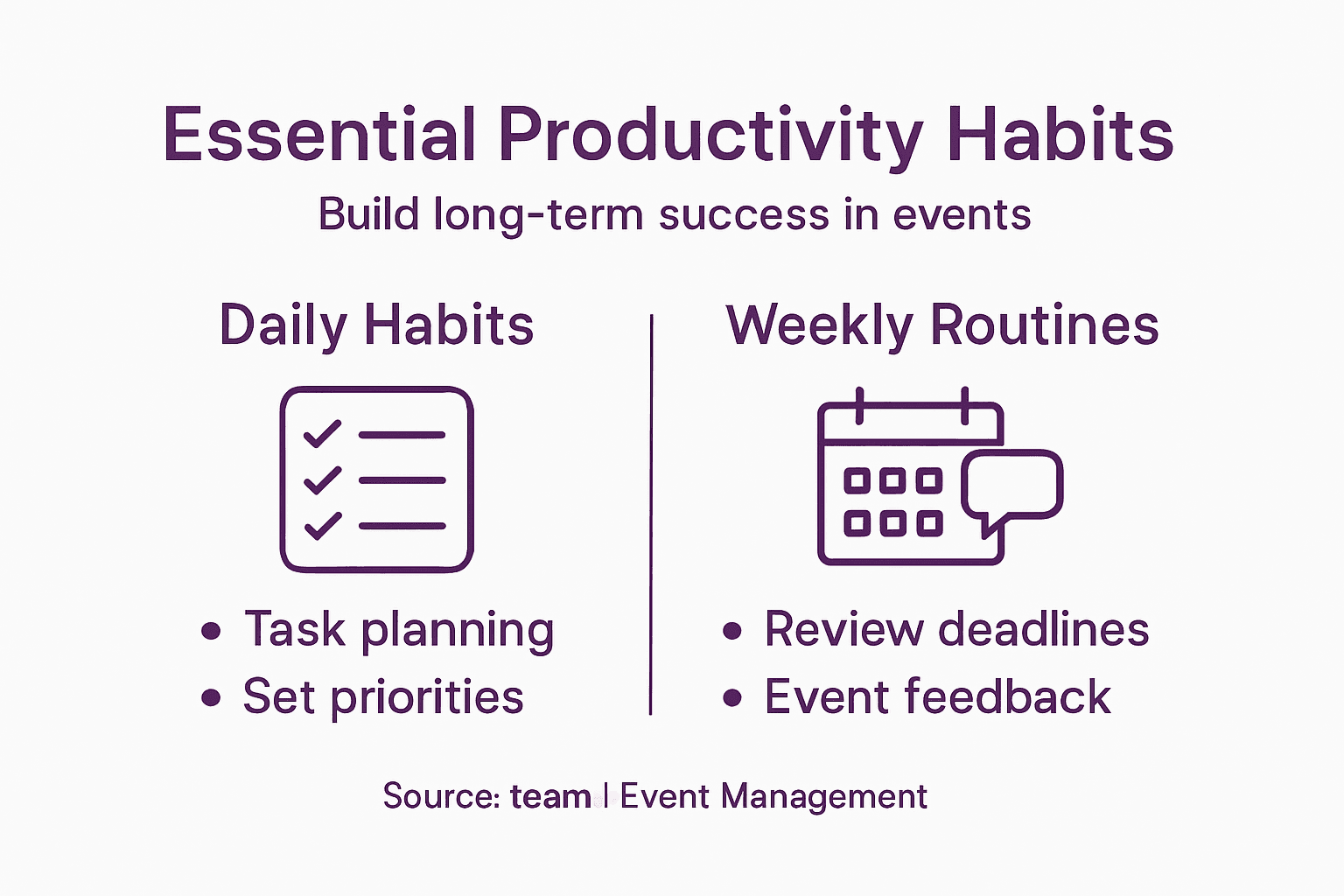
The challenge isn’t knowing which habits matter. It’s maintaining them when motivation fluctuates. You’ll have weeks where planning feels pointless because nothing urgent is happening. Then suddenly you’re managing three events simultaneously and wishing you’d been more consistent. Forming effective study and work habits requires aligning goals with consistent practice, and this principle applies directly to event management. Your academic coursework and your practical training both improve when supported by solid habits.
Start with one habit, not five. Pick something achievable. Perhaps it’s spending 15 minutes every Friday afternoon reviewing next week’s deadlines. Or sending a weekly check-in message to your vendors. Or documenting one lesson from each event participation. Once that habit feels automatic, add another. Building gradually creates sustainable change rather than overwhelming yourself.
Your habits become your competitive advantage during placement interviews. Employers notice candidates who ask thoughtful questions, who’ve documented their learning, who’ve developed systems. These aren’t personality traits. They’re habits that anyone can build. Effective time management and goal setting form the foundation of high-performing students, and these directly translate to professional success in event management.
The difficult truth is that habits feel pointless in the moment. Reviewing deadlines takes time you’d rather spend elsewhere. Documenting lessons feels tedious. But six months from now, when you’re managing a complex event smoothly whilst your peers are panicking, you’ll understand exactly why these habits matter.
Professional tip Anchor one new habit to an existing routine you already do every day, like reviewing your calendar with your morning coffee, so the new habit requires minimal willpower to maintain.
Elevate Your Event Management Productivity with Expert Training
Struggling to balance coursework, hands-on training and placement preparation is a challenge many event management students face today. The article highlights key pain points such as managing competing demands, aligning study with real-world experience and mastering time management strategies critical for success in this dynamic industry. Concepts like deliberate time management, reflective learning and leveraging digital tools are essential for developing the habits that transform busy students into confident professionals ready to lead impactful events.
At team I, we understand these challenges because we have 24 years of industry experience shaping students just like you. Our specialised programmes offer practical exposure through internships and real event participation partnered with DNA Entertainment Networks. This creates a seamless integration between theory and practice helping you build those vital productivity habits and career-aligned skills. Discover detailed course options focusing on social, sports, wedding and corporate events tailored to your career goals in Bangalore and beyond.
Don’t let the complexities of event management slow your progress. Take control today through our certification programmes and hands-on training designed specifically to elevate your academic productivity into professional success. Start building your future now by connecting with us at team I and transform challenges into opportunities.
Frequently Asked Questions
What is the definition of productivity for event management students?
Productivity for event management students is about aligning daily tasks with career goals, focusing on quality engagement with coursework rather than simply completing assignments.
How can I effectively balance my coursework and event training?
Integrate your study and training sessions. Reflective learning, where you connect classroom theories with practical experiences, can help reinforce your knowledge and skills.
What time management strategies are essential for event management?
Key strategies include thorough planning, goal setting, prioritisation of tasks, and task organisation. These elements work together to ensure you manage multiple event components effectively.
What digital tools should I use for managing events as a student?
Utilise digital tools like Trello for task management and Slack for real-time communication. These tools help streamline collaboration, monitor project status, and keep all team members informed.
Recommended
- 7 Essential Work Life Balance Tips for Event Managers – team I
- 7 Key Tips for Succeeding in Event Management Part Time – team I
- The Essential Guide to Importance of Time Management – team I
- How to Organise Events for Maximum Impact: Step-by-Step Guide – team I
- Social Events | RMD Photo Booths
Thinking about a career in event management?
team I is Bangalore’s only EEMA-certified event management institute, running for 24 years, where students work on real live events with real budgets and real deadlines rather than classroom simulations. See the full range of event management courses in Bangalore, or go straight to the flagship Certificate Program in Event Management (CPEM).