

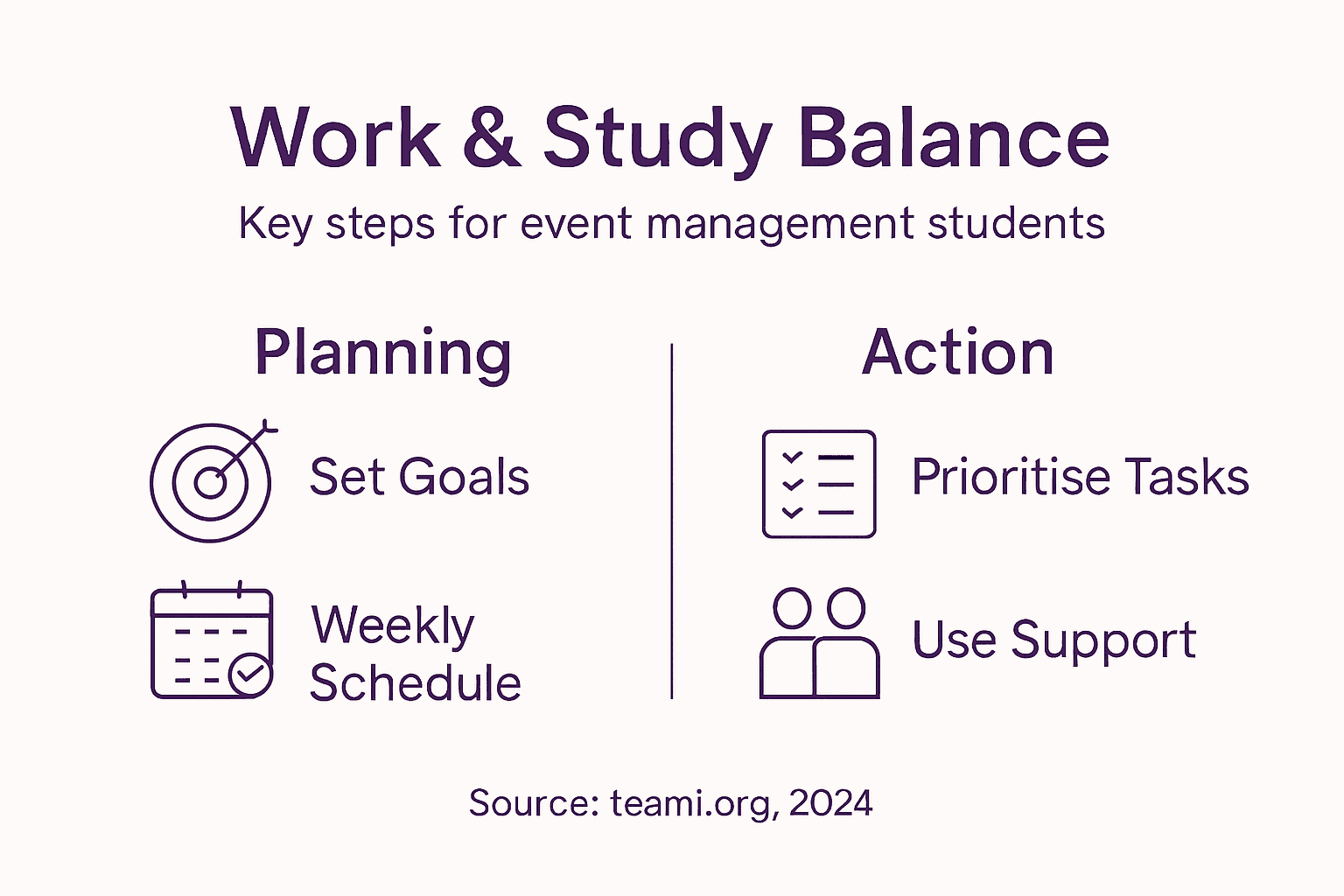
Juggling study deadlines and part-time shifts in Bangalore can often feel like a test of endurance for aspiring event managers. The challenge of managing multiple responsibilities matters not just for passing exams but for building future employability in a competitive industry. By focusing on strategic goal setting, adopting flexible schedules and prioritising tasks, you can develop practical skills that help you thrive both academically and professionally. In this guide, you will discover key methods for achieving a balance that keeps you motivated and opens new opportunities.
Table of Contents
- Step 1: Set Realistic Goals For Work And Study
- Step 2: Establish A Flexible Weekly Schedule
- Step 3: Prioritise Tasks For Maximum Efficiency
- Step 4: Utilise Support Networks And Resources
- Step 5: Monitor Progress And Adjust Tactics
Quick Summary
| Important Insight | Explanation |
|---|---|
| 1. Set Realistic Goals | Break down long-term aspirations into short-term targets using the SMART framework to prevent burnout and stay motivated. |
| 2. Establish a Flexible Schedule | Map out core commitments and strategically allocate time for work, study, and self-care to manage responsibilities efficiently. |
| 3. Prioritise Tasks Effectively | Use methods like the Eisenhower Matrix to categorise tasks, focusing on those that align with your goals and deadlines. |
| 4. Build Support Networks | Engage with mentors, peers, and professionals to create a robust network that aids academic and career growth. |
| 5. Monitor and Adjust Progress | Regularly self-assess your progress and adapt strategies to address challenges, maintaining momentum towards your goals. |
Step 1: Set realistic goals for work and study
Balancing work and study requires strategic goal setting that transforms overwhelming challenges into manageable achievements. By creating professional development objectives, you establish a clear roadmap for success that keeps you motivated and focused.
To set realistic goals effectively, break down your long-term career aspirations into achievable short-term targets. This approach helps maintain your momentum and prevents burnout. Consider these strategies for setting practical objectives:
- Identify specific skill gaps in your current professional profile
- Determine time constraints between work and academic commitments
- Create measurable milestones that track your progress
- Align goals with your career trajectory
Your goals should stretch your capabilities without breaking your spirit.
When developing these goals, use the SMART framework – ensuring objectives are specific, measurable, attainable, relevant, and time-bound. This means crafting goals that are concrete and realistic, such as “Complete two online certification courses while maintaining my current work schedule” rather than vague statements like “improve my skills”.
Pro tip: Schedule quarterly reviews of your goals to adjust and realign your objectives based on changing work and study demands.
Step 2: Establish a flexible weekly schedule
Creating a dynamic schedule is your secret weapon for successfully managing work and academic commitments. Flexible scheduling helps balance multiple responsibilities by allowing you to adapt your time strategically and efficiently.
To develop an effective weekly schedule, start by mapping out your core commitments and understanding their time requirements. Break down your schedule into distinct categories:
- Work hours and fixed commitments
- Academic class times and online learning sessions
- Study and assignment blocks
- Personal time and self-care
- Buffer zones for unexpected tasks
Flexibility doesn’t mean chaos – it means intelligent time management.
Utilise digital tools to your advantage. Use digital calendars to block and prioritise time strategically. Colour-code different activity types, set realistic time allocations, and build in margins for transition and potential overruns.

Pro tip: Review and adjust your schedule weekly, treating it as a living document that evolves with your changing work and study demands.
Step 3: Prioritise tasks for maximum efficiency
Mastering task prioritisation transforms chaos into strategic progress. Effective prioritisation techniques dramatically improve productivity by helping you focus on activities that truly drive results.
To prioritise tasks effectively, consider using the Eisenhower Matrix, which categorises work based on urgency and importance:
To further clarify how prioritisation methods differ, here’s a comparison of two popular task management approaches:
| Approach | Main Focus | Ideal For | Typical Tools |
|---|---|---|---|
| Eisenhower Matrix | Urgency vs importance | Strategic daily planning | Quadrant-based apps |
| ABC Method | Task categorisation by priority | Handling large task lists | Checklist and digital planners |
- Urgent and important: Immediate actions requiring your attention
- Important but not urgent: Strategic tasks for long-term goals
- Urgent but not important: Delegate or minimise these tasks
- Neither urgent nor important: Eliminate from your schedule
Not all tasks are created equal – your time is your most valuable resource.
Students can enhance productivity by breaking down complex tasks into manageable chunks. Start by listing all commitments, then systematically rank them according to deadlines, complexity, and potential impact. Consider using colour-coding or digital task management tools to visualise your priorities and track progress.
Pro tip: Reassess your task priorities daily, spending no more than 10 minutes each morning aligning your task list with your most critical objectives.
Step 4: Utilise support networks and resources
Building a robust support network is crucial for successfully balancing work and academic commitments. Engaging with professional networks offers strategic advantages for your personal and professional development.
Your support network should encompass multiple dimensions:
- Academic mentors and faculty advisors
- Professional colleagues and industry contacts
- Peer study groups
- Online learning communities
- University support services
Your network is your net worth in professional and academic growth.
Academic workshops can enhance engagement skills and provide valuable resources. Actively seek opportunities to connect with professionals in your field, attend networking events, participate in webinars, and leverage university alumni networks. Remember that building relationships is a two-way street – offer support and insights to your contacts as well.
Pro tip: Allocate at least one hour weekly to intentional network building, treating it as an investment in your future career progression.
Step 5: Monitor progress and adjust tactics
Success in balancing work and study hinges on consistent self-assessment and strategic adaptation. Ongoing monitoring enables timely identification of challenges and helps you stay on track with your goals.
Establish a robust monitoring framework with these key strategies:
For reference, here is a summary of key progress monitoring methods that support ongoing improvement:
| Method | Frequency | Benefits |
|---|---|---|
| Self-review sessions | Weekly | Spot issues early |
| Performance spreadsheets | Weekly or monthly | Track quantifiable results |
| Mentoring check-ins | Monthly | Gain expert feedback |
- Weekly self-review sessions
- Performance tracking spreadsheets
- Digital progress monitoring apps
- Regular check-ins with mentors
- Reflective journaling
Adaptation is not failure – it’s intelligent progress.
Comprehensive reviews help maintain educational effectiveness by providing insights into your learning and working patterns. Create a monthly review ritual where you assess your progress, identify bottlenecks, and recalibrate your strategies. Be honest with yourself about what’s working and what needs adjustment.
Pro tip: Use a simple traffic light system – green for on track, amber for needs attention, red for urgent intervention – to quickly visualise your progress across different areas.
Achieve Event Management Success by Balancing Work and Study Effectively
Balancing your professional commitments while pursuing education can feel overwhelming, especially in a dynamic field like event management. The challenges of setting realistic goals, prioritising tasks, and maintaining a flexible schedule are critical to staying motivated and avoiding burnout. If you are seeking practical ways to bridge theory with hands-on experience, specialised training and industry-relevant certification can transform your aspirations into tangible career growth.
teami.org offers you a proven pathway to master these essential skills with 23 years of expertise in event management education. Through our online and hybrid certification courses, you gain practical exposure via real event participation and internships, all designed to integrate smoothly with your busy life. Our collaboration with DNA Entertainment Networks ensures you receive current industry insights and job placement support.
Ready to take control of your event management journey now Learn more about our course offerings and career opportunities at teami.org. Discover how to set clear objectives and prioritise effectively by connecting with our expert team at teami.org support. Your path to balancing work and study with confidence starts here with teami.org.
Frequently Asked Questions
How can I set realistic goals while balancing work and study in event management?
To set realistic goals, break down your long-term career aspirations into short-term targets that are achievable within your current schedule. Consider identifying specific skill gaps and creating measurable milestones to track progress, such as completing a course every quarter.
What strategies can I use to create a flexible weekly schedule for work and study?
Start by mapping out all your fixed commitments, including work hours and class times, and then allocate specific blocks for study and personal time. Utilise a digital calendar to colour-code your activities and adjust your schedule weekly for optimal time management.
How should I prioritise my tasks for maximum efficiency in event management?
Utilise the Eisenhower Matrix to categorise your tasks based on urgency and importance. Focus on completing urgent and important tasks first, and reassess your priorities daily to ensure you are aligned with your most critical objectives.
What types of support networks should I consider for balancing work and academic commitments?
Build a support network that includes academic mentors, professional colleagues, and peer study groups. Regularly connect with these individuals to exchange insights and ensure you’re receiving guidance that can help you in both your work and study.
How can I monitor my progress effectively in balancing work and study?
Establish a monitoring framework that incorporates weekly self-review sessions and monthly performance tracking. Use reflective journaling to assess what strategies are working and adjust your tactics as needed to stay on track with your goals.