
India’s events industry is not quietly growing. It is surging. With the market projected to reach USD 119.77 billion by 2034, the opportunities opening up for trained event professionals right now are genuinely extraordinary. Yet many students still dismiss event management as a “fun side hustle” or a career for people who could not figure out something more serious. That perception is deeply wrong. Event management is rigorous, fast-moving, and commercially complex. If you are a student or young professional wondering whether this path is worth pursuing, this article will give you the honest, detailed picture you need.
Table of Contents
- The real scope of event management in India’s booming economy
- Why students and young professionals choose event management
- Skills, training and credentials: What you need for success
- Rewards, realities and resilience: What to expect in your event management career
- A strategic leap: Our perspective on launching your event management journey
- Take the next step with industry-connected event management courses
- Frequently asked questions
Key Takeaways
| Point | Details |
|---|---|
| Massive industry growth | India’s event management sector is booming, providing abundant job opportunities for newcomers. |
| Diverse career rewards | Event management brings creativity, networking, and rapid career progression alongside unique challenges. |
| Skills and credentials matter | Certifications and industry-specific training give candidates a significant advantage in this competitive field. |
| Real-world experience counts | Practical exposure and resilience are essential for a sustainable and rewarding career in event management. |
The real scope of event management in India’s booming economy
Let’s start with the numbers, because they tell a story that most people are not hearing. The Indian event management industry is one of the fastest-growing service sectors in the country. Multiple research sources point to growth rates between 10% and 15% compounded annually, driven by rising disposable incomes, rapid urbanisation, corporate expansion, and India’s deep cultural appetite for celebration.
Here is a snapshot of the scale we are talking about:
| Segment | Key driver | Annual growth rate (approx.) |
|---|---|---|
| MICE (Meetings, Incentives, Conferences, Exhibitions) | Corporate India expansion | 12% to 14% |
| Wedding and social events | Rising middle-class spending | 11% to 13% |
| Entertainment and live events | OTT and digital fan culture | 10% to 12% |
| Sports events | IPL, Pro Kabaddi, new leagues | 14% to 16% |
| Corporate product launches | Startup and tech sector boom | 10% to 12% |
Each of these segments creates a different type of professional demand. A corporate events coordinator needs different skills from a wedding production manager. A sports event logistics lead operates in a completely different environment from an entertainment festival producer. The point is this: the Indian event management overview reveals not one career path but dozens, spread across industries that are all growing simultaneously.
“Market size estimates for Indian event management vary widely, but all indicate substantial growth, creating consistent demand for skilled and certified professionals across every event category.”
What does this mean for you, practically? It means the talent pipeline has not caught up with the industry’s scale. Companies are hiring. Agencies are expanding their rosters. Hospitality groups are building in-house event teams. The gap between available trained professionals and available jobs is real, and it is an opportunity that a focused, well-trained candidate can exploit directly. You do not need to wait five years for a chance. The window is open now.

With the scale and future promise of this industry in mind, let’s look at the driving factors that make event management appealing as a genuine career choice.
Why students and young professionals choose event management
Ask anyone who has built a career in events, and they will not give you a simple answer. It is rarely just one thing. It is the creative problem-solving at 11 PM when the AV rig stops working. It is the moment a 2,000-person audience erupts in applause for an event you built from a spreadsheet and a vision. It is the professional network you build in three years that most people take a decade to accumulate.
Here is what genuinely draws smart, driven people into this field:
- Creative control on a massive scale. Every event is a blank canvas. You decide the story, the atmosphere, the sensory experience. No two briefs are identical.
- Rapid career progression. In most corporate industries, promotions are slow and hierarchical. In events, you move as fast as your results do. A standout execution gets noticed immediately.
- Networking that compounds. Every event puts you in the room with clients, vendors, performers, corporate leaders, and media professionals. Your address book grows exponentially with every project.
- Variety of roles. From production and logistics to marketing, sponsorship, PR, and client management, you can move across functions and find your specialisation over time.
- Global relevance. The skills you build in India translate directly to international markets. Event management is one of the few careers where Indian experience is genuinely valued abroad.
That said, a career in event management carries real demands that you should walk into with both eyes open. The hours are long, especially in the week before a major event. Last-minute client changes are standard, not exceptions. The pressure is relentless at peak moments.
Research also highlights that event management career opportunities reward resilience deeply, but those who enter unprepared for the stress can experience significant burnout. The contrast is clear: professionals who build strong foundations through structured training typically navigate the high-pressure environment far better than those who learn entirely on the fly.
Pro Tip: Before committing fully, shadow a working event professional for even one weekend. Watching how they handle vendor delays, venue crises, and client expectations in real time will tell you more about your fit for this career than any brochure ever could.
Understanding what draws people into the profession, it is crucial to unpack what a successful career in event management genuinely requires in terms of skills and credentials.
Skills, training and credentials: What you need for success
Here is the uncomfortable truth: enthusiasm is not a skill. The events industry is full of enthusiastic people. The ones who rise are the ones who show up with a sharp, well-rounded skill set and the discipline to use it under pressure. Event management is not just glamour. It is logistics, negotiation, budget control, team leadership, and creative direction, all happening simultaneously.
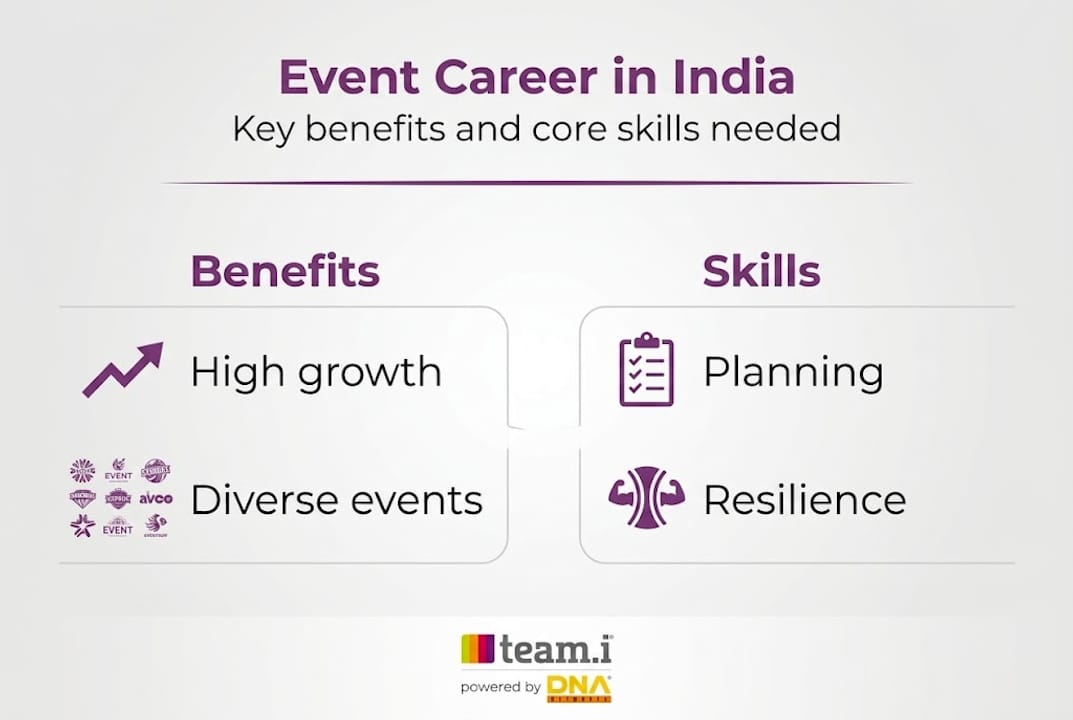
The skills you need to build break down into three broad categories:
- Organisational skills. Managing multiple vendors, timelines, permits, and deliverables at once. One missed confirmation can cascade into a catastrophic failure on event day.
- Interpersonal and communication skills. You will negotiate vendor contracts, manage client expectations, brief creative teams, and resolve conflicts, sometimes all in the same hour.
- Creative and conceptual thinking. Clients pay for originality. The ability to translate a brief into a compelling concept that feels fresh and purposeful is what separates average producers from sought-after ones.
- Financial acumen. Budget management is a core responsibility. Understanding margins, cost controls, and vendor negotiations directly affects your reputation and your employer’s bottom line.
- Technology literacy. Event management software, project management tools, virtual event platforms, and social media activations are all part of the modern toolkit.
Now, how do you build these skills? Training and credentials matter more than most people admit.
| Route | Best for | Typical duration | Industry recognition |
|---|---|---|---|
| Short certification course | Quick upskilling, career switchers | 3 to 6 months | High, if industry-accredited |
| Diploma programme | Comprehensive foundational training | 1 to 2 years | Very high |
| Online programme | Flexible learners, working professionals | 3 to 12 months | Good, depends on provider |
| On-the-job learning only | Those already in industry | Ongoing | Limited without credentials |
The data strongly favours formal training combined with practical exposure. Visiting event management as a career insight resources reveals that employers consistently prefer candidates who bring both classroom knowledge and hands-on experience. Developing skills for event management through structured programmes accelerates your competence in a controlled environment before you are tested under real event conditions.
There is also a meaningful distinction between certification and diploma pathways. A certification is faster and targeted, ideal if you already have some industry exposure. A diploma is deeper, building a broader foundation that covers the full spectrum of event types and management functions. Both have genuine value, depending on your starting point and career goals.
Pro Tip: When evaluating any training programme, ask specifically about industry partnerships and live project exposure. A course that places you on real events during your training is worth significantly more than one that keeps you entirely in the classroom.
With a clear view of what is needed, it is time to explore the real-world challenges and rewards of choosing this career path.
Rewards, realities and resilience: What to expect in your event management career
Let’s be honest about both sides. The event management career is one of the most rewarding in India’s service sector, but it demands a specific kind of person. The ones who thrive are not necessarily the most naturally talented. They are the most resilient, the most adaptable, and the most relentlessly prepared.
The rewards are real and substantial:
- Job satisfaction. Very few careers give you the experience of seeing your work come alive in front of hundreds or thousands of people. The emotional payoff of a successful event is immediate and profound.
- Growing remuneration. Event manager earnings in India have risen meaningfully as the industry scales. Senior professionals and independent consultants earn competitively, especially those with specialist expertise in high-demand segments like sports events or MICE.
- Network equity. The relationships you build, networking skills for event managers being central to this, become one of your most bankable professional assets over time.
- Entrepreneurial pathways. Many experienced event professionals launch their own agencies, often within five to seven years of entering the industry.
The challenges are equally real:
- Time pressure is a constant. Deadlines in event management are non-negotiable because the event date does not move.
- Last-minute changes from clients, vendors, or venues require rapid decision-making without the luxury of deliberation.
- Physical and emotional fatigue during peak periods is common and must be actively managed.
- Diversity and inclusion remain evolving conversations in parts of the industry, though the picture is improving, particularly in metro cities and organisations that actively recruit from varied backgrounds.
“High rewards for resilient professionals who invest in networking and continuous growth; high burnout risk for those who enter unprepared and without structured support behind them.”
The key word in that quote is resilient. Building an event career in India successfully is a long game built on short, intense sprints. You learn to recover quickly, update your approach, and show up better the next time. That capacity for recovery, cultivated deliberately through training and early exposure, is what separates a decade-long career from a two-year burnout story.
Having weighed the advantages and realities, it is helpful to step back and see why now, more than ever, choosing an event management career in India is a genuinely strategic move.
A strategic leap: Our perspective on launching your event management journey
At team I, we have spent 24 years watching talented students enter this industry and either soar or stall. The single biggest differentiator is never raw talent. It is preparedness.
India’s rapid urbanisation is creating event roles that simply did not exist ten years ago. Hybrid event producers, digital experience designers, sports franchise event leads, experiential marketing specialists: these are not future jobs. They are current vacancies, and most candidates are not ready for them. That gap is an opportunity.
What we genuinely believe, from deep inside this industry, is that the students who invest in advancing their media and event careers through industry-connected training are not just better prepared, they are fundamentally different candidates. They walk into interviews having already managed real logistics on real events. They have already made mistakes in controlled environments and learned from them. That experience is not something you can fake or fast-track without structured exposure.
Build resilience early. Embrace the chaos as a teacher. Treat every internship and live project as your actual career beginning, because it is.
Take the next step with industry-connected event management courses
Now that you are clear on the opportunities and the realities, here is how to move forward with confidence. team I offers event management courses built specifically for students and young professionals who want real-world preparation, not just theoretical grounding. With 24 years of industry experience, partnerships with DNA Entertainment Networks, and proven placement support, team I bridges the gap between ambition and employment. If flexibility matters to you, explore our online event management programme that delivers the same industry-grade training on your schedule. Reach out today and find the course pathway that fits your goals and gets you onto real events, faster.
Frequently asked questions
What is the growth outlook for event management careers in India?
The Indian events industry is expected to grow at roughly 10.65% CAGR, with some estimates projecting a market size reaching USD 119.77 billion by 2034, creating consistent demand for trained professionals across all event categories.
Which skills are essential to succeed in event management?
Success in event management depends on strong organisational, interpersonal, and creative problem-solving skills, with logistics and discipline being as critical as creative flair, and formal training significantly accelerating your ability to deliver them under pressure.
Are certification courses necessary for event management jobs?
While not always mandatory, certification courses give you a measurable edge because employers favour candidates who demonstrate both theoretical knowledge and hands-on exposure, with structured training directly addressing the skill gap that many self-taught applicants carry into interviews.
Does event management offer long-term career growth?
Yes, India’s expanding events industry is generating a growing number of specialist and senior roles, and skilled professionals with strong networks and continuous learning habits consistently find advancement opportunities, including entrepreneurial pathways, within a relatively short career window.
Recommended
- Can I Choose Event Management as a Career? – team I
- How to choose an event management career in India 2026 – team I
- Why Event Management as a Career? India’s Opportunity and a Global Frontier
- Build a successful event management career in India 2026 – team I
Thinking about a career in event management?
team I is Bangalore’s only EEMA-certified event management institute, running for 24 years, where students work on real live events with real budgets and real deadlines rather than classroom simulations. See the full range of event management courses in Bangalore, or go straight to the flagship Certificate Program in Event Management (CPEM).