

Most british professionals find that busy schedules can quickly spiral out of control without strong time management skills. In fact, people who master time management report up to 25 percent higher productivity at work. The ability to make better choices about your time sets the foundation for reaching personal goals and reducing daily stress. By understanding core concepts and practical methods, you can discover productive habits that truly fit your individual style and the demands of modern british working life.
Table of Contents
- Understanding Time Management Basics And Concepts
- Types Of Time Management Techniques Explained
- Benefits Of Good Time Management In Event Careers
- Common Pitfalls And How To Avoid Them
- Practical Tools For Effective Time Planning
Key Takeaways
| Point | Details |
|---|---|
| Effective Time Management | Involves setting achievable goals, creating structured schedules, and recognising productivity rhythms to enhance efficiency. |
| Techniques for Optimisation | Utilise methods like the Pomodoro Technique and Eisenhower Matrix to tailor time management strategies to individual needs. |
| Impact on Event Careers | Good time management reduces stress and enhances work quality, fostering strategic thinking in high-pressure settings. |
| Avoiding Common Pitfalls | Proactively address procrastination and lack of prioritisation by developing self-awareness and clear boundaries in task management. |
Understanding Time Management Basics and Concepts
Time management is more than simply scheduling tasks it is a comprehensive approach to maximising personal productivity and achieving strategic goals. At its core, time management represents a systematic method of allocating your most precious resource your time with intentionality and purpose.
According to ou.edu, effective time management involves several critical components that transform how individuals approach their daily responsibilities. Key strategies include:
- Setting realistic and achievable goals
- Creating structured daily schedules
- Prioritising tasks based on importance and urgency
- Understanding personal productivity rhythms
- Recognising and mitigating potential productivity barriers
As Barnard College highlights, successful time management isn’t about rigid control but maintaining flexibility while establishing clear frameworks. The most effective approaches recognise that personal productivity fluctuates and requires adaptive strategies. This means developing systems that support your unique working style rather than imposing inflexible constraints.
Ultimately, mastering time management requires self awareness, strategic planning, and consistent practice. By understanding your individual work patterns, identifying potential distractions, and implementing personalised productivity techniques, you can transform how you approach tasks and dramatically improve your overall efficiency and performance.
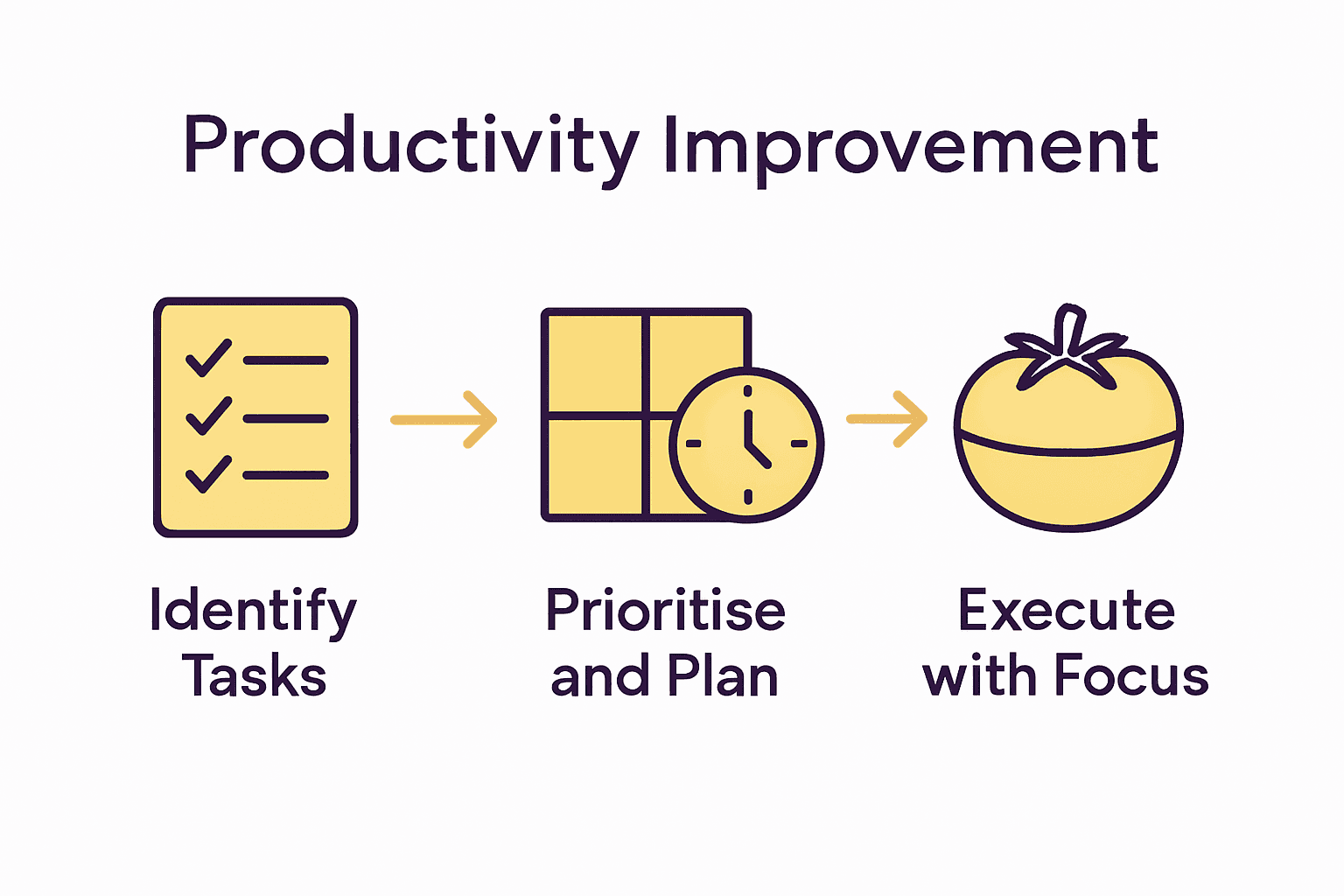
Types of Time Management Techniques Explained
Effective time management is not a one-size-fits-all approach. Professionals require diverse techniques that can be adapted to different work styles, personal preferences, and specific organisational challenges. Strategic time management involves selecting and implementing methods that align with individual productivity patterns and professional goals.
According to usa.edu, several powerful techniques stand out in helping individuals optimise their productivity. These include:
- Pomodoro Technique: Working in focused 25-minute intervals with short breaks
- Eisenhower Matrix: Prioritising tasks based on urgency and importance
- Parkinson’s Law: Limiting task time to reduce unnecessary work expansion
Research from Berkeley Law emphasises that successful time management goes beyond simple scheduling. Key considerations include understanding personal biological rhythms, creating an optimised work environment, and selecting techniques that complement individual energy levels and concentration patterns.
Mastering these techniques requires practice, self reflection, and continuous adaptation. Professionals should experiment with different methods, track their effectiveness, and develop a personalised approach that maximises their unique strengths and minimises potential productivity barriers. The goal is not perfection, but progressive improvement in how time and energy are allocated across professional and personal responsibilities.

Benefits of Good Time Management in Event Careers
In the high-pressure world of event management, time management is not just a skill it is a fundamental survival strategy. Professionals in this dynamic industry must navigate complex logistical challenges, coordinate multiple stakeholders, and deliver seamless experiences under intense time constraints.
According to Purdue Global, effective time management offers transformative benefits that directly impact career success. Key advantages include:
- Dramatically reduced stress levels
- Consistently higher quality work output
- Enhanced professional credibility
- More predictable and balanced work-life integration
- Increased capacity for strategic thinking and problem solving
Fairmont State University emphasises that beyond individual performance, good time management significantly improves overall personal well-being. In the event management sector, where rapid decision making and precise execution are paramount, these skills become even more critical. Professionals who master time management can anticipate challenges, allocate resources efficiently, and maintain composure during high-pressure scenarios.
Ultimately, time management in event careers is about creating a sustainable professional approach that allows for creativity, strategic planning, and personal resilience. By developing robust systems and techniques, event professionals can transform potential chaos into orchestrated excellence, turning time from an adversary into a strategic ally in their career progression. The most successful event managers are those who can predict, plan, and perform with remarkable precision and calm.
Common Pitfalls and How to Avoid Them
Time management challenges can derail even the most well-intentioned professionals, particularly in the fast-paced world of event management. Productivity obstacles emerge in various forms, threatening to disrupt carefully crafted plans and professional momentum.
Research from Blinn College highlights several critical time management pitfalls that professionals must navigate:
- Procrastination: Delaying critical tasks and creating unnecessary pressure
- Inefficient Scheduling: Poor task allocation and unrealistic time estimates
- Multitasking: Fragmenting attention and reducing overall productivity
- Lack of Prioritisation: Failing to distinguish between urgent and important tasks
- Poor Boundary Setting: Allowing interruptions and non-essential activities
Successful professionals develop strategic approaches to mitigate these challenges. This involves creating robust systems that anticipate potential productivity barriers, establishing clear boundaries, and developing self-awareness about personal work patterns. Implementing techniques like time blocking, setting realistic goals, and regularly reviewing task progress can transform potential obstacles into opportunities for growth and efficiency.
Ultimately, avoiding time management pitfalls requires a proactive, reflective approach. Event management professionals must continuously adapt their strategies, learn from past experiences, and cultivate a mindset of continuous improvement. By recognising potential stumbling blocks and developing personalised mitigation strategies, individuals can build resilience, maintain professional momentum, and consistently deliver exceptional results.
Practical Tools for Effective Time Planning
In the dynamic landscape of event management, time planning requires a strategic arsenal of tools and techniques designed to transform potential chaos into orchestrated precision. Professionals must leverage both digital and analog resources that align with their unique workflow and cognitive preferences.
According to Bethel University, successful time management hinges on implementing comprehensive planning tools. Key recommendations include:
- Daily Schedules: Creating granular task breakdowns
- Weekly Planners: Establishing broader strategic overviews
- Semester-at-a-Glance Calendars: Tracking long-term project trajectories
- Detailed To-Do Lists: Systematically prioritising responsibilities
- Strategic Break Tracking: Incorporating intentional recovery periods
Modern event professionals have an unprecedented range of digital and physical tools at their disposal. Sophisticated applications like digital project management platforms, cloud-based scheduling software, and integrated productivity systems can streamline complex workflows. However, the most effective time management approach combines technological solutions with personalised planning methodologies that respect individual working styles.
Ultimately, selecting the right time planning tools requires experimentation, self-reflection, and continuous adaptation. Learn more in our comprehensive event planning checklist to discover how professional event managers create seamless, efficient planning systems that transform potential overwhelm into strategic excellence.
Master Time Management to Elevate Your Event Management Career
The challenge of mastering time management as outlined in “The Essential Guide to Importance of Time Management” is clear. Many aspiring event professionals struggle with prioritising tasks, avoiding procrastination, and creating effective schedules that match their unique productivity rhythms. The article highlights the critical need to transform these challenges into strengths by adopting adaptive strategies like prioritising urgent and important tasks and using planning tools that fit individual work styles.
If you are ready to overcome these obstacles and boost your productivity with proven strategies, teami.org offers specialised education and training designed precisely for event management professionals. Our courses provide hands-on experience in real event situations and teach you how to apply time management techniques to succeed in high-pressure scenarios. Discover how to build a career with the right skills and industry connections by exploring our certification programs and gaining insights from experts at DNA Entertainment Networks.
Take control of your future today with a strategic learning path that sharpens your time planning and execution skills. Visit teami.org to find out how you can start transforming your time management challenges into professional victories now.
Frequently Asked Questions
What are the key strategies for effective time management?
Effective time management involves setting realistic goals, creating structured schedules, prioritising tasks, understanding personal productivity rhythms, and recognising potential barriers to productivity.
How can time management benefit my career, particularly in event management?
Good time management can reduce stress levels, improve work quality, enhance professional credibility, aid in work-life integration, and increase strategic thinking and problem-solving capacity, all of which are vital in event management.
What common pitfalls should I avoid in time management?
Common pitfalls include procrastination, inefficient scheduling, multitasking, lack of prioritisation, and poor boundary setting. Recognising and addressing these can improve productivity.
What tools can I use for effective time planning?
Useful tools for time planning include daily schedules, weekly planners, semester-at-a-glance calendars, detailed to-do lists, and apps for tracking tasks. The key is to find tools that align with your personal workflow.
Recommended
- How You Can Be Effective And Efficient In The Times Of Crisis – team I
- Event Planning Checklist 2025: Step-by-Step Guide for Success – team I
- Understanding Event Management for Beginners – team I
- Event Budget Planning Guide 2025: Steps for Success – team I
- House Cleaning Basics: Essential Guide for McKinney Homes 2025
- Bathroom Counter Organization Ideas for Stylish and Busy Homes (2025) – BLUSHBEES USA
Thinking about a career in event management?
team I is Bangalore’s only EEMA-certified event management institute, running for 24 years, where students work on real live events with real budgets and real deadlines rather than classroom simulations. See the full range of event management courses in Bangalore, or go straight to the flagship Certificate Program in Event Management (CPEM).