Think global event management standards only matter if you’re planning the Olympics or a G20 summit? That’s the misconception holding back a generation of talented Indian event professionals. In reality, ISO 20121 is the internationally recognised standard for sustainable event management, and it applies to every event type and size, from a corporate conference in Bengaluru to a destination wedding in Udaipur. Understanding global event standards is no longer optional for ambitious professionals. It is the credential that separates those who get hired from those who get overlooked.
Table of Contents
- Understanding ISO 20121 for sustainable event management
- The Events Industry Council’s sustainable event standards and certification
- Operational compliance and global event standards beyond sustainability
- Applying global standards practically to Indian events
- Why mastering global event standards is the game changer for Indian event careers
- Enhance your career with team I’s specialised event management training
- Frequently asked questions
Key Takeaways
| Point | Details |
|---|---|
| Global frameworks matter | Global event management standards like ISO 20121 guide sustainable and credible event delivery applicable in India. |
| Certification boosts careers | Credentials such as the SEPC demonstrate knowledge and leadership in sustainable event practices to employers. |
| Operational standards are key | Compliance with safeguarding and documentation deadlines is crucial for international event participation. |
| Practical integration needed | Indian event professionals should adopt global standards within everyday workflows for measurable improvements. |
| Training enables success | Structured courses help aspirants master standards and enhance their professional opportunities in India’s market. |
Understanding ISO 20121 for sustainable event management
ISO 20121 is the backbone of global event management standards. It tells organisations exactly how to establish, maintain, and improve an Event Sustainability Management System (ESMS) across every stage of an event’s lifecycle. That means pre-planning, production, and post-event review, all documented and auditable.
Here is what the certification process actually looks like in practice:
- Gap analysis: You assess your current event planning processes against ISO 20121 requirements. This reveals where your supplier policies, waste management, or stakeholder communication fall short.
- System documentation: You build documented procedures covering environmental impact, social responsibility, and economic considerations. Think supplier codes of conduct, carbon footprint tracking, and community engagement plans.
- Stage one audit: An external certification body reviews your documentation. They check that your policies are fit for purpose and your team understands them.
- Stage two audit: Auditors observe your system in action, often during a live event. This is where paper policies become real accountability.
- Annual surveillance: Certification is not a one-time badge. Auditors return annually to verify that your practices are improving, not stagnating.
For Indian event businesses, this process builds something money cannot buy quickly: trust. Clients across corporate, sports, and entertainment sectors increasingly ask for evidence that their events are managed responsibly. Understanding the importance of certification in event management becomes obvious when you realise it directly affects whether you win or lose a pitch.
Pro Tip: Start your ISO 20121 journey by documenting your supplier selection criteria now, even before formal certification. Clients notice when you can articulate why you chose a particular vendor on sustainability grounds.

The Events Industry Council’s sustainable event standards and certification
ISO 20121 operates at the organisational level. The Events Industry Council (EIC) works at the practitioner level, and that distinction matters enormously for your individual career.
EIC’s Sustainable Event Standards provide globally recognised international event guidelines that cover environmental, social, and economic criteria, supported by the Sustainable Event Professional Certificate (SEPC) for individual professionals. The SEPC is the credential that puts your name, not just your employer’s name, on the global map.
What do EIC standards actually cover? Far more than recycling bins and bamboo straws:
- Organisational management: Governance, ethics, and stakeholder communication frameworks
- Marketing and communications: Inclusive language, accessible event content, and responsible brand representation
- Climate action: Carbon measurement, reduction targets, and offset accountability
- Diversity and inclusion: Representation in speaker line-ups, supplier diversity, and accessible venue design
- Social impact: Community benefit programmes attached to events, local procurement targets
The tiered structure (Bronze, Silver, Gold) is genuinely useful. It means you do not need a perfect system from day one. You start at Bronze, demonstrate measurable improvement, and work upwards. For a recurring corporate event or an annual college festival in India, this incremental approach fits perfectly into real-world constraints.
The SEPC is not just an acronym to add to your LinkedIn profile. It trains you to implement these standards in real scenarios, from negotiating with caterers on food waste targets to structuring a sustainable event career pathway. Pair this with awareness of emerging event industry trends in 2025 and beyond and you arrive at the event management job market already thinking at a global level.
Operational compliance and global event standards beyond sustainability
Sustainability is only one pillar. The other, less glamorous side of global event protocols is operational compliance, and ignoring it is genuinely career-limiting.
Consider what international event participation actually demands. USA Archery’s international participation guidelines illustrate this vividly: strict advance documentation, eligibility verification, and mandatory SafeSport safeguarding training, all with hard deadlines. Miss one deadline and your athletes do not compete. The principle is identical for any international event collaboration you manage.
Key compliance areas every serious event professional must understand:
- Documentation calendars: Visa applications, accreditation submissions, and athlete or participant eligibility forms each carry non-negotiable deadlines set months in advance
- Safeguarding policies: Any event involving minors or vulnerable participants requires verified training for all key staff, often from a recognised body
- Travel and risk management: Global travel advisories from bodies such as the US State Department directly affect event logistics, insurance requirements, and participant safety plans
- Health emergency preparedness: WHO’s Exercise Polaris II demonstrated multi-country coordination for simulating disease outbreak responses, a direct model for how large-scale event health protocols are now developed
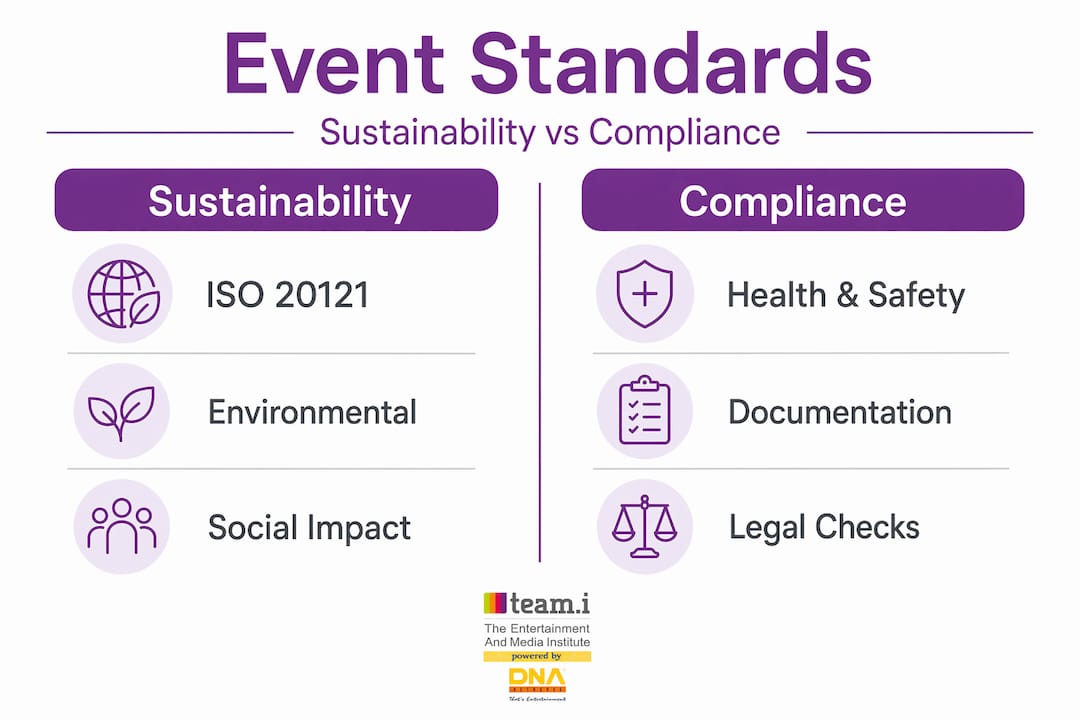
Here is a quick comparison of sustainability versus operational compliance focus areas:
| Area | Sustainability standards | Operational compliance |
|---|---|---|
| Primary focus | Environmental and social impact | Safety, eligibility, and legal requirements |
| Key frameworks | ISO 20121, EIC Standards | Governing body rules, WHO protocols, travel advisories |
| Documentation type | ESMS records, supplier audits | Eligibility forms, training certificates, risk assessments |
| Consequence of failure | Reputational damage, lost contracts | Event cancellation, legal liability |
If you are working on events with international partners, the international partner engagement checklist is worth bookmarking before your next planning cycle begins.
Pro Tip: Build a compliance calendar before you build your event timeline. Regulatory deadlines do not shift to accommodate your production schedule. Your production schedule must shift to accommodate them.
Applying global standards practically to Indian events
Theory without application is just trivia. Here is how you actually embed global event management standards into the Indian events you will work on right now.
Step-by-step approach for adopting ISO 20121:
- Set a sustainability policy early: Before you book a single vendor, define your event’s environmental and social commitments in writing. One page is enough to start.
- Engage suppliers who understand the framework: Ask caterers, AV companies, and venue managers whether they track waste or energy consumption. Their answers tell you everything about their alignment.
- Use auditable records from day one: Simple spreadsheets tracking water usage, waste diverted from landfill, and supplier certifications give you the foundation for a genuine ESMS.
- Review after every event: Document what improved and what did not. This is what auditors look for, and it is what clients increasingly want to see.
For EIC standards, apply the tiered benchmarks to recurring events you manage. An annual college cultural festival is a perfect testing ground. Apply Bronze criteria in year one, measure your outcomes, and target Silver in year two.
Here is a practical metrics tracking table you can adapt immediately:
| Metric | Target | Measurement method |
|---|---|---|
| Waste diverted from landfill | 60% or above | Waste manifest from disposal contractor |
| Local supplier spend | 40% of total budget | Purchase records by supplier postcode |
| Accessible facilities provided | 100% of venues | Venue accessibility checklist |
| Carbon footprint documented | Yes or No | Transport and energy consumption log |
Explore top event management certification courses to understand which formal programmes teach these frameworks with the depth your career needs. And if you want to understand why certification matters beyond a certificate on the wall, the answer is in the data above: measurable, repeatable, audit-ready records.
Why mastering global event standards is the game changer for Indian event careers
Here is the uncomfortable truth most event management guides will not say plainly: the Indian event industry is brutally competitive, and good intentions do not differentiate you. Documented, auditable systems do.
Employers and clients increasingly seek evidence of repeatable management systems beyond good intentions. That sentence should stop you in your tracks. It means that showing up with enthusiasm and a portfolio of photos is no longer the bar. The bar is showing up with a compliance record, a sustainability report, and a certification that proves you can manage the risks that keep clients up at night.
Many aspiring professionals treat global standards as bureaucratic overhead, something large corporations deal with. That framing is exactly backwards. Standards are the framework that lets a sharp, hungry professional from Bengaluru or Hyderabad walk into a pitch with a multinational client and speak the same language as a London or Singapore-based competitor. Without that common language, you are negotiating blind.
The deeper truth is this: event industry regulations and international event guidelines create structure, and structure creates scale. When your processes are repeatable and documented, you can grow. You can onboard new team members faster. You can take on larger events with less chaos. You can defend your decisions under pressure. That is not bureaucracy. That is professionalism that holds up when things go wrong at 11 PM on event night.
Unlock your event management career with certification and you are not just adding a line to your CV. You are changing how the industry reads you.
Enhance your career with team I’s specialised event management training
Ready to move from understanding global event management standards to actually applying them? team I’s expert-led programmes are built precisely for that transition. Courses incorporate global best practices including ISO 20121 and EIC Sustainable Event Standards, with practical Indian market examples drawn from corporate events, concerts, and weddings. You will learn to build compliance calendars, track sustainability metrics, and engage international partners with confidence. With flexible online event management courses and on-campus options, team I fits your schedule and your ambitions. Explore the full event management course and discover the certification pathway that positions you for top-tier careers across Bengaluru, Mumbai, Delhi, and Hyderabad.
Frequently asked questions
What is ISO 20121 and why is it important in event management?
ISO 20121 is an international standard that guides organisations to manage events sustainably by addressing environmental, social, and economic impacts across an event’s lifecycle, building credibility and stakeholder trust. It is applicable to events of any scale, making it relevant whether you are organising a company conference in Pune or a multi-day music festival.
How can I get certified in international sustainable event standards?
The Sustainable Event Professional Certificate offered by the Events Industry Council provides education and validation in applying global sustainability standards to real event scenarios. It is an individual credential, meaning your certification travels with you regardless of employer.
Are global event management standards relevant for small or local events in India?
Yes. ISO 20121 applies to events of any size and type, so local Indian organisers can use its framework to improve sustainability and operational processes without needing to manage an international-scale budget.
What operational compliance must be considered for international event participation?
Professionals must handle eligibility verification, safeguarding training, and advance documentation submissions as required by governing bodies, all with non-negotiable deadlines that precede the event by months.
How do global health emergencies affect event planning standards?
WHO’s Exercise Polaris II exemplifies how international coordination shapes health emergency preparedness standards, requiring event professionals to integrate risk protocols and contingency planning into every major event plan.
Recommended
- Professional ethics in event management: India guide – team I
- Master event management fundamentals: career guide India – team I
- Why Event Management as a Career? India’s Opportunity and a Global Frontier
- Event management lifestyle: a practical guide for 2026 – team I
Thinking about a career in event management?
team I is Bangalore’s only EEMA-certified event management institute, running for 24 years, where students work on real live events with real budgets and real deadlines rather than classroom simulations. See the full range of event management courses in Bangalore, or go straight to the flagship Certificate Program in Event Management (CPEM).