
Think event licensing in India is a single form and a stamp? Think again. In reality, Indian event organisers typically need a layered mix of municipal approvals, police permissions, fire safety clearance, and more, all before a single speaker fires up. This is the part of event management that separates the professionals from the hopefuls. Master it, and you become genuinely indispensable. Ignore it, and even a brilliantly planned event can be shut down before the first guest walks through the door.
Table of Contents
- Understanding the Indian event licensing landscape
- Step-by-step framework: mapping event requirements
- Permissions for special elements: music, food, and alcohol
- State-specific event licensing and online portals
- What most event guides leave out about licensing in India
- Take the next step: professional training in event management
- Frequently asked questions
Key Takeaways
| Point | Details |
|---|---|
| No single event licence | Events in India require multiple permissions tailored to event type, venue, and components. |
| Framework simplifies compliance | Using a methodical checklist for event variables makes licensing easier and reduces errors. |
| Special permissions for music, food, alcohol | Event licences for music, FSSAI registration for food, and state alcohol permits are non-negotiable for compliance. |
| State rules and portals matter | Event licensing procedures and timelines can vary widely by state and increasingly use online portals. |
| Relationships accelerate approvals | Building rapport with local officials and staying adaptable gives event managers a crucial advantage. |
Understanding the Indian event licensing landscape
Let’s be direct about something: there is no single, universal event licence in India. Not one. Every event you organise demands a tailored combination of permissions, drawn from multiple authorities who often operate independently of each other. This is controlled chaos at the administrative level, and navigating it is a core skill for every serious event professional.
The Indian event management industry has grown enormously, and so has the regulatory framework around it. Here is a breakdown of the key authorities you will typically encounter:

| Permission type | Issuing authority | Typical requirement trigger |
|---|---|---|
| Municipal/venue approval | Local municipal corporation | Any public or semi-public event |
| Police permission | District/local police | Crowd management, law and order |
| Fire safety clearance | State fire department | Large setups, high occupancy |
| Liquor licence | State excise department | Alcohol at events |
| Music/copyright licence | PPL, IPRS, or both | Live/recorded music |
| Food safety approval | FSSAI (central/state) | Any food or catering service |
As event licensing guidance confirms, organisers must approach each of these separately, with different timelines, documentation sets, and points of contact. The implication for you as an emerging event manager is significant: start mapping permissions the moment a brief lands on your desk, not the week before the event.
“Starting your licensing process late is not a risk. It is a guarantee of problems.”
Every authority has its own processing rhythm. Some take days. Some take weeks. And in certain states, certain permissions simply cannot be expedited, regardless of who you know or how urgent the situation feels.
Step-by-step framework: mapping event requirements
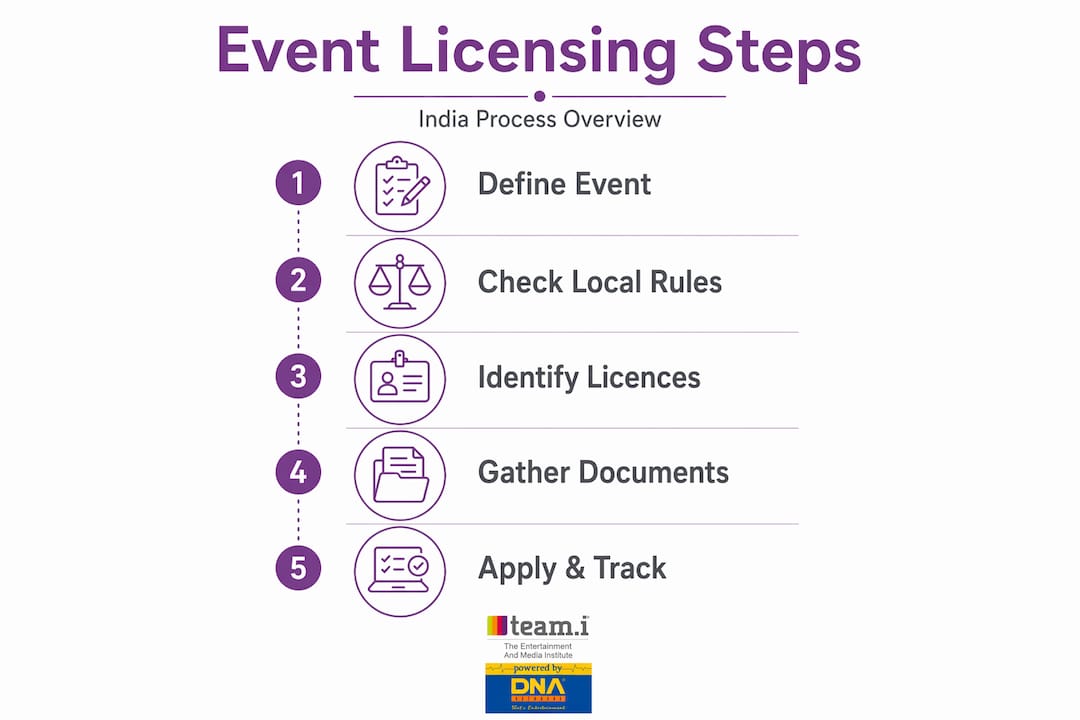
Once you grasp the range of authorities involved, it is time to adopt a systematic approach for your specific event. Think of this as your pre-production checklist, before the décor, before the vendor calls, before anything creative happens.
Start with these six key variables:
- Venue type — Is it a private banquet hall, an open ground, a public park, or a government-owned auditorium? Each triggers different permission chains.
- Crowd size — The larger the gathering, the more complex the approvals. This is not negotiable. Large events in India, particularly public gatherings, face strict thresholds.
- Music — Will there be a DJ, a live band, or even background recorded music? Licensing is required for each scenario.
- Alcohol — Serving liquor? You will need a state excise permit, and the documentation required varies dramatically from Maharashtra to Karnataka to Delhi.
- Catering — Any food or beverage service triggers FSSAI compliance requirements.
- Special hazards — Pyrotechnics, lasers, elevated stages, or fireworks each bring their own safety and permission layers.
As licensing frameworks for Indian events recommend, mapping these variables to local and state authorities upfront saves you from scrambling later. Think of it as reverse-engineering your event from a regulatory standpoint before building it forward creatively.
Here is how requirements typically differ by event type:
| Event type | Police permission | Music licence | Alcohol permit | FSSAI needed |
|---|---|---|---|---|
| Private birthday party (under 50 guests) | Usually not required | Recommended | Optional/state-specific | If catering is served |
| Ticketed concert (1,000+ guests) | Mandatory | Mandatory | Mandatory (if served) | Yes |
| Public political rally | Mandatory | Sometimes | No | If food is distributed |
| Corporate conference | Sometimes required | Recommended | If served | Yes |
| Wedding (banquet hall) | Rarely required | Recommended | State excise permit | Yes |
Tamil Nadu offers a sharp example of how local SOPs can reshape your planning entirely. Special permissions for large gatherings above 5,000 people are mandated under Tamil Nadu’s SOP, with defined advance application windows for specific venue types. Miss that window, and you are not getting your permission on time.
Pro Tip: Build a “permissions calendar” that works backwards from your event date. Mark submission deadlines for each licence type, and assign ownership to a specific team member. Vague responsibility means no accountability.
Good crowd management strategies often depend on having the right permissions in place first. You cannot plan crowd flow effectively if you do not know yet whether police will be present, or how many entry points local authorities will mandate.
Permissions for special elements: music, food, and alcohol
With the core framework in place, let us take a closer look at the unique challenges around music, food, and alcohol at Indian events. These three elements trip up even experienced organisers because the rules are genuinely non-obvious.
Music licensing: the PPL trap
Here is a mistake that catches people out constantly. PPL India (Phonographic Performance Limited) distinguishes sharply between two types of licences. The Background Licence versus Event Licence distinction matters enormously: a Background Licence is not valid for events or functions. You need a specific Event Licence for each event where sound recordings are played. Many organisers assume their existing background music licence covers a DJ set at a corporate dinner. It does not.
The IPRS (Indian Performing Rights Society) handles a separate but related set of musical rights, covering composers and lyricists. For a fully compliant event featuring live or recorded music, you may need permissions from both PPL and IPRS. Yes, both.
Food safety: FSSAI is non-negotiable
FSSAI licensing for events is foundational for any event involving food distribution or catering. Required documents typically include identity proof, address proof, premises proof, and a No Objection Certificate (NOC). Whether you are running a corporate lunch for 80 or a wedding banquet for 800, FSSAI compliance applies.
Key checklist for food and alcohol at events:
- FSSAI registration or state/central licence (based on turnover and scale)
- NOC from local municipal authority for the catering setup
- State excise permit for alcohol (applied for separately in each state)
- Valid food handler health certificates for catering staff
- Hygiene compliance inspection, if mandated by local authority
Pro Tip: Always request your caterer’s FSSAI licence number before signing the contract. If they cannot produce it, they are not compliant, and that liability lands squarely on the event organiser.
Statistic to remember: India’s FSSAI licensing system covers over 5 million food business operators nationwide, yet compliance at events remains inconsistently enforced. That inconsistency is precisely why documentation protects you legally.
State-specific event licensing and online portals
Beyond the broad national principles, state-level differences can change your licensing workflow completely. India is not a monolith when it comes to event regulation. What applies in Bengaluru may not apply in Bhopal, and what is a simple online application in one state may require in-person visits and multiple rounds of documentation in another.
The growing trend across India is the use of single-window online portals to streamline event permission applications. For example, Haryana’s event permission portal on India’s national portal allows organisers to apply for permissions for Jalsa, public meetings, processions, and similar gatherings directly online. This is a genuinely useful development, but it also illustrates how state-specific and category-specific the process remains.
Key things to watch across states:
- Thresholds vary: What triggers a mandatory police permission in one state may not in another.
- Timelines differ: Application windows range from 3 days to 30 days in advance, depending on state rules and event type.
- Portal versus in-person: Some states are fully digital; others still require physical filing with local district offices.
- NOC chains: Some states require sequential NOCs, meaning you cannot apply for permission B until permission A is granted.
Always verify directly with your local district administration or municipal corporation. No blog article, including this one, can replace that on-the-ground verification.
What most event guides leave out about licensing in India
Here is the honest, unfiltered take: most licensing checklists are written by people who have never had a collector’s office tell them their fire NOC is invalid because the third page was submitted before the second. Paperwork reality in India is far messier than any neat table suggests.
The professionals who truly excel at this are not the ones who memorised every rule. They are the ones who built relationship capital with local authorities, venue managers, and experienced mentors over time. When a permission gets delayed two days before your event, it is those relationships that get things moving, not a checklist.
Regulatory requirements also evolve. What was valid last year may require a fresh application this year. Staying connected to your local event management community and industry associations keeps you current in ways that no online guide can.
Understanding professional ethics for event managers is deeply connected to this. Cutting corners on licensing is not just a legal risk. It is a reputational one. One shut-down event follows your professional name for years.
Adaptability is your real licence. Build it deliberately.
Take the next step: professional training in event management
Reading frameworks is a start. Knowing how to apply them under real pressure is what makes a career. At teami.org, we have spent 24 years training event professionals who can handle the full spectrum, creative vision and regulatory precision. Our event management course covers compliance, vendor negotiations, and live event production with mentors who have done it all in the field. If you prefer flexibility, explore our online event courses to build expertise at your own pace. The industry does not wait. Neither should you.
Frequently asked questions
Is there a single licence for all events in India?
No, you typically need multiple permissions from different authorities based on your event’s specifics, including municipal, police, fire, and food safety approvals.
How early should I apply for event licences in India?
Many states require applications weeks in advance, especially for large gatherings. Tamil Nadu, for instance, mandates special permissions for gatherings above 5,000 people with defined advance windows.
Do I need a separate licence for music at my event?
Yes. PPL India requires a distinct Event Licence for functions, separate from standard background music licences, and this applies per event.
What licences are needed if food is served at an event?
You must secure FSSAI registration or licence and comply with documentation requirements including ID, address proof, premises proof, and NOC before serving any food.
Are there online portals for event licensing applications?
Yes. States like Haryana offer online event permission applications through India’s national portal, though procedures and scope vary significantly by state and event type.
Recommended
- Professional ethics in event management: India guide – team I
- Overview of Indian Event Management Industry – team I
- How to choose an event management career in India 2026 – team I
- Event management course costs in India: 2026 guide – team I
Thinking about a career in event management?
team I is Bangalore’s only EEMA-certified event management institute, running for 24 years, where students work on real live events with real budgets and real deadlines rather than classroom simulations. See the full range of event management courses in Bangalore, or go straight to the flagship Certificate Program in Event Management (CPEM).