Skills for event managers are the core competencies that enable professionals to organise, execute, and evaluate events under complex, high-pressure conditions. India’s event industry spans multi-day destination weddings in Udaipur, corporate summits in Hyderabad, and massive college festivals in Bangalore. Each of these demands a different mix of hard and soft capabilities. The professionals who thrive are not just creative. They are organised, digitally fluent, and relentlessly calm under fire. This guide breaks down every skill you need to build a serious career in event management.
1. What are the core skills for event managers in project planning?
Event management is project management with a stage. Creativity without rigorous project management leads to failure. That means building detailed timelines, managing vendor contracts, and tracking every moving part from the first client brief to the final debrief.
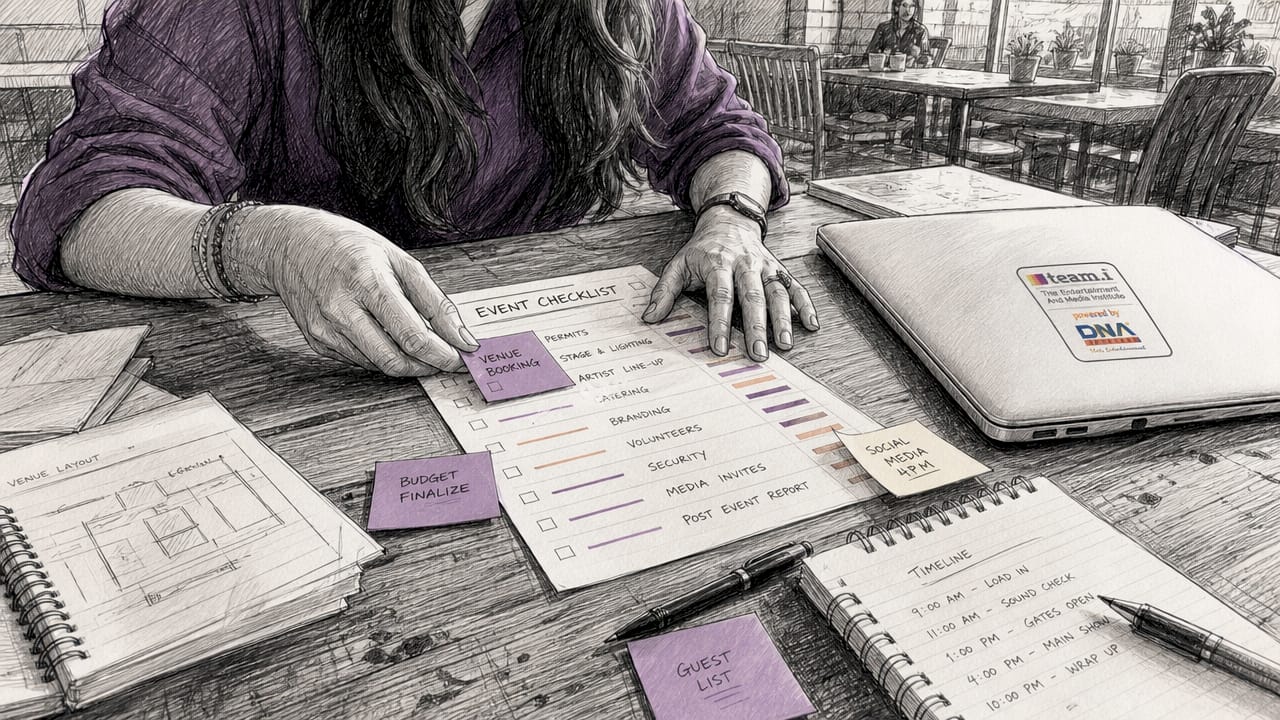
Successful event managers coordinate multiple workstreams simultaneously, with timelines often spanning 6 to 18 months for large-scale events. A destination wedding in Jaipur or a corporate conference in Mumbai does not come together in a week. You are managing décor vendors, caterers, AV teams, and travel logistics all at once.
Top professionals use tools like Asana, Trello, and Monday.com to track tasks across teams. These platforms make it easy to assign ownership, set deadlines, and flag delays before they become crises. Explore the essential event management tools that experienced managers rely on in 2026.
- Build a master timeline and share it with every vendor
- Assign a single point of contact for each workstream
- Review progress weekly, not just when problems surface
- Document every decision and change in writing
Pro Tip: Top managers reverse engineer their timelines, working backwards from the event date to identify critical milestones early. This approach surfaces bottlenecks weeks before they become emergencies.
2. How do communication skills elevate event management success?
Strong event managers tailor communication to every stakeholder. The language you use with a client is not the language you use with a lighting technician. Getting this wrong creates costly misunderstandings.
Active listening is the most underrated skill in the room. When a client gives you a vague brief like “make it feel grand,” your job is to ask the right questions until you have a concrete plan. That translation from ambiguous vision to executable detail is where most junior managers fail.
Negotiation matters enormously in the Indian market. Vendor relationships in cities like Delhi and Hyderabad run on trust and long-term rapport. Knowing when to push on price and when to preserve the relationship is a skill that takes real experience to develop.
- Listen fully before responding to a client or vendor
- Confirm every verbal agreement in writing within 24 hours
- Adapt your tone for sponsors, freelancers, and internal teams separately
- Practise conflict resolution before you need it on event day
Professional training for event managers ranges from one-day soft skills workshops to multi-module courses covering leadership, delegation, and client management. Structured learning accelerates what would otherwise take years of trial and error.
3. Which digital and technical skills are now non-negotiable?
Digital and hybrid event technologies have become a baseline expectation. Every serious event manager in 2026 needs to understand live streaming, hybrid platforms, and event registration software. This is no longer optional.
Data fluency is equally important. After a corporate event in Bangalore, your client wants to know the ROI. That means you need to collect attendance data, measure engagement, and present findings in a clear report. Managers who articulate measurable business outcomes move from logistics coordinators to trusted business advisors.
Generative AI tools are now part of the workflow for content creation, agenda planning, and post-event communications. Cultural fluency also matters. An event for a tech firm in Bengaluru has a different digital tone than a traditional wedding in Chennai.
- Learn at least one hybrid event platform end-to-end
- Build a basic post-event data report template and use it every time
- Use AI tools for first drafts of run-of-show documents and briefing notes
- Understand sustainability requirements and how to report on them
4. Why does attention to detail separate good managers from great ones?
Experienced event managers use methodical checklists and run multiple venue walks and tech rehearsals before every event. The place card that is misspelt, the microphone that cuts out during the keynote, the seating row that is one chair short. These are the details that define your reputation.
Proactive management beats reactive management every time. The best professionals in India’s event circuit do not wait for problems to appear. They run mental rehearsals of the event day, anticipating every failure point and preparing a response in advance.
Pro Tip: Buffer 10–15% into your critical timeframes and financial allocations. A contingency reserve in schedule, budget, and mental capacity is what separates professionals from amateurs when a vendor cancels at 6 AM on event day.
At a college festival in Pune or a product launch in Mumbai, the margin for visible error is zero. Clients remember the one thing that went wrong far longer than the ten things that went right. Build your event risk assessment habit early and make it non-negotiable.
5. How does budget management fit into essential event management skills?
Budget management, legal compliance, and risk assessment are now core requirements for event managers. This includes handling licensing, insurance, and detailed financial tracking for every event. Managers who cannot read a budget sheet are a liability.
Financial discipline in the Indian market is particularly demanding. Vendor pricing is rarely fixed. Costs shift based on season, city, and relationship. You need to track every rupee, flag overruns early, and present clean financial summaries to clients without being asked.
Legal compliance adds another layer. Large events in Bangalore or Delhi require permissions, safety certifications, and sometimes GDPR-equivalent data handling for international clients. Knowing these requirements before you need them protects both you and your client.
6. How do leadership and team-building skills impact event delivery?
Leadership in event management requires building quick trust and respect among short-term, diverse teams using clear delegation and conflict resolution under pressure. You are often leading people you met 48 hours ago. That demands a very specific kind of authority.
Effective delegation is not just assigning tasks. It is assigning the right task to the right person, confirming they understand it, and checking in without micromanaging. At a large cultural event in Hyderabad, your team might include freelance photographers, client-side staff, and venue crew who have never worked together.
Clear communication channels are the backbone of onsite coordination. A shared WhatsApp group is not a system. A proper briefing document, a clear chain of command, and a pre-event walkthrough with all team leads. That is a system.
- Brief every team member individually before the event begins
- Assign a deputy who can make decisions when you are unavailable
- Use a single communication channel for urgent issues only
- Debrief the team within 48 hours of every event to capture lessons
Skills in entertainment and media events require the same leadership discipline, applied to even faster-moving environments.
7. What soft skills do event managers need to build long-term careers?
Event management soft skill development is the long game. Technical skills get you hired. Soft skills keep you in the room. Adaptability, emotional intelligence, and cultural sensitivity determine whether clients call you back.
Adaptability is tested at every event. The outdoor stage in Goa gets rained on. The keynote speaker misses their flight to Delhi. The catering vendor calls at noon to say they are running two hours late. Your ability to stay calm, think clearly, and communicate confidently in those moments defines your career trajectory.
Cultural sensitivity is particularly vital in India. A wedding in Kerala has different customs, timelines, and family dynamics than one in Punjab. A corporate event for a global tech firm in Bengaluru requires a different register than a government function in Lucknow. Reading the room is a skill you build deliberately, not accidentally.
Emotional intelligence rounds out the picture. Clients are often stressed. Vendors are under pressure. Your team is tired. The manager who can read those emotional states and respond with the right tone at the right moment holds everything together.
What Teami has taught me about building real event management skills
Event management careers are evolving to require a blend of creative concepting and rigorous project governance. After 24 years of watching this industry grow in India, the pattern is clear. The professionals who build lasting careers are not the most creative people in the room. They are the most prepared.
The mistake most aspiring managers make is treating soft skills as secondary. Communication, leadership, and adaptability are not personality traits you either have or do not have. They are learnable skills. The event managers who invest in structured training early outperform those who rely on instinct alone.
India’s event market is genuinely one of the most demanding in the world. The scale of a wedding in Rajasthan, the complexity of a corporate summit in Mumbai, the energy of a college festival in Bangalore. These are not training grounds. They are the real thing. You need to arrive ready.
The best advice: build your hard skills and your soft skills in parallel. Neither is enough on its own. And get real exposure, not just classroom hours, as early as you possibly can.
— Teami
Build your event management skills with Teami
Teami has trained event professionals for 24 years, with direct industry partnerships through DNA Entertainment Networks and a track record of placing graduates into real roles across India. The event management course overview covers every skill discussed in this article, from project planning and vendor negotiation to digital tools and leadership. Programmes are available online and in-person, with practical exposure through live events, internships, and industry projects. If you are ready to move from aspiring to working, Teami’s online event management programme gives you the structure and the real-world access to get there.
FAQ
What are the most important skills for event managers?
Organisational discipline, communication, budget management, and digital fluency are the most critical skills for event managers. Leadership and problem-solving under pressure are equally important for onsite execution.
How long does it take to develop event management skills?
Core technical skills can be built through structured training in months, but soft skills like negotiation and leadership develop over multiple real events. Structured programmes with live event exposure accelerate this significantly.
Are soft skills more important than technical skills in event management?
Both are non-negotiable. Technical skills cover planning, budgeting, and digital tools. Soft skills cover communication, adaptability, and leadership. Professionals who develop both consistently outperform those who focus on only one.
What digital skills do event managers need in 2026?
Event managers need proficiency in hybrid event platforms, event registration software, and basic data analysis for ROI reporting. Familiarity with generative AI tools for content and planning is now a practical advantage.
How do I start building skills for event planning with no experience?
Enrol in a structured certification programme, volunteer at local events, and seek internships with production companies or event agencies. Practical exposure alongside formal training is the fastest route into the industry.