
TL;DR:
- Industry-ready event management programs emphasize practical experience, internships, and live projects.
- Modern curricula teach digital tools, hybrid event techniques, and safety standards crucial for industry success.
- Certifications with industry endorsement and real event experience significantly improve employability and salary prospects.
India’s live events sector grew 44% in the media and entertainment space, and the industry is now valued at USD 47.75 billion in 2025, projected to hit USD 119.77 billion by 2034. That kind of growth does not wait for outdated syllabuses to catch up. If your programme is still built around rote learning and end-of-year exams, you are not being prepared for the industry. You are being prepared for a world that no longer exists. This article breaks down exactly what an industry-ready event management curriculum looks like, why it matters for your career, and how to spot the programmes that will genuinely get you hired.
Table of Contents
- What is an industry-ready event management curriculum?
- Essential tools and techniques for event professionals
- Emerging trends and industry requirements
- Certifications, career pathways, and placement prospects
- A fresh take: What really makes candidates in demand
- Get started with an industry-ready event management programme
- Frequently asked questions
Key Takeaways
| Point | Details |
|---|---|
| Blend of theory and practice | An industry-ready curriculum must offer equal parts classroom learning and hands-on event experience. |
| Tech and trends matter | Digital tools, hybrid events, and risk protocols now feature in leading programmes for future-proof careers. |
| Certifications fast-track careers | Short-term, industry-endorsed certifications provide a strong entry point into event management jobs. |
| Internships boost employability | Live projects and structured internships give you the practical edge hiring managers want. |
What is an industry-ready event management curriculum?
Let’s be direct. “Industry-ready” is not a marketing phrase. It is a measurable standard. A programme earns that label when it produces graduates who can walk onto a live event site, manage a vendor, handle a crisis, and deliver results without needing six months of hand-holding.
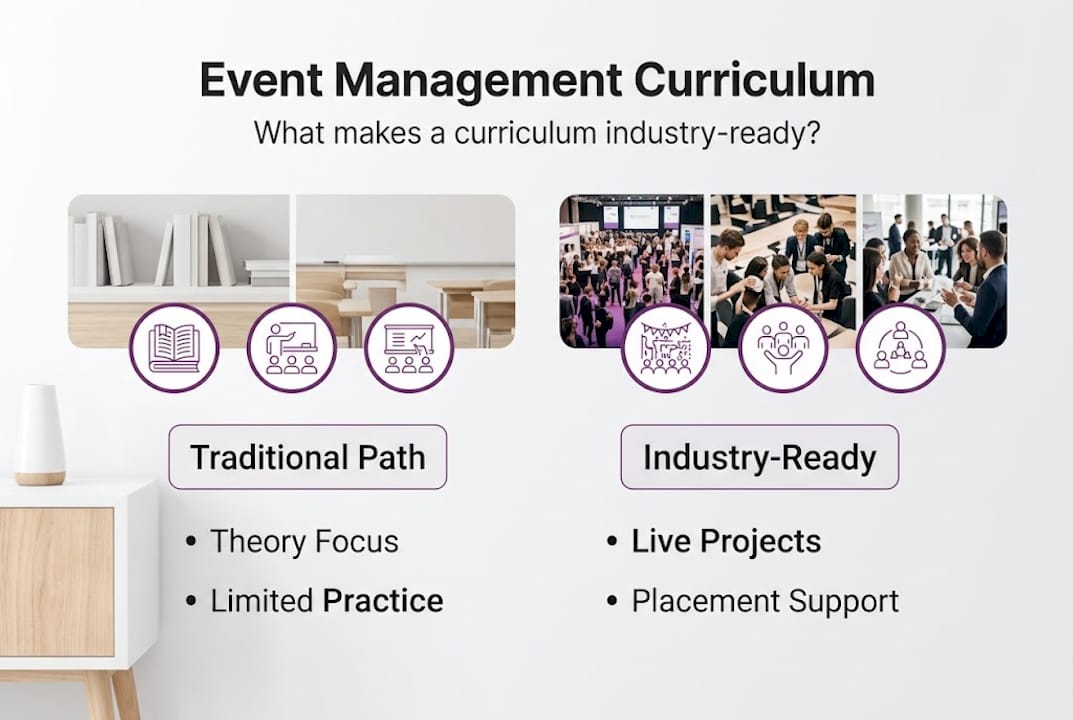
In the Indian context, that means a genuine 50:50 split between theory and practice. Not 80% lectures with a two-week internship bolted on at the end. Real industry-ready learning means compulsory live projects, structured internships, and classroom content that directly mirrors what happens backstage at a corporate summit or a 10,000-person music festival.
The event management course curriculum at a serious institute covers a broad range of modules that build on each other progressively. Here is what those core modules look like:
- Event planning and conceptualisation: Translating a client brief into a workable event concept
- Budgeting and logistics: Managing costs, timelines, and vendor contracts under pressure
- Marketing and promotion: Building audience, driving ticket sales, and managing brand presence
- Execution and operations: Onsite coordination, crew management, and real-time problem solving
- Client management: Communication, expectation setting, and post-event reporting
- Emerging trends: Hybrid event formats, AI-assisted planning tools, and sustainability practices
These core modules are the backbone of any curriculum worth your time and money. No single module stands alone. Budgeting feeds into logistics. Logistics feeds into execution. Everything is connected, just like a real event.
| Curriculum element | Theory-only programme | Industry-ready programme |
|---|---|---|
| Live project exposure | Rare or optional | Compulsory |
| Internship structure | End-of-course add-on | Integrated throughout |
| Tech tools training | Minimal | Core component |
| Industry mentorship | Limited | Structured and ongoing |
| Assessment style | Exams and essays | Project outcomes and presentations |
The difference is stark. And when you are competing for your first role against candidates who have already managed real events, that difference is everything. Getting practical work experience baked into your programme is not a bonus. It is the baseline.
Essential tools and techniques for event professionals
Knowing what to learn is one thing. Knowing how leading programmes build those skills is another. The best curricula do not just hand you a reading list. They throw you into controlled chaos and teach you to think on your feet.
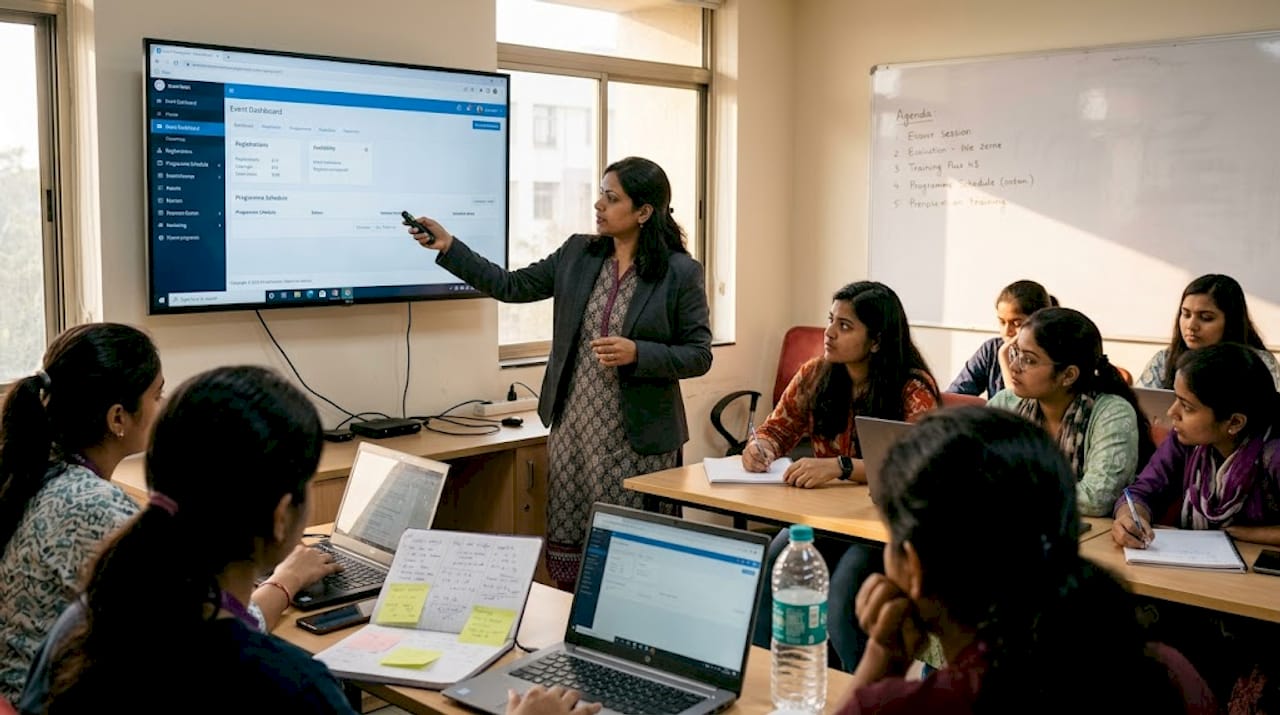
Modern event managers are expected to be digitally fluent. That means working comfortably with project management tools like Trello and Asana, design platforms like Canva and Figma, and digital marketing suites for social media, email campaigns, and paid promotion. If you cannot build a basic event landing page or schedule a content calendar, you are already behind.
Here is a snapshot of the tools and techniques that serious programmes now teach:
- Project management: Trello, Asana, Monday.com for task tracking and team coordination
- Design and branding: Canva, Figma, Adobe Express for event collateral and visual identity
- Digital promotion: Meta Ads, Google Ads, email marketing platforms, and influencer coordination
- Vendor and logistics management: Spreadsheet mastery, procurement workflows, and contract templates
- Post-event analysis: Feedback tools, ROI reporting, and data-driven debriefs
The role of technology in event planning has shifted from “nice to have” to “non-negotiable.” Employers are not impressed by candidates who say they are “quick learners” with tech. They want proof you have already used these tools under pressure.
Pro Tip: Before you even enrol in a programme, ask the institute to show you the tools their students use during live projects. If the answer is vague, that tells you everything.
Strong digital marketing skills are particularly valuable. Events live and die by their audience. A well-executed digital campaign can sell out a venue. A poor one leaves seats empty. Programmes that teach you to build and run those campaigns give you a serious edge when you are pitching for your first job.
The full event lifecycle matters too. Pre-event planning, onsite execution, and post-event analysis are three distinct phases, each with its own skill set. Programmes that only teach the glamorous middle section are doing you a disservice.
Emerging trends and industry requirements
The event industry does not stand still. What was cutting-edge three years ago is now standard practice, and what is emerging today will be expected of you by the time you graduate. A curriculum that does not evolve is a curriculum that is already out of date.
Here is how forward-thinking programmes are now addressing the latest industry demands:
“The best programmes do not just teach you what the industry looks like today. They prepare you for what it will demand tomorrow.”
Safety and compliance have moved to the front of the agenda. The EEMA Safety Manual now sets the gold standard for risk management, crowd control, and emergency protocols across India. Any serious programme should be teaching these standards as core content, not as an optional module.
| Trend | Why it matters | Curriculum response |
|---|---|---|
| Hybrid and virtual events | Audiences now expect both in-person and digital access | Dedicated modules on platform management and dual-format production |
| AR and VR integration | Immersive experiences are becoming a client expectation | Hands-on sessions with emerging tech tools |
| Sustainability | Clients and regulators demand greener events | Sustainable procurement and waste management training |
| Crisis management | One incident can end a career or a company | Live simulations and EEMA-aligned safety protocols |
| Legal compliance | Licensing, permits, and liability are non-negotiable | Dedicated legal and compliance modules |
Learning about hybrid and virtual events is no longer optional. Post-2020, the ability to produce a seamless hybrid experience, where your in-room audience and your online audience both feel equally engaged, is a genuine differentiator. Programmes that include hybrid event best practices as a core component are preparing you for the reality of the market.
You should also look for programmes that align with industry safety benchmarks and teach you to manage risk proactively. Crowd flow logistics, emergency evacuation planning, and vendor liability clauses are not just theoretical concepts. They are skills that protect people.
Pro Tip: When evaluating a programme, check whether safety and compliance training is integrated into live project assessments. That is the mark of a curriculum that takes the industry seriously.
Certifications, career pathways, and placement prospects
Not all credentials are created equal. And knowing the difference between a short certification, a diploma, and a full degree can save you both time and money.
Here is a straightforward breakdown:
- Short certifications (6 to 12 months): Fast entry into the industry, ideal for young professionals who want to start working quickly. Best when paired with live project exposure and industry endorsement.
- Diplomas (1 to 2 years): A solid middle ground. More structured than a short course, with broader curriculum coverage and typically stronger placement support.
- Bachelor’s degrees (3 years, e.g., BBA in Event Management): Formal academic credentials that open doors to corporate roles and international opportunities. Takes longer but carries weight with larger employers.
- Online and hybrid programmes: Increasingly popular and legitimate, particularly when offered by institutes with real industry partnerships and verified placement records.
The diploma vs degree question really comes down to your timeline and career goals. If you want to start working within the year, a well-structured certification with compulsory internships is a strong move.
| Credential type | Duration | Entry salary range | Placement support |
|---|---|---|---|
| Short certification | 6 to 12 months | INR 2.4L to 3L per annum | Varies widely |
| Diploma | 1 to 2 years | INR 3L to 4L per annum | Generally strong |
| Bachelor’s degree | 3 years | INR 3.5L to 5L per annum | Strongest |
Top programmes claim 100% placement assistance with robust alumni networks, and entry-level salaries typically range from INR 2.4 lakh to 4 lakh per annum, with paid internships common across the sector. The benefits of event management courses extend well beyond the classroom, particularly when placement support and alumni connections are part of the package.
Industry-endorsed credentials, particularly those recognised by EEMA, carry genuine weight with employers. They signal that your training met a verified standard, not just a self-assessed one.
A fresh take: What really makes candidates in demand
Here is something the brochures do not always say plainly. Employers in the events industry are not hiring your grade sheet. They are hiring your instincts, your composure under pressure, and your ability to make fast decisions when a speaker cancels 45 minutes before showtime.
Years of industry hiring teach one consistent lesson: hands-on live event exposure outranks a theory-heavy degree every single time. Candidates who have managed real events, even small ones, during their training stand out immediately. They ask better questions in interviews. They understand the language of the industry. They do not flinch when the brief changes.
Certifications from bodies like EEMA provide a genuine edge because they are built on standardised benchmarks. They tell an employer that you were trained to a measurable industry standard, not just a classroom one. When you are evaluating event management institutes, look hard at the live project record and the industry affiliations, not just the course brochure.
Lifelong learning is the real career accelerator. The tools change. The formats evolve. The candidates who keep upskilling, who stay curious about AR, AI, sustainability, and new event formats, are the ones who move from coordinator to manager to director. Your first qualification opens the door. What you do after that determines how far you go.
Get started with an industry-ready event management programme
If you are serious about building a career in events, the next step is choosing a programme that does more than hand you a certificate. You need industry mentorship, compulsory internships, real project exposure, and a placement team that is genuinely invested in your success.
At teami.org, with 23 years of industry experience and a direct partnership with DNA Entertainment Networks, that is exactly what we offer. Review our event management course guide to understand exactly what a rigorous, industry-aligned programme looks like. Explore why event education matters for your long-term career, and check our placement opportunities to see where our alumni are working today. Your career in events starts with the right foundation.
Frequently asked questions
What modules are essential in an industry-ready event management curriculum?
Core modules include event planning, budgeting, logistics, marketing, operations, client management, and emerging trends like hybrid events and AI tools. These build progressively on each other to mirror real-world event production.
Are short certifications or diplomas enough to start a career?
Short certifications of 6 to 12 months suit quick entry for young professionals, but internships, live projects, and continual upskilling are critical for long-term growth. EEMA-endorsed programmes add significant credibility.
How important are live projects and internships in event management education?
Live projects and internships are the single most important factor in bridging theory and practical ability, making candidates genuinely competitive in a fast-moving job market.
What salary can I expect after completing an industry-aligned event management programme?
Entry-level salaries typically range from INR 2.4 lakh to 4 lakh per annum, with higher potential for candidates who complete paid internships and hold recognised certifications.
Are tech skills like AI and digital marketing required?
Yes. Tech-savvy professionals with proficiency in digital marketing, AI planning tools, and hybrid event formats consistently achieve higher employability and faster career progression.