

TL;DR:
- Event management is a demanding profession requiring discipline, resilience, and strong planning skills.
- Core skills include project management, risk mitigation, budgeting, and technology adaptation.
- Long-term success depends on practical experience, certifications like EEMA or Vskills, and handling India-specific logistical challenges.
Everyone assumes event management is a world of spotlights, celebrity handshakes, and endless creative highs. The reality? It’s controlled chaos dressed in a sharp blazer. India’s event management market is growing at over 10% CAGR, projected to cross INR 10,000 crore by 2029, and the opportunities are genuinely exciting. But the professionals thriving in this industry aren’t just creative dreamers. They’re disciplined strategists who can pivot a 500-person outdoor wedding when the monsoon hits at 6 PM. This guide cuts through the glamour myth and gives you a real, practical picture of what this lifestyle demands and how to build a career that lasts.
Table of Contents
- What does the event management lifestyle really involve?
- Skills, tools and frameworks driving successful events
- Overcoming unique challenges in Indian event management
- Careers, growth, and certification pathways
- The truth most guides skip: is the event management lifestyle right for you?
- Kickstart your event management career with the right support
- Frequently asked questions
Key Takeaways
| Point | Details |
|---|---|
| Discipline over glamour | Success in event management demands organisation, risk management, and stamina more than creativity. |
| Practical skills matter | Certifications with internships and hands-on training boost employability and career growth. |
| Indian context challenges | Monsoons, vendor delays, and crowd control require contingency planning unique to India. |
| Salary and growth potential | Entry salaries start at ₹3 lakh and can rise above ₹20 lakh with experience and specialisation. |
What does the event management lifestyle really involve?
Let’s be honest about something most people get wrong. Event management as a career isn’t a permanent party. It’s a profession that rewards the organised, the resilient, and the relentlessly prepared. The glamour is real, yes. But so is the 2 AM vendor call, the last-minute stage redesign, and the spreadsheet that never seems to close.
A typical week for an event manager in India can look wildly different depending on the season. During peak months, from October through February, your schedule is a blur of site visits, client briefings, vendor negotiations, and showflow reviews. Off-season brings planning marathons, budget reconciliations, and pitching new business. Neither phase is slow.
Here’s what the day-to-day lifestyle actually involves:
- Creative brainstorming balanced with hard logistical problem-solving
- High-pressure deadlines that shift without warning
- Extensive travel, especially for destination weddings and corporate offsites
- Multitasking across teams, vendors, clients, and venues simultaneously
- Burnout risk during peak season if boundaries and systems aren’t in place
“Event management demands long, irregular hours and serious multitasking. The lifestyle is glamorous on the surface but requires deep discipline, stamina, and a high tolerance for pressure.”
The misconception that discipline and creativity are opposites is exactly what trips up newcomers. The best event managers treat planning like a craft. They build systems so that when chaos arrives, and it always does, they’re already three steps ahead.
Pro Tip: Keep a personal event debrief journal. After every project, note what went wrong, what saved you, and what you’d do differently. This habit builds the kind of battle-tested instinct that no classroom alone can teach.
Exploring event management fundamentals early in your training will give you a framework that turns reactive firefighting into proactive planning.
Skills, tools and frameworks driving successful events
Understanding the work life, we must also explore what skills and frameworks power this industry. Because showing up enthusiastic isn’t enough. You need a toolkit that actually works under pressure.
The most in-demand event professionals in India today combine traditional project management skills with sharp digital fluency. Here’s a ranked list of the skills that genuinely move careers forward:
- Project management: Structuring timelines, budgets, and deliverables with precision
- Risk mitigation: Anticipating what can go wrong and building contingency layers
- Budgeting and financial control: Managing vendor payments, client expectations, and profit margins
- Technology adaptation: Using digital tools to streamline planning and communication
- Stakeholder management: Keeping clients, vendors, sponsors, and teams aligned
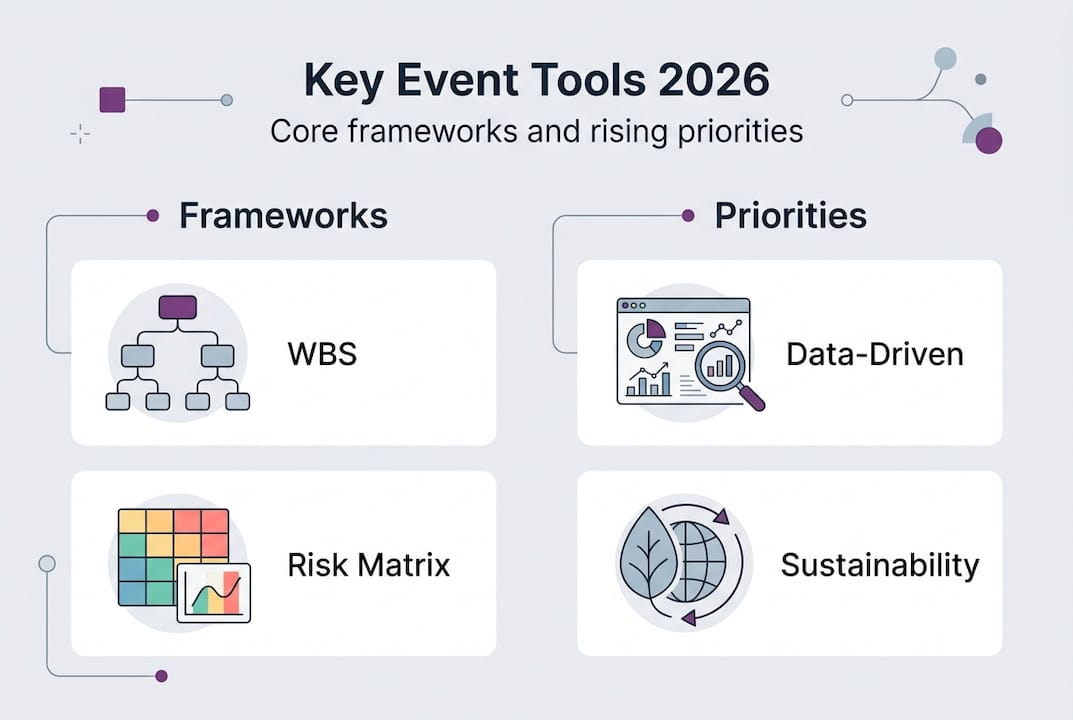
On the methodology side, three frameworks dominate professional event planning. Work Breakdown Structure, or WBS, helps you decompose a large event into manageable tasks. The RACI matrix clarifies who is Responsible, Accountable, Consulted, and Informed for every task. CPM/PERT scheduling maps your critical path so you know exactly which delays will derail your entire timeline. These key methodologies are not optional extras. They’re the backbone of any serious event operation.
| Framework | Best used for | Key benefit |
|---|---|---|
| WBS | Large, complex events | Breaks work into clear tasks |
| RACI matrix | Team coordination | Eliminates role confusion |
| CPM/PERT | Timeline management | Identifies critical deadlines |
| Risk matrix | Contingency planning | Prioritises threats by impact |
The industry is also shifting fast. Data-driven event planning is now standard in corporate formats, with ROI metrics, personalisation tools, and hybrid event formats becoming non-negotiable for clients. Understanding technology in event planning is no longer a bonus skill. It’s a baseline expectation.
Sustainability is another rising priority. Clients increasingly ask about carbon footprints, waste management, and sustainable event venue practices. Knowing how to answer those questions sets you apart from the competition.
Overcoming unique challenges in Indian event management
Equipped with essential skills and tools, you must still anticipate and handle region-specific challenges. India is not a generic event market. It’s a collection of microclimates, cultural nuances, regulatory environments, and logistical realities that can humble even the most experienced professional.
Here are the most common challenges you’ll face on the ground:
- Monsoon disruptions at open-air venues, particularly in coastal and central India
- Vendor reliability issues, including last-minute cancellations and quality inconsistencies
- Crowd management at large-scale public events where footfall can exceed projections
- Regulatory permissions that vary by state, venue type, and event category
- Power and infrastructure gaps in Tier 2 and Tier 3 cities
Let’s look at how professionals handle two of the trickiest scenarios:
| Challenge | Risk level | Mitigation strategy |
|---|---|---|
| Monsoon at open venue | High | Backup indoor space, waterproof staging, weather alerts |
| Vendor delay on event day | High | Pre-qualified backup vendors, penalty clauses in contracts |
| Overcrowding | Critical | Crowd flow logistics plan, outdoor seating workflow protocols |
| Permit delays | Medium | Apply 60 days in advance, maintain authority relationships |
The edge cases in Indian event management are real and frequent. A risk matrix helps you score each potential problem by likelihood and impact, so you’re not treating a 10% chance of rain the same as a 90% chance of a generator failure. EEMA safety standards provide a compliance framework that also signals professionalism to clients and venues.
Building strong vendor management strategies is genuinely one of the highest-leverage skills you can develop early in your career. Your vendor network is your safety net.
Pro Tip: Don’t wait until something goes wrong to build relationships with local authorities and venue managers. Visit them before you need a favour. That goodwill is worth more than any contingency budget.
Staying ahead of event industry trends also helps you anticipate regulatory shifts and new client expectations before they catch you off guard.
Careers, growth, and certification pathways
Successfully tackling challenges is only part of the journey. Understanding the right career path and the credentials that accelerate it is equally vital.
The salary landscape in Indian event management is more varied than most guides admit. Your earning potential depends heavily on your city, your specialisation, and whether you’ve built a credible portfolio. Here’s a realistic breakdown:
- Entry-level (0 to 3 years): ₹3 to 7 lakh per annum, with higher figures in Mumbai, Delhi, and Bangalore
- Mid-level (3 to 7 years): ₹7 to 15 lakh per annum, rising sharply with specialisation in weddings, sports, or corporate events
- Senior level (7+ years): Above ₹20 lakh per annum, with leadership roles at large agencies
- Freelancers: Variable, but niche expertise in luxury weddings or international IPs can command premium rates
Statistic to note: Entry-level professionals in metro cities with certified training consistently earn at the higher end of the ₹3 to 7 lakh band compared to those without formal credentials.
Certification genuinely matters here. EEMA and Vskills certifications are widely recognised by employers and clients alike. Vskills is government-recognised, which adds credibility in institutional and public sector event contexts. EEMA membership connects you to India’s most influential event industry network.
But here’s the truth that separates good programmes from great ones: practical internships and live project exposure are worth more than any certificate on its own. Employers want to see that you’ve stood at a venue at 11 PM solving a real problem, not just read about one in a textbook.
Explore event planning certifications that combine classroom learning with real event participation. Understand the event manager salary landscape for your target city and specialisation. And never underestimate the importance of internships in building the kind of portfolio that gets you hired fast.
The truth most guides skip: is the event management lifestyle right for you?
Here’s the perspective most career guides are too polite to share. Passion is not enough. The event industry in India is littered with talented, creative people who burned out within three years because they underestimated the operational grind.
The professionals who build long, rewarding careers in this field share a specific set of traits. They thrive under pressure rather than just tolerating it. They treat risk management as seriously as creativity. They build systems obsessively because they know that systems are what save you when everything else fails.
The glamour versus grind reality is stark. Creativity is secondary to operational discipline on most event days. The person who keeps their cool when the AV system fails five minutes before a keynote is more valuable than the person who designed the most beautiful stage set.
Burnout is real and it’s common. But it’s also largely preventable when you build your career on resilience, strong boundaries, and a genuine love for the problem-solving side of this work. If you’re drawn to a creative career in event management, be honest with yourself about whether you also love the logistics. Because you’ll spend far more time on the latter.
This industry rewards the resilient. It truly does. But you have to decide if you’re built for it before you’re standing in a flooded venue at midnight wondering why you didn’t choose a desk job.
Kickstart your event management career with the right support
Ready to turn insight into action? The difference between aspiring and actually working in event management often comes down to one thing: structured, practical training with real industry access. At teami.org, with 23 years of experience and a direct partnership with DNA Entertainment Networks, you get more than a certificate. You get backstage passes to real events, mentorship from battle-tested professionals, and placement support that connects you to India’s top agencies. Explore the full event management course details, browse online event management programmes that fit your schedule, and review top event management certifications that employers actually respect. Your career starts with the right foundation.
Frequently asked questions
What is the work-life balance like in event management?
Event managers face long, irregular hours particularly around live events, but professionals who build strong planning systems and delegate effectively can maintain a sustainable rhythm outside peak season.
Which certifications matter most for a career in event management?
EEMA and Vskills certifications are the most respected in India, especially when paired with practical internship experience that demonstrates real-world readiness to employers.
How much can a fresher expect to earn as an event manager?
Entry-level salaries range from ₹3 to 7 lakh per annum, with metro cities and certified candidates consistently landing at the higher end of that band.
How do event managers handle risky situations like heavy rain or overcrowding?
Professionals use risk matrices and EEMA safety standards to score and prioritise threats, combined with pre-planned contingencies such as backup venues, qualified alternative vendors, and crowd flow protocols.