

Virtual event planning is the structured process of organising and executing online events through a defined lifecycle that delivers measurable attendee experiences and clear business outcomes. Whether you are running a corporate webinar from Bengaluru, a digital conference for a Mumbai-based brand, or an online workshop for a pan-India audience, the difference between a forgettable stream and a genuinely impactful event comes down to process. Platforms like Zoom, Webex, and Microsoft Teams give you the infrastructure. What wins the room is the planning behind them.
What are the critical phases of virtual event planning?
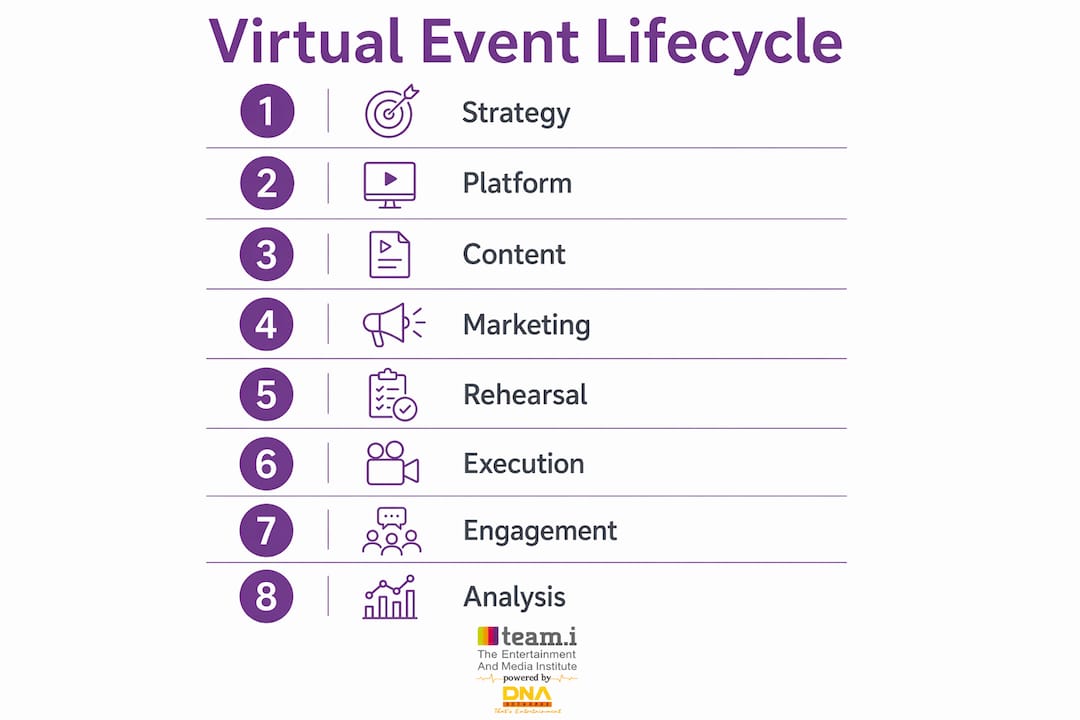
Virtual event management follows eight distinct lifecycle phases, each requiring a named owner and a firm deadline. According to EventsAir’s lifecycle model, a complete virtual event plan is organised into these phases to ensure a consistent attendee experience.
| Phase | Key Activities | Owner |
|---|---|---|
| Strategy & objectives | Define goals, KPIs, audience | Event Lead |
| Platform selection | Compare tools, confirm tech stack | Tech Lead |
| Content & speaker management | Agenda, speaker briefs, rehearsals | Programme Manager |
| Tech stack integration | CRM, registration, streaming setup | Tech Lead |
| Marketing & communications | Invites, reminders, social posts | Marketing Manager |
| Stakeholder management | Sponsor decks, partner briefings | Event Lead |
| Event-day execution | Live moderation, tech support | Producer |
| Post-event analysis | Surveys, analytics, reporting | Event Lead |
Assigning owners to each phase is not a formality. When a Hyderabad-based IT firm ran a 2,000-attendee product launch webinar without a named tech lead, their registration system and streaming platform failed to sync on the day. Three hundred attendees never received their joining links. Accountability by phase prevents exactly that.
- Set a deadline for each phase at least two weeks before the event date.
- Use a shared project management tool like Asana or Notion to track phase completion.
- Review phase status in weekly standups with all owners present.
Pro Tip: Build a buffer week before the marketing phase begins. Indian audiences, particularly in Tier 2 cities, often need a second reminder cycle in regional languages to convert registrations.
Which platforms should you choose for online event management?
Platform selection is the single decision that shapes every other part of your tech stack. Zoom dominates Indian corporate webinars for its reliability and familiarity. Webex suits large enterprise conferences with its stronger security compliance. Microsoft Teams works best when your attendees already live inside the Microsoft 365 ecosystem. For running virtual events with multilingual Indian audiences, live interpretation and caption support become non-negotiable selection criteria.
| Platform | Best For | Engagement Tools | Language Support |
|---|---|---|---|
| Zoom | Webinars, workshops | Polls, Q&A, breakout rooms | Auto-captions, interpretation |
| Webex | Enterprise conferences | Slido integration, whiteboards | Real-time interpretation |
| Microsoft Teams | Internal corporate events | Live reactions, breakout rooms | Auto-captions |
| Hopin | Large-scale virtual expos | Networking tables, expo booths | Limited |
Tech stack integration matters as much as the platform itself. Your registration tool, CRM, and streaming platform must exchange data cleanly. A Delhi-based consulting firm once ran a 500-person digital conference planning event where attendee data sat in three separate systems. Post-event follow-up took four days instead of four hours.
Pro Tip: Run a full internal rehearsal on your chosen platform at least 72 hours before the event. Invite five colleagues to join as mock attendees. You will catch audio routing issues, screen-share permission errors, and caption lag before your real audience does.
How do you execute smooth day-of event production?
The run of show (ROS) is the live operating document that runs your event. It is not a schedule. It is a broadcast-level operating system that specifies every technical action, from mute and unmute cues to polling times and screen-share transitions. Without it, your team relies on memory and improvisation, which is where live events fall apart.
Assign these four roles before any rehearsal begins:
- Producer — controls the platform backend, manages mute/unmute, launches polls, and triggers recordings.
- Moderator — faces the audience, manages Q&A, keeps the session on time.
- Support Contact — handles attendee tech queries via chat or a dedicated WhatsApp line.
- Event Lead — owns the overall programme and makes real-time decisions on timing changes.
Rehearsal is not optional. A detailed run of show rehearsed at least twice, once 24–48 hours before and again 30–60 minutes before going live, is the standard for professional virtual event delivery. The first rehearsal catches structural problems. The second catches the small things that still break on the day.
- Test every slide transition and video clip in the actual platform, not just locally.
- Confirm speaker audio and lighting 48 hours before, not on the morning of the event.
- Prepare a contingency script for the moderator to use if a speaker drops out mid-session.
Pro Tip: Structure your agenda as a sequence of re-entry points. If an attendee in Chennai drops off due to a connectivity issue, a clear re-entry point every 20 minutes lets them rejoin without feeling lost. This is especially relevant for Indian audiences where network stability varies.
What are virtual event best practices for engagement and accessibility?
Virtual sessions should avoid keeping attendees passive for more than two hours. That is not a soft suggestion. Passive viewing beyond two hours produces measurable drops in poll participation and session completion rates. Break your programme with interactive segments, Q&A slots, or short networking breaks every 45–60 minutes.
Accessibility is where most Indian virtual events still fall short. Live captions and transcripts are the baseline. Auto-generated captions work for simple content but lose accuracy fast during technical presentations or multi-speaker panels. For a pan-India audience spanning Hindi, Tamil, Telugu, and English speakers, real-time interpretation is a genuine differentiator.
Engagement tactics that work in the Indian context:
- Pre-event access guides sent via WhatsApp, not just email, reduce live support requests significantly.
- Practice sessions for first-time virtual attendees, common in educational and government webinars, build confidence before the event begins.
- Dedicated networking slots using breakout rooms or event apps like Brella give attendees a reason to stay beyond the main sessions.
- Live polls every 20–30 minutes keep attention active and give you real-time data on audience sentiment.
Pro Tip: Publish an accessibility statement on your event registration page and name a specific contact person for accessibility queries. This single step builds attendee confidence and reduces last-minute support requests on the day.
How do you measure success in remote event organisation?
KPIs must be defined before the event begins, not after. Defining success metrics upfront and mapping them to measurable data points is what separates events that learn from events that just happen. A Bengaluru-based edtech company that tracked only registration numbers missed the fact that their session completion rate was 34 per cent. Their content was losing people halfway through.
| KPI | What It Measures | How to Track |
|---|---|---|
| Registration-to-attendance rate | Marketing and reminder effectiveness | Platform analytics |
| Live engagement rate | Poll responses, Q&A participation | Platform dashboard |
| Session completion rate | Content quality and pacing | Attendance timestamps |
| NPS / CSAT score | Overall attendee satisfaction | Post-event survey |
| Financial ROI | Revenue vs. event cost | Finance + CRM data |
Behavioural engagement signals such as questions asked, poll responses, watch time, and post-event site actions feed directly into lead scoring models. That data enables targeted CRM follow-up within hours of the event closing, not days later. For corporate events in Mumbai or Delhi where sales pipelines depend on webinar leads, speed of follow-up is a competitive advantage.
Pro Tip: Set your KPI targets during the strategy phase, not after the event. Write them into your event brief alongside your objectives. When the post-event report lands, you will know immediately whether you succeeded.
What I have learnt from planning virtual events in India’s market
The biggest mistake I see is treating the run of show as a formality. Teams spend weeks on speaker content and 20 minutes on the ROS. Then a speaker’s video freezes during a live product reveal, the producer has no contingency cue, and the moderator fills dead air with apologies. That is not a tech failure. That is a planning failure.
India’s virtual event audience is genuinely diverse. A single webinar might reach attendees in Shillong on a mobile connection and attendees in Gurugram on fibre. Planning for the lowest common denominator in connectivity, and building re-entry points into your agenda, is not a compromise. It is professional practice.
The hybrid event space is where the real growth is happening. Professionals who master virtual event management now are building the exact skills that hybrid production demands. KPI discipline, ROS rigour, and accessibility thinking transfer directly. Start building those habits on every virtual event you run, regardless of scale.
— Teami
Build the skills to run professional virtual events
Teami has spent 24 years training event professionals who work on real productions, not simulations. If you want to move from watching virtual events to running them at a professional level, the event management course at Teami covers virtual event production, platform management, run-of-show creation, and post-event analytics as part of a hands-on curriculum. You also get access to Teami’s industry network through its partnership with DNA Entertainment Networks, which means real placements, not just certificates. For those who prefer flexible study, Teami’s online event management programme lets you build these skills around your existing schedule.
FAQ
What is virtual event planning?
Virtual event planning is the structured process of organising online events through defined phases covering strategy, platform selection, content management, execution, and post-event analysis. Each phase requires a named owner and deadline to deliver a consistent attendee experience.
How many phases does a virtual event lifecycle have?
A complete virtual event lifecycle has eight phases: strategy and objectives, platform selection, content and speaker management, tech stack integration, marketing and communications, stakeholder management, event-day execution, and post-event analysis.
What is a run of show in virtual events?
A run of show is a live operating document that specifies every technical action during a virtual event, including mute cues, screen-share transitions, polling times, and contingency triggers. It prevents reliance on memory and keeps delivery at a professional standard.
How long should virtual event sessions run without a break?
Virtual sessions should not keep attendees passive for more than two hours. Breaking every 45–60 minutes with interactive segments, polls, or networking slots maintains engagement and reduces drop-off rates.
Which KPIs matter most for measuring virtual event success?
The most critical KPIs are registration-to-attendance rate, live engagement rate, session completion rate, NPS or CSAT score, and financial ROI. These should be defined during the strategy phase and tracked via platform analytics and post-event surveys.