
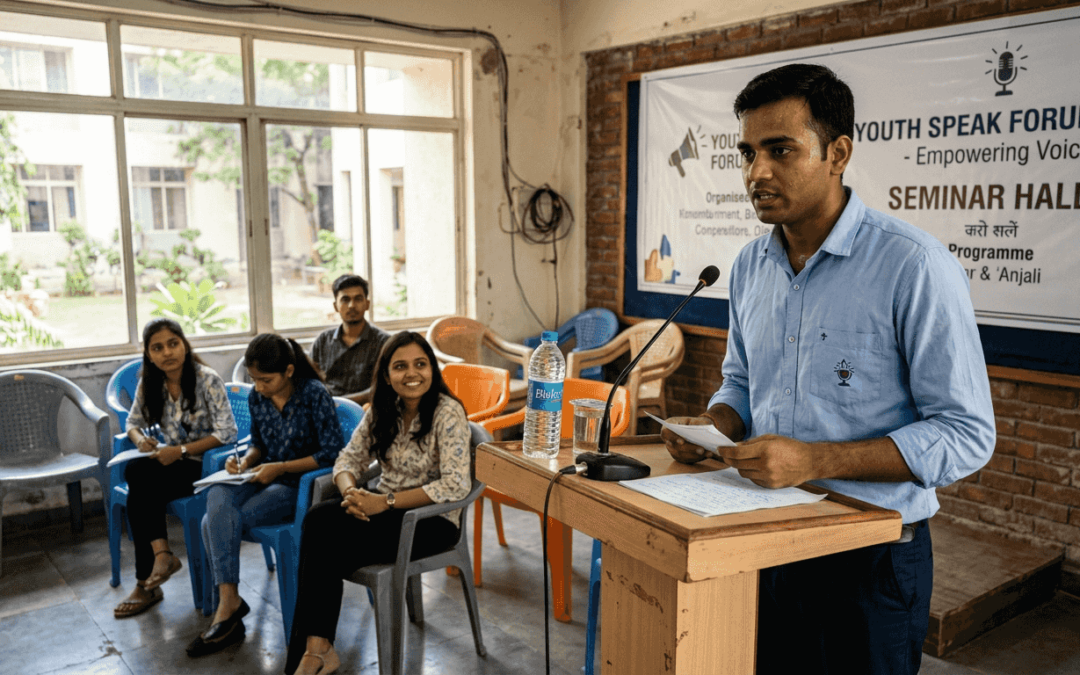
Public speaking often terrifies aspiring event managers in India, yet it’s a skill that can make or break your career. Many struggle with stage fright, impacting career progression and opportunities. This guide provides practical, actionable techniques to help you overcome anxiety, structure speeches effectively, and deliver presentations with confidence. Whether you’re pitching to clients or hosting large events, these steps will build your speaking skills from the ground up.
Table of Contents
- Introduction To Public Speaking For Beginners
- Prerequisites: What You Need To Start
- Step 1: Captivate With Your Opening
- Step 2: Master Your Topic
- Step 3: Practise With Purpose
- Step 4: Use Clear Language And Controlled Pace
- Step 5: Use Pauses Strategically
- Step 6: Engage With Eye Contact And Body Language
- Common Mistakes And How To Fix Them
- Expected Outcomes And Success Metrics
- Boost Your Event Career With Expert Training
- Frequently Asked Questions
Key takeaways
| Point | Details |
|---|---|
| Preparation is essential | Structured planning, topic mastery, and deliberate practice reduce anxiety and improve delivery |
| Delivery techniques matter | Simple language, controlled pace, strategic pauses, and eye contact boost clarity and engagement |
| Practice drives improvement | Daily 10-15 minute sessions with recording and feedback accelerate skill development |
| Common mistakes are fixable | Speaking too fast, over-reliance on notes, and weak structure can be corrected with focused practice |
| Progress is measurable | Within 4-8 weeks, beginners typically see reduced anxiety, fewer filler words, and stronger audience connection |
Introduction to public speaking for beginners
Public speaking is the act of delivering prepared messages to audiences to inform, persuade, or entertain. For event managers in India, it’s not just about standing on stage but about pitching proposals, coordinating teams, engaging sponsors, and managing live audiences. Strong speaking skills directly influence client trust, team morale, and event success.
Beginner challenges are common and predictable:
- Stage fright and physical anxiety symptoms like trembling or sweating
- Difficulty organising thoughts into clear, logical structures
- Over-reliance on scripts causing disconnection from audiences
- Monotone delivery that fails to engage listeners
- Uncertainty about appropriate body language and eye contact
The good news? Public speaking is absolutely learnable. It’s a skill developed through structured preparation and consistent practice, not an innate talent. Event managers who master speaking see tangible career benefits: stronger client relationships, more confident team leadership, better negotiation outcomes, and increased promotion opportunities.
This guide covers practical skills you can implement immediately. You’ll learn how to captivate audiences from your opening line, structure content for clarity, practise effectively, control delivery pace, use pauses strategically, and engage through body language. These aren’t abstract theories but actionable techniques proven to build confidence and competence.
Prerequisites: what you need to start
Before diving into techniques, set yourself up for effective learning. You don’t need expensive equipment or formal training, just a few basics and the right mindset.
Essential tools and preparations:
- A smartphone or recording device to capture practice sessions for review
- Notebook or digital notes app for organising speech outlines and key points
- Quiet practice space where you can speak aloud without interruption
- Basic understanding of your topic before attempting to present it
- Willingness to receive constructive feedback from peers or mentors
Mindset matters enormously. Approach public speaking as a skill you’re building, not a test you’re passing. Expect initial discomfort but recognise it diminishes with repetition. Understand your audience’s profile: their knowledge level, interests, and expectations shape how you prepare content.
Proper preparation includes researching your topic thoroughly, anticipating questions, and creating clear objectives for each speech. What do you want listeners to know, feel, or do after hearing you? This clarity guides every preparation choice.
Pro Tip: Record your very first practice session before learning any techniques. This baseline recording will show you exactly how much you’ve improved after 4-6 weeks of focused practice.
Consistent, small efforts beat sporadic intensive sessions. Commit to 10-15 minutes daily rather than occasional marathon practices. This regularity builds muscle memory for confident delivery and reduces anticipatory anxiety.
Step 1: captivate with your opening
The first 30 seconds determine whether audiences lean in or tune out. Beginners often waste openings with generic statements or lengthy introductions. Instead, grab attention immediately with techniques that create instant connection.
Effective opening strategies:
- Share a brief, relatable story that illustrates your main point emotionally
- Ask a thought-provoking rhetorical question that makes audiences reflect
- Present a surprising statistic or fact that challenges common assumptions
- Use a vivid analogy that frames your topic in memorable terms
- Start with a bold statement that creates curiosity about what follows
Opening with stories or questions increases audience engagement significantly. For Indian audiences in event management contexts, stories about cultural celebrations, festival logistics challenges, or memorable client moments resonate particularly well.

For example, instead of “Today I’ll discuss vendor management,” try “Last Diwali, our caterer cancelled 48 hours before a 500-guest wedding. Here’s how we turned potential disaster into our most successful event.” The story creates immediate interest and positions you as someone with valuable experience to share.
Pro Tip: Write three different openings for the same speech and test each with a small audience or recording. The version that feels most natural and generates the strongest initial reaction is usually your best choice.
Tailor openings to your specific audience. Corporate event presentations benefit from data and efficiency angles. Wedding or social event topics connect through emotion and personal meaning. Understanding this nuance helps you choose the most impactful opening approach for each situation.
Step 2: master your topic
Confidence flows directly from knowledge. When you truly understand your subject, words come easier, hesitation decreases, and you handle unexpected questions smoothly. Topic mastery reduces hesitation and filler words dramatically.
Steps to master your content:
- Research your topic thoroughly from multiple credible sources
- Identify the three to five core messages you want audiences to remember
- Organise content into clear introduction, body, and conclusion structure
- Use simple, precise language that your audience already understands
- Create logical transitions that connect each section smoothly
- Anticipate likely questions and prepare concise answers
Structure matters enormously for clarity. Structured speeches improve retention by making information easier to follow and remember. Your introduction previews what’s coming, the body delivers core content in digestible chunks, and the conclusion reinforces key takeaways with a clear call to action.
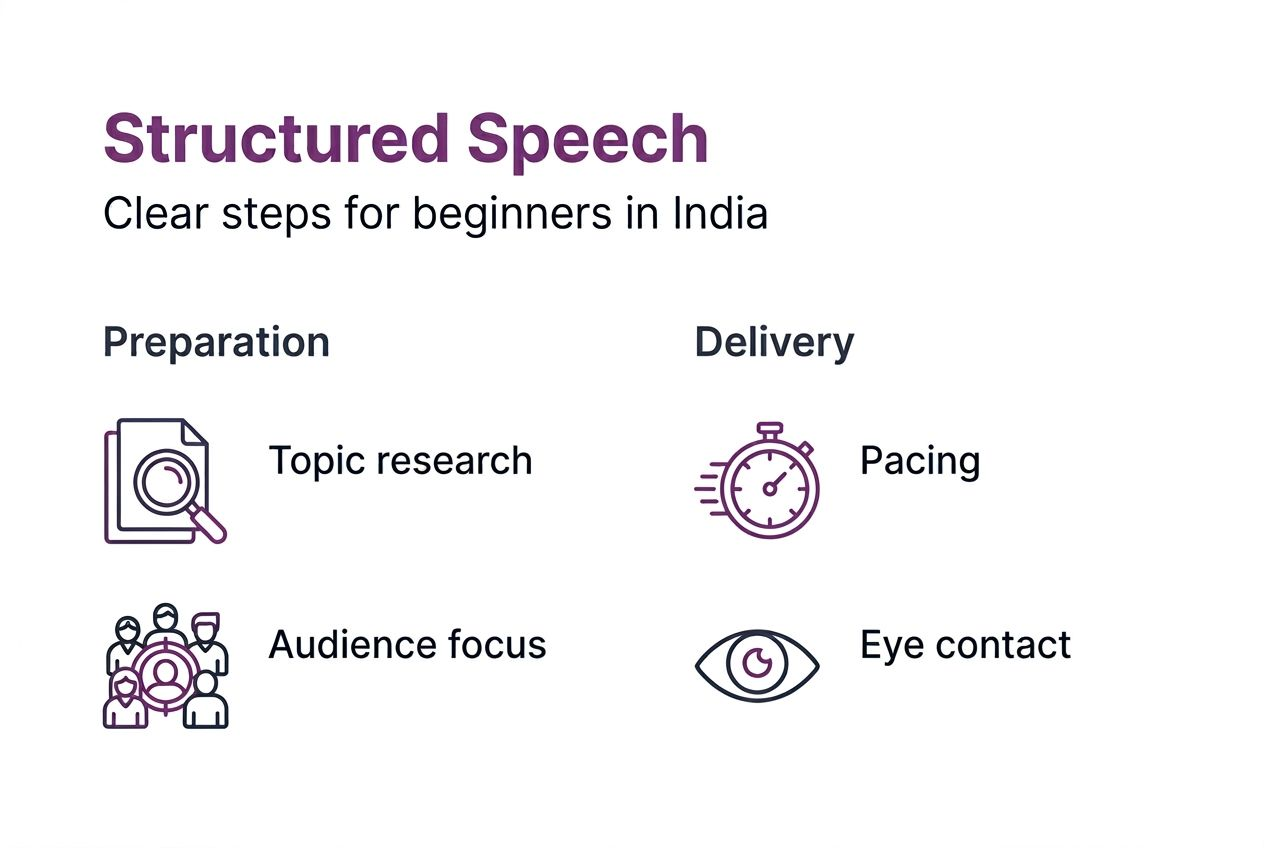
| Aspect | Unstructured Speech | Structured Speech |
|---|---|---|
| Audience retention | 35-40% | 70-80% |
| Speaker confidence | Low, frequent hesitation | High, smooth delivery |
| Message clarity | Confusing, hard to follow | Clear, logical flow |
| Filler word usage | High (um, uh, like) | Minimal |
| Audience questions | Often off-topic | Relevant and focused |
Avoid complexity for its own sake. If you can explain a concept in five words instead of fifteen, do it. Presentation skills improve dramatically when you strip away jargon and speak as you would to a friend explaining something important.
Step 3: practise with purpose
Random repetition won’t build skills efficiently. Deliberate, focused practice with specific goals accelerates improvement and builds genuine confidence. Daily practice sessions reduce anxiety substantially within weeks.
Effective practice techniques:
- Set specific goals for each session: today I’ll work on eye contact, tomorrow on pacing
- Record every practice session and review critically for improvement areas
- Practise in front of mirrors initially to observe and adjust body language
- Gradually increase difficulty: alone, then small trusted group, then larger audiences
- Seek honest feedback from people who will point out specific areas to improve
“Daily practice sessions of 10-15 minutes reduce anxiety by 40% in 4 weeks, with recorded feedback accelerating progress.”
Recording is transformative because it reveals what you actually do versus what you think you do. Most beginners are surprised by filler word frequency, speaking pace, or facial expressions they weren’t conscious of. This awareness is the first step toward deliberate correction.
Practice with feedback accelerates confidence gains far beyond solo practice. Ask reviewers for specific observations: “Did I maintain eye contact?” or “Were my main points clear?” rather than vague “How was I?” questions. Specific feedback enables targeted improvement.
Pro Tip: Join local event management groups or Toastmasters clubs where you can practise regularly in supportive environments. The combination of structured feedback and consistent speaking opportunities builds skills faster than isolated practice alone.
Vocal variation and body language deserve deliberate practice too. Experiment with volume changes, strategic emphasis, hand gestures, and movement. Record these experiments to see what enhances your message versus what distracts from it.
Step 4: use clear language and controlled pace
Clarity beats cleverness every time. Audiences appreciate speakers who make complex ideas accessible, not those who show off vocabulary. Simple language increases retention significantly compared to unnecessarily complex wording.
Language and pacing best practices:
- Choose common words over technical jargon unless your audience expects specialist terms
- Define any necessary technical terms simply the first time you use them
- Speak at a moderate pace: roughly 120-150 words per minute for clear comprehension
- Adjust volume to room size and audience distance without shouting
- Enunciate clearly, especially word endings that often get dropped
- Vary pace slightly for emphasis: slow down for important points, speed up slightly for background
Moderate pace reduces filler words and improves comprehension substantially. When you rush, your brain struggles to find words, triggering “um” and “uh” as gap-fillers. Slowing down gives you time to think ahead while speaking, eliminating this nervous habit.
For Indian event management contexts, consider your audience’s English comfort level. If presenting to diverse groups, simpler vocabulary ensures everyone follows along. If addressing event professionals, industry terms are appropriate but should still be explained for any newcomers present.
Volume control shows awareness and respect. Too quiet suggests lack of confidence or preparation. Too loud feels aggressive and exhausting for audiences. Clear presentation techniques balance audibility with conversational tone, making listeners feel you’re speaking with them, not at them.
Step 5: use pauses strategically
Silence feels uncomfortable for beginners, who often rush to fill every gap. Yet effective pauses increase comprehension and perceived speaker confidence significantly. Pauses give audiences time to process information and give you moments to collect thoughts.
When and why to pause:
- After asking questions, allowing audiences mental space to consider answers
- Before and after key points to create emphasis and importance
- During transitions between major sections or ideas
- When you feel anxious, replacing filler words with brief silence instead
- After statistics or surprising facts to let information sink in
Pauses replace filler words naturally. When you feel “um” coming, pause instead. The brief silence feels much longer to you than to audiences, who simply perceive a thoughtful, confident speaker. This single technique transforms delivery quality dramatically.
For event presentations, pauses are particularly powerful after revealing budget figures, timeline commitments, or logistical solutions. The silence emphasises importance and gives stakeholders time to mentally process implications before you continue.
Pro Tip: Practise holding pauses for a full three seconds. Count silently “one Mississippi, two Mississippi, three Mississippi” to build comfort with longer silences. This feels eternal initially but sounds perfectly natural to listeners.
Strategic pausing also helps manage speech anxiety. When you feel overwhelmed, a deliberate pause lets you breathe, recentre, and continue smoothly. Audiences interpret this as confident control, never guessing you’re managing internal stress.
Step 6: engage with eye contact and body language
Non-verbal communication carries as much weight as your words. Eye contact improves audience connection and perceived confidence substantially. Your posture, gestures, and facial expressions either reinforce or undermine your verbal message.
Body language essentials:
- Maintain eye contact with various audience members, shifting naturally every 3-5 seconds
- Stand with upright posture: shoulders back, weight balanced, avoiding slouching
- Use open hand gestures that support points without excessive or distracting movement
- Keep facial expressions aligned with content: smile for positive points, serious for challenges
- Avoid nervous habits: fidgeting, pacing, touching face, playing with objects
- Move purposefully if speaking space allows, but don’t pace aimlessly
Eye contact creates connection and trust. For Indian audiences, cultural norms vary slightly, but generally making respectful, distributed eye contact across the room signals confidence and inclusion. Don’t stare at any one person uncomfortably long, but don’t scan so quickly you seem nervous either.
Gestures should emphasise and clarify, not distract. When discussing three points, hold up three fingers. When describing something large, spread hands appropriately. Natural gestures emerge when you’re focused on communicating clearly rather than controlling every movement consciously.
Body language tips for event contexts include acknowledging different audience sections equally, physically moving toward questioners when responding, and using the full stage or speaking area to create dynamic energy. Static speakers lose audience attention faster than those who use space purposefully.
Common mistakes and how to fix them
Recognising typical beginner errors helps you avoid them proactively. Most unsuccessful presentations stem from a handful of fixable mistakes repeated consistently.
Frequent mistakes and corrections:
- Speaking too fast: Consciously slow down, use pauses, practise with metronome or timer
- Over-reliance on notes: Switch to bullet points, practise until you need only brief glances
- Weak or missing structure: Always outline introduction, body points, and conclusion before practising
- Monotone voice: Deliberately vary pitch and volume, emphasise key words, record to hear difference
- Avoiding eye contact: Practise with friendly faces first, gradually expand comfort zone
- Apologising or self-deprecating: Project confidence even when nervous, audiences mirror your energy
Speaking pace is the most common and impactful mistake. When nervous, beginners rush through content, making comprehension difficult and increasing their own anxiety further. The fix is simple but requires conscious effort: slow down deliberately, even if it feels unnaturally slow initially.
Over-dependence on full scripts creates several problems: you lose eye contact, sound robotic, and panic if you lose your place. Transition to detailed outlines, then to brief bullet points. This progression builds confidence in your material knowledge and creates more natural, engaging delivery.
Fixing presentation mistakes requires identifying them first. Recording practice sessions reveals these errors clearly. Then address one mistake per practice session rather than trying to fix everything simultaneously. This focused approach produces faster, more sustainable improvements.
Expected outcomes and success metrics
Understanding realistic progress timelines and measurable indicators keeps you motivated and helps track genuine improvement. Public speaking skill development follows predictable patterns when practised consistently.
| Outcome | Timeline | Success Indicator |
|---|---|---|
| Reduced physical anxiety | 3-4 weeks | Less trembling, steadier voice, controlled breathing |
| Fewer filler words | 4-6 weeks | Recording shows 60-70% reduction in “um,” “uh,” “like” |
| Improved structure | 2-3 weeks | Clear introduction, body, conclusion in every speech |
| Natural eye contact | 5-7 weeks | Comfortable looking at various audience members throughout |
| Confident body language | 6-8 weeks | Upright posture, purposeful gestures, reduced fidgeting |
| Audience engagement | 6-10 weeks | More questions, positive feedback, visible attention |
Within one to two months of consistent daily practice, most beginners experience noticeable anxiety reduction. Physical symptoms like rapid heartbeat or sweating decrease as your brain recognises speaking as safe rather than threatening. This physiological shift supports all other improvements.
Speech clarity improves steadily as you master content structuring and pacing control. Audiences retain more information, ask more relevant questions, and provide more positive feedback. These external signals confirm your internal perception of growing competence.
Confidence compounds. Early small wins—delivering one good opening, maintaining eye contact for a full minute, receiving positive feedback—build momentum for continued practice and improvement. Track these wins explicitly in a practice journal to recognise genuine progress during inevitable plateaus or setbacks.
Boost your event career with expert training
Public speaking skills become even more powerful when combined with comprehensive event management training. Formal certification programmes teach industry-specific speaking contexts: client pitches, vendor negotiations, team briefings, and live event hosting.
Team I offers specialised courses designed for aspiring Indian event managers, including focused modules on presentation and communication skills. Online event management courses provide flexible learning that fits around existing commitments whilst building practical skills employers value. With 23 years of industry experience and strong placement records, the institute combines theoretical knowledge with hands-on practice through real event participation.
Comprehensive training accelerates career progression by developing multiple competencies simultaneously: technical event planning, vendor management, budget control, and crucial soft skills like public speaking. Graduates enter the industry confident and prepared, with certifications that distinguish them in competitive job markets.
Frequently asked questions
What is the best way for beginners to overcome stage fright?
Regular practice in safe, supportive environments builds confidence gradually. Record yourself to identify specific improvement areas, then practise those elements deliberately. Start with small, friendly audiences and progressively increase exposure as comfort grows.
How can I make my speeches more engaging for diverse Indian audiences?
Use relatable stories and examples from familiar contexts like festivals, weddings, or local events. Maintain simple language accessible to varied English proficiency levels. Make respectful eye contact with different audience sections to ensure everyone feels included.
How long does it typically take to see improvement in public speaking skills?
With focused daily practice of 10-15 minutes, most beginners notice reduced anxiety and clearer delivery within four to eight weeks. Consistent effort matters more than practice duration. Recording sessions helps track tangible progress in pacing, clarity, and confidence.
Should beginners write full scripts or use notes when preparing speeches?
Use bullet-point outlines rather than full scripts. Complete scripts encourage reading rather than speaking naturally, reducing eye contact and audience connection. Brief notes prompt your memory whilst leaving flexibility to adjust language naturally as you deliver.
How do I handle unexpected questions or challenges during presentations?
Pause briefly to collect your thoughts before responding. It’s perfectly acceptable to say “That’s an excellent question” to buy a moment for thinking. If you don’t know an answer, acknowledge it honestly and offer to follow up later rather than inventing responses.
Recommended
- Public Speaking Essentials for Event Professionals – team I
- How to choose an event management career in India 2026 – team I
- Event planning jobs: find the best certification in India 2026 – team I
- Event & Project Management India 2026: Boost Careers 40% – team I
- Comment réussir une interview vidéo : Guide pratique 2025
- 7 Practical Work Goal Examples for Students and Professionals – Optio Station: Best Project Management App for Prioritization