
An event planning organizer is the professional responsible for coordinating every detail of an event, from the first budget meeting to the final vendor debrief. The role sits at the intersection of creative vision and operational discipline, and in India’s high-stakes wedding and corporate event sectors, that combination is non-negotiable. Event management covers the full event lifecycle, whereas event planning focuses mainly on pre-event tasks like budgeting and vendor selection. Understanding that distinction is the first step to building a career that actually delivers results on the ground.
What does an event planning organizer actually do?
The title “event planning organizer” is the everyday phrase. The industry term is event manager or event planner, and the difference in scope matters. An event manager owns outcomes end to end, from concept to post-event reporting. A coordinator handles specific logistics within that bigger picture. Think of a large Bangalore wedding: the event manager holds the full vision, while coordinators manage catering, décor, and guest flow separately.
The role demands both sides of the brain working at once. You are pitching a creative concept to a client in the morning and negotiating a sound system contract by afternoon. In Mumbai’s corporate event circuit, planners regularly manage 500-person product launches where a single vendor delay can collapse the entire run of show. That is the controlled chaos this career lives in.

What essential skills define an effective event planning organizer?
Professional event planners typically hold degrees in business, hospitality, or tourism, though real experience can substitute formal education in many cases. Certifications signal competence to clients and employers, particularly in a competitive market like India where the industry is growing fast and standards are rising.
The core skills every planner needs are:
- Communication and negotiation: You represent your client in every vendor conversation. Weak negotiation costs money and creates legal gaps.
- Project management: Timelines, budgets, and task ownership must be tracked with discipline, not instinct.
- Vendor and contract management: High-end planners rigorously negotiate vendor contracts to protect client interests with enforceable contingencies.
- Cultural fluency: Indian weddings in Hyderabad or Delhi involve rituals, family hierarchies, and catering requirements that a planner must understand deeply.
- Crisis composure: When a generator fails at a college festival in Pune, the planner who stays calm and executes Plan B earns their reputation.
Pro Tip: Build a personal vendor directory early in your career. A reliable list of caterers, AV technicians, and décor suppliers in your city is worth more than any single certification.
How do event planning organizers structure teams?
Effective event planning teams have clear roles: an Event Lead for strategy, a Logistics Coordinator for operations, and a Marketing Lead for attendee engagement. A single decision-maker as Event Lead keeps momentum. Without that clarity, decisions stall and vendors get conflicting instructions.
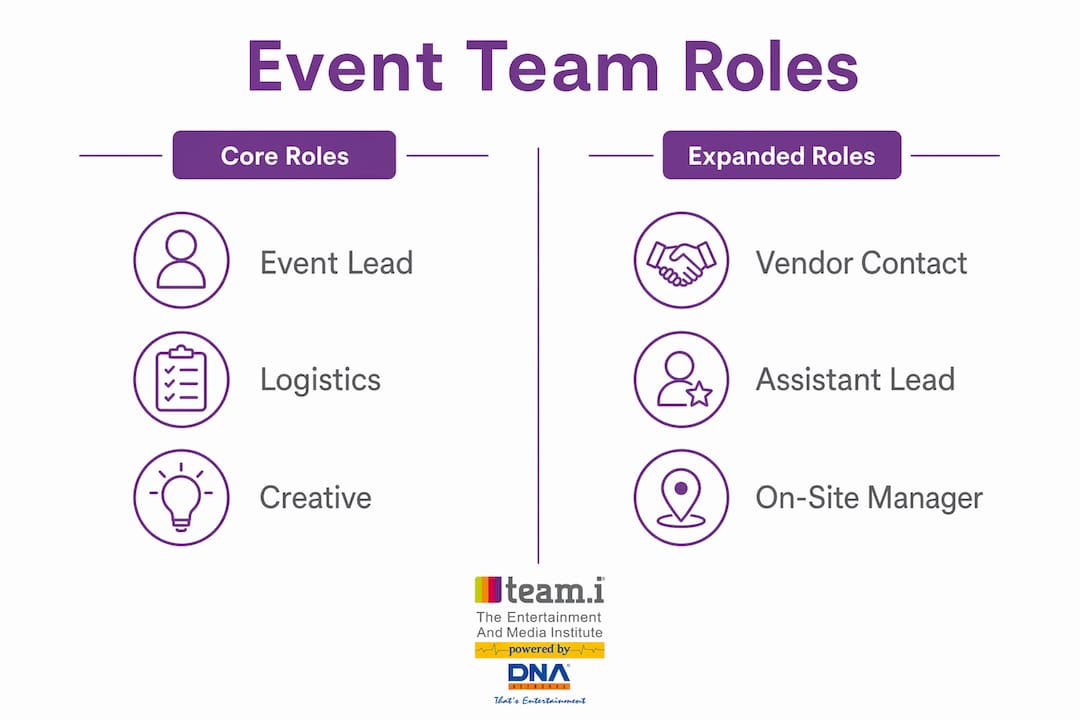
Here is how a typical team breaks down for a corporate event in Bangalore:
| Role | Primary responsibility | Answers to |
|---|---|---|
| Event Lead | Strategy, client relationship, final decisions | Client |
| Logistics Coordinator | Venue, transport, vendor scheduling | Event Lead |
| Marketing Lead | Invitations, social media, attendee comms | Event Lead |
| On-site Supervisor | Day-of execution, staff management | Event Lead |
For large Indian weddings, this structure expands. A wedding in Jaipur with 800 guests might have separate coordinators for each ceremony, a dedicated hospitality team for outstation guests, and a tech lead managing lighting and sound. The importance of collaboration in event management becomes obvious the moment one coordinator goes off-script and the whole timeline shifts.
Pro Tip: Assign one person as the sole point of contact for each vendor. Multiple contacts create confusion and give vendors room to dodge accountability.
What tools do professional event organizers rely on?
Event planning is 70–80% project management and logistics. That statistic reframes the job entirely. Creative ideas matter, but the tools that keep timelines, budgets, and communications organised are what separate professionals from amateurs.
Planners working on large-scale events in India use a layered toolkit:
- Project management platforms: Tools like Asana or Trello track task ownership and deadlines across large teams.
- Registration and ticketing systems: Essential for conferences and corporate events where attendee data must be captured accurately.
- Floor plan software: Used to map venue layouts for events at spaces like the Bombay Exhibition Centre or Bangalore International Exhibition Centre.
- Communication platforms: WhatsApp groups remain the dominant real-time coordination tool in India, supplemented by email for formal vendor correspondence.
- Contract management tools: Shared document platforms where vendor agreements, payment schedules, and contingency clauses are stored and accessible.
Hybrid events require separate registration, engagement tools, and dedicated staff to include virtual attendees effectively. A corporate conference in Delhi that streams to 300 remote participants needs a parallel digital production team, not just a camera pointed at the stage.
How do event organizers manage risk and on-site execution?
Pre-developed contingency plans are what distinguish professionals from novices. Every serious planner builds Plan B, Plan C, and sometimes Plan D before the event date arrives. For an outdoor concert in Mumbai during the monsoon season, that means a covered backup venue, a revised set schedule, and pre-briefed staff who know exactly what to do when the rain hits.
On-site execution follows a strict sequence:
- Distribute the run-of-show document to all vendors and team members at least 48 hours before the event.
- Conduct a full venue walkthrough on the morning of the event to confirm setup matches the floor plan.
- Hold a pre-event briefing with all on-site staff to align on cues, escalation paths, and emergency contacts.
- Assign a dedicated timeline keeper whose only job is to track the run-of-show minute by minute.
- Debrief immediately after the event to capture what worked, what failed, and what the contingency plan actually cost.
Backward-scheduled milestones and detailed run-of-show documents prevent cascade delays on event day. One late vendor can push every subsequent cue if the timeline has no buffer. Build 10-minute buffers between major segments as standard practice. The event logistics discipline required at this level is genuinely demanding, and it is exactly what separates a good event from a great one.
Pro Tip: Keep a physical emergency kit on-site: printed vendor contacts, spare cables, a basic first aid kit, and petty cash. Digital tools fail. Paper does not.
What makes attendees remember an event?
Strategic intentionality aligns every event decision to measurable outcomes, not just aesthetics. A corporate event organizer who designs a product launch around a clear business goal, say, generating 200 qualified leads, makes different choices than one who simply tries to make the room look impressive. Every element, from the seating layout to the speaker order, serves that goal.
Engagement strategies that work in the Indian market include:
- Personalised guest experiences: Name cards, curated welcome kits, and culturally relevant food choices signal that the organiser paid attention.
- Interactive programming: Panel discussions, live demos, and audience Q&A sessions keep energy high at conferences in cities like Hyderabad and Chennai.
- Sensory design: Lighting, fragrance, and music are not afterthoughts. At a high-end Delhi wedding, the transition from the mehendi to the reception is a full sensory shift, and the planner orchestrates every beat.
- Real-time feedback loops: Live polling and instant feedback tools help a conference event planner adjust on the fly and demonstrate value to the client post-event.
The best events feel effortless to guests precisely because the organiser worked hardest behind the scenes.
What I have learnt from 24 years inside India’s event industry
The biggest misconception I see in aspiring planners is that creativity is the job. It is not. Creativity is the entry ticket. The job is execution under pressure, and India’s event market tests that pressure like nowhere else. A 1,000-person wedding in Udaipur with 14 ceremonies, 40 vendors, and a client family with strong opinions is not a creative challenge. It is a logistics operation with a creative wrapper.
The planners who build lasting careers here are the ones who treat every vendor relationship as a long-term partnership, not a transaction. They are the ones who know that a well-negotiated contract protects everyone, not just the client. And they are the ones who, when the power goes out during a Bangalore corporate gala, already have the backup generator running before the audience notices. That level of readiness does not come from talent. It comes from training, repetition, and the right mentors.
— Teami
Build your event planning career with Teami
Teami has spent 24 years training event professionals who work on real productions, not simulations. The event management course covers everything from vendor negotiation and run-of-show scheduling to hybrid event production and corporate event strategy. You get hands-on exposure through live events, internships, and industry partnerships with DNA Entertainment Networks. If you are serious about becoming a professional event organizer in India, the online event management programme gives you the same rigour with flexible scheduling. Teami’s placement record speaks for itself. The industry does not wait for you to feel ready. You get ready first.
FAQ
What is the difference between an event planner and an event manager?
An event planner focuses on pre-event tasks like budgeting, vendor selection, and design. An event manager owns the full lifecycle, including on-site execution and post-event reporting.
What qualifications does an event planning organizer need?
Degrees in business, hospitality, or tourism are the standard entry point, though industry certifications and hands-on experience carry significant weight with Indian employers.
How do professional organizers handle unexpected problems on event day?
They rely on pre-built contingency plans, detailed run-of-show documents, and clear escalation paths so the team can pivot without waiting for instructions.
What tools do event organizers use to manage large events?
Project management platforms, registration systems, floor plan software, and contract management tools form the core toolkit, with WhatsApp widely used for real-time coordination in India.
Is event planning mostly creative work?
No. Event planning is 70–80% project management and logistics. Creative direction guides the vision, but operational discipline delivers the result.
Recommended
- Event planning business plan: your complete guide for India – team I
- Event planning skills for Indian students: 2026 guide – team I
- Master event management fundamentals: career guide India – team I
- Event coordinator intern: your complete career guide – team I
Thinking about a career in event management?
team I is Bangalore’s only EEMA-certified event management institute, running for 24 years, where students work on real live events with real budgets and real deadlines rather than classroom simulations. See the full range of event management courses in Bangalore, or go straight to the flagship Certificate Program in Event Management (CPEM).