

Managing high-pressure events is never just about schedules and logistics. For aspiring event managers and young professionals in India, technical skills alone do not guarantee success in the ever-evolving workplace. Modern employers increasingly value professionals who display strong emotional intelligence, as research confirms that emotional intelligence strongly correlates with job performance, leadership, and team resilience. Understanding how emotional intelligence shapes collaboration, communication, and decision-making can set you apart—and this guide shows you how to sharpen these vital skills for greater workplace impact.
Table of Contents
- Emotional Intelligence In Modern Workplaces
- Core Components And Common Misconceptions
- Key Skills For Event Management Success
- Benefits For Teamwork And Leadership
- Challenges, Pitfalls, And Ways To Improve
Key Takeaways
| Point | Details |
|---|---|
| Emotional Intelligence is Essential | Modern workplaces prioritise emotional intelligence over technical skills for effective collaboration and leadership. |
| Core Components Matter | Developing self-awareness, empathy, and conflict resolution skills enhances professional performance and team dynamics. |
| Continuous Improvement is Key | Emotional intelligence can be developed through practice, feedback, and reflective techniques. |
| Address Challenges Proactively | Overcoming barriers like emotional reactivity and empathy deficits is crucial for personal growth and workplace effectiveness. |
Emotional Intelligence in Modern Workplaces
Emotional intelligence (EQ) has transformed from a buzzword to a critical workplace skill, fundamentally reshaping how professionals interact and succeed in complex organisational environments. Modern workplaces demand more than technical expertise; they require nuanced interpersonal capabilities that enable effective collaboration, communication, and leadership.
Recent research demonstrates that emotional intelligence plays a pivotal role in professional performance. Emotionally intelligent leadership practices are essential for managing organisational dynamics, particularly during periods of significant change and complexity. These practices extend beyond traditional management techniques, focusing on building trust, psychological safety, and long-term team effectiveness.
Key components of emotional intelligence in modern workplaces include:
- Self-awareness: Understanding personal emotional triggers and responses
- Empathy: Recognising and responding to colleagues’ emotional states
- Relationship management: Navigating interpersonal dynamics constructively
- Adaptability: Responding flexibly to changing workplace environments
- Conflict resolution: Addressing disagreements with emotional maturity
The impact of emotional intelligence extends far beyond individual performance. Professional success correlates strongly with EQ skills, influencing decision-making processes, team dynamics, and organisational resilience. Professionals with high emotional intelligence can better manage workplace stress, build stronger networks, and create more supportive work environments.
Here is a summary of how different aspects of emotional intelligence impact workplace outcomes:
| Aspect of EQ | Typical Business Impact | Example Scenario |
|---|---|---|
| Self-awareness | Improved decision-making | Recognising stress triggers |
| Empathy | Stronger team relationships | Supporting a colleague in need |
| Relationship management | Higher team performance | Mediating workplace disputes |
| Adaptability | Better response to change | Adjusting to new leadership |
| Conflict resolution | Reduced workplace tensions | Resolving deadlines conflict |
Pro tip: Develop your emotional intelligence by practicing active listening, regularly reflecting on your emotional responses, and seeking constructive feedback from colleagues and mentors.
Core Components and Common Misconceptions
Emotional intelligence is a complex psychological construct that extends far beyond simple emotional recognition. Different models of emotional intelligence demonstrate the nuanced nature of this critical skill, challenging many widespread misconceptions about its origin and development.
The core components of emotional intelligence typically encompass four primary domains:
- Self-awareness: Understanding personal emotional patterns and triggers
- Self-regulation: Managing and controlling emotional responses
- Social awareness: Recognising and interpreting others’ emotional signals
- Relationship management: Effectively navigating interpersonal interactions
Psychological research reveals that emotional intelligence is not a fixed trait but a skill that can be systematically developed and refined. Many professionals mistakenly believe EQ is an innate characteristic, unchangeable from birth. This misconception prevents individuals from actively improving their emotional competencies.
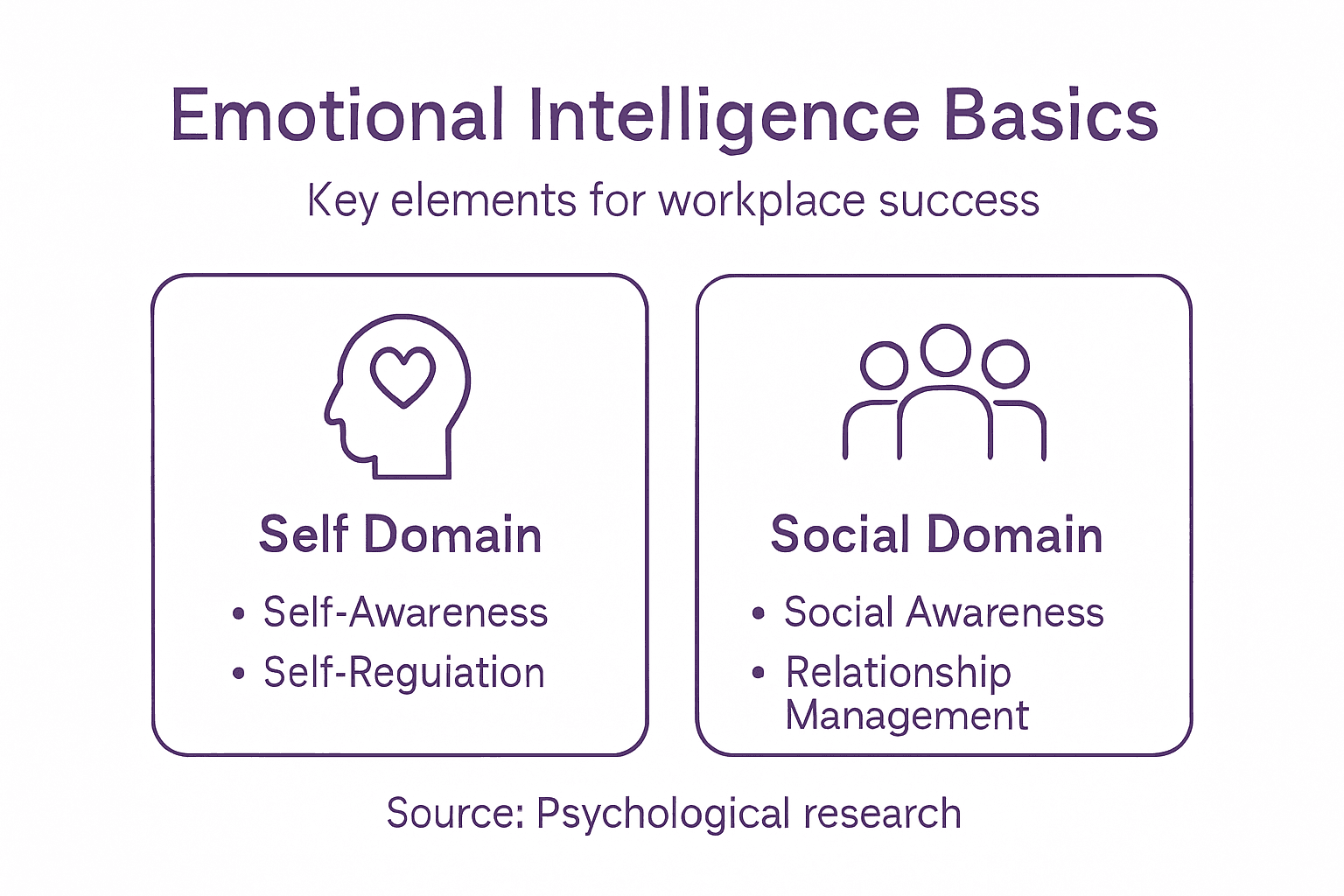
Common myths about emotional intelligence include the belief that it is identical to personality or intellectual intelligence. In reality, EQ represents a distinct set of skills focused on emotional perception, understanding, and management. Unlike traditional intelligence quotient (IQ), emotional intelligence can be deliberately enhanced through targeted practice, self-reflection, and structured learning experiences.
The following table contrasts emotional intelligence with traditional intelligence and personality:
| Attribute | Emotional Intelligence | Traditional Intelligence (IQ) | Personality Traits |
|---|---|---|---|
| Focus | Emotions and relationships | Cognitive skills and logic | Characteristic behaviours |
| Can be developed? | Through practice and feedback | Limited, mostly stable after youth | Partially, often inherent |
| Key workplace value | Collaboration and leadership | Analytical or technical tasks | Cultural fit and motivation |
Pro tip: Regularly journal your emotional responses and seek constructive feedback to gradually improve your emotional intelligence awareness and management skills.
Key Skills for Event Management Success
Successful event management requires a sophisticated blend of technical expertise and advanced emotional intelligence. Social emotional learning skills are crucial for navigating the complex and dynamic landscape of professional event planning, enabling practitioners to excel in high-pressure environments.
Key emotional intelligence skills for event management professionals include:
- Empathy: Understanding and responding to stakeholders’ emotional needs
- Self-regulation: Managing personal stress and maintaining composure
- Communication: Articulating complex ideas clearly and compassionately
- Adaptability: Quickly adjusting to unexpected challenges
- Conflict resolution: Mediating disagreements constructively
Event management demands exceptional emotional competencies that go beyond traditional technical skills. Professionals must simultaneously manage their own emotions while navigating diverse interpersonal dynamics, coordinating multiple stakeholders, and maintaining a strategic focus on event objectives.

The most successful event managers develop a holistic skill set that combines technical knowledge with profound emotional intelligence. This approach allows them to create memorable experiences, build strong professional relationships, and consistently deliver outstanding results across various event contexts.
Pro tip: Invest in continuous self-reflection and seek feedback from colleagues to systematically enhance your emotional intelligence capabilities.
Benefits for Teamwork and Leadership
Emotional intelligence transforms workplace dynamics by creating more cohesive, resilient, and high-performing teams. Emotional wellness supports effective leadership by enabling professionals to navigate complex interpersonal relationships with greater empathy and strategic understanding.
The key benefits of emotional intelligence for teamwork and leadership include:
- Enhanced Communication: Breaking down barriers and promoting transparent dialogue
- Trust Building: Creating psychological safety within team environments
- Conflict Resolution: Addressing disagreements constructively and professionally
- Stress Management: Maintaining team momentum during challenging periods
- Collaborative Problem-solving: Leveraging diverse perspectives effectively
Leaders with high emotional intelligence demonstrate a remarkable ability to read team dynamics, anticipate potential challenges, and create supportive work environments. They can effectively modulate their emotional responses, ensuring that team interactions remain productive and respectful, even during high-pressure situations.
Successful leadership is no longer about technical expertise alone, but about understanding and managing human dynamics. Emotionally intelligent leaders inspire trust, foster innovation, and create workplace cultures that encourage individual growth and collective achievement.
Pro tip: Practice active listening and regularly seek feedback from your team to continuously enhance your emotional intelligence capabilities.
Challenges, Pitfalls, and Ways to Improve
Developing emotional intelligence is not a straightforward journey. Professionals often encounter significant obstacles that can impede their progress and undermine their efforts to enhance their emotional skills. Building emotional intelligence requires strategic approaches that address fundamental psychological barriers.
Common challenges in developing emotional intelligence include:
- Emotional Reactivity: Responding impulsively without thoughtful consideration
- Limited Self-Awareness: Struggling to recognise personal emotional patterns
- Defensive Mechanisms: Protecting oneself instead of being open to feedback
- Empathy Deficits: Difficulty understanding others’ perspectives
- Stress Management: Becoming overwhelmed by complex emotional situations
Overcoming these challenges requires deliberate and consistent practice. Professionals must cultivate mindfulness, develop robust self-reflection techniques, and commit to continuous personal growth. This involves creating structured opportunities for emotional learning, seeking constructive feedback, and developing strategies for emotional regulation.
Successful emotional intelligence development is not about eliminating emotions, but about understanding and managing them effectively. By embracing vulnerability, practicing active listening, and maintaining a growth mindset, individuals can transform potential limitations into opportunities for personal and professional development.
Pro tip: Keep a daily emotional journal to track your reactions, identify patterns, and systematically improve your emotional intelligence.
Elevate Your Career with Emotional Intelligence in Event Management
Understanding and mastering emotional intelligence is vital for thriving in today’s demanding event management landscape. The article highlights challenges such as managing stress, navigating interpersonal dynamics, and adapting effectively—all essential skills for successful leadership and teamwork. At teami.org, you gain more than just theoretical knowledge. With over 24 years of industry experience and collaboration with DNA Entertainment Networks, our specialised training equips you to harness emotional awareness, empathy, and conflict resolution in real event settings.
Unlock your potential through our comprehensive certification programmes including online and hybrid courses that offer hands-on projects and internships. Whether you aim to excel in corporate, wedding or sports event management, developing emotional intelligence will set you apart in the competitive market. Don’t let emotional challenges hold you back. Visit teami.org today to explore how you can start transforming your professional skillset and join a community of leaders who understand why emotional intelligence matters most at work.
Frequently Asked Questions
What is emotional intelligence and why is it important at work?
Emotional intelligence (EQ) is the ability to understand and manage your own emotions, as well as recognise and influence the emotions of others. It is important at work because high EQ contributes to better teamwork, effective communication, and strong leadership, ultimately leading to greater organisational success.
How can I improve my emotional intelligence in the workplace?
You can improve your emotional intelligence by practicing active listening, reflecting on your emotional responses, seeking feedback from colleagues, and engaging in regular self-reflection. These methods can help develop key skills such as self-awareness, empathy, and adaptability.
What are the key components of emotional intelligence?
The key components of emotional intelligence include self-awareness, self-regulation, social awareness, and relationship management. These elements collectively help individuals navigate their emotional landscape and enhance interpersonal dynamics in the workplace.
How does emotional intelligence affect teamwork and leadership?
Emotional intelligence positively impacts teamwork and leadership by fostering better communication, trust-building, conflict resolution, and collaborative problem-solving. Leaders with high EQ are more adept at managing team dynamics and creating supportive environments, which can enhance overall team performance.
Recommended
- Developing Emotional Intelligence for Event Leaders – team I
- Importance of Soft Skills in Workplace Success – team I
- Effective Communication at Work – Elevating Team Performance – team I
- Future Workplace Skills: What Event Managers Need Now – team I
Thinking about a career in event management?
team I is Bangalore’s only EEMA-certified event management institute, running for 24 years, where students work on real live events with real budgets and real deadlines rather than classroom simulations. See the full range of event management courses in Bangalore, or go straight to the flagship Certificate Program in Event Management (CPEM).