
A time management workshop for students is a structured training session that equips learners with proven strategies to organise their study time, prioritise tasks, and maintain focus under pressure. Research confirms a moderate positive correlation between time management strategies and student learning outcomes, with a correlation coefficient of r = 0.250 across undergraduate populations. That number is not abstract. It means the students who plan deliberately outperform those who rely on instinct, every semester. Workshops typically run between 45 and 120 minutes and are offered free through university support centres, making them one of the most accessible academic tools available. The importance of time management cannot be overstated for students juggling assignments, internships, and real-world commitments.
Why does time management matter so much for students?
Time management behaviours explain 26.2% of variance in student academic performance. That makes it a stronger predictor of results than most standardised tests. You can be talented and still fall behind if your schedule is chaos.

The challenges are real and specific. Indian college students face semester-end exam clusters, back-to-back submission deadlines, and the added pressure of internships or part-time event work in cities like Bangalore, Mumbai, and Hyderabad. A student coordinating a college fest in Delhi while preparing for mid-terms is not managing time. They are surviving it.
A workshop on productivity addresses this directly. It does not lecture you on motivation. It gives you a system. You learn to map your semester, protect your peak focus hours, and stop treating “I’ll study later” as a plan.
The parallel with the event industry is exact. At Teami, students working on live productions quickly learn that a show with no run sheet falls apart by 6 PM. Academic life without a weekly plan falls apart by week four of the semester.
- Assignments pile up when there is no semester-level view
- Willpower runs out by Wednesday if it is your only tool
- Procrastination is not a personality trait. It is a planning gap
- Energy crashes mid-semester when rest is not scheduled
- Internship hours eat into study time without a buffer plan
What are the core techniques taught in student productivity workshops?
The best workshops do not teach you to work harder. They teach you to work in a way your brain can actually sustain. Here are the core components, ranked by the order you should build them.
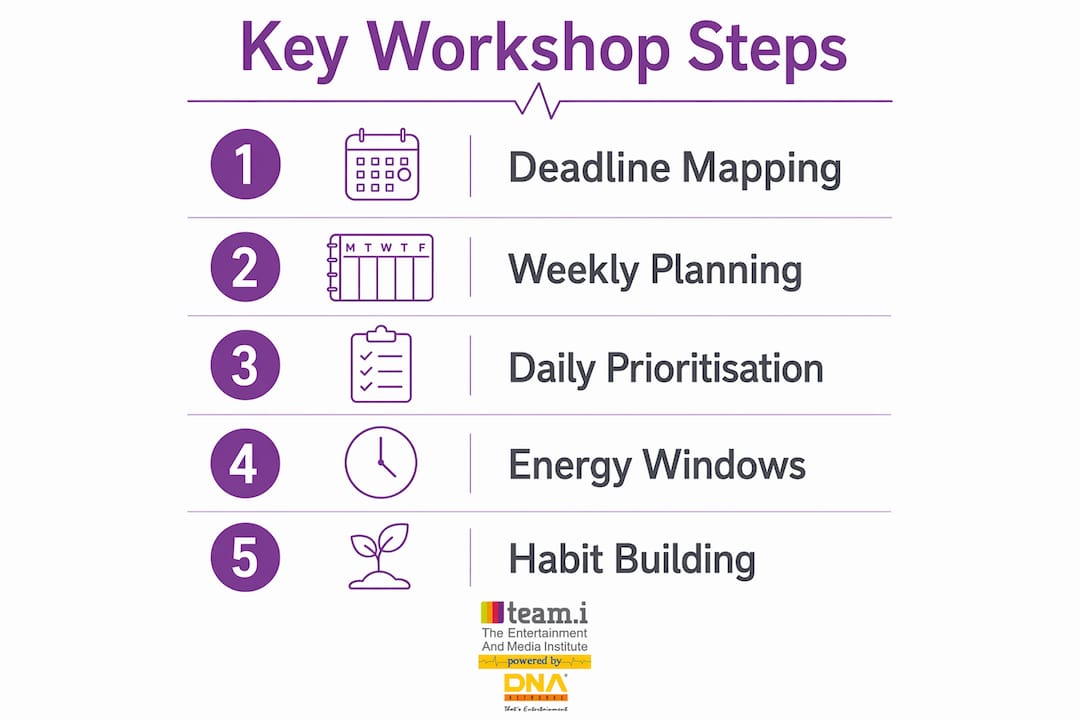
- Semester-level deadline mapping. Start with the full picture. Plot every exam, submission, and internship date on a single calendar. Students who see the whole semester at once make smarter weekly choices.
- Weekly time allocation. Divide available hours across subjects before the week begins. Weekly planning in advance consistently produces better academic outcomes than deciding day to day.
- Outcome-driven daily task lists. Write “active recall on chapters 4 and 5 of marketing theory” instead of “study marketing.” Measurable study sessions improve cognitive engagement because your brain knows exactly what done looks like.
- The Pomodoro technique. Work in 25-minute focused intervals, then take a 5-minute break. The Pomodoro technique aligns with the brain’s natural attention restoration cycle, preventing the cognitive fatigue that kills a three-hour study block.
- Energy and attention management. Time management is not just about the clock. Managing attention and energy, not just hours, is what separates students who finish strong from those who burn out in week ten.
Pro Tip: Schedule your hardest subject during your peak energy window, not your most convenient one. If you are sharpest at 8 AM, that slot belongs to the subject you fear most, not to scrolling.
Workshop formats at a glance
| Format | Duration | Typical provider | Best suited for |
|---|---|---|---|
| Drop-in session | 45 minutes | University support centres | Quick skill introduction |
| Structured workshop | 60–90 minutes | Academic skills units | Practical planning exercises |
| Full programme | 90–120 minutes | Specialist institutes | Deep habit building |
| Integrated course module | Ongoing | Institutes like Teami | Real-world application |
The integrated course model, as practised at Teami, embeds time management in event planning directly into live project work. You do not just learn the theory. You apply it under the same pressure conditions you will face in your career.
How do you build lasting habits after a workshop?
Attending a workshop is the start, not the finish. The students who see real change are the ones who install the habits into their weekly routine before the motivation fades.
Pro Tip: Do your weekly review every Sunday evening. Compare what you planned against what you actually completed. This single habit prevents the academic drift that derails most students by week six.
Reviewing output weekly against your original plan is the most reliable way to catch problems early. If you planned four study blocks and completed two, the question is not “why am I lazy?” The question is “what got in the way, and how do I protect those blocks next week?”
Here is what consistent implementation looks like in practice:
- Protect peak hours. Block your two best focus hours before anything else fills the calendar. A student at a Teami internship in Bangalore once described this as “treating my brain like a venue. You book the best slot first.”
- Track output, not input. Hours spent studying is a vanity metric. Pages actively recalled, problems solved, and concepts explained back to yourself are real outputs.
- Adjust dynamically. A rigid schedule breaks. A flexible one bends. When a corporate event rehearsal runs long, you reschedule the study block, you do not cancel it.
- Use a weekly schedule system to visualise your commitments. Seeing your week as a visual grid makes conflicts obvious before they become crises.
Common mistakes that kill workshop results
Most students leave a workshop energised and then revert to old habits within two weeks. The mistakes are predictable, which means they are preventable.
“The biggest enemy of student productivity is not distraction. It is the belief that you will feel motivated enough tomorrow to do what you are avoiding today. Planning removes the need to feel ready.”
- Relying on willpower alone. Students who plan weekly outperform those who depend on daily motivation. Willpower is a resource that depletes. A written plan does not.
- Ignoring sleep. Sleep deprivation reduces memory consolidation by 20.39% and concentration by 22.72%. Cutting sleep to study more is a net loss. You retain less of what you read.
- Vague study sessions. “Study for exams” is not a task. It is a wish. Specific outcomes drive specific progress.
- Skipping the weekly review. Without a review, small slippages compound into a missed semester. The review is not optional. It is the system’s engine.
- Treating the workshop as a one-time fix. Academic time management is a practice, not a certificate. The students who improve most are those who revisit their system every month and adjust it.
What I have seen time management workshops actually change
After 24 years of watching students come through Teami, I can tell you the transformation is not subtle. The students who take academic time management seriously are the same ones who handle a 500-person corporate event in Hyderabad without losing their nerve.
The connection is direct. When you learn to map a semester, you are learning the same skill as mapping a production timeline. When you protect your peak focus hours, you are practising the same discipline as protecting the critical path on a show day. The event industry does not forgive poor planning. Neither does an exam board.
What surprises most students is how quickly the habits compound. Two weeks of consistent weekly planning and the anxiety around deadlines drops noticeably. Four weeks in, and you are not just managing time. You are making decisions about what deserves your best hours. That is a professional skill, not just an academic one. The practical guide to time management skills at Teami was built on exactly this insight.
— Teami
Teami’s approach to student time management and productivity
Teami’s event management courses integrate time management and productivity training directly into live project work, not as a separate module but as a daily practice. Students work on real events alongside DNA Entertainment Networks, which means every deadline is real, every schedule matters, and every planning failure has visible consequences. That context makes the learning stick in a way that a standalone workshop cannot replicate. If you want to build student time management skills that hold up under genuine pressure, Teami’s programmes offer the environment where those skills are tested and refined from day one.
FAQ
What is a time management workshop for students?
A time management workshop for students is a structured session teaching planning, prioritisation, and focus techniques. Workshops typically run 45–120 minutes and are often available free through university support centres.
How much does time management affect academic results?
Time management behaviours explain 26.2% of variance in student academic performance, making it a stronger predictor than most standardised tests.
What techniques are taught in these workshops?
Core techniques include semester-level deadline mapping, weekly time allocation, outcome-driven daily task lists, and the Pomodoro technique, which uses 25-minute focused intervals followed by 5-minute breaks.
How often should students review their time management plan?
Students should review their plan every week, ideally on Sunday, comparing planned tasks against completed work to catch drift before it compounds across the semester.
Does sleep really affect time management?
Sleep deprivation reduces memory consolidation by 20.39% and concentration by 22.72%, meaning poor sleep directly undermines any time management system regardless of how well it is planned.
Recommended
- Event planning skills for Indian students: 2026 guide – team I
- Productivity Tips for Students: Succeed in Event Management – team I
- The Essential Guide to Importance of Time Management – team I
- Master time management in event planning career growth – team I
Thinking about a career in event management?
team I is Bangalore’s only EEMA-certified event management institute, running for 24 years, where students work on real live events with real budgets and real deadlines rather than classroom simulations. See the full range of event management courses in Bangalore, or go straight to the flagship Certificate Program in Event Management (CPEM).