
Event management colleges in India are defined as specialised institutions that train students in the planning, production, and execution of professional events, from corporate summits and music festivals to large-scale Indian weddings. The field is formally known as event and experiential management, and the best programmes blend classroom learning with real backstage access. Over 240 colleges now offer these courses across the country, spanning government and private institutions. Names like NIEM, NAEMD, and MIT-WPU have shaped thousands of careers. If you are serious about this industry, choosing the right college is the single most important decision you will make before your first showflow.
What types of event management colleges exist in India?
Over 240 event management colleges operate across India, with roughly 145 private and 24 government-owned institutions. That spread gives you real choice, but it also means the quality gap between the best and the rest is wide.
Courses are available at three levels:
- Certificate programmes: 6–12 months, ideal for school leavers or career changers wanting fast entry
- Undergraduate degrees (BBA/BA in Event Management): 3-year full-time programmes, the most common route
- Postgraduate programmes (MBA/PG Diploma): 1–2 years, suited to graduates wanting to specialise in corporate, entertainment, or wedding events
- Online and hybrid courses: Flexible formats offered by institutes like Teami, designed for students who cannot relocate
Admission to most colleges requires passing Class 12 examinations, with some institutions adding interviews or aptitude assessments. That is a low barrier. The real filter is what the college does with you once you are in.
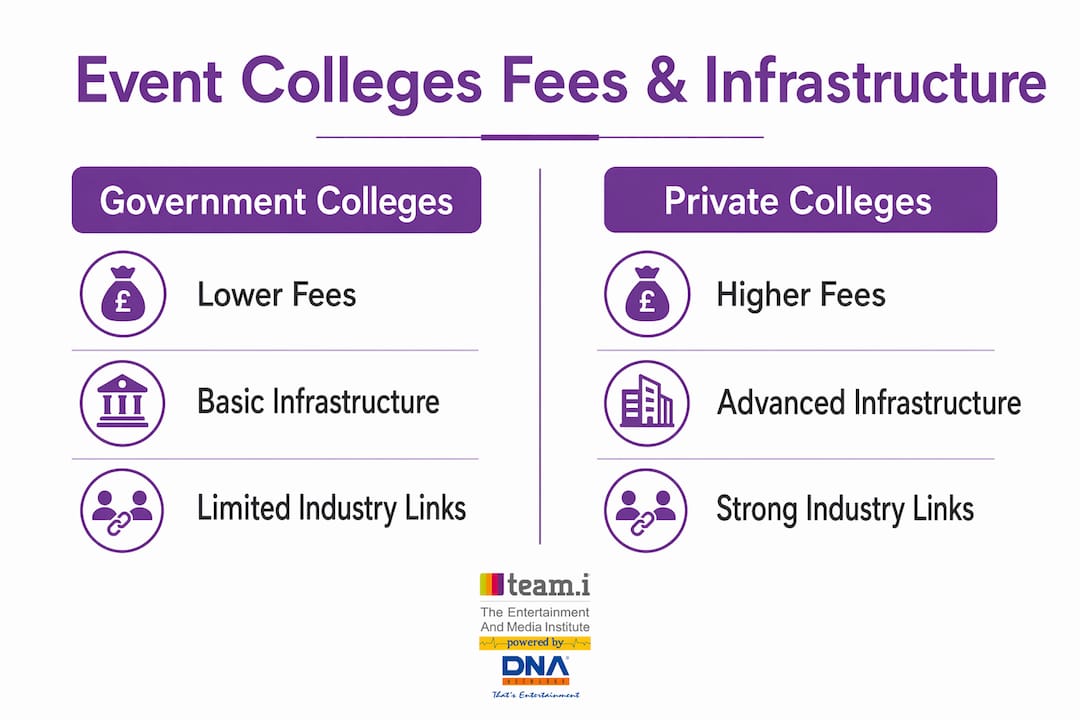
Private colleges like NAEMD, Amity University, and MIT-WPU typically offer broader industry-linked opportunities than government counterparts, including live event projects, vendor negotiations, and internships with production houses. Government colleges trade infrastructure for affordability. Neither is automatically better. The right choice depends on your budget and how much hands-on exposure the curriculum actually delivers.
Pro Tip: Ask any college you are considering: “How many live events will I work on before I graduate?” If they cannot give you a specific number, keep looking.
How do fees and infrastructure compare across top colleges?
Fees across the best event management institutes in India vary dramatically. Government colleges like Yashwantrao Chavan Maharashtra Open University charge between INR 15,000 and INR 85,000 for undergraduate courses. Private colleges like Chandigarh University and MIT-WPU can reach up to INR 8.97 Lakh. That is a tenfold difference, and it reflects a real gap in what you receive.

| College | Course type | Approx. fees (INR) |
|---|---|---|
| Yashwantrao Chavan Maharashtra Open University | UG / Distance | 15,000–85,000 |
| NAEMD Mumbai | UG / PG Diploma | 1,50,000–3,50,000 |
| Chandigarh University | BBA Event Management | Up to 8,97,000 |
| MIT-WPU Pune | BBA / MBA | Up to 8,97,000 |
| Amity University | BBA / MBA | 2,00,000–5,00,000 |
Private colleges generally offer better infrastructure and broader industry connections than government institutions. That advantage shows up in placement rates, internship quality, and the calibre of guest faculty. You are not just paying for a degree. You are paying for the network and the stage time.
Pro Tip: Compare a college’s fee against its placement record, not just its ranking. A college charging INR 3 Lakh with strong DNA Entertainment Networks-style industry tie-ups will outperform a INR 8 Lakh programme with no live event access.
What career opportunities and salaries can event management graduates expect?
Entry-level event managers in India earn between INR 4 Lakh and INR 8 Lakh annually, depending on city and sector. That range is wider than most people expect. A wedding planner in Mumbai and a logistics manager for a Hyderabad tech conference can both sit within that bracket, but their day-to-day realities are completely different.
The most in-demand job roles for fresh graduates include:
- Event planner: End-to-end coordination of corporate and social events
- Wedding planner: India’s fastest-growing event sub-sector, with demand surging in cities like Jaipur, Udaipur, and Delhi
- Logistics manager: Vendor coordination, venue setup, crowd flow management
- Hospitality manager: Guest experience, F&B coordination, VIP handling at concerts and conferences
- Production assistant: Stage management, AV coordination, showflow execution
Leading colleges in Mumbai, Delhi, Bangalore, and Hyderabad provide networked exposure to both corporate and entertainment event sectors. That exposure accelerates career growth in ways that no classroom module can replicate. You learn crowd control at a 10,000-person concert differently than you learn it from a textbook.
The entertainment and corporate event sectors are growing fastest right now. Large-scale IP events, brand activations, and destination weddings are generating consistent demand for trained professionals. Graduates who combine a recognised qualification with real internship hours are the ones getting hired first.
How to choose the best event management college for your career goals
Choosing the right college is not about rankings. It is about fit. Here is a practical framework:
- Define your specialisation first. Wedding management, corporate events, sports events, and entertainment production each require different skills. Pick a college that offers depth in your chosen area, not just a generic events module.
- Check the internship structure. Hands-on learning through internships and live projects is the single biggest differentiator between good and great programmes. Ask for specifics: which companies, how many hours, and whether placements are guaranteed.
- Consider location seriously. Colleges in Bangalore, Mumbai, Delhi, and Hyderabad sit inside active event markets. You can attend industry events, network with professionals, and pick up freelance work while still studying. A college in a smaller city may be cheaper but will cost you in opportunity.
- Evaluate industry connections. Institutes with formal partnerships with production companies or entertainment networks give you access to real productions during your course. Teami’s collaboration with DNA Entertainment Networks is one example of what genuine industry integration looks like.
- Compare the best event management courses side by side. Look at curriculum depth, faculty backgrounds, and alumni outcomes before committing.
The best event management institute in India for you is the one that puts you on a real stage before you graduate. Everything else is secondary.
What I have learnt after 24 years of watching students choose the wrong college
Most students pick a college based on its name or its brochure. That is the wrong filter entirely. After 24 years in this industry, the pattern is clear: the graduates who build strong careers fast are the ones who got their hands dirty early. Not the ones with the most impressive-sounding degree.
India’s event industry is controlled chaos. A Diwali corporate gala in Bangalore, a 500-person destination wedding in Udaipur, a college fest in Delhi with three stages running simultaneously. None of that is theoretical. You cannot prepare for it by sitting in a lecture hall. You prepare for it by doing it, making mistakes, and doing it again under pressure.
The uncomfortable truth about event management career growth in India is that your first two years out of college matter more than your degree itself. Who you interned with, which events you worked, and what problems you solved under pressure. Those are the credentials that get you hired and promoted.
Choose a college that treats practice as the theory. Everything else is just a certificate on a wall.
— Teami
Teami’s event management courses: built for the real industry
Teami has spent 24 years training event professionals who work on real productions, not simulations. The event management course options at Teami span certification, diploma, and online programmes, all built around live event exposure and industry-connected faculty. Specialisations cover social events, corporate productions, sports, and weddings. The curriculum is shaped by Teami’s partnership with DNA Entertainment Networks, which means students work alongside active industry professionals from day one. If you are ready to stop studying events and start working them, the online event management programme offers a flexible entry point without compromising on real-world depth.
FAQ
How many event management colleges are there in India?
Over 240 event management colleges operate across India, including approximately 145 private and 24 government-owned institutions.
What is the eligibility for event management courses in India?
Most colleges require a Class 12 pass certificate as the minimum qualification, with some institutions conducting additional interviews or aptitude tests.
What salary can I expect after an event management degree in India?
Entry-level salaries range from INR 4 Lakh to INR 8 Lakh per annum, varying by city, employer, and specialisation within the events sector.
Are online event management courses worth it in India?
Online programmes from industry-connected institutes deliver genuine value when they include live project work and internships. A purely theoretical online course without practical exposure will not prepare you for the realities of the Indian event industry.
Which cities have the best event management colleges in India?
Mumbai, Delhi, Bangalore, and Hyderabad host the strongest programmes because they sit inside active event markets, giving students direct access to corporate, entertainment, and wedding event networks.
Recommended
- Blog – team I
- Event planning skills for Indian students: 2026 guide – team I
- What is an event management course: your 2026 guide – team I
Thinking about a career in event management?
team I is Bangalore’s only EEMA-certified event management institute, running for 24 years, where students work on real live events with real budgets and real deadlines rather than classroom simulations. See the full range of event management courses in Bangalore, or go straight to the flagship Certificate Program in Event Management (CPEM).