Corporate event services are defined as the end-to-end professional management of business occasions, covering strategy, planning, production, and post-event analysis under a single coordinated framework. Whether you are organising a leadership summit in Bangalore, a product launch in Mumbai, or a pan-India sales conference in Delhi, the difference between a forgettable afternoon and a genuinely impactful event comes down to how well these services are structured. Providers like Centric Events and Global Event Services demonstrate that full lifecycle management integrates AV, staging, creative design, and logistics to eliminate the coordination gaps that derail most corporate events. This guide breaks down every component you need to execute with confidence.
What do corporate event services actually include?
Corporate event management covers venue selection, contract negotiation, housing, vendor coordination, catering, transportation, registration, and on-site management. That is not a checklist. That is a full operational system, and every element depends on the others.
Here is what a genuinely comprehensive service package looks like in practice:
- Venue selection and negotiation: Shortlisting venues in metro cities like Hyderabad or Chennai, reviewing capacity, AV infrastructure, and catering exclusivity clauses before signing anything.
- Vendor coordination: Managing caterers, decorators, AV technicians, security, and transport providers as a unified team rather than separate contractors.
- Registration and guest management: Building branded registration pages, managing RSVPs, and coordinating delegate kits and name badges on-site.
- Budget tracking and financial reconciliation: Monitoring spend against approved budgets in real time, not after the event when it is too late to course-correct.
- On-site execution: Deploying a dedicated event manager who is first on-site and last to leave, managing the full lifecycle including show calling, crew briefings, and guest flow.
- Post-event reporting: Delivering a structured debrief covering performance against objectives, vendor assessment, and financial reconciliation.
The critical insight here is that centralised contract management reduces operational risk significantly. When one team owns all vendor relationships, nothing falls through the gaps between suppliers.
Pro Tip: Build a single master contact sheet for every vendor, including their on-site mobile number, their supervisor’s number, and their delivery or arrival window. Share it with your entire operations team before the event day.

How do corporate event branding solutions enhance company events?
Event branding is not decoration. It is an operational discipline that shapes how attendees perceive your company from the moment they register online to the moment they walk out of the venue.
Consistent visual systems span physical and digital touchpoints: stage backdrops, LED graphics, directional signage, registration page design, social media assets, and branded merchandise. Each element must be designed with production constraints in mind. A backdrop that looks stunning in a design file can fail completely if the venue ceiling height is lower than expected, or if installation time is cut short by a previous event running over.
| Branding element | Physical touchpoint | Digital touchpoint |
|---|---|---|
| Stage design | Backdrop, podium wrap, LED panels | Live stream frame, virtual background |
| Signage | Directional boards, standees, banners | Event app navigation, email headers |
| Registration | Welcome desk branding, badge design | Registration page, confirmation email |
| Social media | Photo walls, branded props | Event hashtag graphics, story templates |
For Indian corporate events, branding must also account for regional language considerations. A conference in Hyderabad serving a mixed Telugu and English-speaking audience needs signage that works in both. Event branding essentials go well beyond aesthetics when you factor in venue sightlines, installation timing, and sponsor visibility requirements. Sponsors in India increasingly evaluate events on the quality and placement of their branding, making this a commercial priority, not just a creative one.
What are the essential planning timelines for corporate events?
Planning timelines are the most underestimated variable in business event planning. Most corporate teams start too late, then spend the final weeks firefighting avoidable problems.
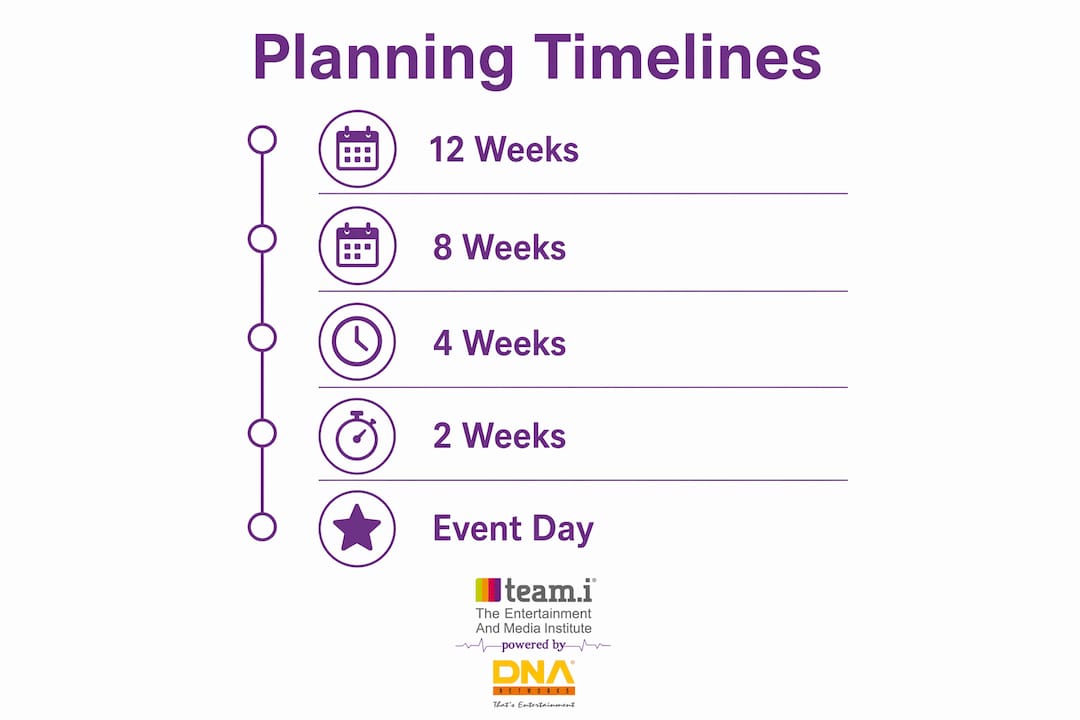
Event timelines vary significantly by event scale: small leadership retreats need 8–12 weeks; mid-sized events need 4–6 months; large conferences require 9–12 months of lead time. That is not a suggestion. It is the minimum runway for doing the job properly.
Here is a practical sequencing framework for a mid-sized corporate event in India:
- Months 4–6 before the event: Define objectives, set the budget, shortlist venues, and confirm the event management partner. Begin facilitator or speaker outreach immediately, as top speakers in India book out months in advance.
- Months 2–4 before the event: Confirm venue, sign vendor contracts, launch registration, and brief the creative team on branding requirements.
- Weeks 4–8 before the event: Finalise the run-of-show, conduct site visits, brief all vendors on logistics, and share the master schedule.
- Week 1 before the event: Conduct a full technical rehearsal, confirm all deliveries, and brief the on-site team with a printed show flow.
- Event day: Deploy the event manager as the single point of authority. All vendor queries route through one person, not ten.
A single source of truth for vendor communications is non-negotiable in complex corporate events. One shared document, one communication channel, and one decision-maker on the day prevents the confusion that turns manageable problems into visible failures.
Pro Tip: Schedule a 30-minute “war room” call with all vendors 48 hours before the event. Walk through the timeline together, confirm arrival slots, and surface any last-minute issues before they become day-of crises.
How is hybrid event technology integrated into corporate events?
Hybrid events are now standard in Indian corporate settings, particularly for organisations with teams spread across Bangalore, Mumbai, Delhi, and Hyderabad. The technology requirements are more demanding than most planners expect.
Hybrid events require strong bandwidth and coordinated rehearsals to prevent technical failure for remote participants. Bandwidth is the foundation. Without dedicated, tested connectivity at the venue, even the best AV setup will fail when 300 people connect to the Wi-Fi simultaneously.
Key technical requirements for a successful hybrid corporate event:
- Dedicated bandwidth: Separate internet lines for streaming and for general delegate use. Never share a single connection.
- AV integration: Cameras, microphones, and switching systems must be synced precisely so remote viewers experience the same quality as in-room attendees.
- Encoding and streaming redundancy: Technical failure in hybrid events most often occurs at the encoding and streaming interface, not the platform itself. Build in a backup encoder.
- Remote engagement tools: Polling platforms, Q&A modules, and virtual networking rooms keep online attendees active rather than passive viewers.
- Full rehearsal: Simulate the complete event, including transitions between physical and virtual presenters, before the actual day. For hybrid event best practices, a rehearsal is not optional. It is the event’s dress rehearsal and your last chance to catch failures before they are live.
What post-event services ensure measurable success?
Post-event analysis is where most Indian corporate event teams go quiet. The event ends, the team disperses, and the debrief never happens. That is a serious missed opportunity.
Comprehensive post-event reporting covers attendee feedback, performance against goals, sponsor engagement, and ROI. It is the structured project closure that turns a one-off event into institutional knowledge.
Here is a practical post-event process:
- Collect attendee feedback within 24 hours. Response rates drop sharply after the first day. Use a short, mobile-friendly survey with no more than eight questions.
- Reconcile the budget. Compare actual spend against approved budgets line by line. Identify where overruns occurred and why.
- Assess vendor performance. Rate each supplier against agreed deliverables. This informs your vendor shortlist for the next event.
- Measure ROI. For guidance on measuring event ROI effectively, track metrics like lead generation, media coverage, delegate satisfaction scores, and sponsor feedback.
- Deliver a debrief report to leadership. A one-page executive summary with three to five key findings is more useful than a 40-slide deck nobody reads.
What I have learnt from running corporate events across India
After working across large-scale corporate events in Mumbai and Bangalore, one truth stands out: the events that fail are almost never underfunded. They are under-coordinated. A generous budget spread across eight separate vendors with no single point of authority is a recipe for visible chaos on the day.
The second lesson is about branding. Indian corporate clients often treat branding as the last item on the production list. It should be the first. When a sponsor’s logo is printed incorrectly on 500 standees the night before the event, there is no good solution. Branding decisions made late create production problems that cannot be fixed under pressure.
On hybrid events: test your technology in the actual venue, not in a studio. Venue walls, ceiling height, and ambient noise all affect audio quality in ways that a pre-production test in a controlled room will not reveal. The teams that run flawless hybrid events in India are the ones who treat the rehearsal as seriously as the event itself.
The best corporate event professionals are not the ones who never face problems. They are the ones who have already solved those problems before the audience arrives.
— Teami
Build the skills to lead corporate event services professionally
Corporate event management is a craft that rewards formal training as much as on-ground experience. If you are serious about building a career in this field, or sharpening your existing skills, Teami’s event management course covers the full spectrum: from vendor negotiation and budget management to hybrid event production and post-event analysis. With 24 years of industry experience and a direct partnership with DNA Entertainment Networks, Teami trains professionals who are ready to execute from day one, not just plan on paper. The curriculum is built around real events, real vendors, and real pressure. That is the only way to learn this industry properly.
FAQ
What do corporate event services typically include?
Corporate event services cover the full lifecycle of an event: venue selection, vendor coordination, contract negotiation, on-site management, and post-event reporting. Providers like Global Event Services and Centric Events integrate logistics, AV, and creative production under one coordinated team.
How far in advance should you plan a corporate event in India?
Small leadership retreats need 8–12 weeks of lead time, mid-sized events need 4–6 months, and large conferences require 9–12 months. Starting late is the single most common cause of avoidable problems in Indian corporate event planning.
Why does event branding matter beyond aesthetics?
Event branding shapes attendee perception across every physical and digital touchpoint, from registration pages to stage backdrops. For Indian corporate events, branding also affects sponsor satisfaction and commercial outcomes, making it a strategic priority from the start of planning.
What is the biggest technical risk in hybrid corporate events?
Technical failure in hybrid events most commonly occurs at the encoding and streaming interface, not the platform itself. Dedicated bandwidth, backup encoders, and full rehearsals that simulate physical-to-virtual presenter transitions are the most effective safeguards.
How should post-event analysis be structured?
Post-event analysis should follow a structured closure process: collect attendee feedback within 24 hours, reconcile the budget, assess vendor performance, measure ROI, and deliver a concise debrief report to leadership. This turns each event into a learning asset for the next one.