
An event proposal is a strategic document that communicates your event concept, scope, budget, and execution plan to a client, sponsor, or stakeholder in order to secure their approval or funding. In the Indian event industry, where a single corporate launch in Hyderabad or a destination wedding in Udaipur can involve dozens of vendors and lakhs of rupees, a poorly written proposal loses the deal before the conversation even begins. Research on over 180,000 proposals confirms the ideal length is six pages, and proposals with cover pages convert 45% better than those without. That single insight should change how you approach every document you send.
What are the essential components of a winning event proposal?

A strong event planning proposal is built on six non-negotiable sections. Miss one, and you leave the client with unanswered questions. Unanswered questions become reasons to say no.
Here is what every proposal must include:
- Client Summary. Open by reflecting the client’s own vision back to them. Name their goals, their audience, and their expectations. This proves you listened. Strong proposals reflect the client’s vision rather than defaulting to generic service lists.
- Scope of Services. List exactly what is included and, critically, what is not. Separating your planning fee from the event budget prevents scope creep and disputes later. Clarifying exclusions upfront protects both parties.
- Budget Breakdown. Present an itemised budget with transparent pricing. 78% of clients prioritise clear pricing in proposals, making this the single most scrutinised section.
- Visual Concept. For weddings, concerts, or brand launches, include mood boards, colour palettes, or theme references. Clients in Mumbai and Delhi respond strongly to visual storytelling.
- Timeline and Milestones. Map out key dates from deposit to event day. A Bangalore corporate client needs to see that you have planned backwards from their launch date.
- Terms, Payment Structure, and Next Steps. State your retainer requirement, payment schedule, and exactly how the client confirms the booking. Digital signature fields and retainer terms reduce time to contract significantly.
Pro Tip: Never bury your pricing at the back. Clients who cannot find the budget quickly assume you are hiding something. Put a summary figure on page two and the full breakdown in a dedicated section.
How do you personalise a proposal for the indian market?
Generic proposals fail in India because the market is not generic. A college fest in Chennai operates on a completely different emotional register than a corporate product launch in Gurugram. Your proposal must speak to that difference directly.
- Reflect the brief, word for word. If the client said “we want an intimate rooftop experience for 200 guests,” your proposal should use that exact language in the opening summary. It signals that you absorbed what they said.
- Translate vision into logistics. Do not just say “we will arrange décor.” Specify the vendor, the style reference, and the setup timeline. Clients in Hyderabad and Bangalore have seen enough vague promises.
- Use relevant portfolio examples. If you are pitching a Punjabi wedding in Amritsar, lead with your best wedding case study, not your corporate work. Relevance builds credibility faster than volume.
- Account for cultural nuances. A proposal for a Ganesh Chaturthi community event in Mumbai needs to acknowledge local permissions, noise curfews, and community stakeholders. Show that you know the ground.
- Keep it concise. Indian clients, particularly in the corporate sector, respond better to focused, well-structured documents than to lengthy narratives. Six pages is the ceiling, not the floor.
Pro Tip: Avoid making your proposal a shopping list of services. Reflect client goals early to build trust before the pricing conversation begins. Trust converts; lists do not.
What tools and formats make your proposal more effective?
The format of your proposal is not a cosmetic choice. It directly affects whether the client reads it, trusts it, and signs it.
| Format | Best Used For | Key Advantage | Watch Out For |
|---|---|---|---|
| Written PDF (6 pages) | Large corporate clients, formal pitches | Detailed, professional, easy to share | Can feel dense without strong design |
| Pitch Deck (slides) | Investor pitches, sponsorship presentations | Visual, fast to scan | Keep under 14 slides or it loses impact |
| Branded Proposal Template | Weddings, social events, repeat clients | Consistent, fast to produce | Must be personalised each time |
| Interactive Digital Proposal | Tech-forward clients, startups | Trackable, modern feel | Requires the right software platform |
Canva offers branded proposal templates that work well for social and wedding events. For corporate clients, a clean PDF exported from Google Slides or Microsoft PowerPoint carries more authority. The cover page is not optional. Proposals with cover pages convert 45% better, and a striking image tied to the event theme sets the tone immediately.
Displaying rates upfront increases client response rates by 25%. That means your pricing page should be easy to find, clearly labelled, and free of confusing jargon.
Pro Tip: Include a digital signature field at the end of every proposal. It removes the friction of printing, signing, and scanning. Clients who can approve in one click are far more likely to do so the same day.
Common mistakes that kill event proposals
Most proposals do not fail because of bad ideas. They fail because of avoidable execution errors. Too much jargon, unclear pricing, and a failure to personalise are the three most common reasons proposals are rejected.
Here is what to stop doing:
- Overloading with industry jargon. Terms like “end-to-end solutions” and “360-degree experiences” mean nothing to a client planning their daughter’s wedding in Coimbatore. Speak plainly.
- Hiding the budget. Clients who cannot find pricing quickly move on. Clarity on next steps and pricing is non-negotiable to avoid losing deals.
- Sending a one-size-fits-all document. A proposal that could have been sent to any client signals that you did not listen. Personalisation is not a bonus; it is the baseline.
- Leaving out the call to action. If your proposal ends without telling the client what to do next, you have handed the decision entirely to them. State the next step clearly: “Sign below and transfer the retainer to confirm your booking.”
- Over-designing the pitch deck. A 25-slide deck for a college fest in Pune is not impressive. It is exhausting. Written proposals suit large clients and formal pitches; pitch decks work best when kept tight.
The fix for all of these is the same: read your proposal as if you are the client. If you cannot find the price, the plan, and the next step within two minutes, rewrite it.
How do you follow up and close the deal after submitting?
Submitting the proposal is not the finish line. The follow-up is where most deals are won or lost.
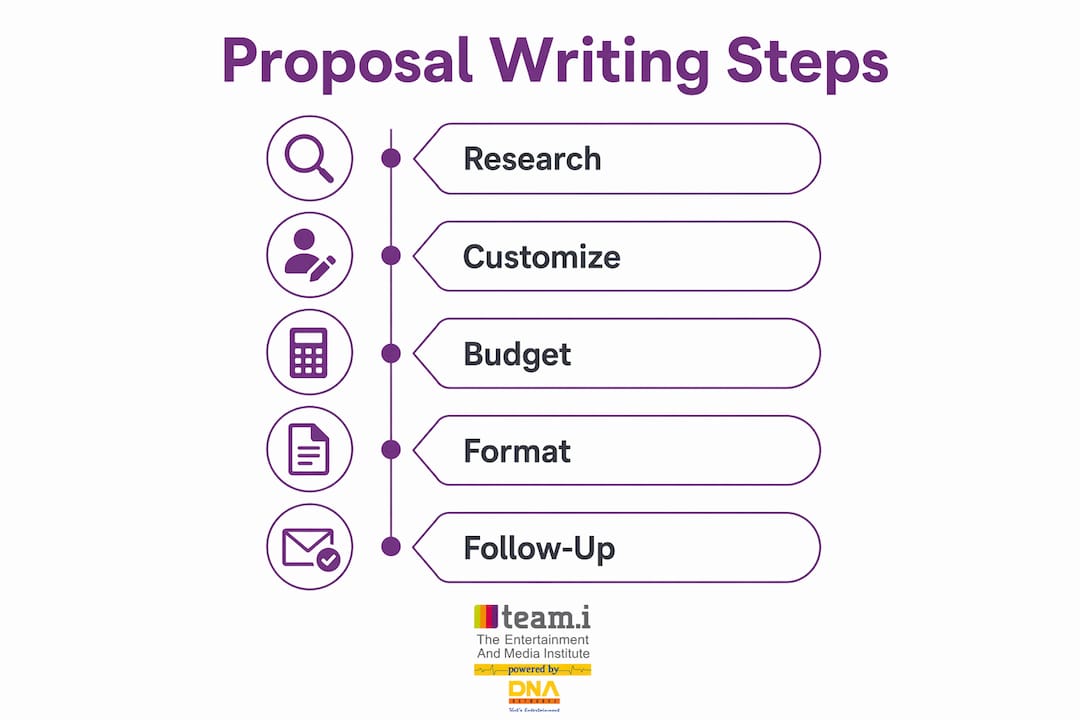
- Follow up within 48 hours. Send a short, professional message confirming receipt and offering to answer questions. Do not wait for the client to come to you.
- Reinforce one key point. Reference something specific from their brief. “I wanted to highlight the vendor logistics plan on page four, which addresses the tight turnaround you mentioned.” This shows you remember the conversation.
- Handle budget questions transparently. If a client pushes back on pricing, do not discount immediately. Explain what the cost covers. Most Indian clients respect clarity over negotiation.
- Set a decision deadline. “This proposal is valid until [date]” creates urgency without pressure. It also protects your vendor holds and venue bookings.
- Confirm the retainer process. Most vendors require a 25%–50% retainer at signing to secure a booking. State this clearly in the proposal and repeat it in the follow-up.
A Bangalore-based event company pitching a corporate awards night for a fintech firm closed the deal in three days by following up with a revised timeline that addressed the client’s concern about the venue handover window. The proposal itself was good. The follow-up made it a contract. For a deeper walkthrough of the full process, the step-by-step proposal guide on Teami’s site covers execution in detail.
What i have learned writing proposals across indian cities
After years of working with event professionals across Bangalore, Mumbai, and Delhi, one truth stands out: the proposals that win are not the most beautifully designed. They are the most honest.
Clients can sense when a document was written for them versus written for everyone. The proposals that close deals fast are the ones that address emotional and functional client needs rather than showcasing the planner’s portfolio. I have seen a two-page typed document beat a 20-slide pitch deck because it answered every question the client had before they thought to ask it.
Pricing transparency is the other non-negotiable. Indian clients, particularly in the corporate sector, have been burned by hidden costs before. When you show your numbers clearly and explain what each line item covers, you are not just presenting a budget. You are building trust. That trust is what gets you the retainer transfer on day one.
Refine every proposal after every client interaction. When a client asks a question your document should have answered, update the template. The best proposals are not written once. They are built over time, shaped by real conversations and real feedback.
— Teami
Ready to master proposals and the full event craft?
Writing a winning proposal is one skill. Executing the event behind it is another. At Teami, you learn both, not in theory, but on real productions alongside industry professionals. With 24 years of experience and a direct partnership with DNA Entertainment Networks, Teami’s programmes put you in the room where deals are made, events are built, and careers begin. If you are serious about turning proposal writing into a professional skill, explore the event management course and see exactly what the training covers. You can also check course eligibility requirements to find out if you are ready to apply today.
FAQ
What is an event proposal?
An event proposal is a formal document submitted to a client, sponsor, or stakeholder that outlines the event concept, scope of services, budget, timeline, and terms. It is the primary tool used to secure bookings, funding, or partnerships in event management.
How long should an event proposal be?
The ideal length is six pages. Research on over 180,000 proposals confirms this as the optimal length, with cover pages boosting conversion rates by 45%.
What should an event budget proposal include?
An event budget proposal should include an itemised cost breakdown, a clear separation of the planning fee from the event budget, payment milestones, and the retainer amount required at signing. Most vendors require a 25%–50% retainer to confirm a booking.
How do you personalise a proposal for event management?
Reflect the client’s exact brief in your opening summary, use portfolio examples relevant to their event type, and address local logistics specific to their city or cultural context. Avoid generic service descriptions that could apply to any client.
Does showing pricing upfront really help?
Yes. Displaying rates upfront increases client response rates by 25%. Clients who find pricing quickly are more likely to move forward rather than disengage out of uncertainty.
Recommended
- Event Design Concepts: Key Ideas for Modern Event Success – team I
- How to Write Event Proposal for Success: Step-by-Step Guide – team I
- How to Prepare a Perfect Event Sponsorship Proposal? – team I
- Creative Writing for Marketing: Unlocking Event Success – team I
Thinking about a career in event management?
team I is Bangalore’s only EEMA-certified event management institute, running for 24 years, where students work on real live events with real budgets and real deadlines rather than classroom simulations. See the full range of event management courses in Bangalore, or go straight to the flagship Certificate Program in Event Management (CPEM).