Business event management companies are specialist firms that handle the complete lifecycle of corporate events, from initial strategy and venue sourcing through to on-site execution and post-event reporting. The industry term for this discipline is corporate event management, and the best firms in India and globally treat it as a full production operation, not a booking service. Companies like Centric Events, 24 Seven, and EVENX have set the benchmark by offering end-to-end event services that cover every moving part of a business event. If you are a corporate client in Bangalore, Mumbai, or Delhi trying to choose the right partner, this guide tells you exactly what to look for.
What services do business event management companies offer?
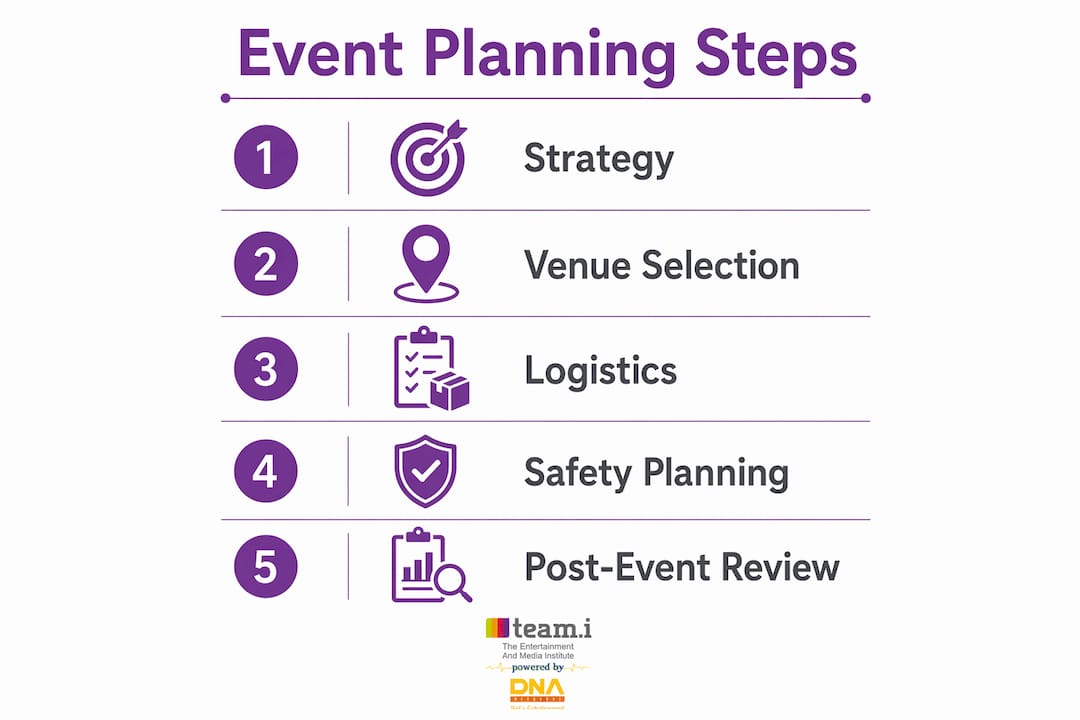
Corporate event companies provide a service scope that runs far deeper than booking a venue and ordering catering. The full lifecycle of a corporate event breaks down into five distinct phases, each requiring specialist skills.
- Strategy and objective-setting: Defining measurable KPIs before a single vendor is contacted. A product launch in Hyderabad and a leadership summit in Delhi have entirely different success metrics.
- Venue sourcing and contract negotiation: Identifying spaces that match capacity, AV infrastructure, and brand requirements, then negotiating terms that protect the client.
- Vendor coordination: Managing caterers, AV suppliers, décor teams, and transport providers as a single integrated unit rather than separate contracts.
- On-site execution: Deploying a production team that owns showflows, crowd flow logistics, and real-time problem-solving on the day.
- Post-event analytics: Measuring attendance, engagement, and ROI against the original KPIs and delivering a written report within five working days.
Technology sits across all five phases. Firms like 24 Seven and Centric now offer hybrid event capabilities including registration platforms, mobile event apps, and real-time analytics dashboards. That matters because a significant share of corporate conferences in India now run simultaneously in-person and online.
Pro Tip: Ask any prospective event management firm to show you a post-event analytics report from a previous client. If they cannot produce one, their “end-to-end” claim stops at the venue doors.

How do corporate event organizers manage timelines and safety?
Timeline management is where good corporate event organizers separate themselves from average ones. The industry standard is a T-minus milestone model, where every task is plotted backwards from the event date with clear dependencies.
- T-24 weeks: Venue contracting and initial supplier briefings confirmed.
- T-16 weeks: Speaker confirmations, AV specifications, and marketing assets locked.
- T-8 weeks: Catering menus, registration platform live, and delegate communications sent.
- T-1 week: Final attendee briefs issued, run-of-show documents distributed to all crew.
- Post-event: Review meeting and written report delivered within five working days.
The critical insight from event planning project management research is that milestone dependencies matter more than the milestones themselves. If the venue contract slips at T-24, every downstream task shifts. A professional firm maps those dependencies explicitly and flags cascade risks early.
Safety planning follows the same logic. Duty of care must be integrated within the first 10% of the planning timeline, not bolted on during the final procurement phase. For a large conference at a Mumbai convention centre or an outdoor corporate event in Bangalore, that means involving risk functions during venue selection, not after the contract is signed.
Safety is also a legal obligation, not a checkbox. Documented evidence of duty of care precautions is required to demonstrate compliance if an incident occurs. Any firm that cannot show you its safety documentation before contract signing is a firm you should not hire.
Pro Tip: Request the safety plan as a named deliverable in your contract, with a submission deadline tied to the T-16 week milestone. This forces the conversation early and protects you legally.
What differentiates the best corporate event management company?
The gap between a strong firm and an average one comes down to three factors: in-house capability, technology integration, and scale range.
| Capability | Full-Service Firm | Multi-Vendor Approach |
|---|---|---|
| Strategy and planning | In-house team, single point of contact | Outsourced to client or consultant |
| AV and production | In-house crew and equipment | Third-party AV supplier |
| Technology (registration, apps) | Proprietary or integrated platforms | Separate vendor contracts |
| Safety and risk management | Embedded in planning process | Added late or delegated |
| Event size range | 50 to 5,000 attendees | Often limited to one scale |
| Accountability | Single integrated team owns delivery | Gaps between vendor responsibilities |
EVENX, operating across Indian metros, exemplifies the integrated accountability model where one dedicated team owns the event from brief to post-event report. That single-ownership structure eliminates the coordination gaps that plague multi-vendor setups, where the AV company blames the venue and the venue blames the caterer.
For hybrid and virtual events, the technology gap between firms is even more pronounced. Top corporate event management companies run their own registration platforms and analytics tools. Firms without that capability are genuinely limited in what they can deliver for a modern enterprise client.
What should you look for when selecting event planning services?
Choosing the right event planning services partner requires a structured evaluation process, not a gut-feel decision based on a pitch deck.
- Write a detailed RFP. A strong event RFP includes an overview, scope of work, budget parameters, evaluation criteria, and a submission timeline. Specificity in the scope directly improves the quality of proposals you receive.
- Confirm documented safety processes. Before signing any contract, require written evidence that the firm has a duty of care framework. This is a non-transferable legal obligation.
- Look for integrated accountability. Ask who owns the event end-to-end. If the answer involves three different managers across three different departments, that is a coordination risk.
- Check their technology stack. Can they run a hybrid event with live registration data? Do they have a mobile app capability? For enterprise events in India, these are now baseline requirements.
- Ask for references from similar events. A firm that excels at gala dinners in Delhi may not have the production muscle for a 2,000-person conference in Hyderabad.
Red flags to watch for: vague scope documents, no post-event reporting process, and an inability to name the specific person who will own your event on the day. Treat event management companies contractually as contractors delivering to your specifications, not as partners who share your legal exposure by default.
What i have learned about choosing event management partners in india
The single biggest mistake I see corporate clients make in India is confusing a firm’s portfolio size with its actual delivery capability. A company that has produced concerts for 10,000 people in Mumbai does not automatically have the precision required for a 200-person executive summit in Bangalore. Scale and specificity are different skills.
The Indian corporate event market is evolving fast. Clients in Hyderabad and Pune are now asking for hybrid event best practices as a standard requirement, not a premium add-on. Firms that have not invested in their technology infrastructure are genuinely struggling to compete.
My strongest advice: prioritise firms with in-house production and logistics teams. When something goes wrong at 6 PM on event day, and something always does, you want one person with full authority to fix it. Multi-vendor setups produce finger-pointing. Integrated teams produce solutions.
Safety documentation is the other non-negotiable. The Indian events industry has had high-profile incidents that resulted in legal proceedings. Asking for documented duty of care evidence is not paranoia. It is professional practice.
— Teami
Build the skills to work with the best in the business
Understanding how professional corporate event organizers operate is the foundation of a strong event management career. Teami’s event management course covers exactly this ground, from vendor contract negotiation and timeline management to hybrid event production and post-event analytics. With 24 years of industry experience and a direct partnership with DNA Entertainment Networks, Teami trains students on real events, not simulations. If you are serious about working with top-tier business function planners or building your own event management practice, certification in event management is the credential that opens those doors.
FAQ
What do business event management companies actually do?
Business event management companies handle the full lifecycle of corporate events, covering strategy, venue sourcing, vendor coordination, on-site execution, and post-event reporting. Firms like Centric Events and EVENX provide these services as a single integrated offering.
How do i choose the best corporate event management company?
Write a detailed RFP with a clear scope of work, budget parameters, and evaluation criteria, then require documented safety processes and confirm that one person or team owns the event end-to-end.
What is the t-minus timeline model in event planning?
The T-minus model plots every planning task backwards from the event date using milestones such as T-24 weeks for venue contracting and T-1 week for final attendee briefs, with explicit dependencies between tasks to prevent cascading delays.
Why does duty of care matter when hiring event organizers?
Safety planning is a legal obligation that requires documented evidence of precautions taken. Clients should request this documentation before signing any contract to protect themselves from legal and operational risk.
What is the difference between a full-service firm and a multi-vendor approach?
A full-service firm provides in-house strategy, production, technology, and logistics under a single accountable team, while a multi-vendor approach splits responsibilities across separate suppliers, which creates coordination gaps and unclear ownership on event day.
Recommended
- How to Start Event Management Company: Complete Guide – team I
- BLOG – team I – Page 8
- Corporate Event Planning Guide 2025: Steps, Skills, and Success – team I
- Event management lifestyle: a practical guide for 2026 – team I
Thinking about a career in event management?
team I is Bangalore’s only EEMA-certified event management institute, running for 24 years, where students work on real live events with real budgets and real deadlines rather than classroom simulations. See the full range of event management courses in Bangalore, or go straight to the flagship Certificate Program in Event Management (CPEM).