Event planning networking is the deliberate practice of building professional relationships within the event management industry to accelerate career growth, secure clients, and unlock opportunities that no job board ever lists. In India alone, the events industry is projected to cross ₹10,000 crore by 2026, and the professionals who rise fastest are not always the most technically skilled. They are the best connected. Communities like the BizBash LinkedIn group with 18,000+ members and The Event Planner Expo in New York prove that structured, intentional networking converts contacts into contracts. Whether you are coordinating weddings in Bangalore or managing corporate summits in Mumbai, your network is your net worth.
What tools and communities support event planning networking?
The right communities separate serious event management networking from random mingling. Three categories matter most: professional LinkedIn groups, Facebook communities, and local industry associations.
The Event Planning & Management group on LinkedIn and the Accelevents Facebook group operate on a no-solicitation model, meaning members share knowledge rather than pitch services. This creates a genuinely useful space for asking vendor questions, sharing production challenges, and spotting emerging trends. For Indian professionals, the Event Management Association of India (EMAI) and regional chapters in Delhi and Hyderabad offer in-person touchpoints that digital groups simply cannot replicate.

Here is a comparison of key communities for event professionals:
| Community | Platform | Members | Best for |
|---|---|---|---|
| BizBash LinkedIn Group | 18,000+ | Industry news, senior connections | |
| Accelevents Facebook Group | 994+ | Peer support, tools discussion | |
| EMAI India | In-person/online | Regional | Local industry access, India-specific |
| Event Planning & Management | 50,000+ | Broad professional networking |
Beyond communities, the tools that support day-to-day networking include:
- LinkedIn for pre-event research and post-event follow-up messaging
- Event-specific apps like Whova or Hopin for conference matchmaking and meeting scheduling
- CRM tools like HubSpot or Zoho CRM to track follow-ups and relationship history
- Social media hashtags such as #EventProfs and #EventManagement to join live conversations during conferences
Pro Tip: Before attending any networking event, spend 20 minutes on LinkedIn identifying three specific people you want to meet. Send a brief connection request with a personalised note the day before. Arriving with a plan beats arriving with a stack of business cards.
How can event professionals maximise networking at conferences?
Maximising networking at conferences requires a strategy, not just a willingness to show up. Setting specific networking goals and focusing on trust and mutual help is the foundation of turning a conference into real revenue or partnership opportunities. Collecting 50 business cards means nothing if you follow up with none of them.
Here is a practical framework for conference networking in the Indian event market:
- Set a goal before you arrive. Decide whether you want to meet potential vendors, find a mentor, or explore collaboration with a peer. Vague intentions produce vague results.
- Research speakers and attendees in advance. Use the conference app or LinkedIn to identify who will be there. The Event Planner Expo recommends targeting key people and using conference apps to schedule meetings before the event begins.
- Use pre-event matchmaking windows. Opening a matchmaking window 7 to 10 days before the event allows attendees to browse profiles, send meeting requests, and arrive with confirmed appointments. This is one of the most underused tactics in the Indian conference circuit.
- Engage in structured formats. Roundtables and speed networking sessions at events like the India International Event Expo (IIEE) in Mumbai force genuine conversation. They remove the awkwardness of cold introductions.
- Follow up within 48 hours. Quick outreach within 48 hours and substantive follow-ups within two weeks sustain relationship momentum and convert leads over months. A WhatsApp message referencing a specific conversation point is far more effective than a generic LinkedIn connection.
For Indian professionals attending events in Bangalore or Delhi, the follow-up window matters even more. Decision cycles in the Indian events market often run on personal trust, and a timely, warm message signals that you are serious.
Pro Tip: Craft a 30-second introduction that answers three questions: who you are, what you specialise in, and what you are looking for. For example: “I manage corporate events for tech companies in Bangalore. I am looking to connect with AV vendors who work at scale.” Specific beats generic every time.
What are best practices for hosting effective networking events?
Hosting your own networking event is one of the fastest ways to position yourself as a connector in the event management industry. But the design of the event determines whether people leave with genuine relationships or just a free drink.
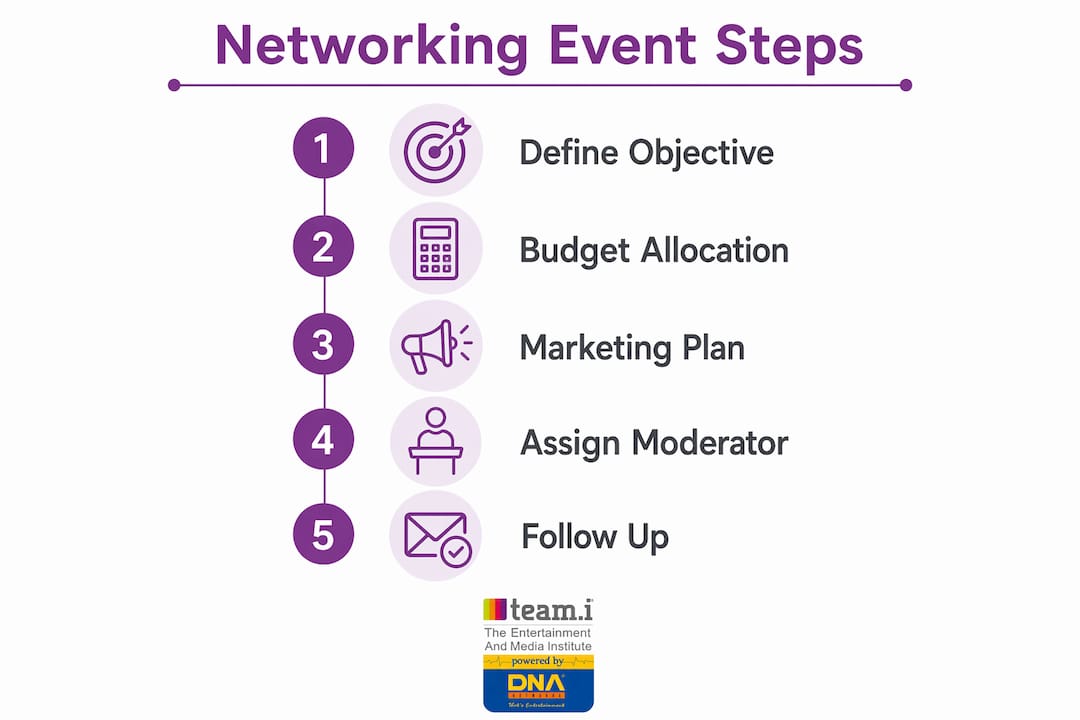
The first decision is defining your objective beyond “networking.” Are you creating a space for wedding vendors in Mumbai to meet planners? Are you running a mentor-led session for young event coordinators in Hyderabad? Clarity of purpose shapes every other decision, from venue to format to guest list.
Budget allocation is where most hosts go wrong. Underfunding marketing can reduce networking turnout by up to 65%. Spending on a beautiful venue while neglecting promotion is a common and costly mistake. Allocate at least 30% of your budget to outreach and pre-event communication.
Layout and timing are invisible but powerful. Allocating 90 to 120 minutes for networking at full-day conferences, with spacious lounges and longer coffee breaks, produces far better outcomes than cramming people into narrow corridors between sessions. Round tables, open floor plans, and clearly labelled topic zones all encourage natural movement and conversation.
Effective formats to consider:
- Speed networking (in-person): 5-minute rotations with a clear bell or signal. Works well at corporate events in Bangalore’s tech corridor.
- Virtual speed networking: Zoom breakout rooms with 3-minute rotations and groups of 5 to 8 keep conversations flowing without the chaos of open video calls.
- Mentor-led mixers: Pair senior event professionals with emerging coordinators. Structured but informal. Highly effective for building loyalty and community.
- Low-pressure mixers: The 2026 Toronto creative mixer model, described as operating without the pressure of traditional networking, is a format worth replicating for Indian city-based creative communities.
Pro Tip: Assign a moderator to every structured session. Moderator roles and topic assignments help participants start conversations and stay engaged, especially in virtual formats where silence becomes awkward fast.
What challenges arise in event planning networking and how do you fix them?
Networking fatigue is real, and it hits event professionals harder than most. You spend your working life managing other people’s experiences, and then you are expected to perform socially at yet another event. Recognising this is not weakness. It is self-awareness.
The most common challenges and their fixes:
- Quantity over quality trap: Collecting contacts without intent produces nothing. Authentic relationships yield more value than large volumes of contacts. Aim for three meaningful conversations per event, not thirty forgettable ones.
- Introversion in structured settings: Guided discussion prompts and moderator-led sessions ease anxiety and encourage authentic interaction, particularly for introverted participants. Ask the organiser for a topic card or agenda in advance.
- Virtual awkwardness: Technical glitches and camera shyness derail online networking. Test your setup 10 minutes early, use a clean background, and have a two-sentence opener ready.
- Follow-up overwhelm: After a large conference, the follow-up list feels impossible. Use a simple spreadsheet or a CRM to tag contacts by priority. Follow up with your top five within 48 hours, the next ten within a week.
- Cultural nuances in India: Relationship-building in Indian professional contexts often requires more patience and informality before business is discussed. Rushing to a pitch in the first conversation is the fastest way to close a door.
The professionals who build the strongest networks in India’s event industry are not the loudest in the room. They are the most consistent in following up.
Check out Teami’s guide on networking skills for event careers to understand the foundational competencies that make every networking interaction count.
What we have learned from 24 years of event industry networking in India
Here is the honest truth: most event professionals in India underestimate how much their career trajectory depends on who they know, not just what they know. We have watched talented coordinators stall because they stayed in their city bubble, and we have seen average planners land extraordinary projects because they showed up consistently at the right events in Delhi and Mumbai.
The professionals who win long-term combine digital presence with physical attendance. They are active on LinkedIn, they show up at IIEE, and they are the first to congratulate a peer on a successful production. That consistency compounds. Referrals in the Indian events market travel through trust networks, and trust is built over time, not in a single conversation.
Our advice: start local. Attend one networking event in your city this month. Join one online community with a no-solicitation rule. Follow up with two people you met last quarter. The best networking events in India are not always the biggest ones. They are the ones where you show up prepared and leave with one real connection.
— Teami
Build your network through professional event management training
If you are serious about growing your career in event management, your network starts in the classroom. Teami’s event management course is built on 24 years of industry partnerships with DNA Entertainment Networks, giving students direct access to real productions, senior professionals, and placement networks across Bangalore, Mumbai, and Delhi. Certification from a recognised programme does not just build skills. It opens doors that cold outreach cannot. Explore Teami’s certified event resource training to see how structured education accelerates both your competence and your connections in India’s fast-growing events industry.
FAQ
What is event planning networking?
Event planning networking is the practice of building professional relationships within the event management industry to access opportunities, referrals, and collaborations. It includes attending conferences, joining online communities, and maintaining consistent follow-up with contacts.
Which communities are best for event management networking in India?
The BizBash LinkedIn group with over 18,000 members and the EMAI India regional chapters are strong starting points. For peer support and tools discussion, the Accelevents Facebook group offers an engaged, no-solicitation environment.
How soon should you follow up after a networking event?
Follow up within 48 hours of meeting a contact, with a personalised message referencing your specific conversation. A substantive second follow-up within two weeks significantly increases the chance of converting the connection into a business relationship.
How do you network effectively at virtual events?
Use breakout room formats with timed rotations of 3 to 5 minutes, prepare a clear two-sentence introduction, and test your technical setup before the session begins. Moderator-led prompts help overcome the initial awkwardness of online introductions.
What is the biggest mistake event professionals make when networking?
Prioritising quantity over quality is the most common error. Focusing on three to five meaningful conversations per event, backed by consistent follow-up, produces far more career value than collecting a large number of contacts with no subsequent engagement.
Recommended
- Networking tips for students: build your career in 2026 – team I
- Blog – team I
- Event Management Internships in 2025: Your Guide to Success – team I
- Event Planning Checklist 2025: Step-by-Step Guide for Success – team I
Thinking about a career in event management?
team I is Bangalore’s only EEMA-certified event management institute, running for 24 years, where students work on real live events with real budgets and real deadlines rather than classroom simulations. See the full range of event management courses in Bangalore, or go straight to the flagship Certificate Program in Event Management (CPEM).