
Talent management in events is one of the most misunderstood functions in the entire industry. Most professionals treat it as a hiring task: find someone, brief them, send them to the venue. But that thinking is exactly what causes an event in Bangalore to fall apart backstage while the front-of-house looks polished. From corporate summits in Mumbai to large-scale wedding productions in Hyderabad, the difference between a brilliant event and a painful one almost always traces back to how people were recruited, managed, and developed. This article breaks down what actually works.
Table of Contents
- Talent management in events: the real challenges
- Smart recruitment and talent acquisition
- Retention and development of your event team
- On-site talent management during execution
- Future trends in event talent strategy
- My perspective on talent in Indian events
- Build your talent management skills with Teami
- FAQ
Talent management in events: the real challenges
The Indian events industry is growing fast, but the talent infrastructure has not kept pace. The industry faces an existential talent gap driven largely by the undervaluation of on-site roles and pay structures that have not been updated in over a decade.
Here is what that looks like on the ground:
- Wedding planners in Delhi regularly hire decorators, coordinators, and MC talent based on personal referrals rather than structured screening, and then wonder why briefings go wrong on the day.
- Corporate event teams in Bangalore running conferences for 2,000 attendees still pay registration desk staff at rates designed for a 200-person seminar.
- Festival organisers at college events in Mumbai face 60% to 70% crew turnover year on year, mostly because there is no career pathway on offer, only a one-off gig.
- Industry mergers and agency consolidations have created overlapping roles and redundancies that push experienced mid-level professionals out of the sector entirely.
The cultural piece matters too. In India, event roles are still widely seen as glamorous but temporary, not serious careers. That perception filters into compensation decisions and, predictably, into attrition rates.
Pro Tip: If you are managing a team for a multi-day production in Hyderabad or Chennai, map every role to a job function with a written brief before you begin shortlisting. It sounds basic. Almost no one does it rigorously.
Smart recruitment and talent acquisition
DIY hiring is a 50/50 gamble at best. And in Q1 2026, the surge in resignations across the events sector made that number worse. Equating the volume of LinkedIn applications with quality is one of the most expensive mistakes an event company can make. Here is how to do talent acquisition for events properly.
Define roles with precision. Before you post anything, write a one-page role brief that covers the specific deliverables, the reporting line, the hours (including setup and breakdown), and the non-negotiables. Vague job descriptions attract vague candidates.
Use structured sourcing channels. For senior hires, event staffing solutions via specialist recruitment agencies consistently outperform general job boards. For on-ground crew in cities like Bangalore and Hyderabad, building relationships with in-demand event career pipelines from training institutes provides a far more reliable talent pool than social media posts.
Run internship and rotational programmes. Organisations that build structured rotational entry points see a significant proportion of interns convert to full-time hires. This is not just about cutting costs. It is about building loyalty before the competition even knows those people exist.
Score your interviews. Use a scoring rubric. Ask each candidate the same situational questions. “Tell me about a time a vendor cancelled 90 minutes before an event. What did you do?” That one question will tell you more about a candidate than their entire CV.
Check references with real questions. Do not ask “Was this person a good employee?” Ask: “Would you hire them again for a high-pressure production, and why?” The specificity changes the quality of the answer completely.
This approach requires more effort upfront. But it is the only approach that consistently reduces the costly cycle of re-hiring every six months.
Retention and development of your event team
Recruitment gets the talent in the room. Retention is what keeps them there. And in India’s events industry, retention is where most organisations lose the plot entirely.
Event professionals managing six-figure budgets and C-suite client relationships are still being paid at legacy coordinator rates. That is not a perception problem. It is a structural one, and fixing it starts with honest compensation benchmarking against strategic marketing or consulting roles, not against what the industry has always paid.
Beyond pay, here is what progressive Indian event firms are doing differently:
- Building career pathways. Not just “you could become a senior manager one day,” but a written progression framework with timelines, skills milestones, and salary bands attached to each step.
- Closing the office/on-site divide. Successful team cultures blend desk-based planners and on-ground crew into a single communicating unit, not two separate groups who only interact on event day.
- Measuring performance by outcomes, not hours. Teams that normalise sustainable working and mandate recovery time after major productions report stronger retention and better delivery quality. The 72-hour event grind culture is not a badge of honour. It is a recruitment deterrent.
Pro Tip: Introduce a formal post-event debrief that includes both on-site crew and planning staff. When people feel their input shapes the next production, they stay. It costs nothing and signals that their work matters.
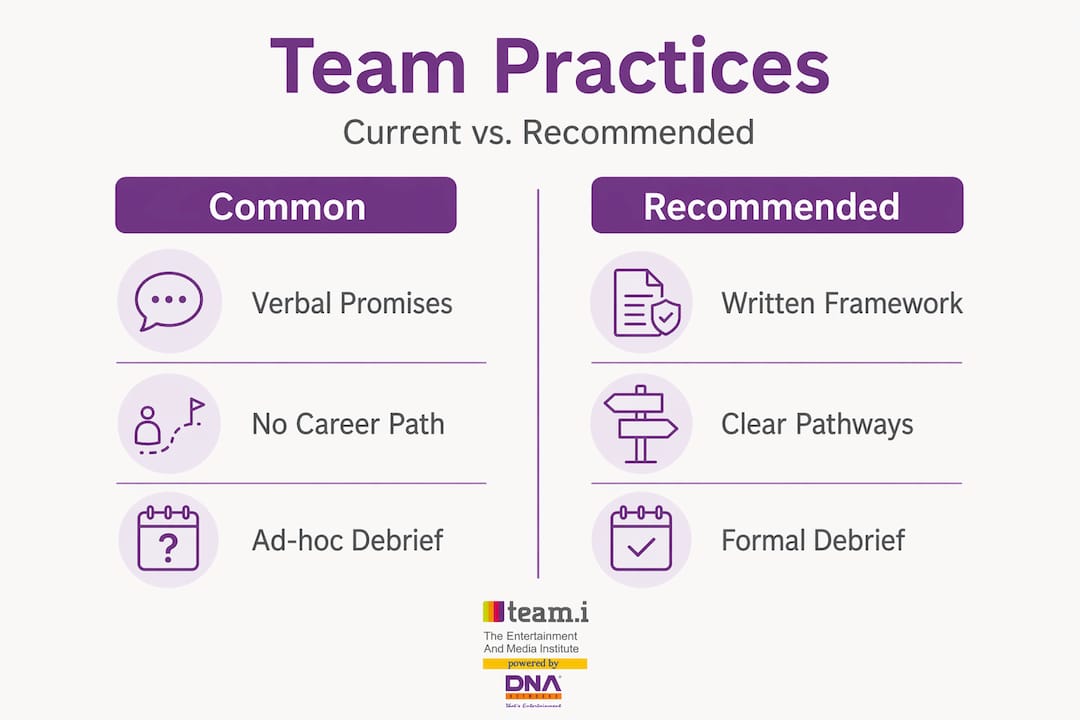
Here is a comparison of common versus recommended retention practices:
| Common practice | Recommended approach |
|---|---|
| Verbal promises of promotion | Written progression framework with salary bands |
| Pay based on industry tradition | Benchmarked against strategic marketing roles |
| Separate briefings for on-site and office staff | Joint pre-event briefings for the full team |
| No formal debrief after events | Structured post-event review with all team members |
| No recovery policy after major productions | Mandatory rest periods written into contracts |
On-site talent management during execution
Planning is where talent management is decided. Execution is where it is tested.
Assign a dedicated working lead on-site. A strong on-site working lead managing logistics frees your planning team to focus on the programme and the client, not crew problems. This one structural decision can change the entire texture of your event day.
Arrive early. Seriously early. Arriving at least five days before a major production provides enough buffer to address the inevitable: a staging contractor who misread the brief, AV equipment that needs re-positioning, or a key crew member who drops out. In India, where venue access timelines are often negotiated rather than guaranteed, this buffer is not optional.
Build a crisis substitution list. Before every event, have at least two confirmed backup contacts for every critical role. Not hypothetical names. Confirmed, briefed, available contacts.
Use technology for real-time coordination. WhatsApp groups work for small crews. For productions above 50 people across a large venue in Mumbai or Delhi, dedicated crew management apps give you visibility that group chats cannot.
Hold a morning standup on each event day. Fifteen minutes. Full team. Showflow walkthrough, role confirmations, and one clear “if this goes wrong, here is the plan.” Events that skip this step spend the first two hours firefighting.
Future trends in event talent strategy
The skills required for effective event team coordination are shifting fast. Here is where the industry is heading:
- Data literacy is no longer optional. Future event professionals need to read attendance analytics, post-event survey data, and ROI reports. Managing talent in events increasingly means recruiting people who can translate numbers into decisions.
- Diversity and inclusion are becoming non-negotiable. Women dominate the events workforce but remain underrepresented in leadership. Indian event firms that correct this structurally, not just symbolically, will make better decisions and attract better talent.
- AI handles logistics, humans handle relationships. Technology will continue to take over scheduling, shortlisting, and communication routing. The human edge in events will remain stakeholder management, creative problem-solving, and cultural intelligence.
- Certification and continuous learning will differentiate candidates. As the Indian events industry matures, accredited qualifications will carry real weight in hiring decisions, not just for entry-level roles but for mid-career progression.
My perspective on talent in Indian events
I have watched brilliant events fall apart because the person with the most institutional knowledge was the lowest-paid person on the team. That is not bad luck. It is a predictable outcome of an industry that has historically confused busyness with value.
In my experience managing teams across weddings in Udaipur and corporate productions in Bengaluru, the most powerful retention tool is not salary alone. It is the feeling that leadership sees the work clearly. When a coordinator has handled a 500-person gala almost entirely on their own and nobody acknowledges it, they start looking elsewhere. Immediately.
The local talent in India’s tier-two cities is seriously underestimated. Some of the sharpest on-ground problem-solvers I have seen came from Coimbatore and Pune, not from the obvious metros. The event companies building sustainable talent strategies are the ones casting their recruitment net wider and investing in development before someone else spots that potential.
My honest take: the firms that treat talent management as a strategic priority today will own this industry in five years. The ones still doing it informally will keep hiring the same people, losing them, and wondering why.
— Teami
Build your talent management skills with Teami
If you are serious about managing talent in events at a professional level, the foundation starts with structured training. Teami offers event management courses built on 24 years of industry experience and direct partnerships with DNA Entertainment Networks, one of India’s largest live entertainment companies. You learn recruitment strategy, team coordination, and on-ground execution by actually doing it, not by reading about it.
For professionals who cannot commit to full-time study, the online event management programme gives you flexibility without cutting corners on depth. You can also explore work experience pathways that put you inside real productions before you graduate.
FAQ
What is talent management in events?
Talent management in events covers the full cycle of recruiting, deploying, developing, and retaining the people who plan and deliver events. It goes well beyond hiring to include career development, compensation strategy, and on-site team management.
Why do Indian event companies struggle to retain talent?
The core issues are outdated pay structures, no clear career progression, and an overwork culture that normalises long hours without recovery time. Systematic underpayment is the single biggest driver of attrition in the sector.
How can event companies improve their recruitment process?
Using structured role briefs, scored interviews with situational questions, and specialist event staffing solutions consistently produces better hires than informal or volume-based approaches. Building pipelines through internship programmes also significantly reduces time-to-hire.
What skills will event professionals need in the future?
Future event professionals need data literacy, business strategy, stakeholder management, and experience design skills alongside traditional event coordination competencies.
How early should on-site event staff arrive for major productions?
Industry practice recommends arriving at least five days before a major event begins. This buffer allows teams to address venue access issues, equipment challenges, and staffing changes without compromising delivery quality.