

Breaking into event management without prior experience feels like being locked out of a venue where the party is already in full swing. You send applications, you wait, and you hear nothing back. Sound familiar? The Indian events industry is booming, and competition for internships is fierce. But here is the truth: most applicants fail not because they lack talent, but because they do not know the rules of the game. This guide walks you through every step, from sorting your documents to acing your interview, so you can stop waiting outside and start working backstage.
Table of Contents
- What you need before applying: prerequisites and documents
- How to search for the right event internship
- Step-by-step application process for event internships
- Key skills and tools to stand out as an applicant
- What to expect: selection, interviews, and first events
- Our honest take: what most guides miss about event internships
- Take the next step: build your event career today
- Frequently asked questions
Key Takeaways
| Point | Details |
|---|---|
| Gather documents early | Having a resume, ID, and certificates ready saves time and reduces mistakes. |
| Use multiple search methods | Combine online applications with strategic networking to find more opportunities. |
| Build essential event skills | Knowledge of event tools, organisation, and communication greatly boosts your chances. |
| Experience matters more than pay | Short-term and even unpaid roles can be stepping stones to full-time event careers. |
| Portfolio and follow-ups | Showcase your event work and maintain contact with recruiters for a stronger impact. |
What you need before applying: prerequisites and documents
Before you fire off a single application, get your foundation right. Skipping this step is the number one reason students get rejected before anyone even reads their resume.
Most event internships in India are open to students currently enrolled in a relevant programme or recent graduates. You will typically need to show proof of enrolment, be within a certain age bracket, and hold a basic understanding of event internship essentials. Some government schemes have stricter eligibility criteria, so always read the fine print before applying.
Here is what your document folder should look like before you apply:
- Resume (tailored to event management roles)
- Aadhaar card (government-issued identity proof)
- Bonafide certificate from your institution
- Recent passport-size photograph
- Academic transcripts (where requested)
These required documents are standard across most internship schemes in India, including government-backed programmes. Missing even one can disqualify your application instantly.
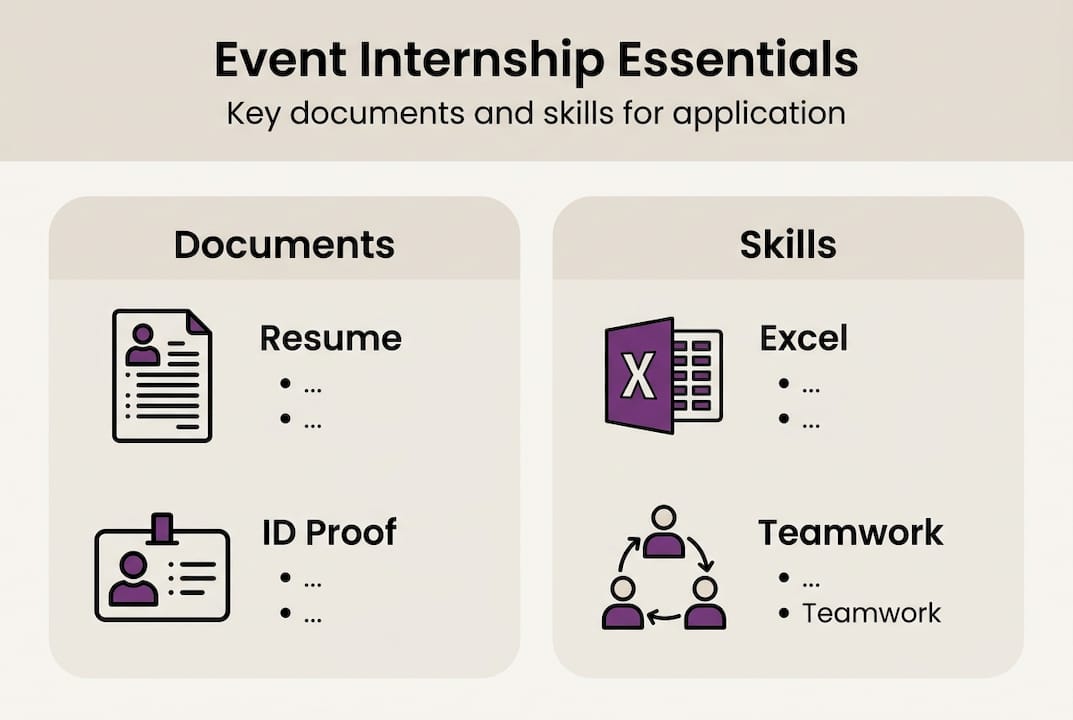
Beyond paperwork, you need a working skills base. Recruiters shortlist candidates who already demonstrate key event skills like MS-Office proficiency, strong communication, organisation, and basic vendor handling. These are not optional extras. They are the baseline.
| Skill area | Why it matters |
|---|---|
| MS-Excel and Google Sheets | Budget tracking, guest lists, logistics |
| Communication (written and verbal) | Vendor negotiation, client updates |
| Organisation and time management | Managing multiple moving parts simultaneously |
| Basic vendor handling | Core to every live event |
| Event management fundamentals | Understanding showflows, runsheets, and timelines |
Explore work experience pathways to understand how structured training can build these skills before you even apply.
Finally, understand the importance of internships and plan ahead. The industry runs on tight timelines, and so does the hiring cycle.
Pro Tip: Keep both digital and physical copies of every document in a dedicated folder. Last-minute scrambling for a bonafide certificate has cost many students their shot at a great placement.
How to search for the right event internship
With documents in hand, it is time to strategise where and how to find the right opportunities. Knowing where to look is half the battle.
The most effective online portals for event internships in India are Internshala, LinkedIn, and Naukri. Register on portals like Internshala, apply directly, and use LinkedIn and alumni networks for outreach. These platforms list everything from two-week corporate event stints to six-month wedding management placements.
Do not underestimate your college placement cell either. On-campus recruitment drives often bring in event companies that never post publicly. Off-campus applications give you more variety but require more hustle. Both routes are worth pursuing simultaneously.
Networking is where hidden opportunities live. Most event internships, especially with boutique agencies and independent planners, are never advertised. They are filled through referrals, WhatsApp groups, and industry contacts. Sharpen your networking tips and start building relationships before you need them.
| Method | Advantages | Limitations |
|---|---|---|
| Online portals (Internshala, LinkedIn) | Wide reach, easy to apply, trackable | High competition, generic listings |
| Campus placement cell | Pre-vetted companies, institutional support | Limited to empanelled organisations |
| Direct networking and referrals | Access to unlisted roles, faster response | Requires existing contacts or initiative |
| Government schemes | Structured, sometimes stipend-backed | Stricter eligibility, slower process |
Also look out for city-specific or gender-inclusive listings. Some companies in Bangalore, Mumbai, and Delhi specifically recruit from local institutes. Government schemes sometimes reserve spots for women or students from particular disciplines. These niche listings have far less competition.
Step-by-step application process for event internships
Found the right opportunity? Now see exactly how to stand out in the crowded field.
A strong application is not just a resume attached to an email. It is a carefully constructed case for why you are the right person for this specific role. Here is how to build it:
- Set up your profile on Internshala and LinkedIn. Use a professional photo, write a sharp bio, and list every relevant skill, course, or project.
- Upload your resume in PDF format. Keep it to one page. Tailor it for event management roles, not a generic template.
- List your skills explicitly. Recruiters search by keyword. If your profile does not say “vendor coordination” or “event logistics,” you will not appear in searches.
- Search with specific filters. Use location, duration, and stipend filters to narrow results. Apply to roles that genuinely match your availability and goals.
- Customise every application message. A copy-paste cover note is obvious and ignored. Reference the company’s recent events or specialisation to show genuine interest.
- Attach supporting documents as specified. Do not attach what was not asked for, but never omit what was.
- Apply early. The application process works best when you apply 3 to 4 months ahead of your intended start date. Early applicants get more attention.
- Follow up politely. Send a brief, professional email one week after applying if you have not heard back. One follow-up is professional. Two is persistent. Three is a problem.
For government internship schemes, the procedure involves additional verification steps and may require physical document submission. Factor in extra lead time for these. Use the streamlined application tools available to simplify your process wherever possible.
Pro Tip: Mirror the exact language from the job description in your resume and cover letter. Recruiters and applicant tracking systems both respond to matching keywords. Read the listing carefully and reflect it back.
For more detail on what works and what does not, check out these internship application tips before you hit submit.
Key skills and tools to stand out as an applicant
Application sent. Now let us maximise your chances with standout skills and tools.

The event industry rewards people who can handle controlled chaos. Coordination, multitasking, vendor handling, and emergency management are not just buzzwords on a job listing. They are the daily reality of every event professional. Build them deliberately.
Here are the skills that separate shortlisted candidates from the rest:
- Coordination and multitasking: Managing logistics, timelines, and people simultaneously
- Vendor handling: Communicating clearly with suppliers, caterers, AV teams, and venue staff
- Emergency management: Staying calm and problem-solving when things go sideways (and they will)
- Budget awareness: Understanding cost tracking and basic financial reporting
- Audience management: Crowd flow, guest experience, and on-ground communication
On the digital side, key event skills like MS-Office, Google Sheets, communication, and organisation are non-negotiable. But going beyond the basics sets you apart.
| Tool | What it does | Why it matters |
|---|---|---|
| MS-Excel and Google Sheets | Data management, budgets, guest lists | Used daily across all event types |
| Eventbrite | Ticketing and registration management | Standard for public and corporate events |
| Cvent | End-to-end event planning software | Widely used by corporate clients |
| Canva | Visual communication and presentations | Useful for pitch decks and proposals |
Learn tools like Eventbrite and Cvent and build event portfolios to make your application genuinely memorable. Document every event you assist with, even informally. Photos, short reports, and a simple write-up of your role create a portfolio that speaks louder than any resume bullet point.
Explore event tech tools and career success work experience to understand how practical exposure translates into career capital.
Pro Tip: Even a short unpaid stint at a local wedding, corporate seminar, or college fest counts. Add it to your portfolio. Recruiters value demonstrated initiative over theoretical knowledge every single time.
What to expect: selection, interviews, and first events
With application and skills sorted, here is what comes next: impressing at interviews and starting your journey.
Most event internship selection processes follow a similar pattern. First, your application is shortlisted based on your resume and profile. Then comes an interview, either virtual or in-person, sometimes followed by a group discussion or a short task.
Typical selection stages include:
- Application shortlisting based on skills, documents, and availability
- One-on-one interview (virtual or in-person) focusing on your motivation and basic knowledge
- Group discussion or scenario task to assess problem-solving and communication under pressure
- Final selection and offer with details on duration, stipend (if any), and start date
Prepare for scenario-based questions. “What would you do if a key vendor cancels two hours before an event?” is a classic. Interviewers want to see how you think on your feet, not whether you have memorised a textbook answer. Study the event behaviour guide to understand what professional conduct on the ground actually looks like.
Once selected, your first days will likely involve supporting event setup, coordinating with vendors, handling admin tasks, and managing audience flow. It is unglamorous. It is exhausting. And it is exactly where the real learning happens.
“Prioritise experience over stipend; unpaid roles often secure future jobs. The connections and reputation you build in your first internship are worth more than any short-term pay cheque.”
Short-term and unpaid internships are genuine launch pads. Treat every task, no matter how small, as an audition for your next role.
Our honest take: what most guides miss about event internships
Here is the uncomfortable truth that most career guides will not say out loud: the majority of students approach internship hunting with the wrong priority. They filter by stipend first. They ask “how much does it pay?” before they ask “what will I learn?” or “who will I work alongside?”
In event management, real work experience stories consistently show the same pattern. The students who took lower-paid or unpaid roles at reputable companies built stronger networks, got better references, and landed higher-paying full-time positions faster than those who chased the biggest stipend at an unknown agency.
Connections and visible initiative carry more weight than any salary figure in this industry. When you own a small task completely, when you solve a problem before your supervisor notices it, when you show up early and stay late without being asked, people remember. And in events, reputation travels fast.
Build a detailed personal event portfolio from day one. Every event you touch, document it. This is non-negotiable for long-term growth.
Pro Tip: Do not wait for the perfect opportunity. A local college fest, a community fundraiser, a small corporate lunch. Every event counts and every event builds your story.
Take the next step: build your event career today
You now have the roadmap. Documents, search strategy, application process, skills, and interview prep. What comes next is action.
If you want to fast-track your journey, explore the event management course options at teami.org, where 24 years of industry experience and direct partnerships with DNA Entertainment Networks translate into real placements and real skills. Structured work experience programmes give you the portfolio and the contacts you need before you even apply for your first role. And if flexibility matters, the online event management courses let you build industry-relevant credentials from anywhere in India. Your backstage pass is waiting.
Frequently asked questions
What are the top online portals for event internships in India?
Internshala, LinkedIn, and college career centres are the most effective platforms for finding event internship listings in India. Local job boards and direct company websites are also worth checking regularly.
What documents do I need to apply for an event internship?
You will need a resume, Aadhaar card, bonafide certificate from your institution, and a recent photograph. Some roles may also request academic transcripts or a brief statement of purpose.
Are unpaid event internships worth considering?
Yes. Many unpaid internships provide valuable hands-on experience and industry connections that frequently lead to paid roles, strong references, and faster career progression.
What technical skills help my event internship application stand out?
Proficiency in MS-Office, Google Sheets, and basic event management software, combined with strong communication and organisational skills, makes your application significantly more competitive.
How early should I apply for event internships before my term break?
Apply 3 to 4 months in advance of your intended start date to give yourself the best chance of selection and enough time to complete any verification processes.
Recommended
- How to choose an event management career in India 2026 – team I
- Why Event Management as a Career? India’s Opportunity and a Global Frontier
- Build a successful event management career in India 2026 – team I
- Event planning jobs: find the best certification in India 2026 – team I
Thinking about a career in event management?
team I is Bangalore’s only EEMA-certified event management institute, running for 24 years, where students work on real live events with real budgets and real deadlines rather than classroom simulations. See the full range of event management courses in Bangalore, or go straight to the flagship Certificate Program in Event Management (CPEM).