

Event budget planning always looks simple when you see neatly organized spreadsheets and tidy bottom lines. Now consider this: over 60% of event planners admit they regularly blow through their budgets due to hidden costs and last-minute changes. Most guides focus on what to include and which tools to use, but the real secret is how strategic flexibility and honest mistake spotting can save you thousands before your event even begins.
Table of Contents
- Understanding Core Event Budget Planning Elements
- Step-By-Step Process For Building Your Event Budget
- Common Budgeting Mistakes And Smart Solutions
- Essential Tools And Templates For Better Budgeting
Quick Summary
| Takeaway | Explanation |
|---|---|
| Identify key budget components | Consider venue costs, staffing, technology, marketing, and operations. Each category requires careful assessment for effective allocation. |
| Build financial flexibility | Allocate 10-15% of your budget for contingencies to address unforeseen expenses while maintaining financial control. |
| Continuously monitor your budget | Treat your budget as a living document. Regularly reassess and adjust to stay responsive to changes and financial realities. |
| Recognize common budgeting mistakes | Be aware of errors such as underestimation of costs and unrealistic revenue projections. Acknowledging these can help prevent financial pitfalls. |
| Leverage digital budgeting tools | Utilize software for real-time tracking and financial analysis to enhance accuracy and efficiency in managing your budget. |
Understanding Core Event Budget Planning Elements
Event budget planning represents the strategic backbone of successful event management, transforming complex financial requirements into a clear roadmap for execution. At its core, budget planning is not merely about counting numbers but creating a comprehensive financial strategy that ensures event objectives are met while maintaining fiscal responsibility.
Breaking Down Essential Budget Components
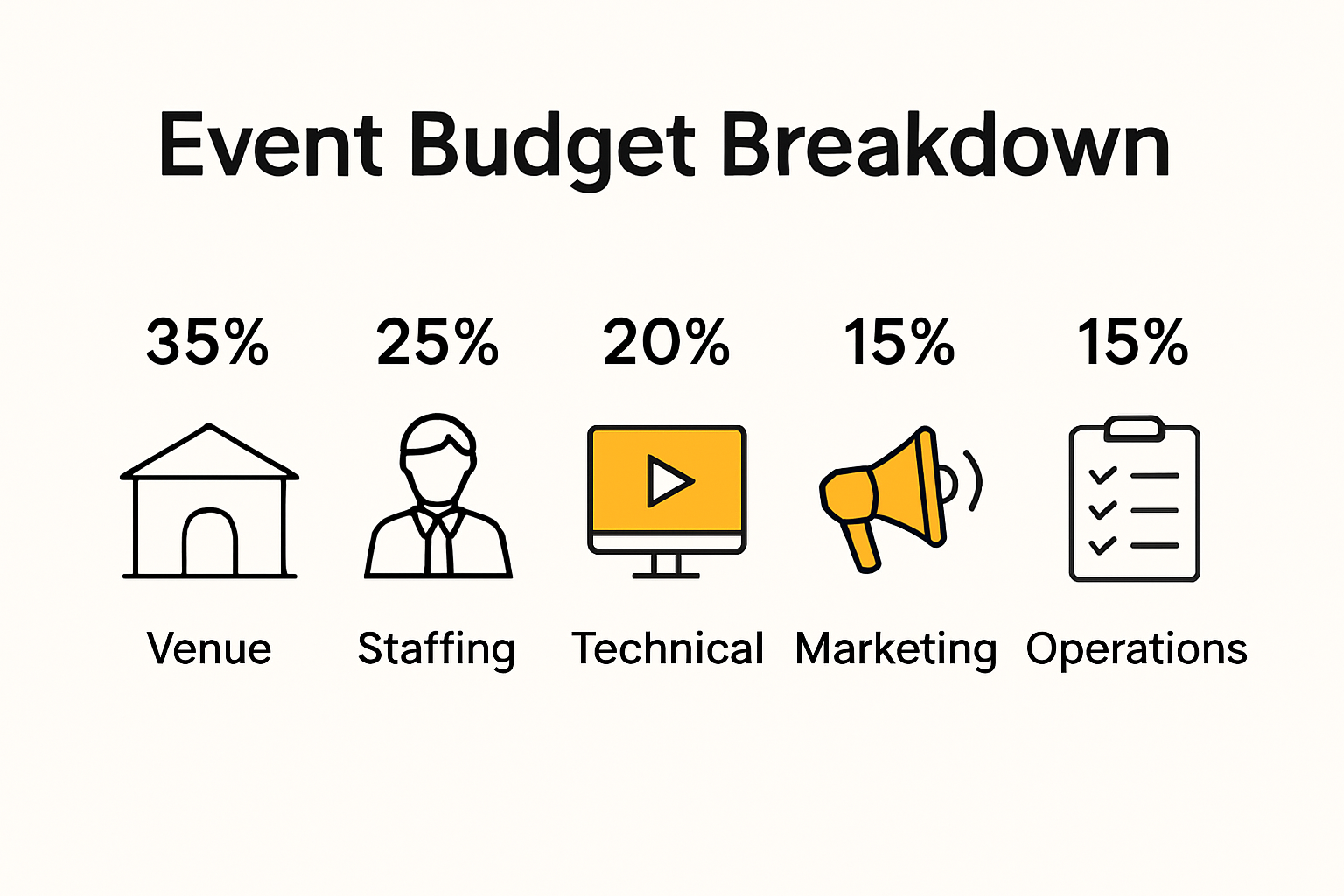
Effective event budget planning involves dissecting multiple financial elements with precision. According to the Event Management Institute, successful budgeting requires systematic identification and prioritization of key event expenditures. Core budget components typically include:
- Venue Costs: Rental fees, setup expenses, and potential additional charges for specialized spaces
- Talent and Staffing: Speaker fees, performer compensation, event staff wages
- Technical Requirements: Audio visual equipment, staging, lighting, sound systems
- Marketing and Promotion: Advertising expenses, digital marketing, print materials
- Operational Expenses: Transportation, catering, security, insurance
Understanding these components allows event professionals to allocate resources strategically and prevent unexpected financial challenges. Each category requires meticulous evaluation and realistic cost projections.
To help visualize these foundational categories, here’s a summary table of common event budget components and related examples:
| Budget Component | Typical Examples |
|---|---|
| Venue Costs | Rental fees, setup charges, special space fees |
| Talent and Staffing | Speaker/performer fees, event staff wages |
| Technical Requirements | AV equipment, staging, lighting, sound systems |
| Marketing and Promotion | Advertising, digital marketing, print materials |
| Operational Expenses | Transportation, catering, security, insurance |
Creating Financial Flexibility
Smart event budget planning goes beyond basic expense tracking. Research from the EVM Institute emphasizes the critical importance of building financial flexibility through strategic contingency planning. Experienced event managers recommend allocating 10-15% of the total budget as a reserve fund to manage unforeseen expenses or last minute adjustments.
This approach transforms budget planning from a rigid financial document into a dynamic financial management tool. By anticipating potential variations and creating buffers, event professionals can navigate unexpected challenges without compromising event quality or financial stability.
The art of event budget planning requires a delicate balance between detailed financial tracking and creative problem solving. It demands not just mathematical precision but strategic thinking that considers every potential financial scenario. Professionals who master this skill can transform complex financial requirements into seamless event experiences that meet both creative vision and economic constraints.
While numbers drive the process, the ultimate goal remains delivering exceptional events that create memorable experiences within defined financial parameters. Learn more about advanced event finance strategies to elevate your budget planning approach and maximize event success.
Step-by-Step Process for Building Your Event Budget
Building an event budget requires a methodical approach that transforms abstract financial goals into a concrete, actionable plan. The process demands careful planning, strategic thinking, and meticulous attention to detail to ensure financial success and event feasibility.
A step-by-step process table provides clarity on the major stages of building an event budget and their key activities:
| Step | Key Activities |
|---|---|
| Initial Financial Assessment & Goal Setting | Define objectives, set targets, conduct market research |
| Detailed Expense Categorization & Allocation | Prioritize costs, identify savings, allocate flexible spending |
| Continuous Budget Monitoring & Adjustment | Ongoing review, modify strategy, respond to changes |
Initial Financial Assessment and Goal Setting
The foundation of effective budget planning starts with a comprehensive financial assessment. Research from Event Management Professionals indicates that successful event budgeting begins with clearly defined objectives and a thorough understanding of financial constraints. Event managers must first:
- Determine Event Scope: Identify the event type, expected attendees, and overall purpose
- Establish Financial Targets: Set clear revenue goals and maximum expenditure limits
- Conduct Market Research: Analyze comparable events and current pricing standards
This initial phase provides a critical framework for all subsequent budgeting decisions. Understanding the financial landscape helps event professionals create realistic and achievable budget parameters.
Detailed Expense Categorization and Allocation
Precise expense categorization is the next crucial step in budget development. According to Event Finance Experts, successful budget creation involves breaking down expenses into granular, manageable categories. Professionals recommend a systematic approach that includes:
- Prioritizing essential expenses
- Identifying potential cost-saving opportunities
- Creating flexible spending allocations
- Developing alternative spending scenarios
By mapping out potential financial paths, event managers can create robust budgets that accommodate various potential outcomes. This approach allows for strategic financial management that balances creativity with fiscal responsibility.
Continuous Budget Monitoring and Adjustment
Budget planning is not a one-time activity but an ongoing process of monitoring and refinement. Event professionals must remain agile, constantly reassessing financial strategies and making real-time adjustments. This dynamic approach ensures financial objectives remain achievable throughout the event planning process.
The most successful event budgets are living documents that evolve with changing circumstances. Regular review and modification allow managers to respond quickly to unexpected challenges or opportunities. Learn more about advanced event financial management to develop a comprehensive understanding of budget optimization.
Ultimately, effective event budget planning is an art form that combines analytical precision with creative problem-solving. It requires a delicate balance between financial constraints and event vision, transforming numerical constraints into memorable experiences that deliver exceptional value.
Common Budgeting Mistakes and Smart Solutions

Event budget planning is fraught with potential pitfalls that can derail even the most well-intentioned projects. Understanding these common mistakes and implementing strategic solutions is crucial for maintaining financial control and event success.
Recognizing Systematic Budgeting Errors
Research by Bent Flyvbjerg reveals that project management often suffers from critical behavioral biases that significantly impact budgeting accuracy. These biases include optimism bias, strategic misrepresentation, and the planning fallacy, which can lead to substantial financial miscalculations.
Common budgeting mistakes event professionals frequently encounter include:
- Underestimating Contingency Costs: Failing to allocate sufficient funds for unexpected expenses
- Overlooking Hidden Expenses: Neglecting secondary costs like permits, insurance, and additional staffing
- Inadequate Financial Tracking: Poor documentation and inconsistent expense monitoring
- Unrealistic Revenue Projections: Overestimating potential income or sponsorship opportunities
These errors can create significant financial strain, potentially compromising the entire event’s viability. Recognizing these potential pitfalls is the first step toward creating a more robust financial strategy.
To help you identify where budget plans often go wrong, the following table summarizes common mistakes and their potential negative impacts:
| Common Budgeting Mistake | Description | Potential Impact |
|---|---|---|
| Underestimating Contingency Costs | Not allocating enough for surprises | Budget overruns, event quality risks |
| Overlooking Hidden Expenses | Missing items like permits or insurance | Unexpected costs, financial strain |
| Inadequate Financial Tracking | Poor monitoring or documentation | Lack of control, missed errors |
| Unrealistic Revenue Projections | Overestimating income sources | Funding gaps, shortfalls |
Strategic Solutions for Budget Management
According to OpenGov’s research, effective budget management requires a proactive and systematic approach. Event professionals can mitigate financial risks by implementing several key strategies:
- Develop comprehensive financial documentation
- Create multiple budget scenarios
- Establish clear communication channels with stakeholders
- Implement regular financial review processes
- Utilize technology for real-time budget tracking
The most successful event managers approach budgeting as a dynamic process, continuously adapting to changing circumstances and potential challenges. This requires flexibility, attention to detail, and a willingness to make real-time adjustments.
Leveraging Technology and Expertise
Modern event budget planning benefits significantly from technological solutions and professional expertise. Learn more about advanced event financial management to gain insights into cutting-edge budgeting techniques. Professional tools and software can provide:
- Automated expense tracking
- Real-time financial reporting
- Predictive budget modeling
- Comprehensive financial analysis
By combining technological solutions with professional expertise, event managers can transform budgeting from a potential source of stress into a strategic advantage. The key lies in maintaining a proactive, informed approach that anticipates challenges and creates flexible financial strategies.
Ultimately, successful budget planning is about more than just numbers. It requires a holistic understanding of event dynamics, financial principles, and the ability to balance creative vision with fiscal responsibility. Professionals who master this delicate balance can create exceptional events that meet both artistic and financial objectives.
Essential Tools and Templates for Better Budgeting
In the complex world of event management, having the right budgeting tools and templates can transform financial planning from a challenging task to a streamlined process. These resources provide structure, clarity, and precision in managing event finances, enabling professionals to make informed decisions quickly and effectively.
Comprehensive Budgeting Template Fundamentals
According to the National Association of Colleges and Employers, a robust event budget template should encompass multiple critical components. The most effective templates include detailed sections for:
- Income Tracking: Documenting all potential revenue streams
- Expense Categorization: Breaking down costs into specific, manageable segments
- Financial Projections: Creating predictive models for potential scenarios
- Real-time Expense Monitoring: Enabling immediate financial updates
- Contingency Allocation: Reserving funds for unexpected expenses
Professional templates go beyond simple spreadsheets. They serve as dynamic financial management tools that provide instant insights into an event’s fiscal health. By offering granular tracking and comprehensive overview capabilities, these templates help event managers maintain precise financial control.
Digital Tools for Advanced Budget Management
Technology has revolutionized event budget planning, introducing sophisticated digital solutions that simplify complex financial tracking. Modern budget management platforms offer features like:
- Automated expense categorization
- Cloud-based collaborative editing
- Real-time financial reporting
- Integration with accounting software
- Predictive financial modeling
These digital tools eliminate manual calculation errors and provide event professionals with instantaneous financial insights. They transform budgeting from a static, time-consuming process into a dynamic, interactive experience that supports strategic decision-making.
Customization and Adaptability in Budgeting Resources
The most valuable budgeting tools are those that offer flexibility and customization. Event managers require resources that can adapt to diverse event types, from corporate conferences to wedding celebrations. Effective templates and tools should:
- Support multiple currency formats
- Allow custom category creation
- Provide scalable financial tracking
- Enable detailed reporting
- Support various event scales
Learn more about advanced event financial management to understand how professional-grade tools can elevate your budgeting approach. The right combination of templates, digital tools, and strategic thinking can transform financial planning from a complex challenge into a precise, manageable process.
Ultimately, successful event budget management is about selecting tools that match your specific needs. By investing in comprehensive, adaptable resources, event professionals can create financial strategies that are both robust and responsive, ensuring events are not just memorable, but financially sound.
Frequently Asked Questions
What are the essential components of an event budget?
The essential components of an event budget typically include venue costs, talent and staffing, technical requirements, marketing and promotion, and operational expenses. Each of these categories must be carefully assessed for effective allocation.
How much should I allocate for contingency expenses in my event budget?
It is recommended to allocate 10-15% of your total event budget for contingency expenses. This reserve helps manage unforeseen costs and last-minute adjustments, ensuring financial stability.
How can I effectively monitor and adjust my event budget?
To effectively monitor and adjust your event budget, treat it as a living document. Regularly review your financial strategy and modify it in response to changes, including budget overruns or new expenses that arise during planning.
What common mistakes should I avoid when planning an event budget?
Common mistakes to avoid when planning an event budget include underestimating contingency costs, overlooking hidden expenses, inadequate financial tracking, and setting unrealistic revenue projections. Recognizing these pitfalls can help prevent financial miscalculations.
Ready to Eliminate Budget Surprises? Upgrade Your Event Planning Skills Today
Event budgeting mistakes and hidden costs have left many professionals frustrated, anxious, and unable to deliver the experiences they imagine. If you found yourself nodding along to the challenges in this guide—estimating expenses, tracking real-time budgets, or building contingency plans—it might be time to take a step up. The Event Literacy resources at team I are crafted for anyone serious about mastering advanced event budget strategies, using industry-verified frameworks and real case learning.
Don’t just dream of flawless financial planning. Make it a reality with expert guidance, hands-on practice, and top-tier tools. Visit teami.org now to explore courses or discover advanced approaches in Event Literacy that can help you launch your next event project with total confidence. Your path to professional event management and worry-free budgets starts here—secure your spot before the next session fills up.
Recommended
- What is Event Management? – team I
- How Event Management Aspirants and Students Can Make Best Use of This Quarantine Period – team I
- The Future Importance of Event Marketing Within Companies – team I
- What are the different types of Events? – team I
Thinking about a career in event management?
team I is Bangalore’s only EEMA-certified event management institute, running for 24 years, where students work on real live events with real budgets and real deadlines rather than classroom simulations. See the full range of event management courses in Bangalore, or go straight to the flagship Certificate Program in Event Management (CPEM).