

Over 60 percent of British event planners rank venue selection as the most decisive factor for overall success. Choosing the right space sets the scene for every guest and shapes the impact of your event, whether it is a corporate meeting or a community fundraiser. From goal setting to contract negotiations, this step by step guide uncovers crucial details and pro tips that empower you to secure the best venue and avoid costly missteps.
Table of Contents
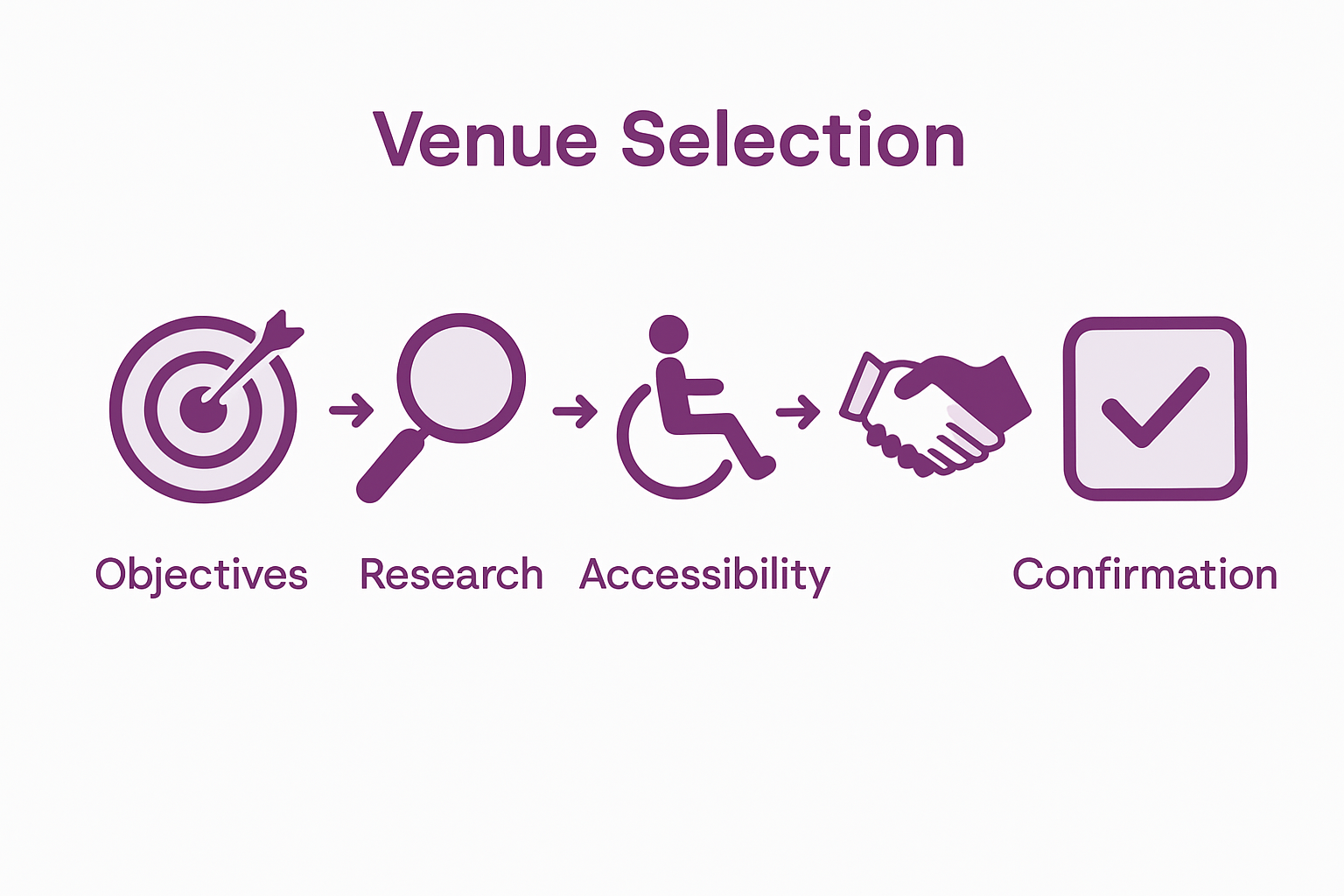
- Step 1: Define Event Objectives And Venue Criteria
- Step 2: Research Suitable Venues Within Your Budget
- Step 3: Evaluate Venue Accessibility And Facilities
- Step 4: Assess Risks And Negotiate With Venue Providers
- Step 5: Confirm And Secure Your Chosen Event Venue
Quick Summary
| Key Point | Explanation |
|---|---|
| 1. Define objectives and venue criteria | Clearly articulate your event’s purpose and specific criteria for the venue to guide effective planning decisions. |
| 2. Research venues within budget | Analyze venue options comprehensively, comparing costs and hidden fees to find the best value for your financial constraints. |
| 3. Evaluate accessibility and facilities | Thoroughly assess the venue’s accessibility features and technological capabilities to ensure a positive attendee experience. |
| 4. Assess risks and negotiate effectively | Review contracts carefully and negotiate directly with venue providers to mitigate risks and secure favourable terms. |
| 5. Confirm and secure your venue | Submit all necessary reservation documents and verify logistical details to solidify your venue choice for the event. |
Step 1: Define event objectives and venue criteria
Defining clear event objectives and precise venue criteria forms the foundational blueprint for successful event management. This critical first step transforms abstract ideas into actionable planning strategies that will guide every subsequent decision.
When establishing event objectives, start by comprehensively articulating the purpose of your gathering. Are you hosting a corporate conference, wedding celebration, academic symposium, or product launch? Each event type demands unique considerations. Identifying specific audience requirements and logistical needs allows you to create a targeted venue selection approach.
Your venue criteria should encompass multiple dimensions beyond mere physical space. Consider factors like capacity, technological infrastructure, accessibility, parking facilities, and geographical convenience. Some technical specifications require particularly careful evaluation. Spatial characteristics such as ceiling height, potential sight line configurations, ambient light control, and delivery accessibility will significantly impact event execution. Professional event planners recommend creating a structured checklist that systematically evaluates potential venues against your predefined objectives.
A strategic pro tip: Always conduct an in person venue inspection before making a final commitment. Photographs and virtual tours provide useful preliminary insights, but physically walking the space reveals nuanced details that digital representations cannot capture.
With your objectives and venue criteria meticulously defined, you are now prepared to progress to the next crucial stage of venue research and selection.
Step 2: Research suitable venues within your budget
Researching suitable venues that align with your financial constraints is a strategic process requiring careful analysis and creative problem solving. This step transforms your initial venue criteria into practical options that balance quality and affordability.

Comparing prices across multiple venues represents the cornerstone of intelligent venue selection. Professional event planners recommend developing a comprehensive spreadsheet that tracks venue costs, included amenities, potential discounts, and additional service charges. Consider exploring unconventional timing options such as weekday or off peak season dates which often feature significantly reduced rates. Many venues offer substantial discounts during non peak periods particularly for corporate events or conferences.
Beyond basic pricing, scrutinise the total cost structure. Hidden expenses like audiovisual equipment rentals, staffing fees, parking charges, and catering minimums can dramatically inflate your initial budget. Request detailed quotations from each potential venue and create a side by side comparison that reveals the true financial commitment. Some venues might appear expensive initially but include comprehensive packages that ultimately provide better value.
A strategic pro tip: Always negotiate and maintain flexibility. Venue managers are often willing to customise packages or offer promotional rates, especially during slower booking periods. Approach negotiations professionally by demonstrating your understanding of market rates and expressing genuine interest in establishing a mutually beneficial arrangement.
With your research completed and potential venues evaluated, you are now prepared to progress to the next crucial stage of venue selection and preliminary discussions.
Step 3: Evaluate venue accessibility and facilities
Evaluating venue accessibility and facilities represents a critical phase in event planning that directly impacts participant experience and overall event success. This comprehensive assessment goes beyond superficial considerations to ensure every logistical detail supports your event objectives.
Assessing venue accessibility requires a systematic approach that considers multiple dimensions of attendee mobility and convenience. Begin by examining physical accessibility features such as wheelchair ramps, elevator access, and designated parking for individuals with mobility challenges. Investigate the venue’s proximity to public transportation routes and evaluate the ease with which participants can reach the location. Consider the walking distance from nearest train stations or bus stops and the availability of clear signage to guide attendees.
Beyond physical access, scrutinise the venue’s technological and operational facilities. Modern events demand sophisticated infrastructure including robust WiFi connectivity, high quality audiovisual equipment, adequate electrical outlets, and flexible spaces that can be configured for different session formats. Professional event planners recommend creating a detailed checklist that comprehensively documents each facility requirement. Pay particular attention to aspects like breakout room availability, sound system capabilities, projection equipment quality, and technical support options.
A strategic pro tip: Always conduct an on site inspection to validate the venue’s actual capabilities. Promotional materials and online descriptions can be misleading, so personal verification remains crucial. Request a comprehensive tour that allows you to test technical equipment, assess spatial configurations, and identify potential logistical challenges before making a final commitment.
With a thorough evaluation of accessibility and facilities completed, you are now prepared to progress to the next critical stage of venue selection and detailed negotiations.
Step 4: Assess risks and negotiate with venue providers
Assessing risks and negotiating with venue providers represents a sophisticated process that requires strategic thinking, legal awareness, and diplomatic communication skills. This critical stage transforms your venue selection from a transactional interaction into a collaborative partnership that protects your event’s interests.
Reviewing venue contracts meticulously forms the cornerstone of effective risk management. Scrutinise every contractual detail including precise date and time specifications, comprehensive fee structures, cancellation policies, and potential additional charges. Pay special attention to hidden expenses such as security deposits, overtime rates, equipment usage fees, and insurance requirements. Experienced event professionals recommend creating a detailed comparison matrix that captures all financial and operational commitments across potential venues.
Negotiation requires a balanced approach combining professionalism and strategic flexibility. Research market rates to establish a realistic baseline for discussions, and prepare a clear understanding of your non negotiable requirements versus areas where you can compromise. Consider exploring potential discounts such as off peak timing, bulk booking advantages, or nonprofit organisational status. Develop a comprehensive contingency plan that addresses potential disruptions including venue unavailability, technical failures, or unexpected capacity constraints.
A strategic pro tip: Always maintain written documentation of all negotiations and agreements. Verbal promises hold little legal weight, so ensure every discussed detail is explicitly captured in the final contract. Request clarification on ambiguous terms and do not hesitate to seek legal counsel if complex contractual language seems challenging to interpret.
With thorough risk assessment and strategic negotiations completed, you are now prepared to progress towards finalising your venue selection and executing your event planning strategy.
Step 5: Confirm and secure your chosen event venue
Confirming and securing your chosen event venue represents the pivotal moment where your strategic planning transforms into tangible event preparation. This critical stage solidifies your logistical foundation and ensures your event vision can become reality.
Submitting official venue reservation documentation serves as the cornerstone of venue confirmation. Begin by meticulously preparing and submitting all required registration forms to the venue management or relevant administrative office. Ensure these documents comprehensively capture event details including precise date, expected attendee numbers, specific space requirements, and any special arrangements or equipment needs. Professional event managers recommend creating a detailed event registration package that anticipates potential administrative queries and demonstrates your organisational thoroughness.
Beyond paperwork, verify practical logistical considerations that guarantee a smooth event experience. Confirm the venue can comfortably accommodate your expected attendee numbers, has appropriate accessibility features, and provides necessary technical infrastructure. Conduct a comprehensive walkthrough to assess physical space configurations, parking availability, audiovisual capabilities, and potential contingency spaces. Develop a backup plan that addresses potential venue capacity challenges or unexpected logistical constraints.
A strategic pro tip: Always request written confirmation of your venue reservation. Digital or physical documentation serves as legal protection and provides a clear reference point for future communications. Maintain copies of all correspondence and ensure you understand the venue provider’s cancellation policies and potential financial implications.
With your venue officially secured and all documentation in order, you are now prepared to progress towards the exciting phase of detailed event planning and execution.
Master Venue Selection with Expert Event Management Training
Selecting the perfect venue involves juggling multiple critical factors such as accessibility, budget constraints, facility requirements and contract negotiations. These challenges often leave aspiring event managers feeling overwhelmed and uncertain about the best strategies to secure an ideal location. By understanding concepts like detailed venue criteria, risk assessment and effective negotiation tactics you are already on the path to success.
To transform these key learnings into practical skills and confidence, explore specialised education at teami.org — a leading institute with 24 years of experience in event management training. Their certification programmes offer structured guidance through real-world event planning situations including venue selection and client management. Are you ready to accelerate your career and master the entire event process from initial planning to flawless execution Take the next step now by visiting teami.org and register for a course that equips you with hands-on expertise and industry connections necessary for success.
Frequently Asked Questions
How do I define clear event objectives for venue selection?
Defining clear event objectives starts by articulating the purpose of your event. Identify the type of gathering, such as a corporate conference or wedding, and consider the specific audience and logistical needs involved.
What criteria should I use when selecting a venue?
When selecting a venue, consider factors such as capacity, technological infrastructure, accessibility, and parking facilities. Create a checklist that evaluates venues against your predefined objectives to ensure a comprehensive assessment.
How can I research suitable venues within my budget?
Research suitable venues by comparing prices and evaluating hidden costs such as audiovisual rentals and catering fees. Develop a spreadsheet to track venue expenses, and consider off-peak booking options to save on costs.
What should I evaluate regarding venue accessibility and facilities?
When evaluating venue accessibility, look for features like wheelchair ramps and proximity to public transport. Also, assess technological capabilities, including Wi-Fi access and audiovisual equipment, to ensure the venue meets your event’s needs.
How do I negotiate with venue providers effectively?
To negotiate effectively, research market rates to establish a baseline and prepare your non-negotiable requirements. Document all agreements in writing, and be flexible to explore potential discounts or custom packages during discussions.
What steps do I take to confirm and secure my chosen venue?
To confirm your chosen venue, submit all required reservation documentation and verify that logistical considerations are met. Request written confirmation of the reservation and maintain copies of all correspondence for your records.
Recommended
- 7 Creative Tips for Using Unconventional Event Venues – team I
- How to Get Clients for Events: Proven Steps for Success – team I
- How to Start Event Management Company: Complete Guide – team I
- 7 Jobs After Event Management to Boost Your Career – team I
Thinking about a career in event management?
team I is Bangalore’s only EEMA-certified event management institute, running for 24 years, where students work on real live events with real budgets and real deadlines rather than classroom simulations. See the full range of event management courses in Bangalore, or go straight to the flagship Certificate Program in Event Management (CPEM).