
You are coordinating a 400-person corporate gala in Hyderabad, your vendor confirmation sheet has three gaps, and it is 6 AM on event day. Sound familiar? Whether you are a working professional in Bangalore or a student juggling college festivals and coursework in Mumbai, poor time management does not just slow you down. It burns you out and costs you opportunities. A structured time management skills workshop gives you frameworks that actually hold up under that kind of pressure, turning reactive scrambling into deliberate, confident execution.
Table of Contents
- Preparing for a time management workshop
- Core techniques taught in workshops
- Challenges you will face after the workshop
- Measuring your progress after the workshop
- My honest take on time management workshops
- Build these skills with Teami
- FAQ
Preparing for a time management workshop
You would not walk into an event day without a runsheet. The same logic applies here.
Workshop formats vary significantly: professional workshops run 4 to 8 hours, often as full-day or half-day sessions, while student-focused formats are shorter, typically 30 to 50 minutes, designed to fit within academic schedules. You will find in-person sessions, live online cohorts, and self-paced digital modules, each at different price points. A full-day professional workshop typically awards 8 Professional Development Units and can cost anywhere from $20 to $450 depending on delivery method.
Before you attend, do this:
- Write out your current workload. What are you actually juggling right now? A Delhi corporate event brief, three vendor calls, and a pending sponsor deck? Bring that list. Participants who bring real to-do lists see dramatically better outcomes because the techniques get tested against actual tasks, not hypothetical ones.
- Pick two or three personal goals. Are you trying to stop missing follow-up deadlines? Cut context switching during event setup? Get specific before you walk in.
- Identify your current scheduling tool. Whether it is Google Calendar, a paper diary, or a WhatsApp reminder, know what you are working with so the workshop techniques can plug into your existing system.
- Note your biggest time drain. For most event professionals in India, it is unplanned client calls and vendor chasing. For students, it is last-minute assignment panic. Naming the problem sharpens your focus.
Customised training that addresses your specific environment consistently produces better adoption of skills than generic workshops do. Go in knowing what you need.
Pro Tip: Take a five-minute workload audit the evening before your workshop. Write down every active task, its deadline, and roughly how long you think it will take. You will use this during exercises and come out with a working plan, not just a theory.
Core techniques taught in workshops
This is where a good time management seminar stops being motivational and starts being mechanical.
The best workshops do not hand you a productivity philosophy. They hand you tools. Here are the four most impactful techniques you will encounter, mapped to real event industry scenarios.
-
The Eisenhower matrix. Categorise every task by urgency and importance. For an event planner in Chennai, “confirm stage rigging” the morning before a concert is urgent and important. “Research new décor trends” is important but not urgent. Most professionals lose hours on tasks that feel urgent but are actually low-importance, like replying to every WhatsApp message in real time. The matrix forces honesty.
-
The 80/20 rule. Time-blocking and prioritisation consistently show that roughly 20% of your tasks produce 80% of your results. For event work, that 20% almost always includes vendor confirmations, client sign-offs, and logistics walk-throughs. Everything else, from formatting a proposal to colour-coding a spreadsheet, can wait or be delegated.
-
Time-blocking and task batching. You do not answer vendor calls while simultaneously building a budget sheet. These are two different modes of thinking. Reducing productivity loss from interruptions by up to 40% is achievable when you batch similar tasks together and defend your focus blocks. Block 9 AM to 11 AM for communication. Block 2 PM to 4 PM for creative or logistical work. Guard those blocks.
-
Building a trusted capture system. One place for everything. Not your phone notes, your email drafts, and a sticky note on your monitor all at once. A single trusted system to capture every task reduces cognitive load, prevents missed deadlines, and cuts the anxiety that comes from constantly wondering what you have forgotten.
Here is a quick comparison of how these techniques apply differently across two common profiles:
| Technique | Event professional in Bangalore | Student at a college festival |
|---|---|---|
| Eisenhower matrix | Prioritise day-of logistics vs. future planning | Separate exam prep from event committee tasks |
| 80/20 rule | Focus on vendor and client communication | Focus on delegation and rehearsal scheduling |
| Time-blocking | Protect logistics hours from ad-hoc calls | Block study hours separate from event work |
| Capture system | One shared team task tracker | Personal planner or Notion board |
Pro Tip: Try task batching for a single week before your next event. Group all vendor calls into one 90-minute slot and all written communication into another. You will be genuinely surprised how much faster you move.
Challenges you will face after the workshop
Attending a workshop is the easy part. Keeping the momentum going in the middle of a Mumbai wedding season or final exam week is where most people fall short.

The first obstacle is time blindness. Most people underestimate task durations by 20 to 50%. You assume a vendor brief takes 20 minutes. It takes 55. This is not laziness. It is a well-documented cognitive bias, and it wrecks even the best-laid schedules.
Distractions in the Indian event context are uniquely intense. You have family WhatsApp groups, client calls at 11 PM, spontaneous on-site changes, and the social pressure to always be “available.” These are real environmental challenges that generic productivity advice does not address.
Here is how you push through:
- Set micro-deadlines. Instead of “finish the event brief by Friday,” set “complete venue section by 2 PM today.” Smaller targets create momentum and make procrastination harder to justify.
- Gamify your tasks. Give yourself a specific reward for completing a focus block. It sounds trivial. It works. The dopamine hit from ticking off a timed task is real and habit-forming.
- Run a weekly self-audit. Every Sunday, spend ten minutes reviewing what you planned versus what you actually completed. No judgement. Just data. Adjust next week’s plan accordingly.
“Workshops that move beyond generic advice to address personality and environment see better participant engagement and longer-term success.” Source: HRDQU Time Management Strategies Webinar
The takeaway: your system needs to fit your life, not the other way around.
Measuring your progress after the workshop
The real test of any time management training is what happens in the weeks after, not during.
Start with specific, measurable goals. Not “be more productive” but “submit all client recaps within 24 hours of an event” or “complete daily task planning before 9 AM every working day.” Vague goals evaporate. Concrete ones stick.
Tracking systems and reflective journals consistently appear in post-workshop success stories among event professionals. You spend five minutes at the end of each workday rating your focus, noting what derailed you, and flagging what needs to shift tomorrow. After two weeks, patterns emerge. You will see clearly whether your biggest issue is mornings, afternoons, or specific types of tasks.
Pro Tip: Use a simple table in a notes app: three columns. “Planned,” “Completed,” and “Reason for gap.” Fill it in daily for two weeks. You will have more insight into your own productivity than any personality test can offer.
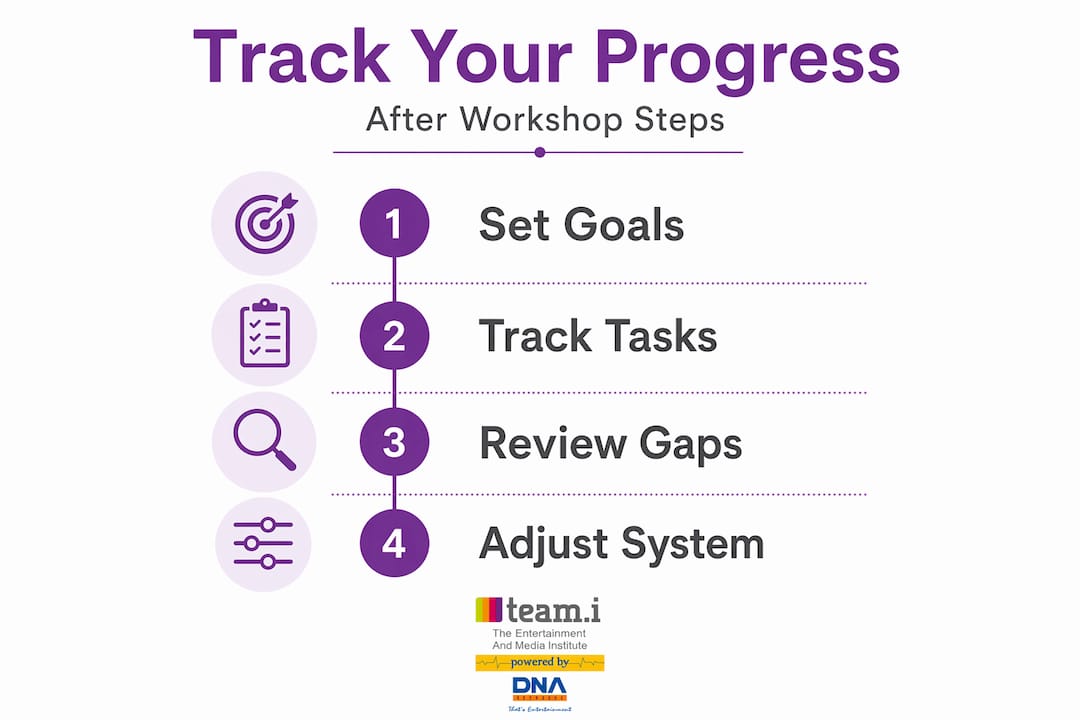
Here is what progress typically looks like across key metrics:
| Metric | Before workshop | After four weeks |
|---|---|---|
| Missed deadlines per week | 3 or more | 1 or fewer |
| Reactive vs. planned work ratio | 70% reactive | 50% planned or better |
| End-of-day clarity on tomorrow | Rarely | Most days |
| Stress level on event day | High | Manageable |
Personalised time management strategies are not optional extras. They are the difference between techniques that stick and techniques that fade after a fortnight.
My honest take on time management workshops
I have sat through time management seminars that felt like watching someone read a self-help book aloud. And I have sat through ones that genuinely changed how I work. The difference is always specificity.
Generic advice tells you to “prioritise.” Real workshop training makes you sit down with your actual task list, in real time, and force-rank it against your energy levels and deadlines. When I first applied time-blocking during a large corporate event week in Bangalore, I initially hated it because it exposed how much I was context-switching unnecessarily. That discomfort was the point.
What I have learnt is this: workshops give you a framework. They do not give you discipline. The framework has to be tested against your messiest week, the one with three vendor crises and a last-minute client change, before it becomes truly yours. If it survives that, keep it. If it does not, adjust it. Treat every technique as a working hypothesis, not a rule. The professionals who genuinely master time management are not the ones following a perfect system. They are the ones who keep adapting a good-enough system.
— Teami
Build these skills with Teami
Teami’s event management courses are built around the reality of India’s event industry, not a textbook version of it. The curriculum covers time management training as part of live event production across Bangalore, Mumbai, Delhi, and Hyderabad, so you practise these skills under conditions that actually mirror the job. If you are a student looking for productivity strategies for event students or a professional ready to go deeper, Teami has a path for you. Explore the full event management course details and see how structured, industry-driven training turns workshop techniques into career-defining habits.
FAQ
How long does a time management skills workshop last?
Professional workshops typically run 4 to 8 hours, while student-focused sessions are shorter, usually 30 to 50 minutes. The format depends on whether the session is in-person, online, or self-paced.
What activities are covered in a time management workshop?
Most workshops include exercises around the Eisenhower matrix, the 80/20 rule, time-blocking, and building a personal capture system. Participants who bring real workloads to these activities get the most practical value.
How do I know if a time management workshop worked?
Track specific metrics before and after: missed deadlines, reactive versus planned work ratio, and daily clarity on priorities. Reflective tracking over four weeks reveals whether the techniques are genuinely sticking.
Why do time management strategies sometimes stop working?
Often because the strategy does not fit the individual’s environment or energy rhythms. Time blindness and underestimating task durations are common culprits. Personalising your approach after a workshop is what separates short-term wins from lasting change.
Are time management workshops worth it for event students specifically?
Yes, particularly workshops that address real workload scenarios rather than generic productivity theory. Customised training aligned to actual responsibilities consistently shows higher skill adoption, which matters enormously when you are balancing coursework with live event coordination.