
TL;DR:
- The Indian media event industry is rapidly expanding, requiring specialized technical and managerial skills.
- Structured planning frameworks and certification significantly enhance career prospects and ability to handle crises.
- Hands-on industry experience and industry partnerships are crucial for success in India’s complex media events.
India’s media event industry isn’t just growing. It’s accelerating at a pace that’s leaving generalist event managers scrambling. The Indian event industry is projected to reach between ₹5.5 and 10,000 crore by 2028 to 2030, growing at a CAGR of 10 to 25%. For media professionals, that represents an enormous opportunity. But here’s the uncomfortable truth: general event management skills won’t cut it in this space. Entertainment launches, broadcast events, celebrity appearances, and hybrid digital productions demand a completely different toolkit. Specialised training isn’t a bonus anymore. It’s the new baseline.
Table of Contents
- Why media event management demands specialised skills
- Key methodologies and frameworks for media event success
- Specialised training: Programmes, certification, and career impact
- Real-world challenges: Indian media events and crisis management
- What most event management guides miss about media careers
- Next steps for your media event career
- Frequently asked questions
Key Takeaways
| Point | Details |
|---|---|
| Specialised skills required | Technical, crisis management, and hybrid tech expertise are vital for media event management success. |
| Certified training boosts careers | Formal programmes and internships lead to higher placements and salaries in entertainment event roles. |
| Frameworks drive success | Modern event methodologies and risk management tools ensure effective planning and execution in India. |
| Real-world challenges matter | Edge cases like monsoon disruptions and celebrity incidents test the practical skills of media event professionals. |
Why media event management demands specialised skills
Most event management guides treat every event as roughly equal. Set a budget, book a venue, manage a guest list. Done. Media events laugh at that checklist.
When you’re coordinating a Bollywood film launch or a live broadcast production, you’re dealing with technical complexity that includes layered AV systems, live streaming integration, AR and VR activations, and real-time PR management. General events rarely require you to manage a celebrity’s mood and a satellite uplink simultaneously. Media events do.
Consider what sets media event management apart from standard corporate or social event planning:
| Factor | General events | Media events |
|---|---|---|
| Technical production | Basic AV setup | Multi-layer AV, broadcast rigs, live streaming |
| Stakeholder complexity | Clients and vendors | Celebrities, PR teams, broadcasters, sponsors |
| Digital integration | Optional | Essential (hybrid, phygital, AR/VR) |
| Crisis stakes | Moderate | Extremely high, reputational and financial |
| Growth rate | Steady | 10 to 25% CAGR in India |
The event management career in India is evolving fast, and the media segment is setting the pace. Entertainment launches, music festivals, IPL-adjacent brand events, and OTT platform activations are now standard deliverables for professionals in this field.
Beyond the technical demands, Indian media events come with a uniquely challenging set of variables:
- Monsoon disruptions affecting outdoor broadcast setups and live audience events
- Municipal permit delays that can derail schedules by days
- Celebrity management crises including last-minute cancellations and protocol breaches
- Digital feed failures during hybrid events with global audiences watching live
- Crowd flow logistics at high-footfall entertainment venues
Using event engagement techniques that work for retail or corporate environments won’t translate directly into entertainment settings where audiences are sharper and expectations are considerably higher.
Pro Tip: If you’re transitioning from general event work into media, begin by shadowing broadcast production teams at regional entertainment events. The gap between what you know and what’s required becomes very clear, very quickly.
Key methodologies and frameworks for media event success
Knowing the challenges is step one. Knowing how to systematically counter them is where your real value as a media event professional is built.
The methodologies used by seasoned professionals include structured planning tools that most generalists simply haven’t been trained on. Here’s a quick breakdown of the essential frameworks:
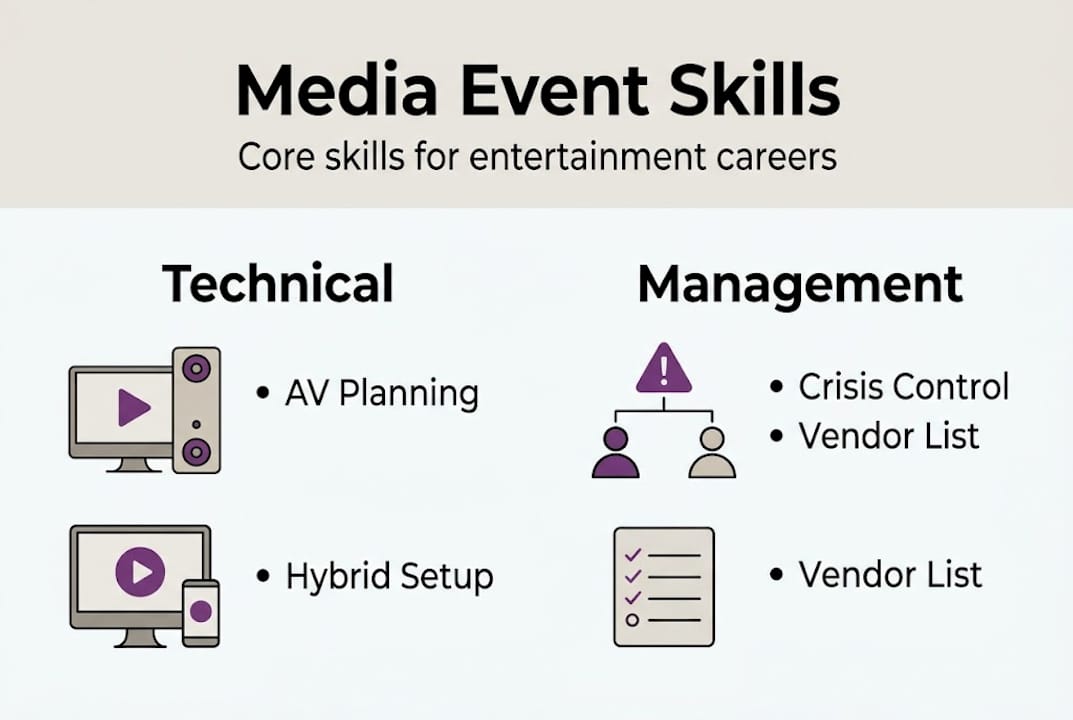
| Methodology | What it does | Why it matters for media events |
|---|---|---|
| Work Breakdown Structure (WBS) | Divides event into granular tasks | Prevents critical media production steps from being missed |
| RACI Matrix | Assigns Responsible, Accountable, Consulted, Informed roles | Cuts confusion during high-pressure broadcast windows |
| CPM/PERT | Maps critical path and timelines | Essential for multi-stage entertainment productions |
| VR pre-visualisation | Digital rehearsal of the event space | Catches staging and AV issues before load-in day |
| Phygital integration | Blends physical and digital audience experience | Baseline for hybrid entertainment events in 2026 |
These frameworks aren’t optional extras. They’re the operating system behind every successful media event. When a live stream drops mid-performance, having a RACI matrix means everyone knows exactly who picks up the phone and who executes the fix.
A structured approach to planning a major media event typically follows these steps:
- Define the event scope using a WBS, breaking down production, logistics, talent, and digital streams separately
- Map your critical path with CPM to identify which tasks cannot be delayed without impacting the show
- Assign RACI roles across departments including AV, PR, celebrity management, and digital broadcast
- Conduct a VR pre-visualisation of the main stage, entry points, and broadcast positions
- Build crisis protocols into every phase, including backup suppliers and emergency communication trees
- Run a dry rehearsal 24 hours before the event with all technical systems live
Real event internships in India are where these frameworks shift from classroom theory to muscle memory. You can study a RACI matrix in a lecture. You only truly understand it when a celebrity’s security team ignores it at 8 PM on show night.
Understanding event manager salary insights also reveals why mastering these methodologies pays off directly. Professionals who demonstrate framework literacy command significantly higher fees and placement opportunities.
Pro Tip: Always build a secondary supplier list into your WBS before finalising your event plan. In India’s media event landscape, having a confirmed backup AV vendor isn’t pessimism. It’s professionalism.
Specialised training: Programmes, certification, and career impact
Once you understand the technical frameworks, the training that actually builds these skills becomes non-negotiable. Not all courses are equal.
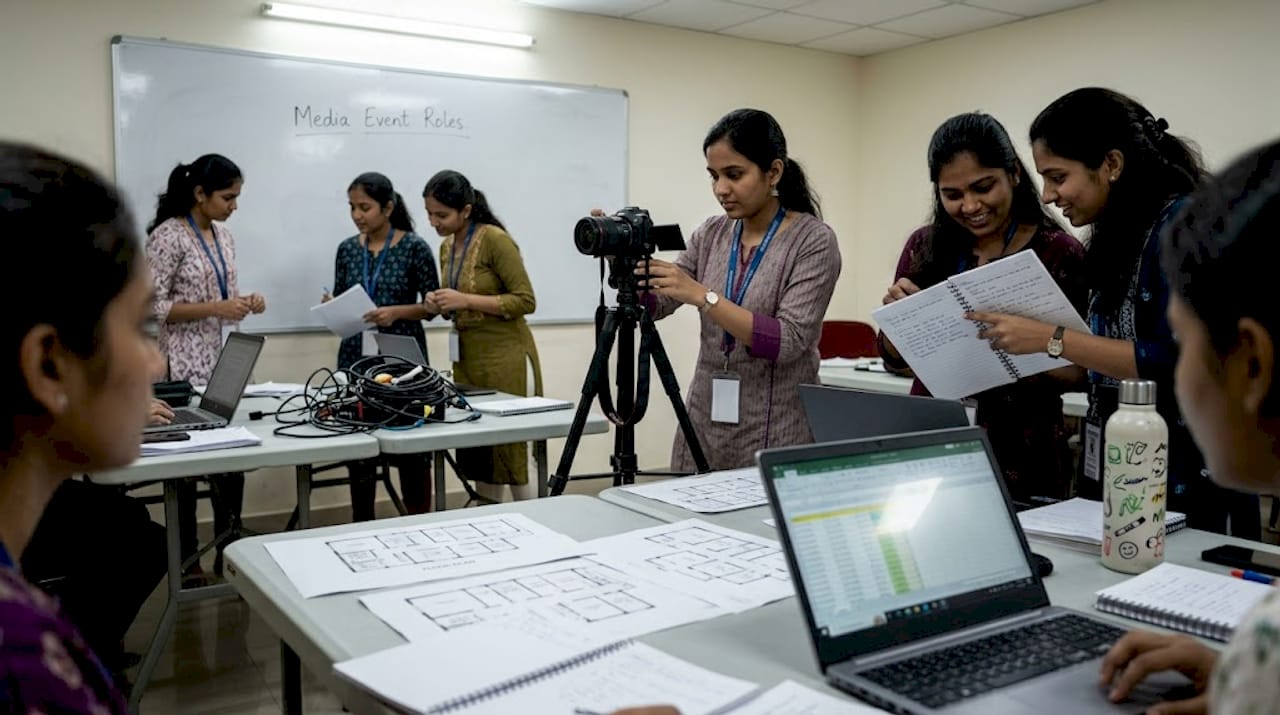
Top event courses for media professionals prioritise practical exposure, industry mentorship, and specialisation in entertainment environments. The difference between a certificate and a credential that opens doors lies in what you actually do during the programme.
team I’s Advanced Program in Event Management, known as APEM, runs for 12 months as a blended learning course and includes six distinct internships. That’s not a token placement. That’s six opportunities to work on real productions, build industry contacts, and develop your crisis management instincts in live environments. The programme specifically targets entertainment sector entry, covering event entrepreneurship, phygital production, and media-specific project management.
The numbers back the value of certification clearly. Certified training boosts placements by 40% and produces salaries that are 15 to 20% higher compared to uncertified candidates entering the same roles.
“The professionals who rise fastest in India’s media event space aren’t just creative. They’re operationally rigorous, crisis-ready, and certified. Certification signals to employers that you’ve been tested under real conditions, not just classroom ones.”
The career pathways that open up after specialised training span a genuinely exciting range:
- Entertainment production manager for OTT platform events and film launches
- Television broadcast event coordinator managing live audience shows
- Live music and festival operations lead across India’s growing live events circuit
- Corporate entertainment specialist for brand-driven media experiences
- Hybrid event producer combining physical production with digital broadcast delivery
Understanding the full weight of event management certification in today’s industry makes the choice straightforward. You can spend years learning on the job, absorbing lessons through costly mistakes. Or you can enter the field already carrying the frameworks, contacts, and credentials that signal you’re ready for the big stage.
Real-world challenges: Indian media events and crisis management
Theory meets practice in some of India’s most demanding live entertainment environments. And the practice is brutal in the best possible way.
Edge cases in Indian media events include AV failures during live broadcast windows, last-minute permit withdrawals from municipal authorities, and celebrity mismanagement situations such as the widely discussed Dino Morea incident, where inadequate pre-event protocol planning created a public relations crisis. These aren’t hypotheticals. They’re case studies that trained professionals learn from directly.
The technical and audience risks you’ll face in media events include:
- Live streaming outages during high-viewership hybrid productions
- Power fluctuations affecting lighting rigs and sound systems mid-show
- Unauthorised stage access by overzealous fans at entertainment events
- Celebrity protocol breaches when security, PR, and logistics teams aren’t aligned
- Permit revocations issued hours before gates open, requiring immediate contingency execution
The professionals who handle these moments without losing the room share one common trait: they planned for failure before they planned for success.
Best practices in media event career guidance consistently emphasise pre-event crisis simulation as a non-negotiable step. Walk your team through the worst-case scenarios. Assign decision authority clearly. Know exactly who speaks to the press if something goes wrong.
“Crisis management in media events isn’t about staying calm. It’s about having already made the hard decisions before the crisis arrives.”
Understanding the full breadth of event management roles makes it clear that crisis handling is a core competency, not a peripheral skill. The media event managers who build reputations are the ones who turn a technical disaster into an invisible moment that the audience never notices.
Pro Tip: Create a one-page crisis card for every major media event you manage. It should list your backup AV supplier, your permit officer’s direct number, your celebrity liaison contact, and your pre-approved press statement template. Keep it laminated. Keep it on you.
What most event management guides miss about media careers
Here’s the perspective most career guides won’t give you. The real differentiator in India’s media event industry isn’t your qualification on paper. It’s whether your qualification was earned in rooms where real decisions had to be made.
Most conventional training programmes treat crisis communication as a module. In reality, it’s the entire job. The Indian media event landscape is uniquely volatile. Weather, bureaucracy, celebrity egos, and digital infrastructure gaps all collide in ways that no purely academic curriculum prepares you for.
Where genuine advantage is built is through industry learning partnerships that place you inside real productions alongside working professionals. Organisations like DNA Entertainment Networks don’t just provide internships. They provide context. When you see how mega IPs are actually run, the frameworks you’ve studied suddenly become second nature rather than abstract diagrams.
Networking built during hands-on training is also deeply undervalued. The media event industry in India runs on trust and reputation. Your first three jobs will likely come from people you met during a production, not from a job portal. Certified practical exposure doesn’t just build skills. It builds the room you’ll be working in for the next decade.
Next steps for your media event career
If this article has done its job, you’re no longer asking whether specialised training matters. You’re asking where to start. team I offers structured pathways designed specifically for media and entertainment professionals ready to take the next step. Begin with a detailed event management course guide to understand which programme fits your current experience level. If flexibility matters to you, explore the online event management programme designed for working professionals. And if hands-on production experience is your priority, discover how event work experience through team I places you directly inside live entertainment events from day one.
Frequently asked questions
What makes media event management different from general event planning?
Media events demand advanced technical production skills, real-time PR management, and hybrid technology integration such as AR/VR and live streaming, which are rarely emphasised in general event planning programmes.
Do certified event management programmes improve job prospects in the entertainment industry?
Yes. Certified programmes boost placement rates by 40% and result in salaries that are 15 to 20% higher for candidates entering India’s media event sector.
What is an example of a crisis management situation in Indian media events?
The Dino Morea incident is a widely cited case where inadequate pre-event protocol planning led to celebrity mismanagement, requiring immediate crisis communication and logistical backup execution.
How long do specialised media-focused event management courses typically last?
team I’s APEM blended programme runs for 12 months and includes six internships, providing sustained hands-on exposure across real entertainment industry productions.
Recommended
- Advance your career: event management in media industry – team I
- Event Management as a Career – team I
- Media and Entertainment Trends – Shaping Event Careers – team I
- Events Management Work Experience: Pathways to Career Success – team I
Thinking about a career in event management?
team I is Bangalore’s only EEMA-certified event management institute, running for 24 years, where students work on real live events with real budgets and real deadlines rather than classroom simulations. See the full range of event management courses in Bangalore, or go straight to the flagship Certificate Program in Event Management (CPEM).