TL;DR:
- India’s media events sector is rapidly growing, offering high salary potential and diverse career paths.
- Success requires technical, creative, soft skills, and specialization in media event management.
- Embracing technology and industry trends is essential for future-ready media event professionals.
India’s events sector is worth USD 14.30 Billion and growing fast, yet thousands of roles go unfilled every year because not enough people have the right training. If you have ever watched a Bollywood award show or a massive music festival and thought, “I want to be behind that,” you are not dreaming too big. You are just missing the roadmap. This guide breaks down what event management in the media industry actually looks like in India, which skills and certifications open the right doors, and how you can position yourself for a career that is anything but ordinary.
Table of Contents
- Understanding event management in the media industry
- Key skills and pathways: launching your media event career
- Comparing roles: event management for media vs. other industries
- Top trends and future opportunities in media event management
- A fresh perspective: what young event managers often overlook
- Level up with specialised courses and career support
- Frequently asked questions
Key Takeaways
| Point | Details |
|---|---|
| Rapid industry growth | India’s media event market is more than doubling, creating bright career prospects. |
| Specialised skills needed | Creativity, technical expertise, and PR savvy are essential to stand out in media event management. |
| Certifications matter | Training and official certification offer aspiring managers a competitive advantage. |
| Stay ahead with trends | Tech will transform the industry—keeping current is key to long-term success. |
Understanding event management in the media industry
Let’s be honest: event management in media is a different beast. It is not about booking a banquet hall or arranging centrepieces. It is about orchestrating controlled chaos at scale, where a single technical failure can go viral for the wrong reasons and a flawless execution can launch careers overnight.
The Indian event industry overview shows just how broad this field has become. Media event management covers everything from high-voltage award ceremonies and film promotional tours to music festivals with 50,000 attendees, PR stunts, and live-streamed product launches. Each of these formats demands a very different skill set compared to, say, a corporate conference or a wedding.
What makes media events uniquely demanding? A few things:
- Technical complexity: You are coordinating live sound, broadcast feeds, lighting rigs, and LED walls simultaneously.
- Creative storytelling: Every moment must feel designed, not accidental. The audience experience is the product.
- Celebrity and talent management: Schedules shift, egos flare, and you still have to keep the show running.
- Real-time problem solving: There is no pause button. When something breaks, you fix it in front of thousands of people.
- Media and press coordination: Journalists, photographers, and live-stream audiences are all watching at once.
The stakes are genuinely higher. And so are the rewards. Tracking media and entertainment trends reveals that live events grew 15% in 2024, then surged to become the fastest-growing M&E segment in 2025 at 44% growth. That is not a blip. That is a structural shift in how India consumes entertainment.
“The media event space is no longer a niche corner of the industry. It is the engine room of India’s entertainment economy.”
Understanding event management and PR skills is essential here because media events live and die by public perception. You are not just running logistics. You are shaping narratives.
Key skills and pathways: launching your media event career
With an understanding of the unique context, it is time to map out how you can actually forge a career in this high-growth field. The good news? You do not need a decade of experience to get started. You need the right foundation and a smart plan.
The skills that actually matter in media event management:
Technical skills include production coordination, AV management, budgeting, and vendor negotiation. Creative skills cover concept development, brand storytelling, and audience experience design. Soft skills, often underrated, include crisis communication, team leadership under pressure, and adaptability when plans collapse at 6 PM on show day.
Here is a clear step-by-step pathway to get you from student to working professional:
- Study the fundamentals. Enrol in a structured event management programme that covers both theory and live project work. Generic business degrees will not cut it here.
- Intern aggressively. Target media production companies, entertainment agencies, and PR firms. Backstage experience is worth more than any certificate alone.
- Build your network early. Attend industry events, follow key professionals on LinkedIn, and introduce yourself to people doing the work you want to do.
- Get certified in your specialisation. A certification focused specifically on media or entertainment event management signals to employers that you are serious and trained.
- Specialise deliberately. Choose a lane: music festivals, film events, award shows, or live broadcast productions. Depth beats breadth at the hiring stage.
The event management career guide lays out how this progression works in the Indian market specifically. And with India’s events market projected to double by 2034, the demand for certified professionals is only accelerating.
Mastering event management fundamentals before you specialise gives you a structural advantage. You understand the whole picture before you own one piece of it.
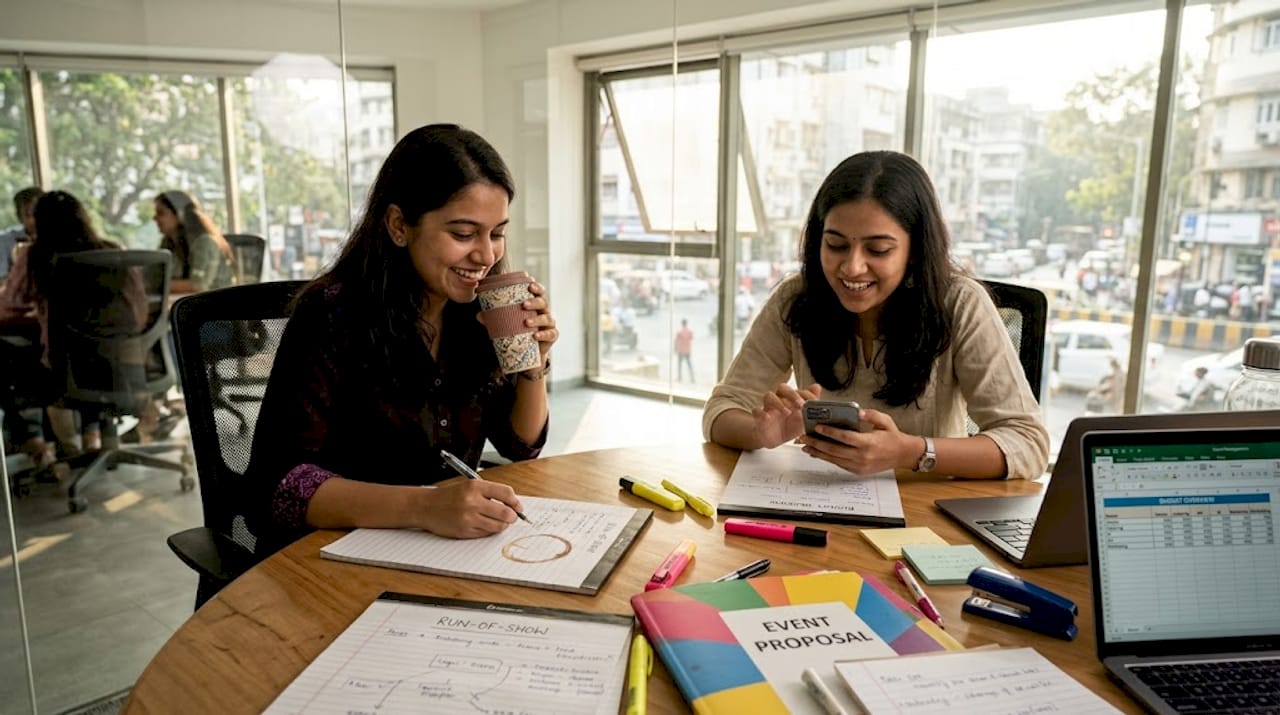
Pro Tip: Specialising in media event management rather than general event planning makes you far more hireable in India’s entertainment hubs like Mumbai, Bangalore, and Hyderabad, where production companies want people who already speak the language of live shows.
Comparing roles: event management for media vs. other industries
But how does managing a media event actually compare to organising other kinds of events? Let’s examine the key differences so you can find your path.
The media and entertainment sector saw the highest growth of all event types in 2025. That matters when you are choosing where to invest your training time and energy.
| Factor | Media and entertainment events | Corporate events | Wedding events |
|---|---|---|---|
| Creativity required | Very high | Moderate | High |
| Technical complexity | Very high | Moderate | Low to moderate |
| Salary potential | High to very high | Moderate to high | Moderate |
| Growth outlook (India) | Fastest growing | Steady | Seasonal |
| Typical roles | Show director, talent coordinator, production manager | Conference manager, brand activation lead | Wedding planner, décor coordinator |
| Work pace | Intense, irregular hours | Structured | Seasonal peaks |
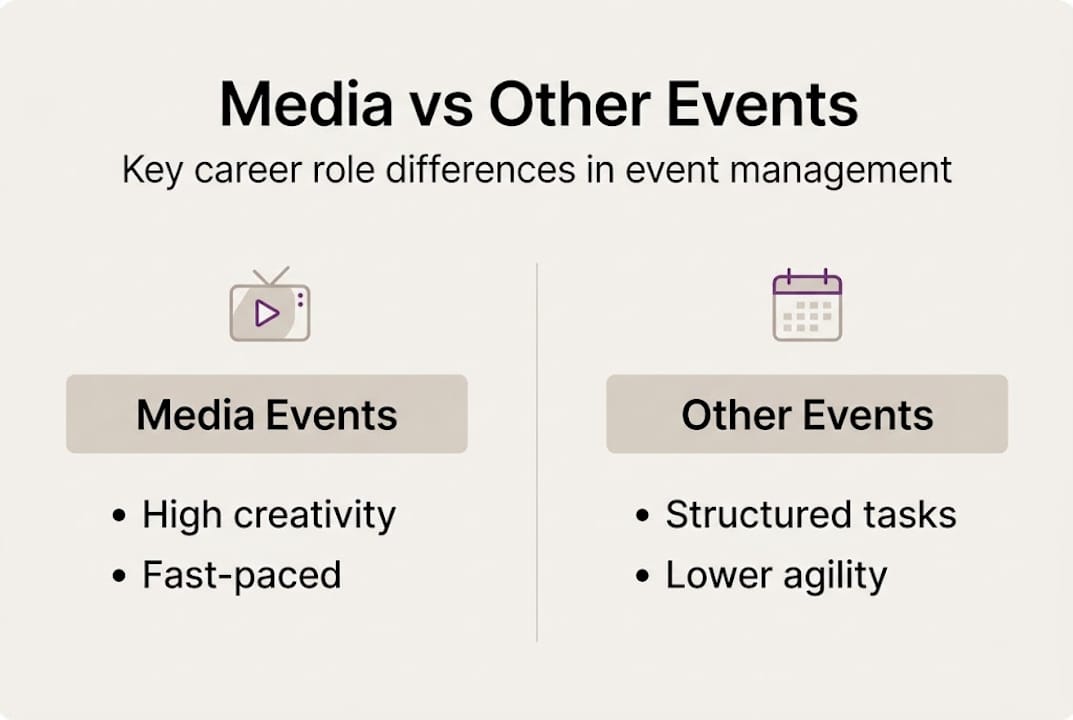
Media event roles demand more creative and technical agility than almost any other event specialisation. You are expected to understand stagecraft, broadcast requirements, and audience psychology all at once. Corporate event managers, by contrast, focus more on logistics, delegate management, and brand consistency. Wedding planners operate in a deeply personal, emotionally charged space where client relationships are everything.
None of these paths is wrong. But if you thrive in fast-moving, high-energy environments where no two days look the same, media is your arena. Reviewing event manager salaries confirms that media and entertainment roles consistently sit at the higher end of the pay scale in India.
Looking at top cities for media events also helps you decide where to plant yourself. Mumbai and Bangalore dominate, but cities like Hyderabad and Delhi are growing fast as entertainment production hubs.
Statistic to remember: The M&E event segment grew faster than corporate and social events combined in 2025. That gap is widening, not closing.
Top trends and future opportunities in media event management
Once you know where you want to go, it helps to be aware of the biggest industry trends and how they are shaping new opportunities.
The technology layer in media events has expanded dramatically. Augmented reality (AR) is now used to create immersive stage backdrops. Virtual reality (VR) gives audiences experiences that blur the line between physical and digital. Live streaming is no longer a backup option; it is a primary revenue channel. If you understand how these tools work alongside traditional production, you become genuinely rare.
Roles that will be in high demand over the next decade:
- Experiential event producer: Designing events that audiences feel, not just watch.
- Live stream and broadcast coordinator: Managing multi-platform simultaneous coverage.
- AR and VR experience designer: Building immersive environments for hybrid events.
- Talent and artist relations manager: The bridge between creative talent and production teams.
- Sustainability event consultant: As green event standards rise, this role is growing fast.
Here is a snapshot of where the industry is heading:
| Year | Estimated India events market value |
|---|---|
| 2024 | USD 14.30 Billion |
| 2026 | USD 16.60 Billion (projected) |
| 2030 | USD 22.00 Billion (projected) |
| 2034 | USD 29.75 Billion (projected) |
With India’s event industry value more than doubling by 2034, the professionals who build their skills now will be the ones leading productions a decade from now. The window to get ahead of the curve is open. It will not stay open forever.
Understanding technology in media event management is no longer optional. It is the baseline expectation for anyone entering this field in 2026 and beyond.
Pro Tip: Follow two or three major Indian entertainment production companies on LinkedIn and subscribe to their behind-the-scenes content. You will learn more about real industry shifts in three months of active observation than in a year of passive study.
A fresh perspective: what young event managers often overlook
Here is something most career guides will not tell you: getting your first certification is the beginning, not the finish line. The professionals who build lasting careers in media event management are not the ones who chased the most glamorous gigs. They are the ones who got seriously good at the unglamorous parts.
Logistics, vendor negotiations, run-of-show documents, technical riders, and budget reconciliation. These are the skills that make you indispensable. Too many aspiring event managers fixate on the stage and ignore the scaffolding holding it up.
Networking is also deeply misunderstood. It is not about collecting contacts at industry parties. It is about being genuinely useful to people before you need anything from them. Show up, do the work, and be the person who solves problems without being asked.
The event management opportunities in India are real and growing. But they go to people who are adaptable, hungry to learn, and willing to start from the bottom of the production hierarchy without resentment. That mindset, more than any single skill, is what separates good from great.
Level up with specialised courses and career support
If you are ready to take the next step, dedicated learning and mentorship can open doors in the media event world that self-study simply cannot. At teami.org, we bring 24 years of industry experience, real event exposure, and placement support directly to students who are serious about this career. Our comprehensive event management courses cover everything from production fundamentals to specialised media tracks. Prefer flexibility? Our online event management programmes let you learn without putting your life on hold. And if hands-on experience is what you need most, explore structured event management work experience opportunities designed to put you on real productions, not just in classrooms.
Frequently asked questions
What qualifications are best for event management in the media industry?
Specialised certifications or diplomas focused on media and entertainment event management offer the clearest advantage, as India’s growing events market increasingly demands certified, skilled professionals over generalists.
Is event management in the media industry a good career in India?
Absolutely. It is one of India’s fastest-growing career fields, driven by the booming entertainment sector, and live events and the M&E segment are consistently the top growth drivers in the industry.
What does a media event manager do?
They plan and execute large-scale events such as film launches, award shows, and music festivals, coordinating creative, technical, and talent teams to deliver a seamless audience experience.
How is media event management different from wedding or corporate events?
Media event managers focus more on creative storytelling, live performances, high-tech staging, and managing celebrity and public relations, making the role technically and creatively more demanding than most other event specialisations.
Recommended
- instaform – team I
- Event Management as a Career – team I
- Build a creative career in event management: guide for aspiring professionals – team I
- How to Start Event Management Career: Step-by-Step Guide – team I
- Event videography step by step: capture every moment
Thinking about a career in event management?
team I is Bangalore’s only EEMA-certified event management institute, running for 24 years, where students work on real live events with real budgets and real deadlines rather than classroom simulations. See the full range of event management courses in Bangalore, or go straight to the flagship Certificate Program in Event Management (CPEM).