
Planning an event without a solid event budget template is like navigating Mumbai traffic without GPS. You will get somewhere, but probably not where you intended, and definitely not on time. Whether you are organising a 200-person wedding in Bangalore, a corporate conference in Hyderabad, or a college fest in Delhi, the difference between a smooth event and a financial disaster often comes down to one thing: how well you tracked your money before, during, and after the planning process. This guide gives you the structure, the tools, and the real-world context to build a budget that actually holds up.
Table of Contents
- Core components of a good event budget template
- How to set up your event budget template in Excel or Google Sheets
- Common budgeting mistakes in Indian events
- Real-world examples from Indian events
- My take on why dynamic budgeting changes everything
- Build your budgeting skills with Teami
- FAQ
Core components of a good event budget template
Not all budget templates are built the same. A template that works for a Delhi concert will look different from one built for a Bangalore corporate event. But the skeleton stays consistent.
Event budget templates should organise costs by category, with a profit and loss view that accounts for conservative, target, and stretch attendance scenarios. That structure is the foundation. Here is what the key categories look like in an Indian event context:
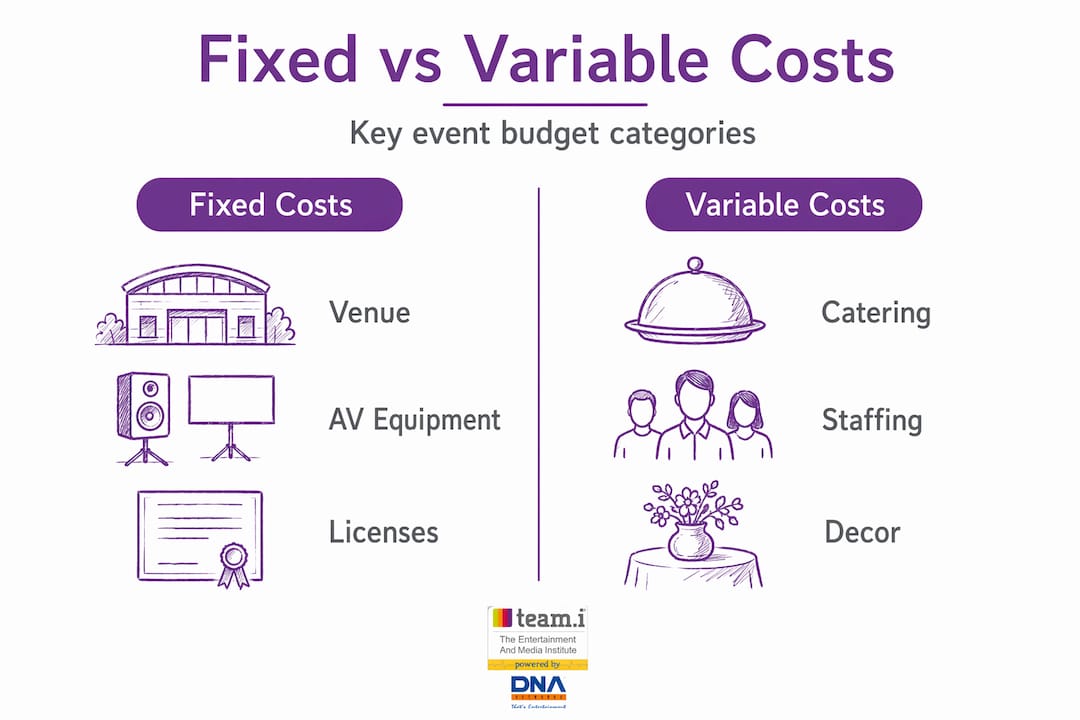
| Cost category | Example line items | Type |
|---|---|---|
| Venue and space | Hall rental, security deposit, parking | Fixed |
| Food and beverage | Catering, bar, service staff | Variable |
| AV and production | Sound, lighting, LED screens, technicians | Fixed |
| Décor and styling | Flowers, furniture, props, draping | Mixed |
| Marketing and promotion | Invitations, social ads, printed collateral | Fixed |
| Staffing and logistics | Event crew, ushers, coordinators | Variable |
| Permits and licences | Municipal permits, noise clearance, FSSAI | Fixed |
| Contingency buffer | Unforeseen costs, last-minute changes | Reserve |
Understanding fixed versus variable costs is not just academic. It changes how you forecast. A venue hire in Mumbai is fixed whether 100 or 500 guests show up. But catering costs scale directly with your headcount. Tag every line item as fixed or variable in your template. When your guest count shifts at the last minute (and in India, it always does), you will know instantly which costs are locked in and which ones will bleed your budget.
For weddings, you will likely have a dominant catering and décor spend. For corporate events in Bangalore, AV and technical production often take the largest slice. For concerts and festivals, artist fees, staging, and high contingency reserves dominate the picture.
How to set up your event budget template in Excel or Google Sheets
You do not need expensive software. A well-built spreadsheet template with automatic subtotals, category sections, and estimated versus actual columns does the job brilliantly. Here is a step-by-step approach to building one that actually works:
Create an input tab. This is where you enter every line item, the estimated cost, the actual cost paid, and the payment status. Label columns clearly: Category, Description, Estimated Cost, Actual Cost, Variance, and Payment Due Date.
Build a summary tab. This pulls totals from your input tab automatically. It should show your total estimated budget, total actual spend, and the variance for each category at a glance. A live variance calculation dashboard highlights overruns the moment they happen, not the day before the event.
Add a cash flow tab. This is where most planners skip and then suffer. Map out every payment due date across your planning timeline. Venue deposits often land 6 to 12 months before the event. Vendor deposits typically run 30 to 50 percent at signing, with final payments due 14 to 30 days out. If you do not map these, you will hit a cash wall right when you can least afford it.
Build in your contingency line. A minimum contingency buffer of 10 to 20 percent of your total projected spend is non-negotiable. Calculate it as a percentage of your subtotal and keep it visible on your summary tab. This is not a slush fund. It is your defence against the unexpected.
Create scenario columns. Add three projected total rows: conservative attendance, expected attendance, and optimistic attendance. This gives you and your client a realistic picture of the financial range, not a single fragile number.
Pro Tip: Colour-code your variance column in your event budget template excel sheet. Green for within five percent of estimate, amber for five to ten percent over, red for anything above ten percent. You will spot problems at a glance without reading every row.

Common budgeting mistakes in Indian events
The numbers are rarely what hurt you. It is the gaps between what you planned and what actually happened that cause real damage. Indian event planners regularly face specific, avoidable pitfalls that a well-used template can prevent:
- Underestimating taxes and hidden charges. GST on catering, service charges at hotel venues, and last-minute overtime fees from technical crews are routinely missed in first-draft budgets. Build a specific line item for taxes in every category.
- Treating the budget as a one-time document. You set it up in month one and then forget about it. By the time the event arrives, the template is wildly out of date. Budgets must be living documents, updated every time a new invoice lands.
- Ignoring cash flow timing. The total budget looks fine, but you have three large deposits due in the same fortnight. Cash flow is the real killer. Mapping payment milestones across your event timeline is not optional for large-scale events in India’s diverse vendor ecosystem.
- No variance flagging system. If your spreadsheet does not visually flag when a category goes over estimate, you will discover the problem far too late to correct it.
Pro Tip: Every time an invoice arrives, enter the actual cost into your budget template before you do anything else. Treat the template as your financial command centre. If it is not updated, it is not useful.
Real-world examples from Indian events
Theory is fine. Real numbers from real cities are better. Here is how a budget template plays out differently depending on the event type and location:
| Event type | City | Dominant cost category | Typical contingency needed | Key planning note |
|---|---|---|---|---|
| Wedding (300 guests) | Mumbai | Catering and venue | 15 to 20 percent | Venue deposits locked 9 months out |
| Corporate conference | Bangalore | AV and production | 10 percent | Sponsorship offsets reduce net spend |
| Music concert | Delhi | Artist fees and staging | 20 percent | Scope changes are frequent |
| College festival | Hyderabad | Marketing and logistics | 10 to 15 percent | Variable sponsorship income |
A Mumbai wedding with 300 guests will routinely see venue and catering absorb 60 to 70 percent of the total budget. The contingency needs to sit at 15 to 20 percent because guest count shifts, décor upgrades, and family-driven last-minute additions are almost guaranteed. Real Indian event budgets expand due to scope changes more than any other single factor.
For a Bangalore corporate event, sponsorship income often offsets a meaningful portion of AV and production spend. Your budget template should have a dedicated income section, not just expenses. When a sponsor confirms, log it immediately and watch your net spend shift.
Scenario planning with conservative, expected, and optimistic attendance models is what separates planners who look professional from those who get caught out. Show your client three versions of the financial picture. It builds trust and demonstrates you have genuinely thought through the risk.
My take on why dynamic budgeting changes everything
I have seen planners build beautifully detailed event budget templates and then never open them again after week two of planning. That is the real problem. Not the template itself.
A static spreadsheet is a false sense of control. The events I have watched unravel financially did not fail because the original budget was wrong. They failed because no one was tracking actuals against estimates in real time. By the time the variance was visible, it was too late to adjust.
The mindset shift that matters most is this: budgeting for events is not a task you complete. It is a discipline you practise every day until the last vendor invoice is paid. When you treat your budget template as a live financial dashboard rather than a filing exercise, you catch problems at five percent over budget, not fifty. That is the difference between a recovery and a crisis.
— Teami
Build your budgeting skills with Teami
A well-structured event budget template is your starting point, not your finish line. Teami’s event management courses are built around exactly this kind of hands-on, real-world financial control. You will not just learn how to create an event budget. You will practise it on live events, with real vendor negotiations, real cash flow constraints, and real consequences. Teami’s 24 years of industry experience and its partnership with DNA Entertainment Networks means the templates and workflows you learn are the ones professionals actually use. Explore the online event management programme and take the first step towards running events that never go over budget.
FAQ
What should an event budget template include?
A strong event budget template covers all major cost categories such as venue, catering, AV, staffing, marketing, and permits, plus a contingency buffer of 10 to 20 percent. It should track estimated costs, actual costs, and variances across every line item.
How do I build a budget template for events in Excel?
Create an input tab with columns for category, estimated cost, actual cost, and payment due date, then link these to a summary tab that calculates variances automatically. Adding a cash flow tab to map payment milestones prevents last-minute cash shortages.
Why is contingency important in event planning budgets?
Unexpected costs such as overtime fees, scope changes, and last-minute additions are common in Indian events. A contingency reserve of 10 to 20 percent of your total projected spend absorbs these shocks without derailing the event.
How often should I update my event budget template?
Update your template every time a new invoice or confirmed cost arrives. Treating it as a living document rather than a one-time setup ensures your variance data stays accurate and early warnings appear before they become crises.
What are the biggest budgeting mistakes in Indian events?
The most common mistakes include underestimating taxes and hidden charges, ignoring cash flow timing for deposits, and failing to update actual costs throughout the planning period. A regularly maintained event budget template prevents all three.
Recommended
- Event Planning Checklist 2025: Step-by-Step Guide for Success – team I
- Master Event Timeline Planning for Seamless Event Delivery – team I
- How to Organise Events for Maximum Impact: Step-by-Step Guide – team I
- Event Logistics Planning: Essential Steps and Tips for 2025 – team I
Thinking about a career in event management?
team I is Bangalore’s only EEMA-certified event management institute, running for 24 years, where students work on real live events with real budgets and real deadlines rather than classroom simulations. See the full range of event management courses in Bangalore, or go straight to the flagship Certificate Program in Event Management (CPEM).