

TL;DR:
- Budgeting is essential for controlling costs, making decisions, and maintaining stakeholder transparency.
- Building a detailed, prioritized, and regularly updated budget prevents financial crises and ensures reliability.
- Strong budgeting skills build trust, improve negotiation, and give professionals a competitive industry edge.
Master event budgeting: 5 steps to guaranteed success
Passion and creativity will get you excited about events. They will not, however, keep the lights on. Across India, aspiring event professionals underestimate one skill above all others: budgeting. When Panjab University allocated ₹22 lakh for festivals only to see events like Jhankar spiral beyond those figures through unmonitored sponsorships, the result was performer cancellations and reputational damage. That is not a creativity problem. That is a budgeting problem. This article gives you the theoretical foundations and practical tools to build, manage, and report on event budgets with real professional confidence.
Table of Contents
- Why budgeting is the foundation of every successful event
- How to build an event budget: Core steps and principles
- Common budgeting mistakes and how to avoid them
- Monitoring, adjusting, and reporting: The lifecycle of effective budgeting
- Why great event budgeting is the hidden advantage few talk about
- Learn professional event budgeting with industry leaders
- Frequently asked questions
Key Takeaways
| Point | Details |
|---|---|
| Budgeting prevents failure | Many events falter due to poor financial planning rather than lack of creativity. |
| Structured budgets reduce risk | A step-by-step approach protects against shortfalls and last-minute surprises. |
| Mistakes offer teachable moments | Analysing real-world mismanagement helps aspiring professionals avoid common errors. |
| Monitor throughout event | Effective budget management is an ongoing process, not a one-time task. |
Why budgeting is the foundation of every successful event
Let’s be honest. When most young event professionals picture their career, they imagine stage lights, headlining acts, roaring crowds, and the buzz of a perfectly executed show. Very few picture a spreadsheet. But that spreadsheet is what makes everything else possible.
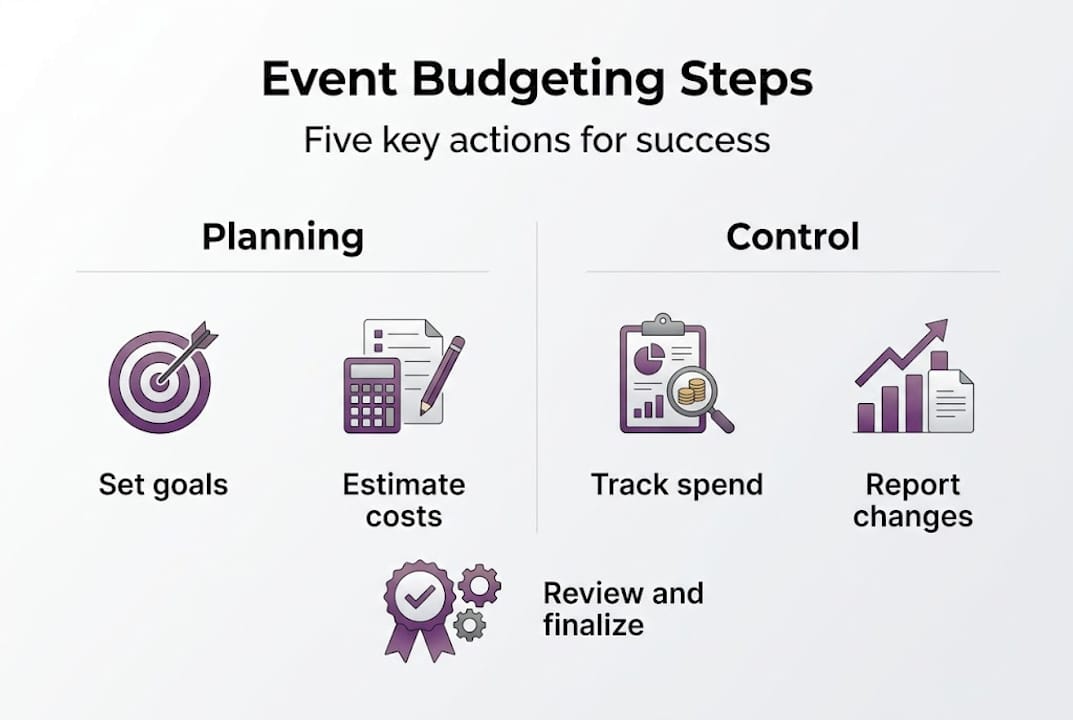
A budget is not just a document. It is a decision-making framework. Every choice you make, from the venue you book to the caterer you hire to the décor you prioritise, is shaped by what your budget allows. Without a clear framework, those decisions become guesswork. And in event management, guesswork is expensive.
Think of your budget as the architectural blueprint of your event. You would not build a stage without engineering plans, and you should not execute an event without financial ones. A well-structured budget does three critical things:
- Controls costs by giving every department a spending ceiling
- Shapes decisions by forcing you to prioritise value over impulse
- Guides stakeholder communication by making financial status transparent to clients, sponsors, and teams
The consequences of skipping this rigour are real and well-documented. Panjab University’s festival budgeting failure illustrates precisely what happens when events rely on sponsor inflows without structured oversight. The institution had ₹22 lakh formally allocated, but events like Jhankar consistently required far more, with unofficial sponsorships quietly filling the gaps. No tracking. No accountability. Eventually, no performers.
“The best-run events are rarely the flashiest. They are the most reliably budgeted.”
Budgeting is also what separates a reliable professional from a hopeful amateur. Clients and employers do not just want someone who is enthusiastic. They want someone who can be trusted with ₹10 lakh, ₹50 lakh, or ₹1 crore without flinching. That trust is built through demonstrated financial control.
For anyone serious about their event management career tips, mastering budgeting early is not optional. It is the single most reliable way to build credibility before you even land your first major role. Financial mismanagement also carries reputational risk that can follow you for years. One event where money runs short, vendors go unpaid, or sponsors feel misled can close doors that creativity alone cannot reopen.
How to build an event budget: Core steps and principles
Building a solid event budget is not as intimidating as it sounds. It follows a logical sequence that, once understood, becomes second nature. Here is how you approach it professionally.
Define the event scope clearly. Before a single rupee is assigned, you need to know what you are planning. How many attendees? Indoor or outdoor? One day or multi-day? A 200-person corporate dinner and a 5,000-person music festival have fundamentally different financial requirements. Scope drives budget, not the other way around.
List every expenditure category. Do not skip anything. Common categories for Indian events include venue hire, artist or speaker fees, sound and lighting equipment, stage construction, food and beverage, décor, photography and videography, marketing and promotions, security, logistics, and staffing. Each category needs its own line item.
Research real costs, not estimates. Call vendors. Get written quotes. Prices in Delhi will differ from those in Bengaluru. A sound system for a corporate seminar costs far less than one for an outdoor concert. Assumptions are where budgets fall apart. Events like Jhankar needed significantly more funds than formally allocated, a direct result of planning with rough figures rather than confirmed quotes.
Assign priorities. Not every budget item carries equal weight. Rank your line items by importance to the event’s core experience. The PA system at a concert is non-negotiable. The colour of the branded napkins is flexible. Understanding this hierarchy helps you make fast, confident decisions when money gets tight.
Build in a contingency fund. Allocate 10 to 15 percent of your total budget for unexpected costs. A sudden weather change, a last-minute vendor cancellation, a technical failure. These are not unlikely scenarios. They are industry realities. Your contingency is not a luxury. It is a professional necessity. Review your full budget planning steps to ensure nothing slips through the cracks.
Track income and expenditure from day one. Revenue from ticket sales, sponsorships, and partnerships must be recorded alongside costs. Do not assume confirmed income until it is in writing. Many events have been derailed by over-counting projected revenue. Understanding budgeting challenges from the outset helps you anticipate and navigate them before they escalate.
Pro Tip: Always track sponsor commitments with written agreements that specify payment timelines. Verbal confirmations are not budgets. A sponsor who promised ₹2 lakh in February but delays payment to two days before your event will cause serious cash-flow problems.
Common budgeting mistakes and how to avoid them
Even experienced professionals make budgeting errors. Knowing the most common ones puts you well ahead of the competition.
| Budgeting mistake | What goes wrong | Better approach |
|---|---|---|
| Over-optimistic revenue forecasting | You count on full ticket sales and all sponsors delivering, but neither happens fully | Use conservative revenue estimates, typically 70 to 80 percent of projected income |
| Underestimating hidden costs | GST, transport, permits, and overtime fees are missed in early drafts | Build a detailed checklist that includes regulatory and logistical costs |
| Ignoring sponsorship oversight | Sponsors are listed as confirmed income with no written contracts or timelines | Require signed agreements with staged payment terms before including any figure in your budget |
| No contingency fund | Any surprise cost becomes a crisis | Reserve 10 to 15 percent of total budget for unforeseen expenses |
| Failing to update budgets in real time | Your budget reflects plans from six weeks ago, not current reality | Review and update your budget weekly, or daily as the event approaches |

Unmonitored sponsorships led directly to performer cancellations at Panjab University events. The money was expected but not guaranteed. When it did not arrive on time, the event could not deliver on its promises. This is exactly the kind of event planning challenge that disciplined budgeting prevents.
Here is a quick checklist of early-warning signs that your budget is in trouble:
- Actual spend is consistently above budgeted figures in the first two weeks
- Sponsorship commitments exist only as verbal agreements or email threads
- Your contingency fund was already used for something predictable, not truly unexpected
- Vendors have not received deposits despite confirmed bookings
- Your team cannot tell you, at any given moment, how much of the budget remains
The fix is rarely dramatic. It is disciplined. Review your budget every week without exception. Assign one person clear ownership of the budget document. And follow event manager success tips that reinforce financial accountability as a core professional habit.
Remember, the most common mistake is not incompetence. It is optimism without structure. You are allowed to be ambitious. You just need to be rigorous about it.
Monitoring, adjusting, and reporting: The lifecycle of effective budgeting
Building a budget is just the beginning. The real skill is keeping it alive, accurate, and useful from the first planning meeting to the final debrief. This is where many aspiring managers stop short.
Here is a simple lifecycle view of how budget monitoring should work:
| Event phase | Budget activity | Frequency |
|---|---|---|
| Pre-event (12 to 8 weeks out) | Set base budget, confirm vendor quotes, log income commitments | Weekly |
| Pre-event (8 to 2 weeks out) | Track actual spend vs budgeted, update income confirmed in writing | Twice weekly |
| Event week | Daily expense tracking, cash-flow check, flag any overruns immediately | Daily |
| Post-event | Reconcile all actuals, prepare final report, document lessons learned | Once, within 48 hours |
This is not bureaucracy. This is how professionals protect themselves, their clients, and their events.
The most important concept in budget monitoring is the actuals vs. budgeted comparison. Your budget is your plan. Actuals are reality. When these two numbers start to diverge significantly, you have an early warning signal. Act on it fast, not two weeks later.
Adjusting is equally important. A last-minute sponsorship arrives? Update your income line and document who confirmed it, when, and for how much. An artist demands a larger fee than quoted? Flag it immediately, identify what can be trimmed elsewhere, and communicate the change to whoever approved the original budget. Unmonitored sponsorship inflows were a core reason PU events faced financial disruption. When money comes in without documentation, it gets spent without accountability.
Knowing how to find event sponsors is one skill. Tracking and reporting what those sponsors contribute is the next level.
Pro Tip: Create a simple one-page budget dashboard that shows your team and client the total budget, amount spent to date, amount remaining, and any flagged variances. Colour code it: green for on track, amber for watch, red for action needed. Anyone who picks it up should understand the financial status of the event within 30 seconds.
Transparency in reporting also builds lasting client trust. When a client sees that you proactively flag a cost increase and already have a solution ready, you are no longer just an event manager. You are a financial partner they can rely on.
Why great event budgeting is the hidden advantage few talk about
Here is something the industry does not say loudly enough: the event professionals who advance fastest are rarely the most creative ones. They are the most financially reliable ones.
Creativity in event management is common. Seriously. Thousands of passionate graduates enter this industry every year with brilliant ideas and genuine flair. What is genuinely rare is someone who can manage a ₹40 lakh budget without surprises, communicate financial updates with clarity, and negotiate vendor contracts knowing exactly what margin they are working with.
Mastering budgeting challenges early in your career does not just prevent disasters. It actively creates opportunities. Clients refer you. Employers promote you. Vendors take you seriously. You become the person in the room who others trust with the real numbers.
Budgeting proficiency also sharpens every other skill you have. When you understand costs deeply, you negotiate better. When you can read a budget in real time, you make faster and smarter decisions on the floor. The discipline of financial management bleeds into time management, stakeholder communication, and operational planning. It makes you a better all-round professional, not just a safer one.
Learn professional event budgeting with industry leaders
If this article has made one thing clear, it is that budgeting is not a background skill. It is the engine that drives every successful event forward. And like every engine, it needs to be properly understood before you trust it with something important.
team I brings 24 years of real industry experience into every course it delivers. Through its comprehensive event management course, you will learn financial planning, vendor negotiation, and budget reporting alongside live event production. No theory without practice. No classroom without a stage. For those who prefer flexible learning, the online event management courses bring the same industry-grade knowledge to wherever you are. If you are serious about building a career that lasts, this is where you start.
Frequently asked questions
What happens if an event goes over budget?
When an event exceeds its budget, organisers are forced to cut essential services or face cancellations, as seen at PU festivals where unmonitored spend led to performers being dropped. Prevention through regular budget reviews is always more effective than crisis management.
How much contingency fund should I allocate in an event budget?
A standard industry practice is to reserve 10 to 15 percent of your total budget as a contingency fund to absorb unexpected costs without disrupting your core event experience.
Why is sponsorship oversight crucial in budgeting?
Without formal agreements and tracked timelines, unmonitored sponsorships create gaps between expected and actual income, leading to cash-flow crises and event disruptions that are entirely avoidable.
What tools can help in tracking event budgets?
Spreadsheet templates, dedicated budgeting software like Eventbrite or Excel-based trackers, and structured weekly expense reports are practical tools for maintaining real-time financial visibility.
Is budgeting equally important for small and large events?
Absolutely. Whether you are managing a 50-person workshop or a 5,000-person festival, disciplined budgeting ensures that every rupee is accounted for and that the event delivers on its promises without financial shortfalls.
Recommended
- Event Budget Planning Guide 2025: Steps for Success – team I
- Event budgeting challenges: overcoming obstacles to stay on plan – team I
- Master Event Timeline Planning for Seamless Event Delivery – team I
- Event Planning Checklist 2025: Step-by-Step Guide for Success – team I
Thinking about a career in event management?
team I is Bangalore’s only EEMA-certified event management institute, running for 24 years, where students work on real live events with real budgets and real deadlines rather than classroom simulations. See the full range of event management courses in Bangalore, or go straight to the flagship Certificate Program in Event Management (CPEM).