

TL;DR:
- Structured event management involves four phases: initiation, planning, execution, and closure.
- Certifications in event project management significantly boost career growth and earning potential in India.
- Effective use of tools like Smartsheet and thorough closure evaluations enhance event success and professional reputation.
Most people assume event management is glamorous chaos. Show up, look sharp, smile for the cameras, and somehow a spectacular event materialises. The reality? It’s structured, it’s rigorous, and it rewards those who treat it like a real discipline. Event project management applies formal project frameworks to everything from venue sourcing to showflow design, turning gut-feel decisions into repeatable, measurable outcomes. And here’s the part that genuinely changes careers: certifications boost careers by 20–40% in India, with measurable salary gains. If you’re serious about this industry, you need to understand the mechanics beneath the magic.
Table of Contents
- The phases of event project management
- Certifications and education for event managers in India
- Building your event project plan: Tools and templates
- Evaluating success: Closure and career impact
- Why certification and structured project management are game changers in India
- Next steps: Advance your event management career
- Frequently asked questions
Key Takeaways
| Point | Details |
|---|---|
| Structured project phases | Successful event management relies on clear initiation, planning, execution, and closure steps. |
| Certification advantage | Formal certifications boost your career prospects and salary in India’s event sector. |
| Tools accelerate results | Using project tools and templates improves efficiency, reduces costs, and ensures seamless delivery. |
| Closure drives growth | Evaluating event projects methodically translates into better future opportunities and professional development. |
| Blend theory with practice | Combining education and hands-on planning makes you stand out in India’s competitive event industry. |
The phases of event project management
Now that you’ve seen why structured event management matters, let’s explore how the process unfolds, step by step.
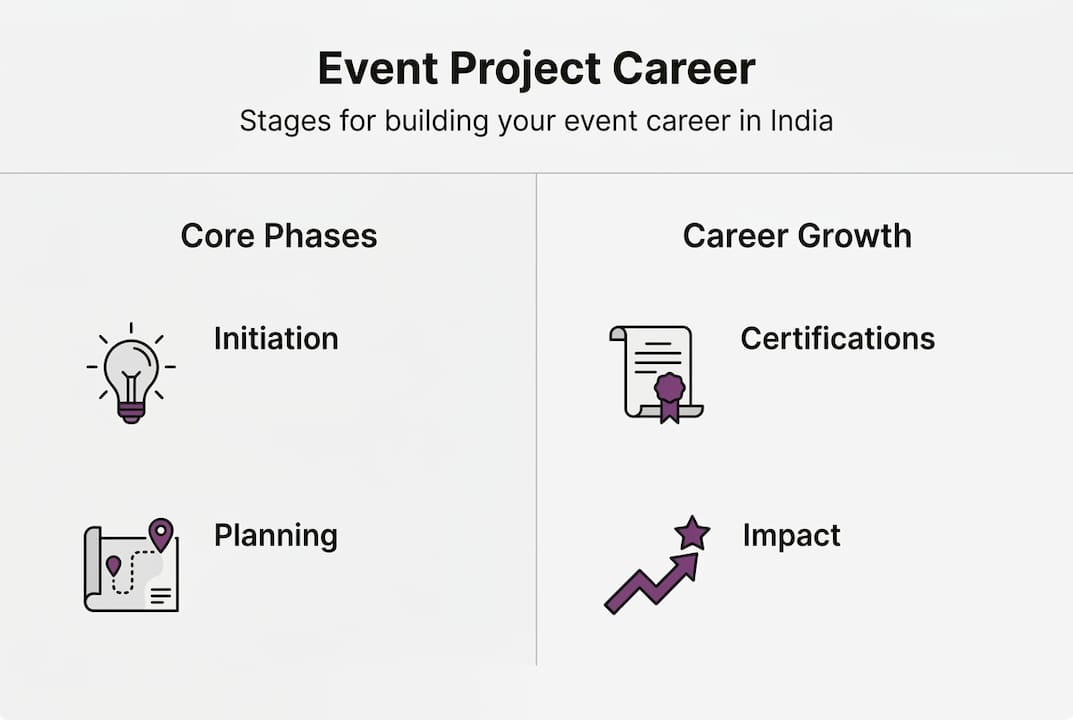
Think of event project management as a relay race. Each leg must be run well, or the whole team loses. The structured approach to event projects breaks down into four core phases: initiation, planning, execution, and closure. Each one has its own goals, its own deliverables, and its own pressure.
- Initiation: You define the event’s purpose, identify key stakeholders, set objectives, and establish scope. This is where you answer the brutal question: why are we doing this, and for whom?
- Planning: This is the engine room. You build a Work Breakdown Structure (WBS), a detailed timeline, a budget, and a risk register. This is also where event timeline planning becomes your best friend, locking in every deadline before chaos can creep in.
- Execution: Teams mobilise, vendors are coordinated, and your plan meets reality. You monitor progress constantly, resolve conflicts, and keep communication flowing across every department.
- Closure: The event ends, but your job doesn’t. You evaluate outcomes, collect feedback, settle financials, and document lessons learned.
Here’s how event project phases compare to general project management:
| Phase | General PM focus | Event PM focus |
|---|---|---|
| Initiation | Business case, charter | Event brief, stakeholder map |
| Planning | Scope, schedule, budget | Venue, vendors, event budget planning |
| Execution | Deliverables, QA | On-site coordination, showflow |
| Closure | Sign-off, lessons | Post-event report, feedback |
Risk management deserves a special mention. In events, risk isn’t abstract. It’s a generator failing at 8 PM, a keynote speaker stuck at the airport, or rain on an outdoor stage. Structured risk planning means you’ve already thought through restaurant event marketing contingencies, backup vendors, and decision trees before the day arrives.
Pro Tip: Build a risk register during the planning phase, not the week before your event. List every foreseeable risk, assign probability and impact scores, and name the person responsible for each mitigation action. It sounds clinical, but it’s what separates professionals from panickers.
Certifications and education for event managers in India
Understanding the project phases lays the foundation, but specialised training is what truly sets you apart.
India’s event industry is growing fast, and so is its appetite for certified professionals. Clients, agencies, and production houses increasingly want proof that you can deliver, not just enthusiasm. Top event certifications worth considering include:
- CMP (Certified Meeting Professional): Internationally recognised, strong for corporate and MICE events.
- CSEP (Certified Special Events Professional): Valued globally, ideal for special and social events.
- Team i Certification: India-focused, practical, and industry-connected through DNA Entertainment Networks.
- SCDL PGCM-EM: Postgraduate certificate with academic credibility.
- IIT Delhi Project Management (PMBOK-aligned): Rigorous, data-driven, respected across industries.
- Rachnoutsav CPEM: Strong local recognition for cultural and public events.
The data speaks clearly: certified professionals earn 20–40% more in India, with better job placement rates and faster career progression.

| Certification | Focus | Best for |
|---|---|---|
| CMP | Corporate/MICE | International roles |
| Team i | Practical/India-based | Local industry entry |
| IIT Delhi PM | Project methodology | Cross-industry careers |
| CSEP | Special events | Creative event roles |
International programmes offer global credibility but can feel disconnected from India’s on-ground realities. Local programmes, particularly those with industry partnerships and live project components, tend to produce job-ready graduates faster. The Calgary Stampede, one of the world’s largest events, demonstrated exactly this kind of operational discipline through a structured PMO approach that transformed their entire event delivery model.
Want to compare your options without commitment? A free certification comparison is a smart first step. And if you’re still building your foundational knowledge, mastering event management fundamentals gives you the base every certification programme assumes you already have.
Pro Tip: Match your certification to your career goal, not your social media feed. If you want to work in corporate events in Bangalore, a PMBOK-aligned or Team i certification will open more doors than a generalist diploma from an unrecognised institution.
Building your event project plan: Tools and templates
Once you’ve chosen your education pathway, it’s time to put knowledge into practice with robust planning tools.
Knowing the phases is one thing. Building an actual project plan that survives contact with real events is another. Here’s where tools and templates become genuinely powerful.
Your essential planning checklist:
- Event brief: Objectives, audience, budget ceiling, key dates
- WBS (Work Breakdown Structure): Every task, broken into manageable pieces
- Gantt chart or timeline: Visual schedule with dependencies and deadlines
- Budget tracker: Real-time income and expenditure log
- Risk register: Risks, probability, impact, and mitigation owners
- Vendor contact sheet: All supplier details, contracts, and escalation contacts
- Showflow: Minute-by-minute run of show
The tools that serious event professionals rely on include Smartsheet, Asana, Monday.com, and dedicated PMO platforms. Smartsheet, in particular, has proven its worth at scale: the Calgary Stampede saved $100K+ annually and completed projects 25% faster after adopting a PMO approach with Smartsheet at its core.
That’s not a small win. That’s the difference between an event company that scales and one that scrambles. Good timeline planning and a solid budget planning guide working together eliminate the fire-fighting that burns out so many early-career event managers.
Online monitoring tools also matter. Tracking event project monitoring metrics during execution gives you real-time data to adjust plans before small problems become expensive disasters.
Pro Tip: Don’t wait until you’re employed to learn these tools. Most PMO platforms offer free trials or student plans. Build a mock event project using Smartsheet or Asana, and you’ll walk into your first interview with a portfolio piece that 90% of candidates don’t have.
Evaluating success: Closure and career impact
With the tools in hand and your project plan finished, understanding how to evaluate outcomes is your final step.
The event is over. The stage is dark, the guests have gone home, and your team is exhausted. But here’s where most early-career event managers make their biggest mistake: they stop. Proper event success evaluation is what separates someone who ran an event from someone who managed one.
A thorough closure process looks like this:
- Financial reconciliation: Compare actuals against budget, identify overruns and savings.
- Stakeholder feedback: Collect structured responses from clients, attendees, and sponsors.
- Team debrief: What worked, what failed, and what must never happen again.
- KPI review: Attendance numbers, audience satisfaction scores, revenue targets, and delivery timelines.
- Lessons learned report: Documented insights that feed your next event’s planning phase.
Common closure mistakes include:
- Skipping vendor feedback (they see things you don’t)
- Delaying the debrief until memories fade
- Treating the post-event report as a formality rather than a strategic document
- Failing to archive templates and contacts for future use
The structured closure phase isn’t just good practice. It’s your career portfolio in real time. Every post-event report you write is evidence of your analytical thinking. Every lessons-learned document you produce shows future employers that you reflect, improve, and grow.
“The professionals who build sustainable careers in events are not just the ones who pull off spectacular shows. They’re the ones who can explain exactly why it worked, and document it clearly enough for the next team to replicate it.”
Your closure work feeds directly into your professional reputation. Documented outcomes become case studies. Case studies become the evidence base for salary negotiations, promotions, and freelance client pitches.
Why certification and structured project management are game changers in India
Evaluating your event and career impact leads naturally to considering what truly sets you apart in India’s competitive landscape.
Here’s the uncomfortable truth most career guides won’t say directly: networking will get you through the door, but structured skills will keep you in the room. India’s event industry is expanding rapidly, and clients are increasingly sophisticated. They don’t just want someone enthusiastic. They want someone who can build a WBS, manage a risk register, and deliver within budget.
The 20–40% career boost from certifications isn’t magic. It’s the market signalling that it values proof over promise. Certified, organised professionals command better fees, attract better clients, and build more durable careers. The conventional wisdom that “experience is everything” is only half right. Experience plus structured methodology is what the industry actually rewards.
Blending formal training with real-world project practice is how you outpace the competition. And career growth through evaluation is how you sustain that pace year after year.
Pro Tip: Don’t treat certification as a finish line. Treat it as the starting block. The professionals who rise fastest are those who apply structured project thinking from day one, on every event, regardless of size.
Next steps: Advance your event management career
Having understood both the practical and philosophical aspects of event project management, it’s time to pursue your next career step.
At Team i, we’ve spent 24 years training event professionals who don’t just attend events. They run them, manage them, and build careers that last. Our event management courses are built around real project frameworks, live event exposure, and industry partnerships with DNA Entertainment Networks that put you on actual stages before you graduate. Explore our online event management programmes for flexible, structured learning that fits your life. And if you’re still weighing your options, understanding the importance of certification in this industry will make the decision far easier.
Frequently asked questions
What are the main phases of event project management?
The four core phases are initiation, planning, execution, and closure, each with distinct tasks, deliverables, and success criteria that guide the entire event lifecycle.
How do certifications affect event management careers in India?
Certifications can boost your career by 20–40% in India, translating into higher salaries, stronger job prospects, and faster progression into senior roles.
What tools are used for managing event projects?
Professionals rely on platforms like Smartsheet, Asana, and PMO tools, with the Calgary Stampede’s PMO approach showing 25% faster project completion and over $100K in annual savings.
What is the best way to evaluate event success?
The most effective closure process combines financial reconciliation, structured stakeholder feedback, KPI reviews, and a detailed lessons-learned report that feeds directly into future planning cycles.
Recommended
- Build a successful event management career in India 2026 – team I
- Master event management fundamentals: career guide India – team I
- Why Event Management as a Career? India’s Opportunity and a Global Frontier
- How to choose an event management career in India 2026 – team I
- INUSUAL | Cómo crear un plan de desarrollo profesional efectivo
Thinking about a career in event management?
team I is Bangalore’s only EEMA-certified event management institute, running for 24 years, where students work on real live events with real budgets and real deadlines rather than classroom simulations. See the full range of event management courses in Bangalore, or go straight to the flagship Certificate Program in Event Management (CPEM).