

TL;DR:
- Choosing an accredited institute with industry connections is vital for recognition and career growth. Practical exposure through real-world projects and experienced faculty ensures job readiness. Location near major event hubs enhances networking and employment opportunities.
Choosing the wrong event management institute in India is not just a financial mistake. It can quietly close doors before your career even begins. Employers screen qualifications fast, and a programme from a non-recognised institute rarely makes the cut. The good news? The right institute, one that is accredited, industry-connected, and built around real-world training, can genuinely transform your prospects. This guide walks you through every critical factor you need to evaluate, from accreditation and curriculum to placement records and location, so you can make a choice you will never regret.
Table of Contents
- Understand accreditation and institute credibility
- Assess course curriculum, faculty, and practical exposure
- Compare course types, duration, and alignment with your goals
- Evaluate placement records, industry links, and location
- Our perspective: What most guides miss about choosing event management institutes
- Next steps: Find your future in event management
- Frequently asked questions
Key Takeaways
| Point | Details |
|---|---|
| Verify accreditation | Ensure the institute is accredited by UGC or AICTE to guarantee degree recognition and secure job opportunities. |
| Prioritise practical learning | Choose programmes led by industry professionals with abundant live project and event exposure. |
| Align with career goals | Match the course type and duration—diploma or degree—with your specific career ambitions in event management. |
| Check placement success | Review placement records, industry ties, and metro location advantages to maximise your employability. |
Understand accreditation and institute credibility
Accreditation is not a formality. It is the difference between a qualification that opens doors and one that collects dust. In India, the two primary bodies you need to know are the University Grants Commission (UGC) and the All India Council for Technical Education (AICTE). UGC governs university-level degree programmes, while AICTE oversees technical and management education. If an event management programme is not listed under either body, its degree or diploma may not be recognised by government employers, major corporates, or even postgraduate institutions.
Verifying accreditation is straightforward. Visit the official UGC or AICTE websites and search for the institute by name. If it does not appear, that is a serious red flag. Many institutes use impressive-sounding names and glossy brochures, but a quick database check takes under five minutes and could save you years of career frustration. As a baseline rule, always prioritise accreditation from UGC or AICTE for degree recognition and employer acceptance in India.
The consequences of studying at a non-accredited institute are real and lasting. Employers in sectors like corporate events, government-sponsored productions, and large-scale entertainment IPs routinely reject CVs with unrecognised qualifications. You may also find yourself ineligible for higher education or professional certifications down the line.
| Accreditation status | Employer acceptance | Eligibility for higher study | Industry credibility |
|---|---|---|---|
| UGC or AICTE recognised | High | Yes | Strong |
| State board approved only | Moderate | Limited | Variable |
| No formal accreditation | Low | No | Weak |
Beyond the official bodies, look at institutes evaluation factors such as industry affiliations, professional body memberships, and how long the institute has been operating. Longevity and consistent industry engagement are quiet but powerful signals of credibility. A programme that has been placing students in real roles for over two decades is telling you something that no brochure can fake.
Pro Tip: Before you attend any open day or speak to an admissions counsellor, spend five minutes on the UGC and AICTE official portals. Confirm the degree recognition process yourself. Do not rely on the institute to show you their own certificates.
Assess course curriculum, faculty, and practical exposure
Once you have confirmed the institute’s credentials, the next critical step is to examine what you will actually learn and who will teach you. A curriculum that was designed ten years ago and has not been updated since is a warning sign. The event industry moves fast. Trends in experiential marketing, hybrid events, and live entertainment production shift constantly. Your curriculum should reflect that.
Faculty quality is just as important as course content. There is a meaningful difference between a lecturer who has read about event logistics and one who has actually managed crowd flow for a 10,000-person concert. Evaluate faculty with real industry experience over academic credentials alone. The best institutes bring in working professionals, not just academics, to teach core modules.
Here is what strong practical exposure looks like in a top-tier programme:
- Live event projects where students take on real responsibilities, not simulations
- Internships with established event companies or entertainment networks
- Industry partnerships that bring you into actual productions during your studies
- Guest lectures from senior professionals across corporate, social, and entertainment verticals
- Showflow and production planning exercises that mirror real-world timelines
The practical learning emphasis of an institute is often what separates graduates who hit the ground running from those who need another year of on-the-job learning just to feel competent.
| Institute type | Curriculum focus | Typical graduate outcome |
|---|---|---|
| Theory-heavy | Textbooks, exams, case studies | Needs significant on-job training |
| Practical-focused | Live events, internships, industry projects | Job-ready from day one |
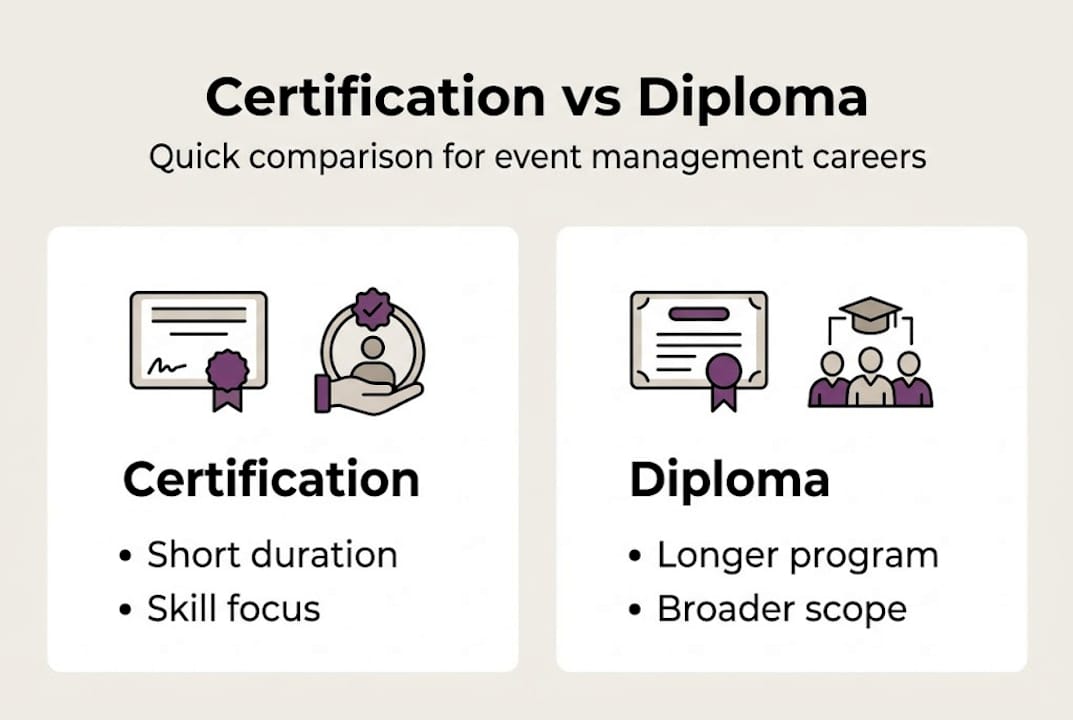
You can also explore the difference between a certification versus diploma to understand which format gives you the most relevant, applied learning for your specific goals.
Pro Tip: Do not just read testimonials on the institute’s website. Find alumni on LinkedIn and ask them directly: “Did you work on real events during your course?” Their answers will tell you more than any marketing material.
Compare course types, duration, and alignment with your goals
With a curriculum overview in hand, it is now time to map your course choice to your individual career ambitions. Not every aspiring event professional needs the same path, and choosing the wrong format is a costly detour.
Event management diplomas typically run for 6 to 12 months. They are designed for quick, focused skill-building and are ideal if you want to enter the workforce fast, transition from a related field, or test the industry before committing to a longer programme. Degree programmes, on the other hand, run for 2 to 3 years and offer broader business, management, and strategic foundations. If you are aiming for senior production roles, agency management, or eventually running your own events company, a degree gives you the long-term credibility and depth that employers respect.
Steps to match your programme type to your career goals:
- Define your immediate goal: entry-level role or managerial track?
- Assess your current experience: are you starting from scratch or building on existing skills?
- Consider your timeline: can you invest 2 to 3 years, or do you need to be earning within 12 months?
- Research the roles you want and check what qualifications employers actually list in job postings.
- Speak to professionals already in those roles and ask what they wish they had studied.
Here is a quick breakdown to help you weigh your options:
Diploma route:
- Faster entry into the workforce
- Lower overall cost
- Focused, practical skill sets
- May limit access to senior roles without further study
Degree route:
- Broader industry knowledge and business acumen
- Stronger long-term career trajectory
- Higher starting salaries at top companies
- Longer time and financial commitment
As a guiding principle, match course duration and type to your career goals: short programmes for entry, degrees for long-term advancement. You can also explore the diploma vs degree in event management decision in more detail, or look at online diploma options if flexibility is a priority for you.
Pro Tip: If you are juggling work or family commitments, look specifically for blended learning formats that combine online theory with in-person practical sessions. The course duration considerations matter as much as the content itself.
Evaluate placement records, industry links, and location
After matching your course to career goals, it is vital to measure how well the institute supports your transition from student to working professional. Placement claims are everywhere. Verified placement data is rare. That distinction matters enormously.

When reviewing an institute’s placement record, look for specifics: named employers, average salary figures, and the percentage of graduates placed within a defined timeframe. Vague claims like “95% placement rate” with no supporting detail are a red flag. Strong institutes publish actual data. Always check placement records, alumni success, and industry partnerships before committing.
Watch out for these red flags in placement claims:
- No named employers or industry partners listed
- Placement statistics with no year or timeframe attached
- Testimonials with no verifiable names or roles
- “Guaranteed placement” promises with no contractual basis
- No distinction between internships and full-time employment in the numbers
Industry partnerships are equally important. Institutes that have active tie-ups with entertainment networks, corporate event agencies, or production houses can offer you live project access and direct hiring pipelines that no classroom can replicate. Check industry tie-ups and placements data when comparing institutes.
Starting salaries for graduates from top event management institutes in India average between INR 3 to 6 lakhs per annum, with metro-based institutes consistently outperforming others on placement outcomes.
Location is a factor that many students underestimate. Location matters for proximity to event hubs like Delhi NCR, Mumbai, and Bangalore. These cities are where the mega IPs, corporate events, and entertainment productions actually happen. Being physically close to that ecosystem means more internship options, more networking events, and more chances to get in front of the right people.
| City | Event industry strength | Placement advantage |
|---|---|---|
| Bangalore | Corporate and tech events, entertainment | High |
| Mumbai | Entertainment, brand activations, film | Very high |
| Delhi NCR | Government, corporate, large-scale IPs | Very high |
You can review detailed event management course comparisons and verified placement records to benchmark what good actually looks like.
Our perspective: What most guides miss about choosing event management institutes
Most guides tell you to check accreditation and look at the curriculum. That is the baseline. Here is what they do not say.
Flashy marketing and a list of high-profile alumni are not your compass. Some of the most impressively branded institutes produce graduates who have never stood on a live event floor before their first job. That gap shows up fast, and it costs you.
What genuinely separates a career-making institute from a credential-dispensing one is real integration with the industry. Not a guest lecture once a semester. Not a factory visit. We mean actual production involvement, where you are responsible for a real outcome on a real event, with real consequences if it goes wrong. That is where learning becomes instinct.
Be especially wary of quick-fix diploma programmes that promise industry-readiness in eight weeks. The event industry rewards people who understand pressure, logistics, and human behaviour under stress. That takes time to develop. When you compare options, also consider event management vs hospitality to make sure you are choosing the field that genuinely fits your ambitions.
Finally, speak to current students, not just alumni. Ask them what they did last week. The answer will tell you everything.
Next steps: Find your future in event management
Selecting the right institute is one of the most important decisions you will make in your event management career. It shapes your skills, your network, and your first job. The factors in this guide, accreditation, curriculum quality, faculty experience, placement data, and location, give you a battle-tested framework for making that choice with confidence.
At teami.org, we have spent 23 years building a programme that is genuinely industry-integrated, accredited, and built around real events. Explore our full event management course guide to understand exactly what we offer. Browse our online event management courses if flexibility matters to you. And when you are ready to see what placement really looks like, check our verified job placements for graduates page. Your next move starts here.
Frequently asked questions
How do I verify if an event management institute is accredited in India?
Verify accreditation via official UGC/AICTE databases by searching the institute’s name directly on their respective government portals before you enrol. Never rely solely on the institute’s own claims.
Is a diploma or degree better for event management careers in India?
Degrees offer broader recognition and are better suited for long-term career advancement, whilst diplomas are a strong choice for quick, focused entry into the industry.
What is the average starting salary after graduating from a top event management institute?
Placements average INR 3 to 6 lakhs as a starting benchmark, with graduates from accredited, metro-based institutes consistently securing higher packages.
Does an institute’s location really matter for event management?
Yes. Location matters for proximity to India’s major event hubs, with institutes in Delhi, Mumbai, and Bangalore offering significantly stronger networking and placement pipelines.
Recommended
- Best 8 Event Management Course in India – Expert Comparison 2026 – team I
- Best 7 event management certification free – Expert Comparison 2026 – team I
- Top event management associations in India for 2026 – team I
- Evaluating Event Management Institutes – Expert Comparison 2025 – team I
- Event Transportation: Safety, Compliance & Best Practices