
TL;DR:
- Ethical foundations like integrity, accountability, compliance, and sustainability are crucial for career success.
- India-specific challenges include monsoon disruptions, vendor reliability, overcrowding, and permit delays requiring ethical solutions.
- Practicing ethics daily, gaining practical experience, and joining industry associations build long-term credibility.
Most people assume that breaking into India’s event industry is about creativity, contacts, and the ability to manage controlled chaos. That assumption will cost you. The professionals who build lasting careers, attract premium clients, and earn genuine industry respect are the ones who treat ethics not as a formality, but as a foundation. India’s event sector is growing at a serious pace, and with that growth comes higher scrutiny, tougher compliance requirements, and clients who can tell the difference between a professional and someone just winging it. This guide gives you the practical ethical framework you need to stand out, stay credible, and build a career worth having.
Table of Contents
- Understanding professional ethics in event management
- Key ethical standards and frameworks for Indian event professionals
- Ethical challenges unique to India’s event management industry
- Applying ethical practices for career development and industry credibility
- What most aspiring event managers miss about ethical practice
- Advance your event management career with the right ethical foundations
- Frequently asked questions
Key Takeaways
| Point | Details |
|---|---|
| Ethics drive credibility | Ethical practice is essential for building trust and a strong reputation in event management. |
| Industry standards matter | Adhering to EEMA safety, sustainability, and risk protocols sets professionals apart in India. |
| Practical experience boosts careers | Hands-on event exposure and certifications provide the best route to mastering ethical conduct. |
| Overcoming local challenges | Proactive planning for monsoons, budget limits, and regulatory delays is key to responsible practice. |
Understanding professional ethics in event management
Professional ethics in event management is not a vague concept. It is a set of real, actionable principles that govern how you deal with clients, vendors, audiences, and the environment. Think of it as the invisible architecture behind every successful event. When things go wrong, and they will, your ethical framework is what keeps you standing.
At its core, professional ethics covers four pillars:
- Integrity: Being honest with clients about budgets, timelines, and risks, even when the truth is uncomfortable.
- Accountability: Owning your decisions and their consequences, whether the event is a triumph or a disaster.
- Compliance: Following legal requirements, safety regulations, and event management fundamentals that protect everyone involved.
- Sustainability: Reducing environmental impact through green protocols and waste reduction, because the industry’s long-term reputation depends on it.
Why does this matter for your career specifically? Because India’s event industry is not a small, forgiving space. Reputations travel fast. A single incident involving safety negligence or vendor fraud can end a career before it properly begins. Conversely, a track record of ethical practice opens doors that talent alone cannot.
“Ethical practices in Indian event management include sustainability, risk mitigation, compliance with EEMA safety standards, and contingency planning using risk matrices.” This is not optional best practice. It is the baseline expectation among serious professionals.
The event management associations operating in India, particularly EEMA (Event and Entertainment Management Association), have made it clear that ethical compliance is now a prerequisite for industry credibility, not an add-on.
For aspiring professionals, understanding ethics early means you enter the industry with the right instincts. You learn to ask the right questions before signing a vendor contract. You know how to flag a safety risk without panicking a client. You build the kind of professional character that clients remember and recommend. That is the real competitive advantage.
Key ethical standards and frameworks for Indian event professionals
Once you understand why ethics matter, the next step is knowing which specific standards shape professional behaviour in India. The landscape is structured, and knowing it gives you a serious edge.
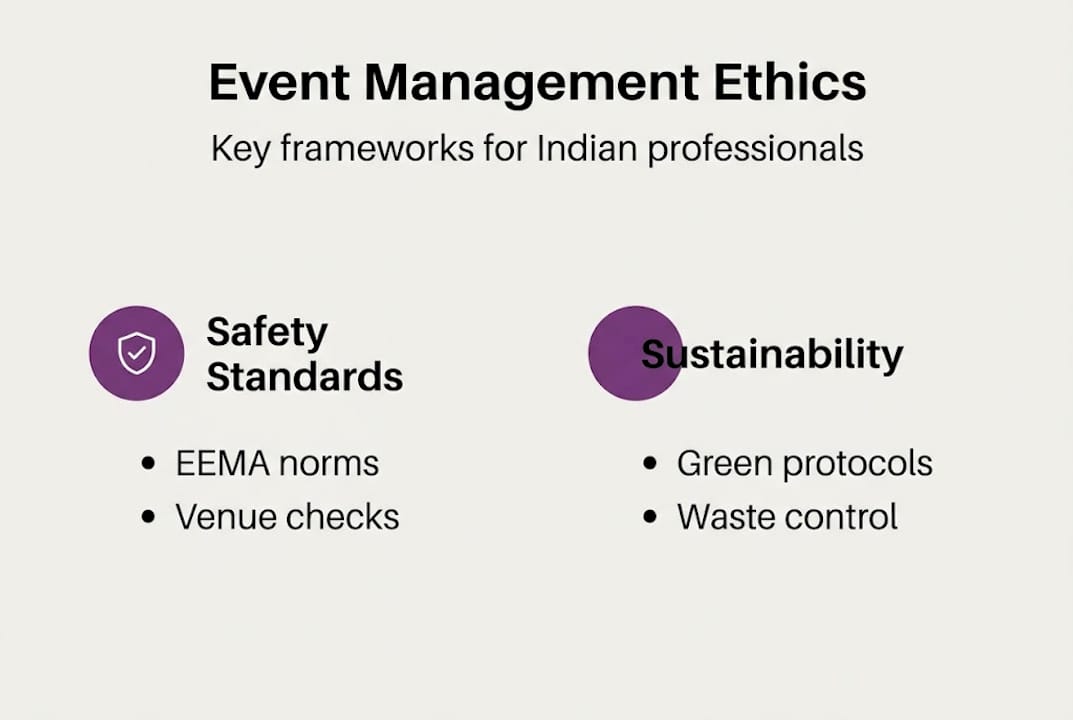
EEMA safety standards are the industry benchmark. Compliance is not just about avoiding penalties. It signals to clients and partners that you operate at a professional level. These standards cover crowd management, emergency protocols, structural safety for stages and installations, and vendor accountability.
Here is a quick overview of the core ethical frameworks and what they address:
| Framework | What it covers | Why it matters |
|---|---|---|
| EEMA safety standards | Crowd control, structural safety, emergency response | Industry benchmark for credibility |
| Green protocols | Waste reduction, sustainable sourcing | Reputation and sponsorship value |
| Risk matrices | Monsoon planning, vendor risk, crowd flow | Prevents costly last-minute failures |
| Contingency planning | Backup venues, alternative vendors | Essential for Indian event conditions |
Sustainability deserves special attention. Events that ignore green protocols risk serious reputational damage. And the financial case is equally strong: sustainable practices can increase sponsorship income and audience loyalty significantly. Clients are increasingly asking about your environmental approach before they sign anything.
Applying a risk matrix is a skill that separates competent event managers from truly reliable ones. A risk matrix maps potential problems (monsoon flooding, vendor no-shows, crowd surges) against their likelihood and impact, then assigns mitigation steps. It is not glamorous work, but it is the kind of preparation that keeps events safe and careers intact.
Here is a practical process for ethical risk planning:
- Identify every potential risk specific to your event type and location.
- Rate each risk by likelihood (low, medium, high) and potential impact.
- Assign a specific mitigation action and a named responsible person.
- Build a contingency plan for your top three risks before the event date.
- Brief your entire team on the plan, not just the senior staff.
Pro Tip: When pursuing event planning certifications, prioritise programmes that include live risk assessment exercises. Reading about risk matrices is useful. Practising them on a real event is transformative.
Building a successful event career in India means treating these frameworks as daily tools, not documents you review once a year.
Ethical challenges unique to India’s event management industry
India’s event landscape is genuinely unlike anywhere else in the world. The scale, the diversity, the weather, and the regulatory environment create ethical challenges that require specific, battle-tested responses.
Let us look at the most common ones honestly:
Monsoon disruptions are not a risk you can ignore. Monsoon disruptions require backup indoor spaces, and failing to arrange them is not just poor planning. It is an ethical failure toward your client and audience. Every outdoor event in India between June and September needs a credible indoor alternative secured in writing.
Vendor reliability is another serious issue. Verbal agreements are common but dangerous. Ethical practice means using written contracts with clear penalty clauses and maintaining a list of backup vendors for critical services. When a vendor lets you down on the day, your client does not care about the reason. They care about the outcome.
Overcrowding is one of the most serious safety risks in Indian events. Crowd flow planning is not optional. It is an ethical obligation to every person who buys a ticket or attends your event.

Permit delays catch many aspiring professionals off guard. The ethical and practical solution is simple: apply for permits at least 60 days early. Leaving it late and hoping for the best is not a strategy. It is a liability.
Sustainability on a tight budget is where many professionals struggle. 75% of organisers cite budget limits as the primary barrier to green practices. But here is the counter-intuitive truth: sustainable events attract better sponsors and build stronger audience loyalty. The upfront investment pays back.
Pro Tip: When choosing your event management career path, seek out programmes and employers who treat these challenges as core curriculum, not edge cases. The ability to handle India-specific ethical dilemmas is what makes you genuinely employable.
Here are the non-negotiable ethical responses to India’s toughest event challenges:
- Always secure a backup indoor venue in writing for any outdoor monsoon-season event.
- Use written vendor contracts with penalty clauses and maintain at least one backup for every critical supplier.
- Create a crowd flow plan and share it with your venue and security team before the event.
- Apply for all permits a minimum of 60 days before the event date.
- Build at least one sustainable practice into every event budget, no matter how small.
A creative event career in India is genuinely exciting. But creativity without ethical grounding is just expensive improvisation.
Applying ethical practices for career development and industry credibility
Knowing the theory is one thing. Turning it into visible professional action is what actually builds your career. Here is how you do it.
Step-by-step approach to applying ethical practice:
- Adopt a personal code of conduct and write it down. It forces clarity about your non-negotiables.
- Join EEMA for networking, mentorship, and access to industry-standard resources.
- Pursue a recognised certification. CPEM certification with live event exposure and placement support is one of the most respected pathways for Indian professionals.
- Volunteer for live events during your training. Classroom knowledge becomes instinct only when tested under real conditions.
- Document your ethical decisions. When you flag a safety risk, when you push back on an unrealistic timeline, keep a record. This becomes your professional story.
“For aspiring professionals in India, join EEMA for networking, certifications like CPEM with live event exposure and placements; prioritise hands-on experience over theory.”
This is not just career advice. It is a reminder that ethics in event management is a lived practice, not a certificate on a wall.
Building credibility also means being transparent about what you do not know. Clients respect professionals who say “I will confirm that detail” far more than those who bluff and fail. Intellectual honesty is an ethical act.
Here is what ethical career-building looks like in practice:
- Attend industry events and association meetings, not just for the networking, but to stay current on evolving standards.
- Seek mentors who have a reputation for ethical practice, not just commercial success.
- Check your degree recognition and ensure your qualifications align with industry expectations.
- Pursue certification for event planning that includes practical, assessed components, not just theory.
Your ethical reputation is built one decision at a time. Make those decisions deliberately.
What most aspiring event managers miss about ethical practice
Here is the uncomfortable truth that most guides will not tell you: treating ethics as a checklist is one of the most common and costly mistakes in this industry.
You can tick every compliance box, attend every EEMA seminar, and still behave unethically in the moment when a vendor offers you a kickback, when a client pressures you to cut a safety corner, or when you are tempted to overpromise to win a contract. Ethics is a daily discipline, not a qualification you earn once.
The professionals who build genuinely respected careers in India’s event industry are those who make ethical decisions visibly and consistently. They are the ones who say no to shortcuts in public, not just in private. That visibility matters. It signals to clients, vendors, and peers that you are someone worth trusting with serious work.
Networking through associations and live event exposure, as highlighted by EEMA membership and CPEM pathways, is not separate from ethical development. It is part of it. When you work alongside experienced professionals on real events, you absorb their ethical instincts, not just their technical skills.
Long-term credibility in this industry depends on visible ethical action. Start building that record now, not after you graduate. You can build your event management career on a foundation that actually lasts.
Advance your event management career with the right ethical foundations
Ethical practice is not just the right thing to do. It is the smartest career move you can make in India’s event industry right now. If you are serious about building a credible, rewarding future in this field, the next step is structured, practical education that puts you in real situations with real stakes.
At teami.org, with 24 years of industry experience and direct partnerships with DNA Entertainment Networks, we offer event management courses that go well beyond theory. From online event management courses to our hands-on event resource training programme, every pathway is designed to give you the ethical grounding, live exposure, and industry connections that actually open doors.
Frequently asked questions
What are the most important ethical standards for event managers in India?
The top standards include sustainability protocols, EEMA safety compliance, transparent vendor relations, and robust risk management frameworks that cover monsoon disruptions, crowd control, and contingency planning.
How can aspiring event professionals gain practical ethical experience?
Hands-on experience through certifications such as CPEM, participation in live events, and EEMA association membership are the most effective ways to build genuine ethical expertise rather than theoretical knowledge alone.
What are unique ethical challenges faced during event planning in India?
The most frequent challenges include monsoon disruptions requiring backup venues, vendor delays, permit delays requiring 60-day advance applications, and managing crowd safety ethically at large-scale events.
Does ethical practice improve career prospects in Indian event management?
Absolutely. Sustainable practices boost sponsorship income and can increase customer loyalty by up to 67%, making ethical event managers significantly more attractive to premium clients and employers.