
Most people assume event management is glamorous, creative, and spontaneous. You picture mood boards, fairy lights, and last-minute magic. But here’s the reality: India’s event management industry is growing at over 10% CAGR, and the professionals thriving in it are not the most creative ones. They’re the most disciplined. Behind every flawless concert, corporate summit, or wedding is a battle-tested framework, a risk register, and a team that planned for every possible failure. This article breaks down the core fundamentals, frameworks, and career pathways you need to build a serious, lasting career in Indian event management.
Table of Contents
- What is event management? Unpacking the fundamentals
- The event project lifecycle: From idea to impact
- Essential frameworks and tools every event manager should know
- Advanced risk management: Overcoming real-world event challenges
- Qualifications, certifications, and career pathways in Indian event management
- Expert tips: What sets outstanding event managers apart
- Launch your event management career with recognised courses
- Frequently asked questions
Key Takeaways
| Point | Details |
|---|---|
| Event management requires discipline | Successful events depend on following a well-defined lifecycle and operational frameworks. |
| Master risk and technology | Anticipating challenges and using the right digital tools give you a professional edge. |
| Certifications build credibility | Formal qualifications and practical experience are essential to launching a career in Indian event management. |
| Balance creativity and execution | Outstanding event managers combine vision with rigorous project management and data-driven outcomes. |
What is event management? Unpacking the fundamentals
Let’s clear something up immediately. Event management and event planning are not the same thing. Event planning focuses on the creative vision: the theme, the décor, the guest experience. Event management is the operational engine that makes all of it actually happen. It covers budgets, vendor contracts, risk mitigation, logistics, and post-event evaluation.
Think of it this way: the planner designs the car. The manager builds it, drives it, and makes sure it doesn’t break down on the motorway.
As you explore choosing an event management career, understanding this distinction is your first real test. The foundational principles of event management rest on structure, accountability, and strategic oversight, not just inspiration.
The event management lifecycle follows five distinct phases:
- Initiation: Define the event’s purpose, scope, and objectives
- Planning: Build your WBS, assign roles, set budgets, and schedule timelines
- Execution: Deliver the event on the ground, managing every moving part in real time
- Monitoring: Track KPIs, manage budget variance, and respond to issues as they arise
- Closure: Conduct post-event reviews, settle vendor payments, and document learnings
“The difference between a good event and a great one is rarely the idea. It’s the discipline behind the delivery.”
Every phase demands a different skill set. You shift from strategic thinker to operational commander to analyst, sometimes within the same day.

The event project lifecycle: From idea to impact
With an understanding of the basics, let’s break down what actually happens from the first idea to the post-event review. The structured lifecycle phases are not just theoretical. They are the backbone of every professionally managed event in India.
Here’s how the lifecycle unfolds in practice:
- Initiation: Identify the client’s goals, define success metrics, and establish a preliminary budget
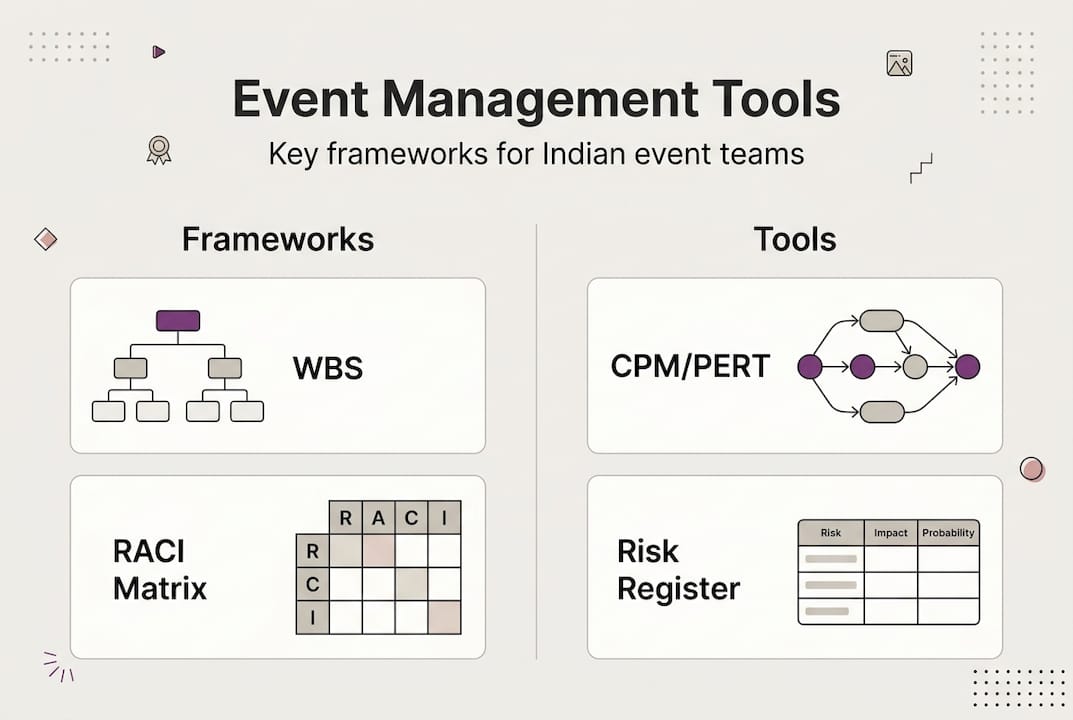
- Planning: Develop a Work Breakdown Structure (WBS) to map every task, assign responsibilities using a RACI matrix, and schedule using CPM or PERT methods
- Execution: Activate your vendor network, manage on-ground teams, and run real-time communications
- Monitoring: Use KPI dashboards to track attendance, spend, and stakeholder satisfaction against targets
- Closure: Debrief with your team, present outcomes to the client, and archive all documentation
Roles shift dramatically across these stages. During initiation, you’re a strategist. During execution, you’re a commander. During closure, you’re an analyst presenting hard data.
| Phase | Primary role | Key tool |
|---|---|---|
| Initiation | Strategist | Scope document |
| Planning | Project manager | WBS, RACI matrix |
| Execution | Operations lead | Run-of-show sheet |
| Monitoring | Analyst | KPI dashboard |
| Closure | Evaluator | Post-event report |
The standard methodologies used across high-performing event teams include WBS, RACI, CPM/PERT scheduling, and risk registers. These are not optional extras. They are the tools that separate professionals from amateurs.
Pro Tip: Build your risk assessment for events before you finalise your budget. Identifying risks early means you can price contingencies in, not scramble for funds on the day.
Essential frameworks and tools every event manager should know
To truly excel, you need to master not only the process but also the frameworks and technologies that underpin execution and monitoring. Let’s get specific.
WBS (Work Breakdown Structure): Breaks your entire event into manageable tasks. Think of it as your event’s blueprint. Every deliverable, from stage rigging to catering sign-off, lives here.
RACI matrix: Clarifies who is Responsible, Accountable, Consulted, and Informed for every task. In large Indian events with dozens of vendors and departments, this prevents the chaos of everyone assuming someone else handled it.
CPM/PERT scheduling: Critical Path Method and Programme Evaluation Review Technique help you identify which tasks must be completed on time to avoid delaying the entire event. Miss one critical path task, and the whole timeline collapses.
Beyond these frameworks, technology is reshaping how events are managed. Benchmark data for event programmes shows that dynamic registration forms deliver a 24.4% conversion rate compared with just 11.6% for static forms. AI-powered personalisation and hybrid event formats are also driving measurable ROI gains across the industry.
Key KPIs every event manager should track:
- Attendance rate: Registered vs. actual attendees
- Budget variance: Planned spend vs. actual spend, expressed as a percentage
- Stakeholder satisfaction: Post-event survey scores from clients, sponsors, and attendees
- Lead generation: For corporate events, the number of qualified contacts captured
- Net Promoter Score (NPS): A measure of how likely attendees are to recommend the event
For context on industry growth metrics and what top-performing portfolios look like, the Indian event sector benchmarks reveal that high-performing teams average 25 events per year with 52% attendance rates and approximately $84,000 in revenue per paid event.
Pro Tip: Adopt a unified digital platform that combines registration, communications, and KPI tracking. Real-time data lets you make decisions during the event, not after it.
Advanced risk management: Overcoming real-world event challenges
Beyond frameworks, true professionals anticipate the unexpected. India’s event landscape is uniquely demanding: monsoon seasons, dense crowds, complex vendor ecosystems, and high-stakes corporate clients all raise the risk profile significantly.
The most common edge cases you will face include:
- Crowd control failures: Overcrowding at entry points or stage fronts. Mitigate with pre-planned crowd flow logistics, designated marshals, and staggered entry times.
- Technical breakdowns: AV failures, power cuts, or connectivity issues. Always have backup generators, redundant AV systems, and a dedicated tech team on standby.
- Weather disruptions: Outdoor events in India are particularly vulnerable. Build weather contingency clauses into every vendor contract and have an indoor backup plan ready.
- Vendor no-shows: A caterer or decorator who doesn’t arrive is a crisis. Maintain a vetted backup vendor list and confirm all suppliers 48 hours before the event.
- Medical emergencies: Have a qualified first-aid team on site, clearly marked medical stations, and a direct line to the nearest hospital.
“A risk you haven’t planned for is a crisis waiting to happen. A risk you have planned for is just a problem with a solution already written.”
The edge cases in Indian events are best managed through risk matrices, contingency plans, regular drills, and appropriate insurance coverage. Critically, EEMA’s safety standards now provide a standardised safety manual that all professional event managers in India should align with.
For detailed risk management strategies and proactive risk assessment frameworks, make these resources part of your ongoing professional development, not just your pre-event checklist.
Qualifications, certifications, and career pathways in Indian event management
After equipping yourself with frameworks and risk strategies, it’s time to formalise your expertise. In India’s competitive market, a recognised certification is not just a credential. It’s a signal to employers and clients that you operate to a professional standard.
The leading Indian providers include NIEM, team I (EEMA-certified), and NDIEM, all of which emphasise practical training and industry internships alongside classroom learning.
When selecting a course, look for:
- EEMA alignment: Ensures your training meets the industry’s safety and operational standards
- Hands-on projects: Real event participation, not just case studies
- Industry connections: Access to live briefs, guest faculty, and placement networks
- Specialisation options: Social events, corporate events, sports, weddings, and entertainment
- Internship integration: Structured placements that build your portfolio before you graduate
Career pathways in Indian event management are genuinely varied. You can move into corporate event production, wedding management, sports event coordination, or launch your own agency. The Indian event management market trends confirm that demand for certified professionals is outpacing supply, which means your timing is excellent.
Explore top certifications for event management and get clear on building your event management career with a structured plan from day one.
Expert tips: What sets outstanding event managers apart
Finally, to stand out in a crowded field, it’s these advanced habits and mindsets that will define your trajectory.
The top event professionals in India combine creative vision with disciplined project management, data-led ROI reporting, and Agile practices that allow them to adapt when plans change mid-event. And they always do.
Here’s what separates the outstanding from the average:
- They measure everything. Attendance, budget variance, satisfaction scores. Data is their language.
- They communicate ROI clearly. Clients don’t just want a great event. They want proof it delivered value.
- They pursue recognised credentials. EEMA-aligned certifications build long-term credibility with corporate clients.
- They adopt Agile thinking. When the headline act cancels at 6 PM, they already have a Plan B and a Plan C.
- They invest in high-performing event portfolios. Studying what works at scale gives you a benchmark to aim for.
Pro Tip: After every event, send your client a one-page ROI summary. Include attendance figures, budget performance, and satisfaction scores. It’s the single most powerful habit for building repeat business and referrals. Start exploring finding the best certification to formalise these skills with industry recognition.
Launch your event management career with recognised courses
You now understand the frameworks, the lifecycle, the risk strategies, and the career pathways. The next step is turning that knowledge into a credential that opens doors. team I’s EEMA-certified programmes combine rigorous classroom learning with real-world event exposure, industry mentorship, and structured placements. Whether you’re starting from scratch or looking to advance, there’s a pathway built for you. Explore the full event management course overview, browse online event management programmes that fit your schedule, or speak to an advisor today to find the right fit for your ambitions.
Frequently asked questions
What are the five main stages of event management?
The five structured stages are initiation, planning, execution, monitoring, and closure, each with distinct objectives, tools, and deliverables that build on one another.
How is event planning different from event management?
Event planning centres on creative vision and attendee experience, while event management covers operational execution and the control of budget, time, and scope constraints.
Which certifications are recommended for event managers in India?
NIEM, team I (EEMA-certified), and NDIEM are the leading Indian providers, all focusing on practical skills, internships, and alignment with EEMA’s industry standards.
Why is risk management crucial for event managers?
Risk management helps you anticipate and address edge cases like crowd control failures, weather disruptions, and vendor no-shows, ensuring events run safely and professionally.
How big is the event management market in India?
India’s event management sector is projected to grow at over 10% CAGR through 2029, driven by rising corporate and experiential event demand across the country.