

What makes feedback the engine behind real progress in event management training? For aspiring professionals and recent graduates in Bangalore, mastering feedback is more than an academic task—it is the key to developing practical skills, refining strategies, and ensuring long-term success. Authentic assessment techniques and structured feedback turn theoretical lessons into measurable growth, helping you transform each training opportunity into a stepping stone towards professional excellence.
Table of Contents
- Defining Feedback In Event Management Training
- Types Of Feedback And Key Distinctions
- How Feedback Drives Skill Improvement
- Best Practices For Effective Feedback Delivery
- Risks And Common Pitfalls In Feedback Processes
Key Takeaways
| Point | Details |
|---|---|
| Importance of Feedback | Feedback is essential for transforming theoretical knowledge into practical skills in event management training. It serves as a mechanism for continuous learning and performance improvement. |
| Types of Feedback | Different feedback types, including evaluative, appreciative, corrective, and developmental, play distinct roles in fostering professional growth and skill enhancement. |
| Effective Feedback Practices | Delivering effective feedback requires specificity, timeliness, and a balanced perspective that encourages a two-way dialogue, ensuring learners are motivated and supported. |
| Risk Mitigation | Awareness of common risks in feedback processes, such as emotional reactivity and vague guidance, allows for the implementation of best practices that nurture a more productive learning environment. |
Defining Feedback in Event Management Training
Feedback in event management training represents a sophisticated, systematic approach to professional skill development, serving as a critical mechanism for continuous learning and performance improvement. Authentic assessment techniques enable learners to understand complex event processes and refine their professional competencies through structured reflective practices.
Effective feedback mechanisms in event management training typically involve multiple dimensions of evaluation:
- Performance Assessment: Detailed analysis of individual task execution
- Skill Gap Identification: Pinpointing specific areas requiring improvement
- Professional Competency Development: Targeted coaching and guidance
- Reflective Learning: Encouraging self-awareness and critical thinking
The primary objective of feedback is transforming theoretical knowledge into practical expertise. By providing structured, constructive observations, trainers help emerging event management professionals develop nuanced skills in communication, time management, and strategic planning. Systematic evaluation methods enable participants to understand their strengths and weaknesses, creating personalised development pathways.

Pro tip: Treat every piece of feedback as an opportunity for growth, not criticism, and maintain a growth mindset throughout your professional training journey.
Types of Feedback and Key Distinctions
Performance feedback in event management represents a multifaceted approach designed to support professional growth through diverse communication strategies. Different feedback categories enable trainers to address specific developmental needs, transforming learning experiences from generic instruction to personalised skill enhancement.
Key types of feedback in event management training include:
- Evaluative Feedback: Measures performance against predefined standards
- Appreciative Feedback: Recognises and reinforces positive behaviours and achievements
- Corrective Feedback: Identifies areas requiring improvement and suggests specific interventions
- Developmental Feedback: Focuses on long-term skill progression and career trajectory
Organisational performance research highlights three primary feedback mechanisms that distinguish professional learning environments. These mechanisms – positive reinforcement, targeted correction, and strategic development – work synergistically to create comprehensive learning experiences that prepare event management professionals for complex industry challenges.
Each feedback type serves a unique purpose in professional development, ranging from immediate performance adjustment to sustained skill refinement. The most effective training programmes integrate multiple feedback approaches, ensuring holistic personal and professional growth for emerging event management talents.
The following table summarises how each feedback type uniquely contributes to professional development in event management training:
| Feedback Type | Core Function | Example Application | Impact on Learner |
|---|---|---|---|
| Evaluative | Benchmarking against standards | Assessing event planning accuracy | Highlights achievement gaps |
| Appreciative | Reinforcing strengths | Praising timely communication | Boosts morale and motivation |
| Corrective | Addressing weaknesses | Suggesting better resource allocation | Guides targeted skill improvement |
| Developmental | Fostering long-term growth | Mapping career progression | Sustains continual development |
Pro tip: Cultivate a receptive mindset towards feedback, viewing each observation as a strategic opportunity for professional transformation.
How Feedback Drives Skill Improvement
Skill development in event management requires a dynamic, responsive approach to learning that goes beyond traditional instructional methods. Training feedback mechanisms create an iterative learning environment where professionals continuously refine their capabilities through structured performance analysis and targeted guidance.
The skill improvement process through feedback typically involves several critical stages:
- Performance Assessment: Identifying current skill levels and competency gaps
- Targeted Intervention: Designing specific strategies for skill enhancement
- Behavioural Modification: Encouraging adaptive learning techniques
- Continuous Monitoring: Tracking progress and adjusting development strategies
Organisational behaviour research demonstrates that effective feedback operates through sophisticated psychological mechanisms. By providing clear, constructive insights, trainers help event management professionals understand the direct relationship between their actions and professional outcomes, thereby motivating continuous improvement and strategic skill development.
The most successful skill improvement strategies integrate multiple feedback channels, creating a holistic approach that addresses technical competencies, interpersonal skills, and strategic thinking. This comprehensive method ensures that emerging event management professionals develop a nuanced understanding of industry requirements and personal performance potential.
Pro tip: Maintain a detailed learning journal to document feedback insights, transforming each observation into a strategic opportunity for personal and professional growth.
Best Practices for Effective Feedback Delivery
Professional feedback in event management requires a sophisticated approach that transcends traditional communication methods. Performance management strategies emphasise creating a constructive dialogue that motivates and guides professional development.
Key principles for delivering effective feedback include:
- Specificity: Providing concrete, observable details about performance
- Timeliness: Offering insights closest to the actual performance moment
- Balanced Perspective: Combining positive reinforcement with constructive suggestions
- Two-Way Dialogue: Encouraging active participation and reflection
- Forward-Looking Approach: Focusing on future improvement, not past mistakes
Feedback communication techniques reveal that the most successful approaches prioritise empathy and clarity. Trainers must create an environment where feedback feels like a collaborative coaching process rather than a judgmental assessment, ensuring learners feel supported and motivated to enhance their professional capabilities.
Successful feedback delivery in event management training requires emotional intelligence and strategic communication. By crafting feedback that is precise, constructive, and delivered with genuine intent to support growth, trainers can transform potential critiques into powerful learning opportunities that drive professional excellence.
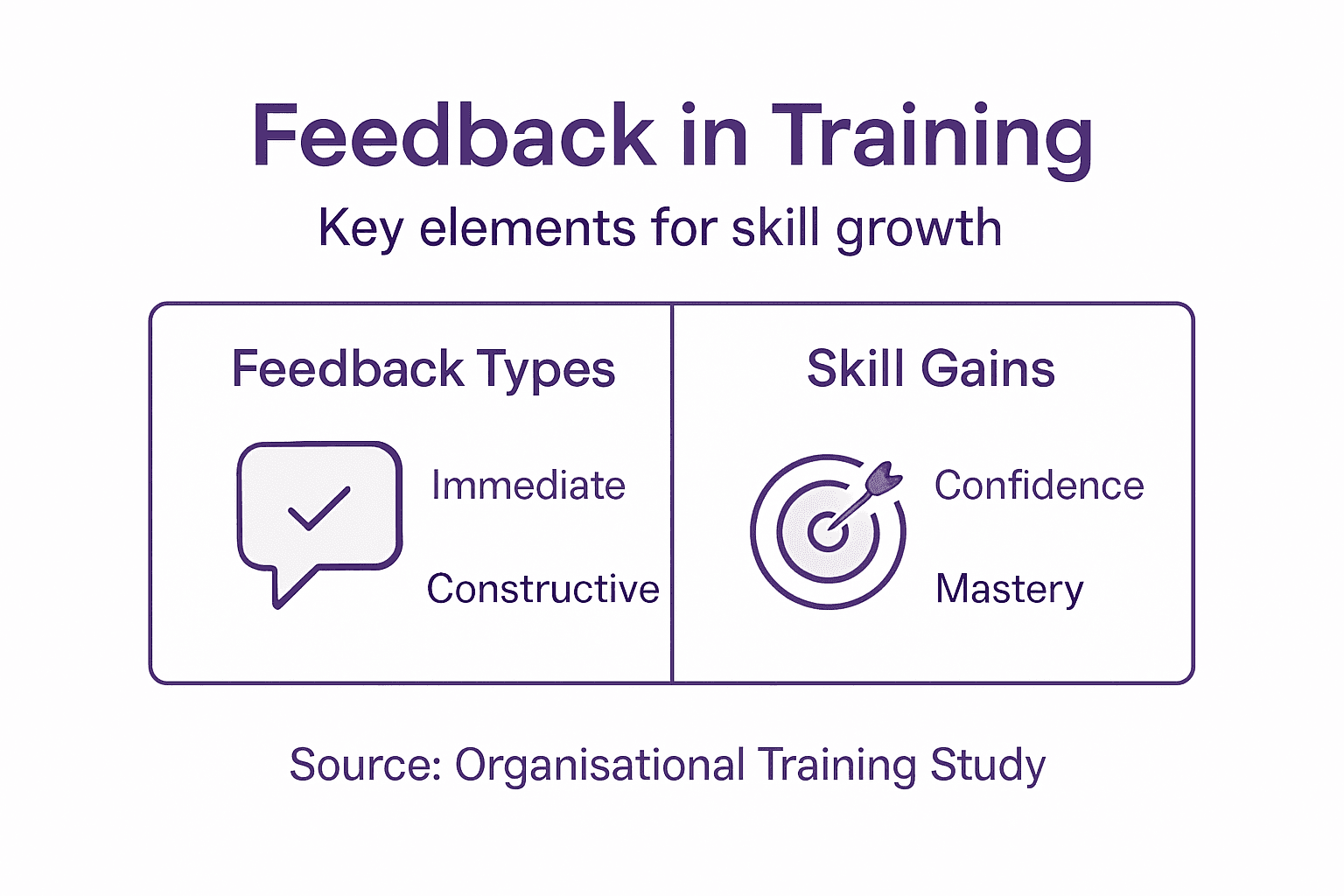
Pro tip: Practice the “sandwich method” of feedback: begin with positive observations, introduce areas for improvement, and conclude with encouraging future-oriented guidance.
Risks and Common Pitfalls in Feedback Processes
Feedback mechanisms in professional training are complex systems that can inadvertently produce counterproductive outcomes when not carefully managed. Cognitive feedback challenges reveal multiple potential barriers that can undermine the learning process and professional development.
Key risks and pitfalls in feedback delivery include:
- Emotional Reactivity: Triggering defensive responses instead of learning
- Cognitive Overload: Providing too much information simultaneously
- Vague Guidance: Offering non-specific or generalised comments
- Personal Criticism: Focusing on character traits rather than behaviours
- Inconsistent Delivery: Applying uneven standards across different individuals
Performance feedback research demonstrates that poorly constructed feedback can create significant psychological barriers. These barriers can diminish motivation, create resistance to improvement, and ultimately compromise the entire professional development process.
Mitigating these risks requires a strategic, empathetic approach that prioritises clear communication, emotional intelligence, and a genuine commitment to supporting individual growth. Event management professionals must develop sophisticated feedback skills that balance constructive critique with supportive guidance, ensuring learners feel valued and motivated.
This table provides a comparative overview of risks associated with poor feedback processes versus best practice approaches for mitigation:
| Common Risk | Consequence | Best Practice Mitigation |
|---|---|---|
| Emotional Reactivity | Defensive learner response | Use empathy and clear communication |
| Cognitive Overload | Reduced retention | Offer concise, focused feedback |
| Vague Guidance | Unclear improvement steps | Provide specific, actionable advice |
| Personal Criticism | Lowered motivation | Focus on behaviour, not character |
| Inconsistent Delivery | Perceived unfairness | Standardise feedback procedures |
Pro tip: Always pause and review your feedback draft, ensuring it focuses on observable behaviours and provides specific, actionable recommendations.
Unlock Your Potential with Expert Feedback and Practical Training
Understanding the critical role of structured feedback in event management training is the first step to transforming your skills and career. If you are eager to move beyond vague advice and experience targeted, actionable coaching that drives real growth discover how teami.org harnesses proven feedback techniques to help you close skill gaps and refine your professional competencies effectively. Our training programmes combine the power of constructive feedback with hands-on projects and real event participation ensuring you build confidence in communication time management and strategic planning.
Take your event management career further by learning through personalised guidance and industry partnerships with DNA Entertainment Networks. Whether you seek foundational knowledge or specialised fields like social sports wedding or corporate events, our 24 years of expertise and high placement record make us your ideal partner. Don t wait let your growth begin today by connecting with us via this link. Start embracing feedback as a powerful tool for skill improvement and unlock opportunities with teami.org now.
Frequently Asked Questions
What are the main types of feedback in event management training?
The main types of feedback include evaluative feedback, which benchmarks performance against standards; appreciative feedback, which recognises and reinforces positives; corrective feedback, which identifies improvement areas; and developmental feedback, which focuses on long-term growth.
How does feedback facilitate skill improvement in training?
Feedback facilitates skill improvement by providing structured performance assessments, targeted interventions, behavioural modifications, and continuous monitoring, enabling learners to refine their competencies effectively.
What are some best practices for delivering effective feedback?
Best practices for effective feedback include being specific about performance, delivering feedback in a timely manner, balancing positive reinforcement with constructive guidance, encouraging two-way dialogue, and focusing on future improvements.
What risks can arise from poor feedback processes in training?
Risks of poor feedback processes include emotional reactivity leading to defensiveness, cognitive overload from too much information, vague guidance that lacks specificity, personal criticism that demotivates, and inconsistent delivery that creates unfairness.