

The surge of streaming, social media, and gaming platforms is transforming how audiences consume and interact with entertainment. Aspiring event managers and young professionals in India are discovering that success now depends on mastering the converging digital ecosystem, where content creation, audience engagement, and technology blend seamlessly. This guide draws on global insights to help you develop multidisciplinary skills, understand new monetisation strategies, and navigate emerging opportunities in the rapidly evolving media and entertainment industry.
Table of Contents
- Defining Media and Entertainment Trends Today
- Key Industry Segments and Emerging Variations
- Technological Innovations Reshaping Content Delivery
- Monetisation Models and the Impact on Events
- Risks, Compliance and Professional Skillsets
Key Takeaways
| Point | Details |
|---|---|
| Adaptability is Essential | Professionals must cultivate versatile skill sets to thrive in the rapidly changing media landscape. |
| Embrace Multi-Platform Strategies | Understanding the interconnected nature of media segments enhances engagement and monetisation opportunities. |
| Leverage Technology for Personalisation | Utilising AI and immersive technologies can transform audience interactions and content delivery. |
| Innovative Monetisation Approaches | Developing hybrid and localised monetisation strategies will enable events to diversify revenue streams effectively. |
Defining Media and Entertainment Trends Today
The media and entertainment landscape is undergoing profound transformations driven by technological innovation and changing audience expectations. Digital ecosystem convergence now characterises how entertainment platforms interact, blending streaming, social media, and interactive content into seamless experiences.
Key trends are reshaping how professionals approach event management and entertainment production. The creator economy has emerged as a powerful force, with individual content makers wielding significant influence across platforms. Gaming is no longer a niche interest but a central entertainment medium, integrating social interaction, storytelling, and participatory experiences. Streaming services continue to fragment traditional media consumption patterns, demanding more personalised and immediate content delivery.
Industry professionals must adapt to these dynamic shifts by developing versatile skill sets. Understanding algorithm-driven content strategies becomes crucial for event managers seeking to create engaging experiences. The boundaries between different media formats are increasingly blurred, requiring event professionals to think creatively about audience engagement and interactive content design.
Industry Insight: Develop cross-platform skills and stay adaptable, as the media landscape continues to evolve rapidly and reward multi-disciplinary expertise.
Key Industry Segments and Emerging Variations
The media and entertainment industry comprises multiple dynamic segments that are increasingly interconnected and evolving at unprecedented speeds. Global entertainment ecosystem now encompasses streaming, gaming, social media, and content creation platforms that blur traditional boundaries between audience and creator.
Traditional industry segments are experiencing significant transformations. Film and television are no longer distinct from digital content, with streaming services producing original content that rivals studio productions. Music has shifted from album-based consumption to individual track streaming and algorithmic playlist curation. Publishing has dramatically changed, with digital platforms enabling direct author-to-reader connections and multimedia storytelling approaches that integrate text, audio, and interactive elements.
Gaming emerges as a particularly significant segment, transcending entertainment to become a social interaction platform. Emerging media variations demonstrate how interactive experiences are reshaping audience engagement. Event management professionals must now understand these complex intersections, recognising that contemporary entertainment requires multidisciplinary skills spanning technology, storytelling, and audience interaction.
Professional Strategy: Develop a holistic understanding of multiple media segments and their interconnections to remain adaptable in the rapidly evolving entertainment landscape.
Technological Innovations Reshaping Content Delivery
Technological innovations are fundamentally transforming how content is created, delivered, and consumed across media platforms. Streaming platform innovations are driving unprecedented changes in audience interaction and content personalisation, with artificial intelligence and immersive technologies playing pivotal roles in reshaping entertainment experiences.
Augmented and virtual reality technologies are breaking down traditional barriers between audiences and content creators. Interactive experiences now enable viewers to become active participants rather than passive consumers. Blockchain technology is emerging as a critical tool for content authentication and creator monetisation, providing transparent mechanisms for rights management and direct artist compensation. Metaverse integrations are creating entirely new dimensions of content engagement, allowing for more complex and interconnected storytelling approaches.

Immersive media technologies are particularly transformative for younger generations, who expect more personalised and interactive content experiences. AI-powered recommendation systems are becoming increasingly sophisticated, using machine learning algorithms to curate content that matches individual preferences with remarkable precision. These technological advancements are not just changing how content is delivered, but fundamentally reimagining the relationship between creators, platforms, and audiences.
Professional Insight: Continuously update your technological skills and remain curious about emerging platforms to stay relevant in the rapidly evolving media landscape.
The following table summarises the transformative effects of recent technological innovations on media content delivery:
| Technology | Main Function | Impact on Content Delivery | Audience Benefit |
|---|---|---|---|
| AI & Machine Learning | Content recommendation | Personalised curation | Matches individual interests precisely |
| Augmented Reality | Interactive overlays | Blurs creator-audience boundary | Offers immersive, engaging experiences |
| Blockchain | Secure transactions | Transparent rights management | Ensures creators receive direct compensation |
| Metaverse Integration | Virtual shared spaces | Multi-layered storytelling | Facilitates richer social interactions |
Monetisation Models and the Impact on Events
The media and entertainment landscape is experiencing profound transformations in revenue generation strategies, with innovative monetisation approaches fundamentally reshaping how events are conceptualised, delivered, and financially structured. Traditional single-stream revenue models are rapidly giving way to sophisticated, multi-dimensional approaches that blend digital and physical experiences.
Hybrid monetisation strategies have emerged as a critical trend, allowing event professionals to diversify income streams beyond conventional ticket sales. These models incorporate multiple revenue channels such as sponsorships, digital content licensing, virtual participation options, and targeted advertising. Streaming platforms and interactive digital experiences are creating new opportunities for audience engagement and revenue generation, enabling events to reach global audiences while developing additional income pathways.
Localised content monetisation strategies are particularly crucial in emerging markets like India, where price sensitivity and fragmented payment systems demand innovative approaches. Event managers must now develop nuanced strategies that balance audience accessibility with financial sustainability, considering factors like regional economic conditions, technological infrastructure, and changing consumer behaviours.
Professional Strategy: Develop flexible monetisation frameworks that can adapt quickly to technological changes and audience preferences, combining multiple revenue streams for maximum financial resilience.
This reference table compares key monetisation strategies now influencing entertainment event planning:
| Monetisation Model | Revenue Streams Included | Market Suitability | Challenge Addressed |
|---|---|---|---|
| Hybrid | Ticket sales, sponsorship, licensing | Global and large events | Diverse income, broader audience |
| Localised Strategy | Regional subscriptions, micro-payments | Emerging markets | Price sensitivity, payment variety |
| Digital-first | Streaming, virtual ads, pay-per-view | Online audiences worldwide | Remote engagement, extended reach |
Risks, Compliance and Professional Skillsets
The media and entertainment industry demands increasingly sophisticated approaches to professional risk management and compliance. Strategic risk management skills have become essential for professionals navigating complex regulatory landscapes and technological challenges.
Cybersecurity and intellectual property protection represent critical areas of professional expertise. Event managers must develop comprehensive understanding of digital rights management, data privacy regulations, and content confidentiality protocols. This requires continuous skill development in emerging technologies, understanding legal frameworks, and implementing robust risk mitigation strategies that protect both organisational and client interests.
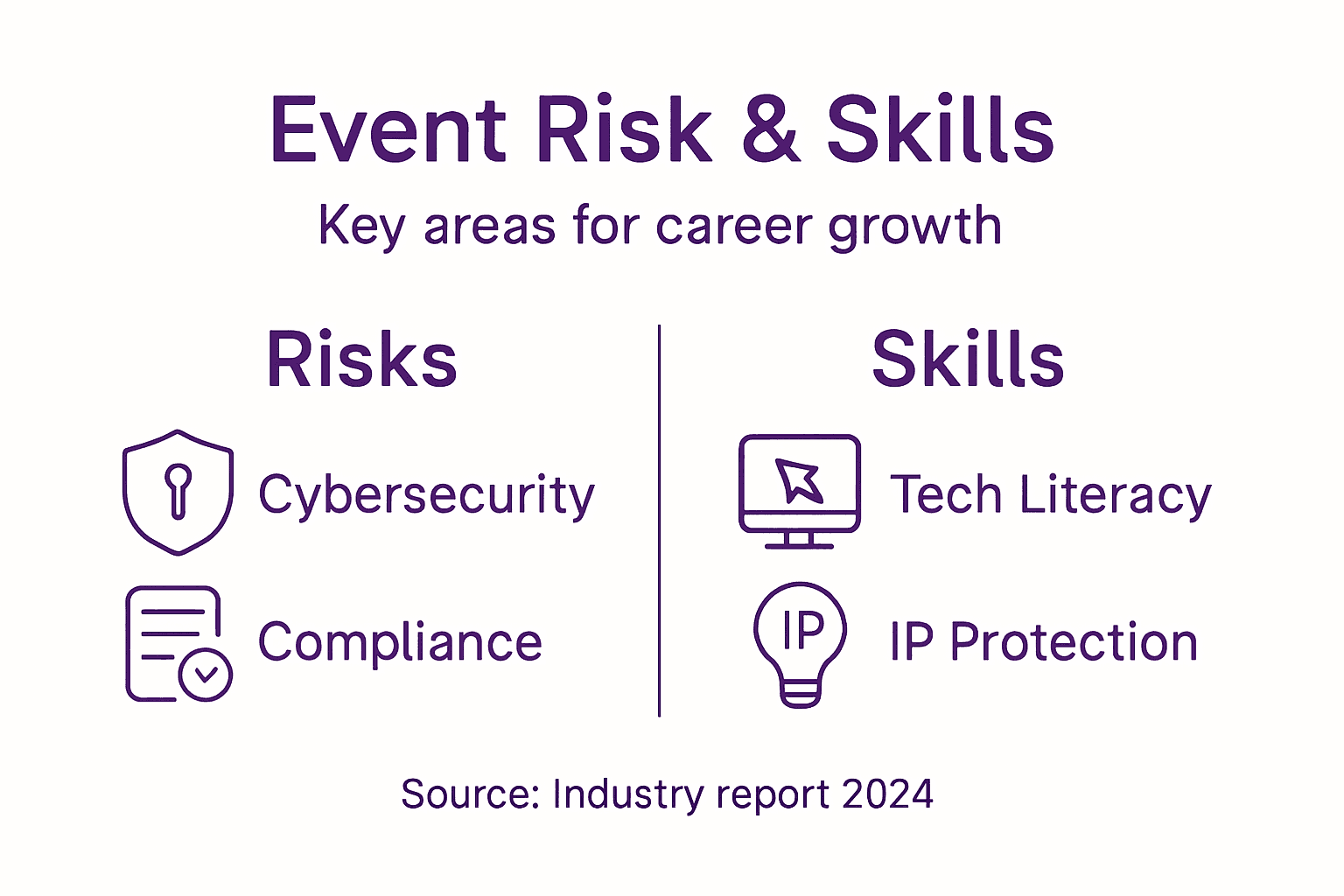
Evolving compliance frameworks demand professionals cultivate interdisciplinary skills combining technological awareness, legal knowledge, and strategic thinking. Cloud-based services, artificial intelligence integration, and dynamic regulatory environments necessitate professionals who can adapt quickly, interpret complex guidelines, and develop proactive risk management approaches that balance innovation with regulatory compliance.
Professional Strategy: Invest consistently in cross-disciplinary skill development, focusing on technological literacy, legal understanding, and adaptive risk management techniques.
Elevate Your Event Management Career with Industry-Leading Training
The rapid shifts in media and entertainment demand event professionals who can master cross-platform skills, innovative monetisation models, and cutting-edge technology. If you want to overcome challenges like adapting to AI-driven strategies or hybrid event formats this is your moment to gain the expertise that sets you apart. At teami.org you gain practical knowledge from 24 years of experience and collaborate with DNA Entertainment Networks ensuring your training is aligned with real industry needs.
Discover specialised courses designed to build your competence in social, corporate, sports, and wedding events while developing vital skills in risk management and emerging media trends. Don’t wait to future-proof your career. Explore our course offerings today by visiting teami.org and take your first step towards becoming a versatile event manager equipped for tomorrow’s media landscape. Ready to transform your career path Now connect with us through this link and unlock new opportunities!
Frequently Asked Questions
What are the key trends currently shaping the media and entertainment industry?
Key trends include the rise of the creator economy, the integration of gaming as a core entertainment medium, the fragmentation of traditional media consumption through streaming services, and the need for personalised content delivery.
How are technological innovations impacting content delivery in the entertainment sector?
Technological innovations such as artificial intelligence, augmented reality, and blockchain are transforming content delivery by enabling personalised experiences, facilitating interactive storytelling, and ensuring creators receive fair compensation through transparent rights management.
What are hybrid monetisation strategies in the context of event management?
Hybrid monetisation strategies incorporate multiple revenue streams, including ticket sales, sponsorships, digital content licensing, and virtual participation options, allowing event professionals to diversify their income and engage global audiences.
Which skills are essential for professionals in the evolving media and entertainment landscape?
Professionals need to develop versatile skills that encompass technological literacy, strategic risk management, compliance knowledge, and interdisciplinary expertise to navigate the rapidly changing media ecosystem.