
Think getting a degree is enough to land a strong event management role in India? Think again. Entry-level salaries can start as low as ₹1.2 Lakhs per year without hands-on experience, while professionals who complete quality internships move faster, earn more, and get noticed sooner. The events industry runs on controlled chaos, real-time decisions, and people skills that no textbook can truly teach. Internships are not a bonus. They are the fast lane.
Table of Contents
- What makes internships vital in event management?
- Skills gained during event internships: A closer look
- How internships impact careers and salaries in India
- Maximising the value of your event internship
- Our perspective: What most guides miss about event internships
- Take the next step in your event management journey
- Frequently asked questions
Key Takeaways
| Point | Details |
|---|---|
| Internships build real skills | Practical experience develops vital communication, problem-solving, and networking abilities that theory alone does not. |
| Faster career progress | Interns often earn higher starting salaries and reach mid-level event management roles more quickly in India. |
| Choose quality opportunities | Prioritise reputable internships, seek diverse tasks, and actively build your professional portfolio for best results. |
| Mind financial realities | Be aware that unpaid internships can pose real challenges for diversity and accessibility in the industry. |
What makes internships vital in event management?
Classroom learning gives you the map. Internships put you on the road. There is a genuinely enormous gap between knowing what a showflow is and actually building one under pressure at midnight before a corporate launch.
The importance of internships for event students is not simply about ticking a box for your CV. It is about becoming someone an employer would actually trust with a live event. According to research on work readiness, practical internship experience develops critical skills including communication, problem-solving, adaptability, networking, and hands-on use of event software. These are the exact qualities that hiring managers in India’s ₹10,000 crore events sector are actively looking for.
Here is what internships genuinely provide that classrooms simply cannot:
- Real vendor negotiations where the stakes are actual money, not a roleplay exercise
- Logistics troubleshooting when a stage setup runs two hours behind schedule
- Client communication when a brief changes the morning of the event
- On-site crowd flow management requiring instant judgement calls
- Cross-functional teamwork with audio-visual crews, caterers, and security
“When they tell you something doesn’t work on-site, it’s not theoretical. You feel it, you fix it, and you remember it forever.”
Building strong event management media skills alongside internship exposure positions you ahead of candidates who have only ever studied in a controlled environment. Employers notice. They always do.
Skills gained during event internships: A closer look
With an overview of why internships matter, it is important to unpack exactly which practical skills they build and how these are applied day-to-day in the workplace.
A quality internship is not just about carrying equipment or handing out lanyards. The roles you can be thrown into are seriously varied, and each one sharpens a different professional muscle. Research confirms that practical internship exposure cultivates communication, adaptability, networking, and technical competence simultaneously.
| Skill area | Internship activity | Career application |
|---|---|---|
| Vendor management | Sourcing and coordinating suppliers | Budget control and negotiation |
| Client relations | Briefing sessions and feedback calls | Account management |
| Logistics | Floor plans, load-in schedules | Production management |
| Budgeting | Tracking spend against estimates | Financial oversight |
| Event software | Using tools like Eventbrite, Cvent | Operational efficiency |
| Networking | Meeting industry contacts on-site | Future job referrals |
You can also grow your skills and professional network by actively seeking out industry events alongside your internship. Each connection made during an internship is a potential future collaborator, referral, or employer.
Explore event work experience pathways to understand exactly what roles are available and how to position yourself for them strategically.
One of the biggest advantages of an internship is adaptability. Real events break down. Speakers cancel. Venues flood. You adapt or the event fails. Every time you problem-solve under pressure, you deposit confidence into a professional account you will draw from throughout your entire career.
Pro Tip: Do not wait to be assigned tasks. Ask for more. Tell your supervisor you want to sit in on vendor calls, attend the briefing with the client, or help draft the post-event report. Diversifying your experience within a single internship doubles its value. And always, always ask for written feedback before you leave.
Developing strong networking habits for event careers early sets the foundation for the kind of reputation that precedes you in India’s tightly knit events industry.
How internships impact careers and salaries in India
Once you have these job-ready skills, it is important to recognise how internships shape your earning power and professional trajectory in a concrete, measurable way.
The salary gap between experienced and inexperienced candidates is real and significant. Event management intern stipends in India typically range from ₹8,500 to ₹11,500 per month. But those who complete strong internships move to mid-level roles paying ₹5 to ₹10 Lakhs per annum far more quickly than those who do not.
The typical career acceleration pathway looks like this:
- Complete a quality internship during or immediately after your course, gaining at least one live event cycle of experience
- Secure an entry-level role (₹1.2 to ₹4 Lakhs per annum) with demonstrated skills and a portfolio to show
- Move to a mid-level opportunity (₹5 to ₹10 Lakhs per annum) within two to three years based on proven track record
Salary snapshot: Professionals without internship experience often stay stuck at entry-level pay for longer. Internship-backed candidates negotiate from a stronger position from their very first interview.
India’s event management career opportunity is genuinely vast. The sector spans weddings, corporate events, sports, concerts, government summits, and entertainment IPs. Employers across all these verticals consistently report that they favour demonstrable experience over academic qualifications alone when making hiring decisions.
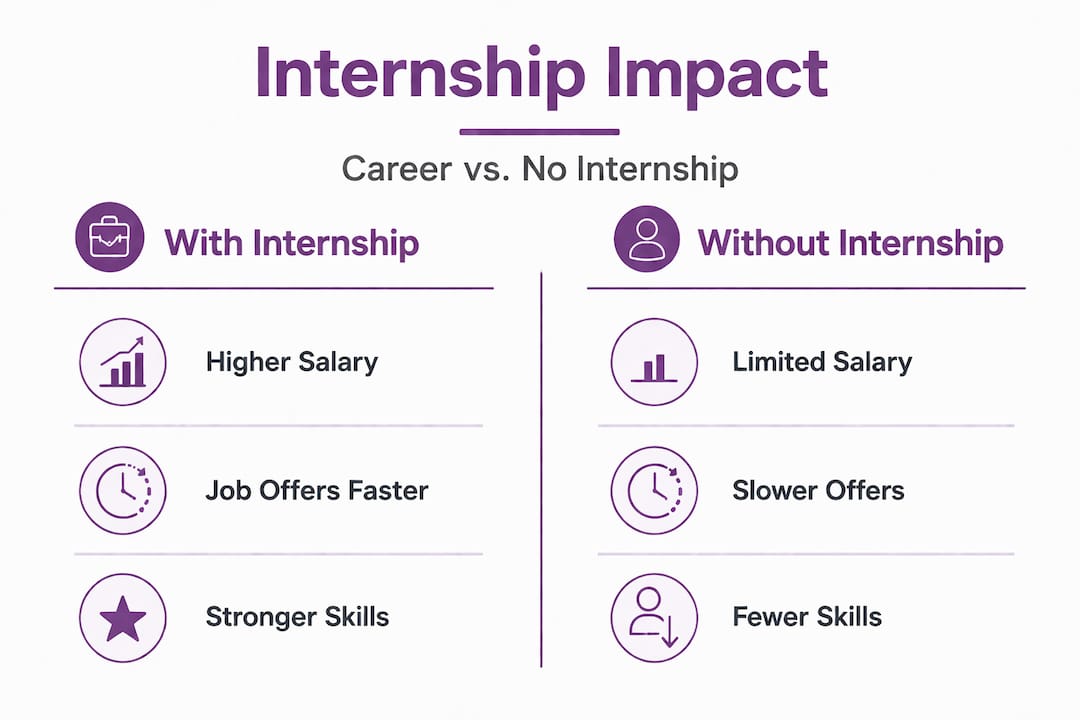
The comparison below illustrates how two candidates with identical degrees but different experience levels are viewed by hiring managers:
| Factor | With internship | Without internship |
|---|---|---|
| Starting salary negotiation | Stronger position | Limited leverage |
| Time to mid-level role | 2 to 3 years | 4 to 5 years |
| Employer confidence | High, proven practical skills | Lower, unproven ability |
| Network on day one of job | Already established | Starting from scratch |
Understanding how to build an event career strategically is the difference between drifting into the industry and commanding it.
Maximising the value of your event internship
Understanding the stakes, let us explore how to select the right internship and turn the experience into a genuine springboard rather than just a line on a resume.
Not all internships are created equal. A reputed firm with multiple event types will teach you ten times more than a small operation that uses you as a photocopier. Research on work readiness confirms that internship quality, not just its existence, moderates the impact on career preparedness. Aim high with your applications.
Here is how to extract maximum value from any internship:
- Choose reputed organisations with a portfolio of live, large-scale events rather than purely administrative roles
- Negotiate varied responsibilities from day one, including client-facing, logistics, and post-event analysis tasks
- Build a portfolio in real time by documenting every contribution with photos, reports, and measurable outcomes
- Treat it like a real job, not a college project. Your punctuality, attitude, and initiative are being evaluated constantly
- Network deliberately, collecting contact details and maintaining relationships after the placement ends
A word of honesty here. Financial barriers due to unpaid internships disproportionately affect students from lower-income and minority backgrounds, limiting diversity across India’s events sector. Always factor stipend availability into your decision-making, and seek event internship application guidance to identify opportunities that genuinely pay.
“The internship that challenges you the most is usually the one that defines your career. Lean into the uncomfortable parts.”
Pro Tip: Build your portfolio from day one, not at the end. Screenshot approvals, save event plans, photograph setups. By the time you interview for your first full-time role, you will have visual proof of your contributions rather than vague claims.
Our perspective: What most guides miss about event internships
After years of watching students enter and exit India’s events industry, we have a strongly held view: most students dramatically undervalue the reflective side of interning.
Completing tasks is not the same as learning from them. The student who spends five minutes after an event asking “what went wrong and what would I do differently?” builds twice the professional intelligence of someone who just moves on to the next task. Reflection is not soft. It is strategic.
We also believe that career success from event experience is shaped more by the relationships you build during an internship than by the technical skills you acquire. India’s events industry is deeply relational. People hire people they trust, and trust is built in corridors, over crisis calls, and in the quiet moments after a show wraps.
Your first internship also sets a professional reputation that travels. Industry circles in cities like Bangalore, Mumbai, and Delhi are smaller than you think. Show up on time, be the person who volunteers for the hard task, and stay until the job is genuinely done. That reputation compounds over years.
Finally, treat your internship portfolio as a living document, not a graduation requirement. Every event you contribute to is evidence. Employers want proof. Give it to them early and give it to them often.
Take the next step in your event management journey
Internships work best when they run alongside structured, industry-relevant education. At teami.org, our event management courses are built around exactly this principle. With 24 years of experience, a direct partnership with DNA Entertainment Networks, and a track record of real placements, we blend classroom rigour with genuine backstage access. Explore our online event management programmes to find a format that fits your schedule and ambitions. Ready to begin? Submit your internship application and take the first concrete step towards a career that rewards what you can actually do.
Frequently asked questions
What is the typical stipend for event management interns in India?
Stipends range from ₹8,500 to ₹11,500 per month for most event management internships across India, varying by city and company size.
How does an internship improve my chances for a full-time job in events?
Internships build the practical skills employers prioritise, including communication, adaptability, and event software proficiency, giving you a measurable advantage over candidates with qualifications alone.
Do event internships have to be paid?
Many are paid, but unpaid internships remain common and can create real financial barriers for students from less wealthy backgrounds, so always factor this into your decision.
What should I look for in a good event internship?
Prioritise placements at reputable firms with varied live event portfolios, clear mentorship, and feedback structures, as internship quality directly influences how career-ready you become.
Recommended
- Why Event Management as a Career? India’s Opportunity and a Global Frontier
- Build a successful event management career in India 2026 – team I
- Why event management matters: career growth and opportunity in India – team I
- How to switch your career to event management in India – team I
Thinking about a career in event management?
team I is Bangalore’s only EEMA-certified event management institute, running for 24 years, where students work on real live events with real budgets and real deadlines rather than classroom simulations. See the full range of event management courses in Bangalore, or go straight to the flagship Certificate Program in Event Management (CPEM).