
You can run a hundred events and still walk into a job interview with nothing concrete to show for it. That’s the uncomfortable truth many aspiring event managers in India discover too late. Experience matters, absolutely. But without formal, recognised credentials, you’re essentially asking employers to take your word for it. Certifications change that equation entirely. They signal structured learning, validated skills, and serious professional intent. This guide breaks down exactly which certifications matter, how they compare to diploma programmes, and how to use them as genuine career launchpads.
Table of Contents
- Why certifications matter in event management
- Top recognised certifications for event managers in India
- Comparing certification vs diploma in event management
- Maximising career benefits from event management certification
- The real impact of certification: what most guides miss
- Kick-start your event management career with the right certification
- Frequently asked questions
Key Takeaways
| Point | Details |
|---|---|
| Certification builds trust | Being certified makes you more credible in the eyes of employers and clients. |
| Choose the right programme | Different certifications and diplomas offer distinct benefits for your career ambitions. |
| Leverage certification for growth | Combine certificates with networking and practical experience to get ahead. |
| Continuous learning matters | Your career grows faster when you keep learning beyond completing a course. |
Why certifications matter in event management
Let’s get one thing straight. The event industry in India is growing at a staggering pace, with weddings, corporate conferences, music festivals, and sports leagues generating billions in revenue every year. That growth means more opportunities but also significantly more competition. When a hiring manager shortlists ten candidates, the certified professional gets noticed first. Full stop.
As certification is imperative to your long-term success in event management, not having one puts you at a measurable disadvantage. Employers use certifications as a fast filter. It tells them you’ve gone beyond casual interest and actually invested time, money, and effort into becoming qualified.
Here’s what a recognised certification practically opens up for you:
- Credibility with clients and employers who see your qualification as proof of competence, not just ambition
- Access to international job markets where Indian certifications from accredited bodies carry real weight
- Structured knowledge in areas like budgeting, vendor negotiation, logistics, and risk management that self-taught professionals often miss
- Networking access through certification bodies, alumni groups, and industry associations that aren’t available to uncredentialed candidates
- Higher starting salaries because your skill set is validated and quantifiable from day one
- Faster career progression since certified managers are often considered for senior roles earlier than their non-certified peers
“The difference between someone who’s been to a hundred events and someone who’s certified isn’t just knowledge. It’s the language they speak when sitting across from a client.”
Pro Tip: Choose a certification that aligns with your specific interests, whether that’s corporate events, weddings, sports, or entertainment. A broadly relevant certification gets you through the door. A specialised one gets you the role you actually want.
Top recognised certifications for event managers in India
Knowing why certification matters, let’s break down the most recognised courses and their relevance in the Indian context. The landscape includes both Indian programmes rooted in local industry realities and international credentials that carry global recognition.
Understanding top event management certifications is the first step to choosing wisely. Here’s a comparison of the most widely sought programmes:
| Programme | Duration | Approximate cost | Recognition level | Best suited for |
|---|---|---|---|---|
| team I CERT Programme | 3 to 6 months | Mid-range | National and industry | Beginners to mid-level |
| CMP (Certified Meeting Professional) | 6 to 12 months | High | International | Corporate events professionals |
| CSEP (Certified Special Events Professional) | 12 months+ | High | International | Experienced professionals |
| NIEM Certificate Course | 3 to 6 months | Low to mid | National | Entry-level applicants |
| Short-term online certifications | 4 to 12 weeks | Low | Varies | Career explorers |
For a thorough free certification comparison across key programme criteria, it’s worth researching each option against your current career stage and budget. Also, connecting with event management associations in India can help you understand which credentials employers in your target segment genuinely respect.
International certifications like CMP and CSEP carry prestige but require significant experience before you’re even eligible to apply. Indian programmes like those offered by team I are designed to get you industry-ready first, then position you for those international credentials later.
Pro Tip: Don’t dismiss Indian certifications in favour of international ones simply because of perceived prestige. An employer hiring for a Bangalore-based corporate events role will value an industry-connected Indian certification far more than a distant international credential with no local network behind it.
Comparing certification vs diploma in event management
To further your decision-making, let’s see how certifications stack up against diploma programmes. These two routes are often confused, and choosing the wrong one can cost you a year and serious money.
A certification is typically a focused, skills-based credential that validates your competency in a specific area. It’s faster, more targeted, and often more affordable. A diploma is a broader academic qualification that covers event management as a field more thoroughly, usually over one to two years.
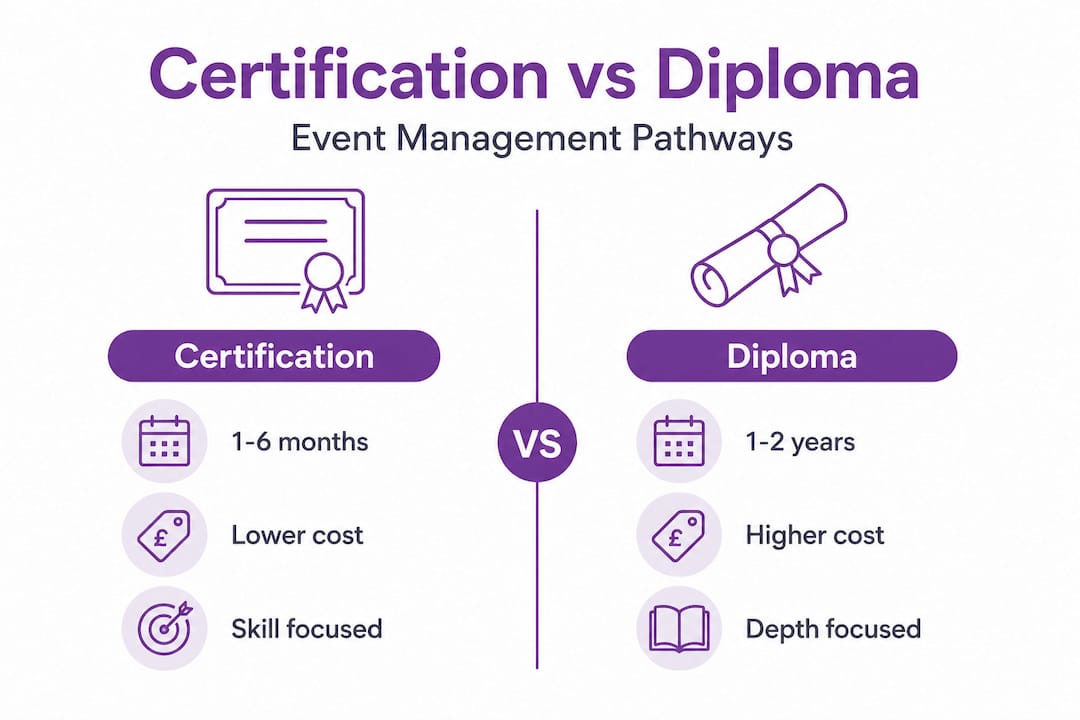
Here’s how they compare directly:
| Factor | Certification | Diploma |
|---|---|---|
| Duration | 1 to 6 months | 1 to 2 years |
| Cost | Lower | Higher |
| Depth of study | Focused and skill-specific | Broad and academic |
| Industry recognition | High for entry-level roles | High for management roles |
| Career impact | Fast-tracks job entry | Supports long-term growth |
| Flexibility | Often online or hybrid | Usually classroom-based |
Understanding certification vs diploma in event management really comes down to where you are and where you want to go.
Choose a certification if:
- You want to enter the workforce quickly without a multi-year commitment
- You already have some industry exposure and want formal validation
- You’re looking to specialise in a niche like weddings, sports events, or corporate conferences
- Budget is a real consideration and you need a faster return on investment
Choose a diploma if:
- You’re starting with zero industry knowledge and want a thorough grounding
- You’re targeting senior management or production roles long-term
- You prefer a structured academic environment with broader exposure
- You have the time and resources for a longer, more immersive programme
Neither route is inherently superior. The right choice is the one that fits your current reality and your specific career destination.
Maximising career benefits from event management certification
With your options clear, focus on how to use certification as a launchpad, not just a title. Earning the credential is step one. What you do immediately afterwards separates professionals who grow from those who stagnate.

The seven key benefits of an event management certificate course extend well beyond the certificate itself. Think of it as a key that opens multiple doors simultaneously, from employer trust to peer networks to practical frameworks you can apply from your very first event on the job.
Here are four concrete actions to take immediately after certification:
- Update your CV and LinkedIn profile with the full certification name, the awarding body, and the date completed. Recruiters search for these terms specifically, and missing them means missing opportunities.
- Reach out to your certification alumni network within the first month. These connections are warm introductions into the industry and often lead directly to job referrals, freelance gigs, or mentorship.
- Apply for at least two industry events as a volunteer or assistant coordinator within three months of certification. Hands-on experience directly after formal learning cements everything you’ve studied and builds your portfolio rapidly.
- Seek formal event management accreditation as a next step, which signals ongoing professional development rather than a one-time credential chase.
Certified professionals report significantly stronger interview performance because they can speak with precision about industry standards, methodologies, and practices rather than relying solely on anecdotes from past experience.
Pro Tip: Pair your certification with at least one real event production experience before applying for full-time roles. Employers love seeing that combination because it shows you can translate what you’ve learned into actual results under pressure.
The real impact of certification: what most guides miss
Most career guides treat certification as a checkbox. Tick it, frame it, move on. That’s a deeply limited view of what’s actually happening when you earn a recognised credential.
What certification really does is change how you’re perceived before you even speak. It signals that you take your own career seriously enough to invest in it formally. That perception shift is significant in a relationship-driven industry like events, where trust is everything.
Understanding what a certificate programme in event management actually involves reveals something most candidates underestimate: the learning process itself is transformative. You don’t just acquire information. You acquire a professional vocabulary, a structured way of thinking about problems, and a peer group of similarly motivated people.
Here’s what employers are actually looking for beyond the credential itself. They want to see that you’ve built genuine discipline. They want evidence that you can study systematically, meet deadlines independently, and engage with industry standards without being hand-held. A certification demonstrates all of that indirectly. It tells a story about who you are as a professional, not just what you know.
The honest truth? Certification alone won’t make you brilliant at events. The industry is controlled chaos, and no certificate fully prepares you for the moment a key vendor cancels six hours before showtime. But certification gives you the frameworks, the confidence, and the credibility to handle those moments far better than someone who’s winging it.
Kick-start your event management career with the right certification
You’ve got the full picture now. Certifications create real, measurable career advantages for event professionals in India, from faster job entry to higher earning potential to global mobility. The key is choosing the right programme for your goals and then actively leveraging that credential from day one.
team I offers battle-tested programmes designed specifically for the Indian event industry, including online event management programmes that fit around your schedule, and the flagship Certified Event Resource Training programme built around real industry exposure. Whether you’re starting from scratch or formalising years of practical experience, explore the full event management course details and find the programme that puts you on the right stage.
Frequently asked questions
Which certifications are best for a beginner in event management in India?
For beginners, widely recognised certifications with strong industry connections are the smartest starting point, as they build credibility quickly and open entry-level doors in corporate, social, and entertainment events.
Is a certification better than a diploma for event management?
It depends entirely on your career goals and timeline. Certifications vs diplomas differ mainly in duration and depth, with certifications being faster and more role-specific, and diplomas providing broader academic grounding for long-term management careers.
Can I get a good job in events with just a certification?
Absolutely, especially when it’s paired with real hands-on experience. The benefits of a certificate course are strongest when you actively network, volunteer at events, and position your credential prominently across your professional profiles.
What should I look for in an event management certification?
Prioritise industry recognition, practical curriculum content, and access to a professional alumni network. A certification that connects you directly to working event professionals and real productions is worth far more than one that only exists on paper.
Recommended
- What are some of the top Event Management Certification Courses? – team I
- 7 Ways Event Planner Certification Near Me Boosts Careers – team I
- instaform – team I
- Certification is imperative to your success in Event Management. Read on to know why. – team I
- Event signage guide: boost visibility and engagement –