

More than 60 percent of british event management graduates say that mastering event evaluation set them apart in the job market. For aspiring event managers from universities worldwide, understanding this crucial process is far more than a classroom exercise. Effective evaluation sharpens practical skills, uncovers real industry value, and opens doors to career opportunities both locally and abroad. This guide reveals how a solid event evaluation strategy transforms potential into true professional advantage.
Table of Contents
- Defining Event Evaluation in Event Management
- Types of Event Evaluation Methods Explained
- Key Metrics and Data Collection Techniques
- How Evaluation Enhances Event Success
- Common Challenges and Mistakes to Avoid
Key Takeaways
| Point | Details |
|---|---|
| Holistic Evaluation | Event evaluation should encompass both qualitative and quantitative data to assess overall effectiveness and provide comprehensive insights. |
| Stakeholder Engagement | Engaging a diverse range of stakeholders throughout the evaluation process is crucial for gathering meaningful feedback and insights. |
| Balanced Metrics | Avoid overemphasis on economic metrics; consider social and environmental impacts for a well-rounded assessment. |
| Strategic Learning | Use insights gained from evaluations to inform future event strategies and drive continuous improvement in event management. |
Defining Event Evaluation in Event Management
Event evaluation represents a systematic management process designed to assess the overall effectiveness, performance, and outcomes of an organised event. Understanding event management’s core principles involves recognising that evaluation is not merely a final assessment but an integrated approach to measuring success across multiple dimensions.
At its essence, event evaluation involves collecting and analysing comprehensive data to determine whether an event achieved its predetermined objectives. This process goes beyond simple participant satisfaction surveys, encompassing a holistic examination of strategic goals, resource utilisation, stakeholder experiences, and potential areas for improvement. Academic research from the Diva Portal suggests that effective evaluation functions as a critical mechanism for organisational learning, enabling event managers to refine strategies and enhance future performance.
The evaluation framework typically includes several key components: quantitative metrics like attendance numbers and financial performance, qualitative feedback from participants and stakeholders, and an analysis of how well the event aligned with its original purpose. Systematic data collection techniques are crucial in transforming raw information into meaningful insights that can guide decision-making and strategic planning for subsequent events.
Pro tip: Develop a standardised evaluation template before your event that includes both quantitative and qualitative assessment criteria to ensure comprehensive and actionable feedback collection.
Types of Event Evaluation Methods Explained
Event evaluation methods encompass a diverse range of systematic approaches designed to comprehensively assess event performance and impact. Evaluation strategies involve multiple paradigms that extend beyond traditional metrics, enabling event managers to gain nuanced insights into their event’s success across different dimensions.
Qualitative Evaluation Methods represent a critical approach in understanding event outcomes. These methods typically include techniques such as in-depth interviews, focus group discussions, participant observations, and open-ended surveys. By capturing subjective experiences and detailed narratives, qualitative approaches provide rich contextual information that quantitative metrics might miss. Managers can explore participant emotions, unexpected challenges, and subtle engagement factors that numerical data cannot fully articulate.
Conversely, Quantitative Evaluation Methods focus on measurable, numerical data points that offer objective insights into event performance. These methods include statistical analysis of attendance figures, financial metrics, social media engagement rates, and structured survey responses with numerical scales. Systematic data collection techniques help transform raw information into meaningful performance indicators, allowing event managers to track precise outcomes and make data-driven decisions about future event strategies.
Pro tip: Develop a mixed-method evaluation approach that combines both qualitative and quantitative techniques to ensure a comprehensive understanding of your event’s true impact and effectiveness.
The following table compares key qualitative and quantitative evaluation methods and their primary uses in event management:
| Method Type | Typical Techniques | Type of Insights Provided |
|---|---|---|
| Qualitative | In-depth interviews, observations | Contextual, detailed feedback |
| Quantitative | Surveys, statistical analysis | Measurable, numeric performance |
| Mixed-Methods | Combining both approaches | Holistic view, triangulated data |
Key Metrics and Data Collection Techniques
Effective event evaluation requires a strategic approach to selecting and implementing robust data collection techniques that provide comprehensive insights into event performance. Evaluation methods demand careful consideration of information sources and stakeholder requirements, ensuring that the chosen metrics align closely with the event’s specific objectives and desired outcomes.
The primary metrics for event evaluation typically encompass several critical dimensions. Attendance and Participation Metrics provide fundamental quantitative data, including total attendee numbers, demographic breakdowns, registration conversion rates, and engagement levels. Financial metrics offer insights into economic performance, tracking revenue generation, cost-per-attendee, sponsorship returns, and overall budget efficiency. Engagement Metrics explore deeper aspects of event success, measuring social media interactions, participant feedback scores, networking opportunities, and qualitative measures of participant satisfaction.
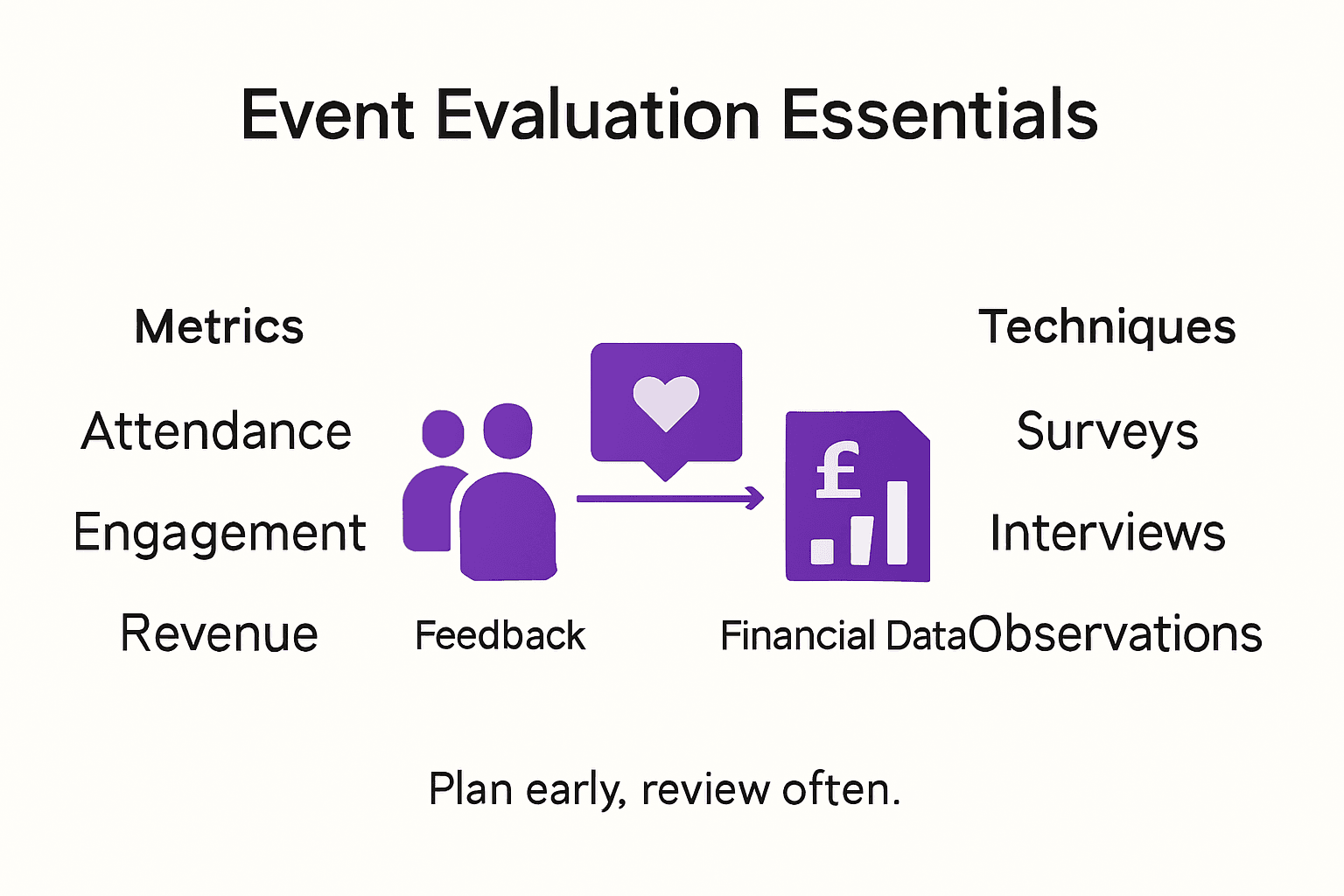
Advanced data collection approaches integrate multiple methodological techniques to capture a holistic view of event outcomes. These sophisticated strategies might include mixed-method research designs that combine structured surveys, direct observations, participant interviews, and machine learning analytics. By triangulating data from multiple sources, event managers can develop nuanced understanding beyond surface-level statistics, uncovering deeper insights into participant experiences, organisational effectiveness, and potential areas for future improvement.
Pro tip: Create a standardised data collection template before your event that includes both quantitative and qualitative metrics, ensuring you capture comprehensive insights across different evaluation dimensions.
How Evaluation Enhances Event Success
Event evaluation serves as a transformative process that goes far beyond simple performance measurement, providing event managers with a strategic framework for continuous improvement and organisational learning. Systematic evaluation supports comprehensive understanding of event outcomes by revealing nuanced insights that extend beyond surface-level metrics, enabling managers to make informed decisions that drive future success.

The enhancement of event success through rigorous evaluation manifests across multiple critical dimensions. Strategic insights emerge from detailed analysis, allowing managers to identify precise strengths and potential improvement areas. Financial performance can be optimised by understanding resource allocation effectiveness, while stakeholder satisfaction becomes more predictable through comprehensive feedback mechanisms. By capturing both quantitative and qualitative data, event managers develop a holistic view that transforms individual events from isolated experiences into interconnected learning opportunities.
Evidence-based evaluation approaches create a powerful mechanism for accountability and strategic refinement. These approaches enable event professionals to track performance against predefined objectives, understand complex audience interactions, and develop increasingly sophisticated event strategies. The iterative nature of thorough evaluation means that each subsequent event benefits from insights gained during previous experiences, creating a cumulative knowledge base that drives continuous professional development and organisational excellence.
Pro tip: Design a standardised evaluation template that captures both objective metrics and subjective feedback, ensuring you collect comprehensive insights that can genuinely inform future event strategies.
Common Challenges and Mistakes to Avoid
Event evaluation presents numerous potential pitfalls that can significantly undermine the effectiveness of assessment processes. Systematic evaluation challenges demand careful strategic planning to ensure meaningful and actionable insights are generated, avoiding common mistakes that can compromise the entire assessment approach.
One of the most critical challenges involves maintaining a balanced perspective during evaluation. Many event managers fall into the trap of over-emphasising economic metrics while neglecting broader impact dimensions such as social and environmental outcomes. This narrow focus can lead to incomplete understanding, potentially missing crucial insights about event effectiveness. Common mistakes include collecting superficial data, failing to engage diverse stakeholders, and developing evaluation frameworks that lack comprehensive and nuanced measurement strategies.
Organisational constraints frequently complicate effective evaluation efforts, introducing significant complexity into assessment processes. Limited budgets, tight timelines, insufficient expertise, and political influences can drastically reduce the quality and reliability of evaluation outcomes. Event managers must navigate these challenges by prioritising realistic evaluation questions, leveraging existing data sources, and designing flexible assessment approaches that can adapt to contextual limitations while maintaining methodological rigour.
Below is a summary of common challenges in event evaluation and recommended solutions for each:
| Challenge | Why It Occurs | Recommended Solution |
|---|---|---|
| Overemphasis on economic metrics | Narrow focus on financial outcomes | Adopt a multi-dimensional approach |
| Incomplete stakeholder engagement | Limited feedback sources | Include diverse stakeholder voices |
| Organisational constraints | Budgets, time, or expertise issues | Leverage existing data and be flexible |
| Superficial data collection | Poor survey design or implementation | Use robust, structured data techniques |
Pro tip: Develop a multi-dimensional evaluation framework that balances quantitative metrics with qualitative insights, ensuring a comprehensive and nuanced understanding of event performance.
Elevate Your Event Management Skills with Expert Guidance
Understanding the importance of event evaluation is crucial for aspiring managers aiming to make impactful decisions that drive success. This article highlights common challenges such as balancing quantitative and qualitative insights and overcoming organisational constraints. If you want to master evaluation methods and develop a holistic approach to managing events, specialised training is essential.
At team.i.org, we offer comprehensive courses designed to equip you with practical skills in data collection, analysis techniques, and strategic evaluation frameworks. Benefit from our 23 years of industry experience, collaborative projects with DNA Entertainment Networks, and hands-on internships that prepare you to confidently implement effective event evaluations. Ready to transform your event management career today Discover our range of certification programmes and take the first step towards becoming a proficient event evaluator by connecting with us here. Your journey to professional excellence starts now.
Frequently Asked Questions
What is event evaluation?
Event evaluation is a systematic process used to assess the effectiveness, performance, and outcomes of an organised event. It involves collecting and analysing data to determine if the event met its objectives.
Why is event evaluation important for aspiring managers?
Event evaluation is crucial for aspiring managers as it helps identify strengths and weaknesses in event planning, enables strategic learning, and improves future event performance through informed decision-making.
What are the key components of effective event evaluation?
Key components include quantitative metrics like attendance and financial performance, qualitative feedback from participants, and an analysis of alignment with the event’s original purpose.
How can aspiring managers avoid common challenges in event evaluation?
Aspiring managers can avoid challenges by adopting a multi-dimensional evaluation approach, ensuring diverse stakeholder engagement, and using robust data collection techniques to gather comprehensive insights.