

Choosing the right qualification can shape your entire career path, especially when exploring event management in India where both British and Indian credentials are increasingly valued. Over 60 percent of employers now look for candidates with professional event management training, making the decision between a diploma and a certification more important than ever. This guide explains the crucial differences, so you can identify which pathway aligns best with your career goals and local job market expectations.
Table of Contents
- Defining Certification And Diploma In Event Management
- Key Differences: Structure, Duration, And Curriculum
- Industry Recognition And Value In India
- Eligibility, Entry Routes, And Typical Learners
- Impact On Career Progression And Job Placement
Key Takeaways
| Point | Details |
|---|---|
| Understanding Programme Differences | Grasp the distinctions between diploma programmes and certification tracks to make informed career decisions in event management. |
| Value of Certifications | Certifications are increasingly preferred in the Indian event industry, enhancing employability and signalling professional competence. |
| Holistic vs Targeted Learning | Diploma programmes offer comprehensive knowledge while certifications focus on validating specific skills through assessments. |
| Strategic Career Planning | Combining a diploma with targeted certifications can create a compelling professional profile, improving job prospects and career progression. |
Defining Certification and Diploma in Event Management
In the dynamic world of event management, understanding the nuanced differences between certification and diploma programmes is crucial for aspiring professionals. Credentials validate professional competencies through distinct pathways, each offering unique advantages for career development.
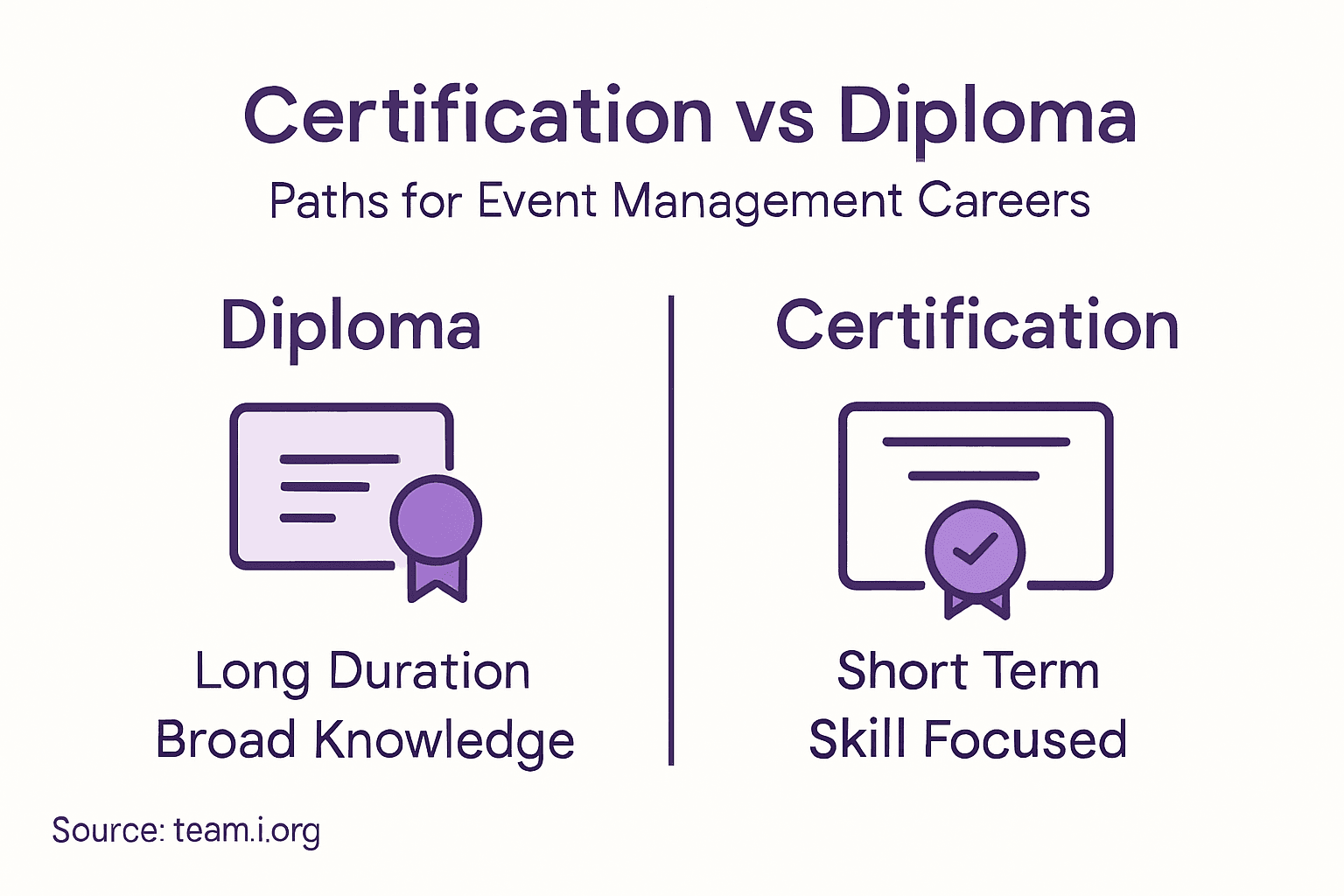
A diploma represents a comprehensive educational programme that provides foundational knowledge across event management disciplines. These structured academic offerings typically cover extensive curriculum areas including event design, marketing strategies, logistical planning, risk management, and budgeting techniques. Students gain broad theoretical understanding complemented by practical skills essential for navigating complex event landscapes.
Conversely, certification represents a targeted professional validation focusing on demonstrating specific competencies through rigorous assessment. Professional certifications assess mastery through standardised examinations, practical demonstrations, and industry-recognised evaluation processes. Certifications serve as powerful credentials signalling an individual’s specialised expertise and commitment to professional standards in event management.
Pro Tip: Always research the specific industry recognition and career pathways associated with different certification and diploma programmes before making your educational investment.
Key Differences: Structure, Duration, and Curriculum
The journey towards becoming a professional event manager involves understanding the intricate differences between diploma programmes and certification tracks. Certificate programmes typically involve focused instruction on specific skill sets, offering targeted learning experiences that differ significantly from comprehensive educational pathways.
Diploma programmes present a holistic educational approach, usually spanning several months to a full academic year. These structured curricula provide in-depth coverage across multiple event management disciplines, including strategic planning, marketing techniques, logistical coordination, risk management, and financial budgeting. Students receive comprehensive theoretical knowledge coupled with practical insights, creating a robust foundation for professional practice. The duration allows for thorough exploration of complex event management concepts, enabling learners to develop nuanced understanding of industry dynamics.

In contrast, certification exams validate professional expertise through rigorous assessment processes. Certifications often require candidates to demonstrate specific competencies through standardised examinations and practical evaluations. Unlike diplomas, these credentials frequently mandate prior professional experience and continuous education credits to maintain professional standing. The focus remains sharply on validating practical skills and current industry knowledge rather than providing extensive theoretical training.
Pro Tip: Consider combining diploma education with targeted certification to create a comprehensive professional profile that demonstrates both foundational knowledge and specialised expertise.
Here’s a concise comparison between diploma and certification pathways in event management:
| Aspect | Diploma Programme | Certification Track |
|---|---|---|
| Focus | Broad theoretical foundation | Targeted skills validation |
| Duration | 6-12 months or longer | Weeks to few months |
| Entry Requirements | Minimum 10+2 qualification | Experience and prior education |
| Assessment Method | Coursework and practicals | Standardised exams, evaluation |
| Career Impact | Entry-level industry roles | Specialist, senior positions |
Industry Recognition and Value in India
In the rapidly evolving event management landscape of India, professional credentials have become increasingly critical for career advancement. Certification credentials prove industry mastery by establishing a standardised benchmark of professional competence that employers across metropolitan cities like Mumbai, Delhi, and Bangalore actively seek.
The Indian event management market demonstrates a growing preference for candidates with recognised certifications that validate practical expertise. Employers increasingly prioritise professionals who can demonstrate verifiable skills through globally acknowledged credentials like the Certified Meeting Professional (CMP) or specialised event planning certifications. These qualifications not only enhance employability but also signal a commitment to maintaining high professional standards. Large corporate event management firms, entertainment companies, and wedding planning organisations are particularly discerning about hiring professionals with validated credentials that demonstrate both theoretical knowledge and practical capability.
Diploma programmes provide foundational knowledge in event management, but certifications are emerging as the gold standard for career progression. The Indian events industry increasingly values professionals who can prove their competence through rigorous assessments and continuous learning. Certification programmes offer targeted skill validation, often requiring professionals to demonstrate current industry knowledge through regular recertification processes. This approach ensures that event management professionals remain adaptive, current, and aligned with the dynamic global event landscape.
Pro Tip: Strategically combine a comprehensive diploma with targeted professional certifications to create a compelling professional profile that stands out in the competitive Indian event management market.
Eligibility, Entry Routes, and Typical Learners
The pathway into professional event management in India encompasses diverse entry routes suitable for individuals with varying educational backgrounds and career aspirations. Prospective learners typically include recent graduates, mid-career professionals seeking specialisation, and entrepreneurial individuals looking to establish themselves in the dynamic events industry.
Entry requirements for diploma and certification programmes demonstrate significant flexibility. Most programmes welcome candidates with a standard 10+2 educational qualification, though some advanced certifications might require a bachelor’s degree. The typical learner profile spans multiple demographics: recent hospitality or communications graduates, working professionals from adjacent industries like marketing and public relations, and ambitious individuals passionate about creating memorable event experiences. Best event management courses often provide tailored pathways for different professional backgrounds, ensuring accessibility and comprehensive skill development.
Critical eligibility considerations extend beyond academic qualifications. Many advanced certification programmes require candidates to demonstrate practical experience, language proficiency, and strong interpersonal skills. Some specialised credentials may mandate minimum work experience ranging from six months to two years in event-related roles. Additional considerations include proficiency in digital marketing tools, basic project management skills, and a demonstrable passion for event design and execution. These multifaceted entry requirements ensure that programme participants possess the foundational capabilities necessary for success in this competitive professional landscape.
Pro Tip: Conduct thorough research on specific programme requirements and strategically build a portfolio showcasing relevant skills and experiences to enhance your candidature.
The following table summarises typical learner profiles and their preferred credential routes in Indian event management:
| Learner Type | Preferred Route | Typical Motivation |
|---|---|---|
| Recent graduate | Diploma | Build essential knowledge and skills |
| Mid-career professional | Certification | Specialise and validate expertise |
| Entrepreneurial individual | Both | Establish credibility and versatility |
| Hospitality/PR sector worker | Certification | Transition to event management roles |
Impact on Career Progression and Job Placement
In the competitive landscape of event management, professional credentials serve as critical differentiators for career advancement and employment opportunities. Certified professionals experience faster progression through enhanced credibility and demonstrated expertise that significantly improves their market positioning.
Certification and diploma paths offer distinctive trajectories for career development in the event management sector. Professionals with recognised credentials like Certified Meeting Professional (CMP) or specialised event planning certifications typically enjoy accelerated career growth, with employers prioritising candidates who can substantiate their skills through verifiable qualifications. Career opportunities expand through strategic certification by providing tangible proof of professional competence and commitment to continuous skill enhancement.
The impact on job placement is particularly pronounced in metropolitan job markets across India. Certification holders often secure higher-tier positions with improved salary prospects, as these credentials validate technical skills, industry knowledge, and professional standards. Large event management firms, corporate event departments, wedding planning organisations, and entertainment companies consistently demonstrate a preference for candidates with recognised professional certifications. These credentials effectively bridge the gap between academic learning and industry expectations, offering professionals a competitive edge in a rapidly evolving sector.
Pro Tip: Invest strategically in professional certifications that align with your specific career goals and target industry segments to maximise your employability and career progression potential.
Elevate Your Event Management Career with Expert Certification and Diploma Options
Navigating the difference between certification and diploma programmes can feel overwhelming, especially when your goal is to excel in India’s competitive event management industry. This challenge highlights the need to secure credible qualifications that combine broad foundational knowledge with specialised skill validation. If you aim to gain both theoretical expertise and practical competencies that employers value, your choice of training will define your career trajectory.
teami.org offers tailored certification and diploma courses designed to bridge the gap between academic learning and real-world demands. With 24 years of industry experience and strategic partnerships like DNA Entertainment Networks, our online and hybrid programmes provide immersive learning through internships and live event participation. Start building a compelling professional profile that meets industry standards today by exploring our comprehensive course offerings and take the first step to transform your passion into a lucrative career. Connect with us now at https://team-i-app-code-production.up.railway.app/api/go/wa?src=certification-vs-diploma-event-careers to discover how our expert-led certifications and diplomas can accelerate your progression in event management.
Frequently Asked Questions
What is the main difference between a certification and a diploma in event management?
A diploma provides a comprehensive educational foundation across multiple disciplines of event management, while a certification focuses on validating specific competencies and skills through rigorous assessment.
How long do diploma programmes and certification tracks typically take to complete?
Diploma programmes generally last from 6 to 12 months or longer, whereas certification tracks can take a few weeks to several months, depending on the complexity of the certification.
Are there specific entry requirements for diploma and certification programmes in event management?
Yes, most diploma programmes require a minimum educational qualification of 10+2, while certification tracks often require prior professional experience and may have additional educational prerequisites.
How do professional credentials impact career prospects in event management?
Holding recognised professional credentials, such as certifications, can significantly enhance credibility, improve employability, and lead to faster career progression, as employers seek candidates who demonstrate validated skills and expertise.