
A bachelor’s degree in event management is a formal, multi-year academic programme that trains students to plan, produce, and manage events across corporate, social, entertainment, and sports sectors. The degree typically runs 3 to 4 years full-time, requiring around 120 credit hours, and covers everything from vendor negotiations and crowd flow logistics to budgeting, marketing, and risk management. In India’s rapidly expanding events industry, spanning mega weddings in Udaipur, music festivals in Mumbai, and corporate summits in Bengaluru, this qualification is fast becoming the baseline employers expect. You don’t just study events. You start building the career from day one.
What does a bachelor’s degree in event management actually cover?
The curriculum is not a list of textbook chapters. It’s a working blueprint for the industry. Core modules typically include event planning and design, risk and safety management, marketing and promotions, logistics, and client management. You learn how to build a showflow, manage a vendor contract, and present a pitch deck to a client who has seen a hundred before yours.

The business core is what separates a strong event management degree from a basic coordination certificate. Financial literacy, budgeting, and ROI measurement are non-negotiable modules. A graduate who can read a P&L and justify a production spend to a CFO is a manager. One who cannot is still a coordinator.
Practical components are where the real learning happens. Internships with production houses, live event projects at college festivals, and portfolio-building assignments put theory into motion. Programmes that integrate current entertainment trends into their curriculum keep graduates relevant to what the industry actually needs right now.
- Core modules: event planning, risk management, logistics, client servicing, production management
- Business foundation: budgeting, financial literacy, ROI measurement, contract law basics
- Practical elements: internships, live project execution, portfolio development
- Popular electives: digital marketing, sport management, data analytics, PR and communications
Pro Tip: Choose a programme where faculty are actively working in the industry, not just teaching from it. When a lecturer has personally managed a 10,000-person concert in Delhi, their advice on crowd flow logistics carries real weight.
How does an event management degree compare with related degrees?
Recruiters in India accept several degree backgrounds for event planning roles. The question is which one positions you best for the specific career you want.
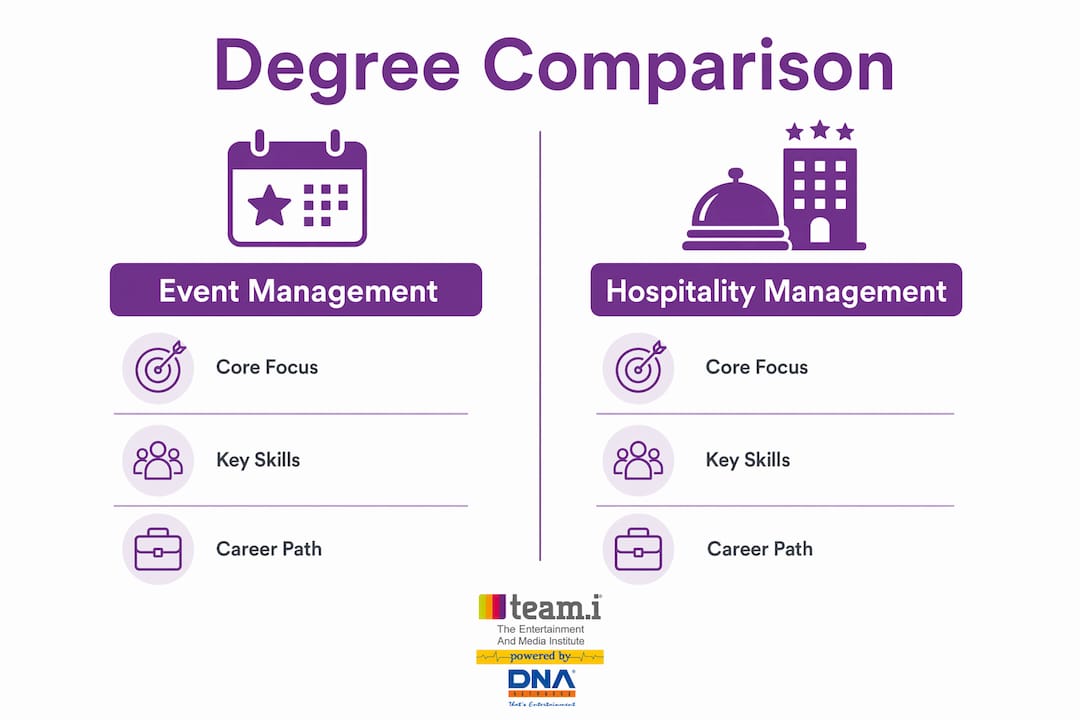
| Degree | Core focus | Key skills taught | Typical career path |
|---|---|---|---|
| Event management | Events, production, logistics | Planning, budgeting, vendor management | Event coordinator, festival manager, wedding planner |
| Hospitality management | Hotels, F&B, guest experience | Service delivery, operations, revenue management | Hotel events manager, catering director |
| Business administration | Strategy, finance, operations | Management, marketing, financial analysis | Corporate event planner, brand activation manager |
| Communications / PR | Media, messaging, public relations | Storytelling, media relations, crisis comms | PR events manager, brand experience lead |
| Marketing | Consumer behaviour, campaigns | Digital marketing, analytics, campaign planning | Experiential marketing, brand events |
The event management vs hospitality management debate is common among Indian students. Hospitality degrees suit those aiming for hotel-based event roles in chains like Taj Hotels or ITC. A dedicated event management degree suits those targeting production companies, entertainment agencies, or independent event firms. Recruiters increasingly prefer candidates with formal degrees and demonstrated portfolios, so the distinction matters more than it did five years ago.
Combining an event management degree with a minor in digital marketing or data analytics gives you a measurable edge. The industry is moving fast towards hybrid events and data-driven audience engagement, and graduates who understand both the stage and the screen are the ones getting hired first.
What career opportunities open up after this degree in India?
India’s events industry is one of the fastest-growing in Asia, with demand concentrated in Bengaluru, Mumbai, Delhi, and Hyderabad. The roles available to a graduate with a strong event planning degree span a wide spectrum.
- Event coordinator at a production house or agency, managing timelines, vendors, and on-ground logistics
- Corporate event planner for companies running product launches, conferences, and employee engagement programmes
- Wedding planner in India’s multi-billion-rupee wedding sector, where large-scale productions in Rajasthan and Kerala are standard
- Festival and concert producer working with entertainment companies on large-format shows
- Sports event manager for IPL-related activations, marathons, and college sports tournaments
Employers now expect formal degrees paired with practical portfolios. A degree alone is not enough. The graduates who move fastest are those who have already executed real events during their studies, not just attended them. Explore event management degree jobs to understand exactly what roles look like at entry level and how to position yourself for them.
Mentorship programmes and alumni networks built into degree programmes significantly accelerate early career placement. In India’s relationship-driven industry, who you know from your college years often determines which production house calls you first.
Pro Tip: Do not wait until your final year to network. Attend industry events, volunteer at college fests, and connect with alumni on LinkedIn from your first semester. The event industry in India runs on trust and referrals.
How to choose the right event management programme
Not all programmes are equal. Here is how to evaluate them honestly.
- Check accreditation and industry recognition. A degree from an accredited institution carries weight with recruiters. Verify whether the programme is recognised by industry bodies or has formal partnerships with production companies.
- Assess faculty credentials. Active industry practitioner faculty are the single biggest indicator of a programme’s real-world relevance. Ask specifically who teaches production management and whether they are currently working in the field.
- Evaluate practical exposure. How many live events do students execute during the programme? Are internships mandatory or optional? Does the programme have partnerships with event companies in Bengaluru, Mumbai, or Delhi?
- Review specialisations available. Programmes offering specialisations in event management across weddings, corporate events, sports, and entertainment give you a focused career entry point rather than a generic qualification.
- Consider online versus campus. Campus programmes offer richer networking and hands-on production experience. Online options provide flexibility for working students but require you to actively seek practical exposure through local internships and industry volunteering.
International tuition fees for event management bachelor’s degrees can reach up to 18,964 USD annually at some institutions. Indian programmes offer significantly more accessible pricing, often with stronger local industry connections that matter more for a career in the Indian market.
Is an online event management degree worth it?
An event coordinator degree online is a real option, and for the right student, it works well. Flexibility is the obvious advantage. You can study from Bengaluru, Pune, or Kochi without relocating, and access global curricula that would otherwise be unavailable.
The limitation is equally obvious. Events are physical. You cannot learn crowd flow logistics from a laptop screen alone. Online students must be disciplined about supplementing their studies with local internships, volunteering at college festivals, and attending industry events in their city.
- Advantages: flexible scheduling, lower costs, access to diverse global content, suitable for working professionals
- Challenges: limited hands-on production experience, weaker on-campus networking, requires self-motivation to seek practical exposure
- How to compensate: intern with local event companies, volunteer at large-format events, join industry associations like EEMA (Event and Entertainment Management Association)
Pro Tip: If you choose an event management degree online, treat every local event you can access as your classroom. Offer to help with logistics, vendor coordination, or on-ground management. That experience is what your CV will be built on.
The media and entertainment skills required in today’s hybrid event environment are teachable online, but the confidence to execute them comes only from standing on a live stage and making real decisions under pressure.
Why the degree matters more now than it ever did
We have watched the Indian events industry change dramatically over the past two decades. When Teami started, a sharp coordinator with hustle and contacts could build a career without formal credentials. That era is largely over. Corporate clients running product launches in Hyderabad, entertainment companies producing festivals in Goa, and wedding families spending crores on destination events in Jaipur all want professionals who can prove their competence before the contract is signed.
The shift towards formal education is not about gatekeeping. It is about accountability. A graduate with a strong business core, a real portfolio, and industry mentors behind them walks into a client meeting differently. They speak the language of budgets, risk mitigation, and ROI, not just décor and timelines.
The graduates we see succeed fastest are those who treated their degree as a launchpad, not a finish line. They used every internship, every live project, and every faculty connection to build something tangible before graduation day. The degree opens the door. What you do inside the programme determines how far you go once you walk through it.
— Teami
Start your event management career with Teami
Teami brings 24 years of industry experience to every programme it offers, with direct partnerships with DNA Entertainment Networks and a placement record built on real industry connections across Bengaluru, Mumbai, and Delhi. Whether you are looking at full-time undergraduate study or a flexible online pathway, Teami’s programmes combine live event execution, practitioner faculty, and specialisations across weddings, corporate events, sports, and entertainment. Get the full picture of what a Teami event management course includes, from curriculum to career support, and take the first step towards a career that starts on day one. For those exploring flexible study options, Teami’s online event management courses offer the same industry rigour with added accessibility.
FAQ
How long does a bachelor’s degree in event management take?
A bachelor’s degree in event management typically takes 3 to 4 years full-time, requiring approximately 120 credit hours. Part-time and online pathways may extend the duration depending on the institution.
Is a degree necessary to become an event coordinator in India?
Employers increasingly prefer candidates with formal degrees and demonstrated portfolios, particularly for corporate and large-scale event roles. A degree significantly improves competitiveness in India’s growing events market.
What minors improve an event management degree?
Minors in digital marketing, sport management, or data analytics are the most effective additions to an event management degree, directly increasing employability in India’s hybrid and experiential event sectors.
Can I study for an event management degree online in India?
Yes, credible online event management programmes exist and suit working students or those outside major cities. Online students should actively supplement their studies with local internships and volunteering to build the practical experience that employers require.
What jobs can I get with an event management degree in India?
Graduates pursue roles including event coordinator, corporate event planner, wedding planner, festival producer, and sports event manager, with opportunities concentrated in Bengaluru, Mumbai, Delhi, and Hyderabad across production houses, entertainment agencies, and corporate firms.
Recommended
- Event planning university: your 2026 career guide – team I
- What degree for event planning: your 2026 guide – team I
- Blog – team I
- What is an event management course: your 2026 guide – team I
Thinking about a career in event management?
team I is Bangalore’s only EEMA-certified event management institute, running for 24 years, where students work on real live events with real budgets and real deadlines rather than classroom simulations. See the full range of event management courses in Bangalore, or go straight to the flagship Certificate Program in Event Management (CPEM).