
Virtual events are not the easy option. Many aspiring planners assume that moving online strips away the hard parts, but the reality is a different kind of controlled chaos entirely. You still face tight deadlines, demanding audiences, and tech that can fail at the worst possible moment. In India, where the digital event industry is growing at a remarkable pace, the demand for skilled virtual event planners has never been sharper. This guide walks you through every essential step, from the foundational skills and tools to audience engagement strategies, success metrics, and the certification pathways that will make you genuinely employable.
Table of Contents
- What makes virtual event planning unique?
- Essential skills and tools for virtual event planners
- Engaging your audience in a virtual environment
- Measuring virtual event success and applying learnings
- Certification and practical pathways for aspiring event planners in India
- What most guides miss: The decisive edge in virtual event planning
- Take your virtual event skills further with certification and training
- Frequently asked questions
Key Takeaways
| Point | Details |
|---|---|
| Virtual planning is unique | Virtual events require tech-savvy organisation and new forms of engagement compared to physical ones. |
| Skills and tools matter | Mastering digital platforms and technical roles sets you apart as a competent virtual event planner. |
| Focus on audience engagement | Interactive formats like live polls and gamification drive lasting participation and satisfaction. |
| Evaluate and improve | Regularly measure metrics and apply feedback to consistently improve your future events. |
| Certification opens doors | Formal training and certification boost your credibility and unlock more job opportunities. |
What makes virtual event planning unique?
The first mistake most newcomers make is treating a virtual event like a physical one with fewer chairs. It is not. The logistical landscape is completely different, and as the virtual event management guide makes clear, virtual event managers face entirely different logistical, engagement, and technology challenges compared to their in-person counterparts.
Think about it. At a physical event, you can read a room. You see someone looking bored, and you respond. Online, that signal disappears. Your audience could be multitasking, commuting, or sitting in a noisy flat. You are competing with every other tab open on their screen.
Here is a quick comparison to put that into perspective:
| Factor | Physical event | Virtual event |
|---|---|---|
| Venue logistics | High complexity | Replaced by platform setup |
| Audience reach | Local or regional | National or global |
| Cost | High (venue, travel, catering) | Significantly lower |
| Engagement | Natural and physical | Requires deliberate digital strategy |
| Tech failure risk | Low | High, requires backup plans |
| Real-time feedback | Visible and immediate | Requires digital tools |
Understanding the difference between hybrid vs virtual events is also critical, especially as Indian corporates increasingly blend both formats for maximum reach.
The benefits of going virtual are real. Lower overheads, no venue cap on attendance, and the flexibility to bring in speakers from Mumbai, Bengaluru, and Singapore in the same session. But none of those advantages materialise unless your planning is tight. The benefits reward the prepared, not the improvised.
Essential skills and tools for virtual event planners
You cannot run a virtual event on enthusiasm alone. Mastering essential virtual event skills means knowing your platforms deeply, and as confirmed by team I, mastering specialised platforms and software is the foundation of becoming an effective virtual event professional.
Here are the core technical skills every planner needs:
- Streaming platform management — configuring and operating Zoom, Microsoft Teams, or specialised broadcast tools without breaking a sweat
- Live chat moderation — managing audience interaction in real time, filtering questions, and keeping energy high
- Attendee analytics — reading dashboards during and after the event to understand drop-off points, engagement peaks, and click behaviour
- Content scheduling — sequencing presentations, breaks, and activities so the programme flows naturally
- Emergency protocols — knowing exactly what to do when a speaker’s audio cuts out or the stream drops
Beyond skills, you need the right company event management tools in your arsenal. Platforms like the instaform tool can significantly streamline registration, attendee management, and real-time communications for Indian event planners.
Key roles on a virtual event team include the production manager who oversees the overall technical flow, the tech support specialist who troubleshoots on the fly, and the content moderator who keeps the audience engaged and safe. These roles do not overlap cleanly, so understanding each one matters even if you eventually specialise in just one.

Pro Tip: Always run a complete technical rehearsal at least 48 hours before your event goes live. Test every speaker’s audio and video, every slide transition, every poll, and every breakout room. Issues caught in rehearsal are learning moments. Issues caught during the live event are disasters.
Engaging your audience in a virtual environment
Here is the uncomfortable truth. You can book brilliant speakers, design a slick programme, and still lose your audience by the second session. Engagement in a virtual environment is not passive. It has to be engineered.
The rise of virtual concerts has shown us that digital experiences require creative strategies for interaction, including live polls, Q&A sessions, and dedicated networking lounges, to truly capture and hold attention.
Effective engagement techniques include:
- Live polls posted every 15 to 20 minutes to keep attendees actively involved
- Dedicated Q&A windows where speakers directly address audience questions, making attendees feel heard
- Breakout sessions that allow smaller group conversations, replicating the corridor networking of physical events
- Interactive challenges or quizzes tied to session content, rewarding participation
- Networking lounges built into the platform where attendees can connect organically between sessions
Memorable virtual formats go beyond traditional panels. Think virtual cooking workshops with celebrity chefs, digital product launches with live demonstrations, or interactive storytelling sessions built around a brand’s history. For inspiration on event entertainment ideas that translate brilliantly online, the options are far wider than most planners initially realise.
“The most engaging virtual events do not replicate physical events online. They reimagine what an experience can be when geography is no longer a barrier.”
Pro Tip: Gamify your event engagement. Award points for attending sessions, submitting questions, completing polls, and visiting sponsor booths. A live leaderboard with a small prize at the end dramatically increases participation rates and keeps energy high from the opening session to the final thank you.
Measuring virtual event success and applying learnings
Running the event is only half the job. What you do with the data afterwards separates the planners who keep getting hired from those who stay stuck at junior level.
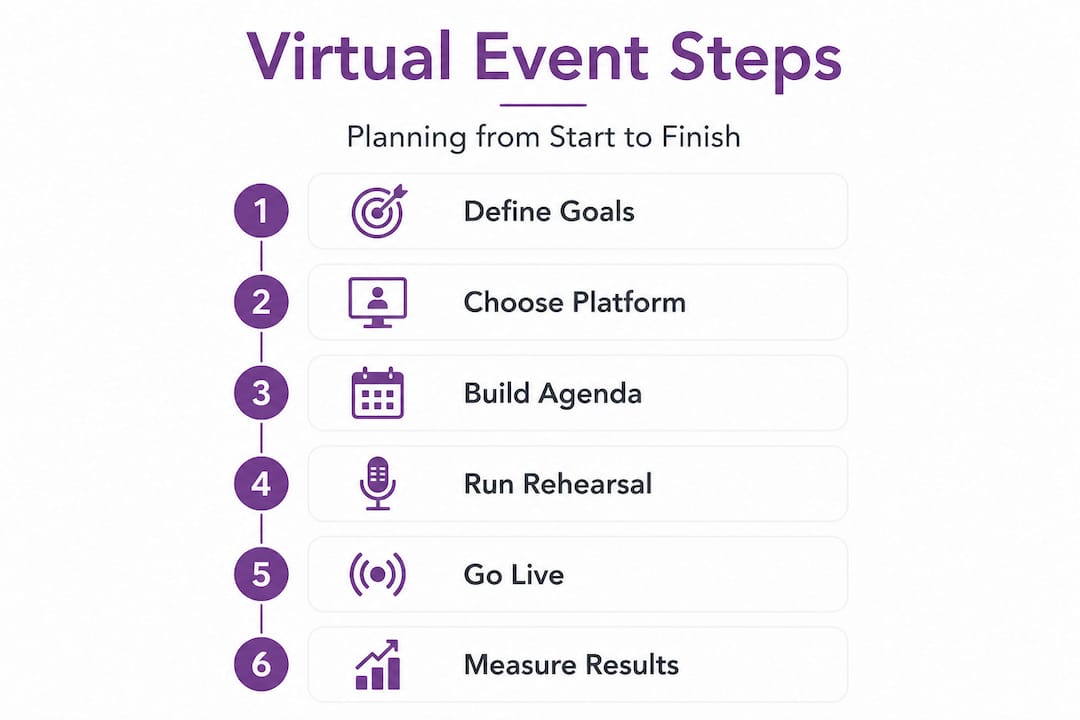
Success measurement for virtual events includes attendee analytics, real-time feedback, and engagement scores, all of which give you a clear picture of what worked and what needs rethinking.
Here is a structured approach to measuring your event:
- Attendance rate — compare registrations against actual attendees, and track drop-off by session
- Engagement score — measure poll responses, chat activity, Q&A submissions, and time spent per session
- Post-event survey — send a short, focused survey within 24 hours while the experience is still fresh
- Sponsor and partner satisfaction — gather feedback from commercial stakeholders, not just attendees
- Content performance — identify which sessions retained the most viewers and which caused drop-offs
| Metric | What it tells you | How to improve |
|---|---|---|
| Drop-off rate | Where interest fades | Restructure session length or content |
| Poll response rate | Level of active engagement | Increase poll frequency or question relevance |
| Net Promoter Score | Overall satisfaction | Address recurring negative feedback points |
| Session replay views | Post-event content value | Repurpose top sessions as on-demand content |
Understanding the full event production process helps you see where measurement fits into the bigger picture. Data from one event becomes the blueprint for the next.
Certification and practical pathways for aspiring event planners in India
Credentials matter. Not because a certificate makes you good, but because it signals to employers and clients that you are serious, trained, and ready. Industry-backed certification dramatically boosts credibility and career prospects for virtual event managers trying to break into a competitive market.
Top options for aspiring planners in India include:
- Certified Meeting Professional (CMP) — internationally recognised, strong for corporate events
- Event Management Development Programme — practical, India-focused, with industry mentors
- Digital event specialist credentials — online courses that focus specifically on virtual and hybrid formats
- Programmes through institutions with established online event management courses that combine theory with real project work
What seriously separates good planners from great ones is the combination of a formal event management course with genuine hands-on experience. Book knowledge without live event exposure is like knowing every chord on paper but never picking up a guitar.
Pro Tip: Prioritise events management work experience alongside your certification. Internships and real project involvement teach you things no classroom can, including how to stay calm when the Wi-Fi dies ten minutes before a keynote speech.
What most guides miss: The decisive edge in virtual event planning
Most guides hand you a checklist and send you off. Here is what they rarely tell you. The planners who consistently succeed in virtual events are not necessarily the most technically skilled. They are the most adaptable. They solve problems before the audience notices there was one.
Technology evolves rapidly. A platform that is industry standard today might be obsolete in 18 months. The planners who stay relevant are the ones who never stop learning, who test new tools before they need them, and who build genuine audience empathy into every decision they make. Understanding your attendees deeply, knowing what frustrates them, what excites them, and what makes them leave early, is genuinely more powerful than any software certification.
Equally important is developing strong event management media skills that allow you to communicate effectively across digital channels before, during, and after your event. Real feedback from real events builds the kind of intuition no textbook creates. Practise relentlessly. Debrief honestly. Iterate fast.
Take your virtual event skills further with certification and training
If this guide has shown you anything, it is that virtual event planning rewards those who invest seriously in their skills. At teami.org, you gain access to 24 years of industry knowledge, real project exposure, and partnerships with DNA Entertainment Networks that translate directly into career opportunities. Explore a structured event management course built for the realities of today’s digital event industry. Supplement your learning with flexible online event management courses, and make sure you build your portfolio through recognised events management work experience programmes that put you on real productions, not just simulations.
Frequently asked questions
Which platforms are most popular for organising virtual events in India?
Zoom, Microsoft Teams, and specialised event platforms like instaform are widely used across India, with the right choice depending on your event scale and audience size.
How can I boost audience engagement during my online event?
Use interactive tools like polls, live chat, breakout sessions, and gamification strategies, as digital experiences require deliberate creative strategies to maintain attention throughout.
What metrics should I use to evaluate virtual event success?
Track attendance rates, real-time engagement scores, post-event survey results, and content replay numbers, since success measurement for virtual events relies on a combination of attendee analytics and direct feedback.
Is formal certification necessary to work in virtual event management?
Practical experience is essential, but industry-backed certification significantly enhances your credibility and opens doors with serious employers and corporate clients.
Recommended
- Virtual Event Management: Complete Professional Guide – team I
- Virtual event management: Essential skills for aspiring managers – team I
- How to Plan a Conference: Step-by-Step Guide for Success – team I
- Master Hybrid Event Best Practices for Outstanding Results – team I
Thinking about a career in event management?
team I is Bangalore’s only EEMA-certified event management institute, running for 24 years, where students work on real live events with real budgets and real deadlines rather than classroom simulations. See the full range of event management courses in Bangalore, or go straight to the flagship Certificate Program in Event Management (CPEM).