
TL;DR:
- India’s event management industry is growing rapidly, creating over 5 million jobs by 2026.
- Successful career switchers leverage transferable skills, practical experience, and strong networking.
- Certifications combined with hands-on internships and portfolios are key to advancing in the field.
You’re sitting at your desk, staring at another spreadsheet, and somewhere across the city a concert crowd is roaring, a wedding mandap is being set up under golden lights, and a corporate launch is kicking off with a live band. You feel it, that pull. India’s event management industry is valued at approximately USD 6.15 billion in 2026, projected to reach USD 9.04 billion by 2031, creating over 5 million direct jobs. The question is not whether this industry is worth joining. The question is: how do you get in, and how fast?
Table of Contents
- Why consider switching to event management?
- What qualifications and training do you need?
- How to gain hands-on experience and network
- Career pathways, salaries, and industry realities
- Experience over qualification: what really drives success?
- Take the first step towards your event management career
- Frequently asked questions
Key Takeaways
| Point | Details |
|---|---|
| Rapid industry growth | The Indian event management industry is expanding fast, creating millions of new roles. |
| Short, practical training | Diplomas and certificates make it possible to change careers in just 6-12 months. |
| Experience is crucial | Internships and live projects make a bigger impact on hiring decisions than certificates alone. |
| Salaries rise quickly | With experience and networking, earning potential grows rapidly, especially in metros. |
Why consider switching to event management?
Let’s be honest. Event management is not just glamorous. It is genuinely one of India’s fastest-growing industries, spanning entertainment, corporate conferences, weddings, sports, and experiential marketing. The event management opportunities available today are broader than ever before, and the market is hungry for trained talent.
The industry overview tells a compelling story. The sector is projected to reach USD 9.04 billion by 2031 at an 8.05% CAGR. That is not a niche. That is a booming economy within an economy.
Here is what makes this sector remarkable for career switchers:
- Prior skills transfer directly. If you have worked in logistics, marketing, communication, hospitality, or finance, you already carry portable skills that event companies actively want.
- The earning curve is steep. Senior event managers earn between 10 and 20 lakh per annum or more in major cities, with real entrepreneurial upside if you launch your own agency.
- Roles are wildly diverse. You can specialise in weddings, sports events, music festivals, MICE (Meetings, Incentives, Conferences, Exhibitions), or brand activations. You are not locked into one lane.
- The industry rewards hustle. Titles and tenures matter less here than your portfolio and your network.
The scale: The sector provides over 5 million jobs across production, logistics, creative, client servicing, and technology roles.
Yes, there are challenges. Seasonal demand means income can be uneven. High-pressure environments, late nights before events, and demanding clients are real. But for professionals who thrive on variety, visible results, and controlled chaos, this industry is genuinely addictive.
The key insight for switchers is this: event management rewards adaptability more than pedigree. You do not need to have studied events from day one. You need to learn fast, practise relentlessly, and build relationships that matter. Now that the opportunity is clear, let’s see what you need to get started.
What qualifications and training do you need?
The good news: you have real choices. The event management education landscape in India ranges from short certificates to full postgraduate degrees, and the right option depends on your timeline, budget, and how quickly you need to earn.
Here is a breakdown of the most common pathways:
| Programme type | Duration | Best suited for |
|---|---|---|
| Certificate course | 3 to 10 months | Working professionals switching careers fast |
| Diploma | 6 to 12 months | Students or professionals wanting depth |
| BBA or B.Sc | 3 years | School leavers building from the ground up |
| PG Diploma or MBA | 1 to 2 years | Graduates seeking senior entry points |
| Short online courses | 14 to 26 hours | Explorers testing the field before committing |
Short courses like iLEAD programmes run from 14 to 26 hours at approximately Rs. 5,000 to Rs. 7,000, while diplomas and certificates offer more structured learning across several months.
For certifications that recruiters actually respect, three names come up repeatedly. The EEMA certification (Event and Entertainment Management Association), offered through institutes like team I, carries serious industry credibility in India. The CEM (Certified in Exhibition and Event Management) from IAEE is an internationally recognised credential. Vskills certification is also widely accepted for entry-level roles.
If you are currently employed and cannot afford to quit, online event management courses and hybrid programmes offer a credible alternative. The blended learning approach combines self-paced modules with live sessions and on-ground event work, which suits career switchers who need flexibility without sacrificing real experience.
Pro Tip: Before enrolling anywhere, ask the institute for its placement record, industry partnerships, and the names of companies where alumni currently work. A glossy brochure means nothing. A verified placement track record means everything.
Solid grounding in event project management principles, vendor negotiation, budgeting, and logistics is non-negotiable regardless of which format you choose. Review the top event certifications available in 2026 to find a programme that matches your career goals. With the right qualification path in mind, the journey continues through practical experience.
How to gain hands-on experience and network
A certificate gets you in the room. Experience gets you the job. This is especially true in event management, where practical exposure is valued more than almost any qualification alone.
Here is a comparison of the main experience routes open to you:
| Experience type | Cost | Speed to build portfolio | Best for |
|---|---|---|---|
| Paid internship | Free (you earn) | Fast | Students and recent switchers |
| Volunteering | Free | Moderate | Anyone building initial exposure |
| Freelance assisting | Free to low | Moderate | Those with some background |
| Full staff role | Salaried | Slowest initially | Career switchers with transferable skills |
Programmes with paid internships offer stipends in the range of Rs. 15,000 to Rs. 20,000 per month, which makes the transition financially manageable. These internships also double as your first entries in the portfolio.
To secure a strong internship, follow these steps:
- Research agencies in your city that manage the type of events you want to specialise in.
- Build a basic CV that foregrounds your transferable skills, even from an unrelated field.
- Apply directly via LinkedIn, agency websites, and through your training institute’s placement cell.
- Follow up within five business days of applying. Persistence signals exactly the kind of attitude event companies want.
- At the internship, say yes to unglamorous tasks. Load-in days and post-event pack-downs teach you more than any classroom can.
The importance of internships cannot be overstated, particularly for switchers who lack an event-specific background.
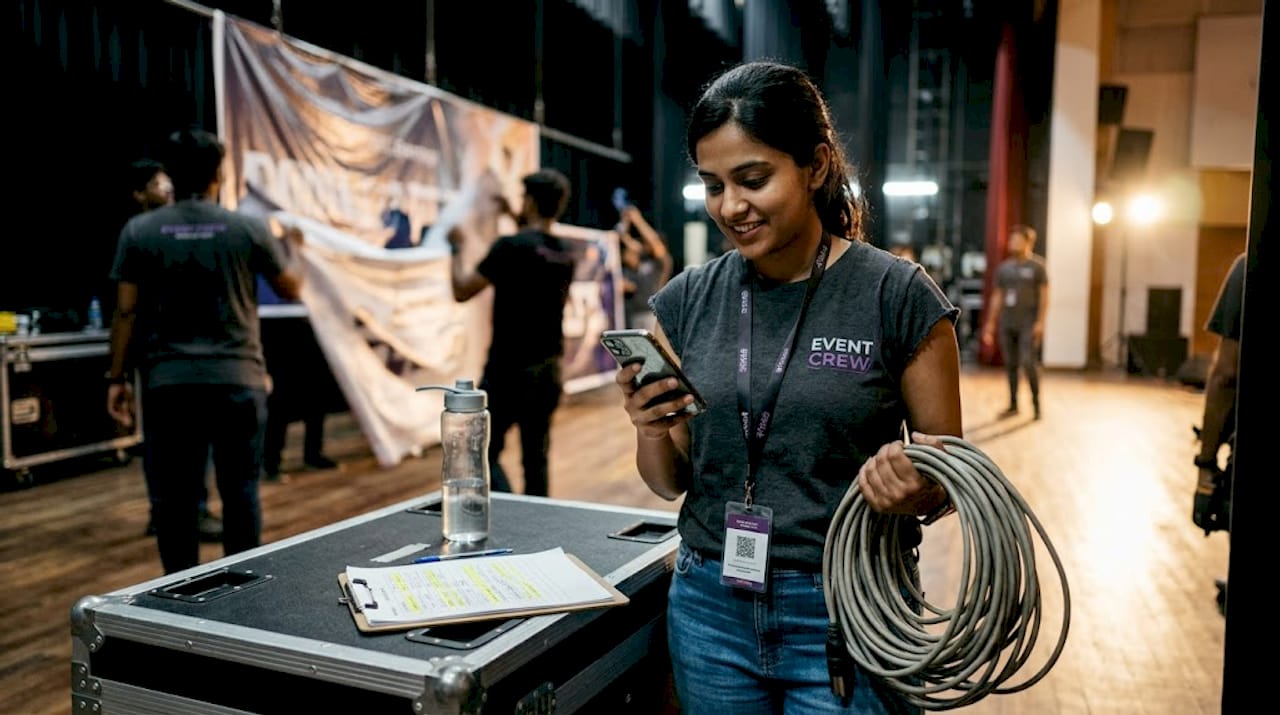
Pro Tip: Document everything. Photograph your set-up work, save client briefs, collect testimonials from supervisors, and compile a visual portfolio. Recruiters at your next role will spend more time looking at your portfolio than at your certificate.
Networking is your other non-negotiable. Join EEMA regional chapters, attend industry award nights, follow event professionals on LinkedIn, and engage genuinely with their content. Review work experience pathways and success tips to plan your networking strategy from day one. Switchers who move from assistant to manager within two to three years almost universally cite active networking as the deciding factor. Armed with both credentials and experience, let’s look at how your career might progress and the challenges to anticipate.
Career pathways, salaries, and industry realities
Understanding where you start and where you can realistically go is essential before you commit. The event management career ladder in India moves faster than most industries, but it demands consistency.
The typical progression looks like this:
- Intern or trainee (0 to 1 year): You are on the ground, learning showflows, vendor coordination, and on-site logistics. Stipend or entry salary.
- Event coordinator (0 to 2 years): You manage specific elements of events independently. Entry-level salaries range from INR 2.4 to 4.6 lakh per annum.
- Event manager (2 to 4 years): Full project ownership, client management, and team leadership. Mid-level salaries sit at 5 to 8 LPA.
- Senior manager or director (4 to 7 years): Strategic oversight, P&L responsibility, and large-scale event ownership. Senior roles reach 10 to 20 lakh or more.
- Entrepreneur or agency founder: Many experienced managers launch their own firms, with uncapped earning potential.
Salaries are higher in metros. The career path from intern to pro confirms that hands-on live event experience is what accelerates each transition, not just tenure.
“Networking and hands-on experience will take you further than any degree alone. The people who succeed in this industry are those who show up, solve problems under pressure, and make every client feel like their event is the only one that matters.”
The realities are worth naming clearly. Irregular hours are standard. Monsoon season genuinely disrupts outdoor events. Client demands can be last-minute and intense. Emotional resilience is not optional; it is a core professional skill.
The career success roadmap and detailed salary insights can help you plan your financial expectations at each stage. With the full journey mapped, it’s time for some honest perspective on what really matters for long-term success.
Experience over qualification: what really drives success?
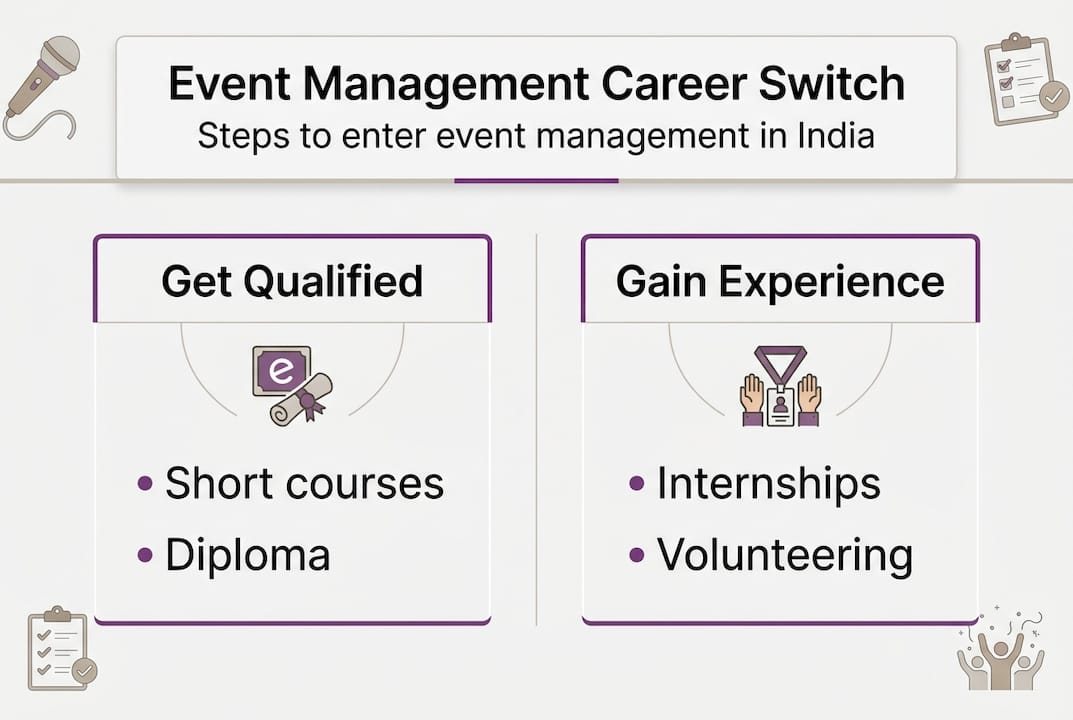
Here is something most training institutes will not tell you directly: the certificate is the ticket, not the destination. Recruiters at serious event companies look at your portfolio first, your references second, and your grades almost never.
Switchers often waste time accumulating additional certificates when they should be on the ground volunteering at festivals, assisting wedding planners, or running logistics for corporate launches. Formal education provides structure, but experts consistently emphasise hands-on internships and live projects as the real accelerators.
The professionals who climb fastest are those who treat every event, even the small ones, as a masterclass. They solve ground-level client crises. They learn why a supplier failed and ensure it never happens again. That kind of learning cannot be replicated in an exam. Read our practical tips for new event professionals to start applying this mindset from day one.
Take the first step towards your event management career
If this article has made one thing clear, it is that the path into event management is absolutely achievable, and it starts with one well-chosen step. At team I, our online event management training is built specifically for career switchers and ambitious students who want real-world readiness, not just a certificate to frame. With 24 years of industry experience, accreditation from EEMA, live project exposure, and a placement network that connects you directly to leading agencies, we give you the backstage pass the industry demands. Explore our full event management course guide and discover the value of structured event internships as part of your training journey.
Frequently asked questions
How long does it take to switch careers to event management in India?
Most career switchers become job-ready within 6 to 12 months by completing a diploma or certificate programme that includes internship components. Shorter online courses can accelerate entry if paired with active volunteering.
What qualifications do employers look for in event managers?
Employers prioritise hands-on experience and a strong portfolio above all else, though certifications like EEMA and CEM from respected institutes add genuine credibility and help you stand out at the shortlisting stage.
Does event management pay well in India?
Entry-level salaries range from INR 2.4 to 4.6 lakh per annum, while senior managers in metros like Mumbai earn 10 to 20 lakh or significantly more, especially in agency or entrepreneurial roles.
Are online event management courses effective for career switchers?
Online and hybrid programmes are increasingly accepted by employers, particularly when they include practical projects, live event assignments, and paid internship placements built directly into the curriculum.
Recommended
- How to choose an event management career in India 2026 – team I
- Build a successful event management career in India 2026 – team I
- Master event management fundamentals: career guide India – team I
- Can I Choose Event Management as a Career? – team I
- Corporate event entertainment checklist: engaging ideas
Thinking about a career in event management?
team I is Bangalore’s only EEMA-certified event management institute, running for 24 years, where students work on real live events with real budgets and real deadlines rather than classroom simulations. See the full range of event management courses in Bangalore, or go straight to the flagship Certificate Program in Event Management (CPEM).