
TL;DR:
- Indian recruiters prioritize practical experience, soft skills, and industry knowledge over technical jargon.
- Preparation using research, the STAR method, and a visual portfolio can significantly boost interview success.
- Candidates stand out by sharing specific, real-life stories of handling crises and demonstrating problem-solving skills.
You’ve spent months learning about event logistics, vendor negotiations, and crowd management. But when the interview chair is in front of you, suddenly every fact you rehearsed vanishes. Sound familiar? Competition for entry-level event management roles in India is fierce, and most freshers walk in underprepared for the specific questions, scenarios, and expectations that Indian recruiters actually care about. This guide cuts through the noise. You’ll discover what recruiters truly look for, how to structure your preparation step by step, how to answer both standard and tricky questions, and how to leave the room remembered for all the right reasons.
Table of Contents
- Know what recruiters really look for in India
- Get ready: Steps to prepare for your interview
- Demonstrate your skills: Answering key interview questions
- Master edge cases: Handling tricky situations in interviews
- Why standing out matters more than ‘knowing the answers’
- Ready to start your event management career journey?
- Frequently asked questions
Key Takeaways
| Point | Details |
|---|---|
| Showcase relevant experience | Internships, college fests, and volunteering set you apart during interviews. |
| Master the STAR method | Structure answers with Situation, Task, Action, and Result for maximum impact. |
| Prepare for tricky questions | Practice responses to real-world event scenarios like speaker cancellations or vendor issues. |
| Certifications and research help | Relevant certificates and deep company research reassure recruiters of your commitment. |
Know what recruiters really look for in India
Let’s get one thing straight: Indian recruiters are not just testing whether you can make a checklist. They want to know if you can survive controlled chaos and still deliver results. That’s a completely different benchmark.
For freshers, highlight transferable skills from college festivals, internships, and volunteering rather than waiting to have a polished job history. Your college cultural fest, that charity fundraiser you organised for your department, or even a neighbourhood sports day counts. Own it.
Here’s what recruiters in India consistently prioritise:
- Practical exposure: Internships, college events, or hands-on volunteering experience
- MICE knowledge: Familiarity with the MICE industry basics (Meetings, Incentives, Conferences, Exhibitions) is regularly tested at interviews for corporate and B2B roles
- Event planning literacy: Being able to walk through a full event lifecycle confidently
- Soft skills: Quick decision-making, teamwork under pressure, and adaptability when plans collapse
- Leadership evidence: Running a college club, captaining a team, or leading a project shows initiative
| Competency | What recruiters assess | How to demonstrate it |
|---|---|---|
| Practical experience | Real event involvement | Specific college/internship examples |
| MICE knowledge | Corporate event context | Define and apply MICE terminology |
| Crisis management | Calm under pressure | Past problem-solving stories |
| Communication | Clarity and confidence | Structured verbal answers |
| Teamwork | Collaboration skills | Role you played in group events |
Notice that technical knowledge sits alongside emotional intelligence. Recruiters want someone who can negotiate with a difficult vendor at 11 PM and still brief the team calmly at midnight. That balance is what separates a good CV from a great candidate.
Pro Tip: Review two or three events run by the company before your interview. Name-drop them in your answers. It signals that you’re already thinking like someone on their team, not just someone who wants a pay cheque.
For more guidance on sharpening your edge before you walk in, check out these event interview expert tips that cover what seasoned hiring managers watch for.
Get ready: Steps to prepare for your interview
Preparation is where most candidates lose the race before it even begins. They practise generic answers. They don’t research the company. They bring a CV and nothing else. Don’t be that candidate.
Here’s a structured approach that actually works:
- Research the company deeply. Look at their social media, recent events, client types, and any press coverage. Know their specialities, whether that’s corporate MICE events, entertainment IPs, or wedding productions.
- Map typical questions to your experience. Expect questions on the event lifecycle, budget management, vendor coordination, MICE terminology, and crisis handling. Prepare short, real-world answers for each.
- Build your portfolio. Bring your CV, but also include event photographs, certificates, and any written planning documents you created. A visual portfolio speaks louder than bullet points.
- Practise the STAR method. STAR method and company research are consistently praised as the most powerful differentiators in event management interviews. STAR stands for Situation, Task, Action, Result.
- Rehearse out loud. Practising in your head is not enough. Say your answers to a friend, record yourself, or practise in front of a mirror.
Common mistakes to avoid:
- Arriving without examples of past events you’ve managed or assisted with
- Giving vague answers like “I’m a good team player” without any proof
- Ignoring technical questions on budgets, timelines, or vendor contracts
- Failing to ask the interviewer questions at the end, which signals low interest
- Overlooking the value of event management certifications as evidence of commitment
Pro Tip: Create a one-page “event snapshot” sheet listing three to four events you’ve been part of, your role, the scale, and one challenge you solved. Bring printed copies. It gives interviewers something tangible to reference, and it shows you mean business.

You should also explore available certificate options to understand which qualifications strengthen your profile before you apply.
Demonstrate your skills: Answering key interview questions
Preparation is only half the battle; let’s explore how to shine when answering the actual interview questions.
There are broadly three types of questions you’ll face: behavioural, technical, and scenario-based. Each type tests something distinct, and each demands a different approach.
| Question type | Example question | What’s being assessed |
|---|---|---|
| Behavioural | “Tell me about a time you handled conflict in a team.” | Emotional intelligence, communication |
| Technical | “Walk me through your event planning process.” | Industry knowledge, methodology |
| Scenario-based | “A keynote speaker cancels two hours before the event. What do you do?” | Crisis thinking, resourcefulness |
| Motivational | “Why do you want to work in event management?” | Passion, cultural fit |
For behavioural questions, always anchor your answer in a real experience. If you only have college or internship examples, that is perfectly fine. The STAR method gives your answer a spine: set the scene, explain your role, describe the exact actions you took, and share the result.
For technical questions, walk through the event lifecycle clearly: briefing, conceptualisation, venue selection, vendor coordination, run-of-show planning, execution, and post-event review. Knowing key media industry skills alongside standard planning knowledge gives you an edge in roles that span entertainment and corporate events.
“Interviewers don’t remember the candidates who gave the most polished answers. They remember the ones who gave the most specific ones. A real story, even an imperfect one, beats a rehearsed script every single time.”
Here’s how to structure a strong answer for a scenario question:
- Acknowledge the situation calmly without dramatising it
- State your immediate priority clearly
- Describe two or three concrete actions you would take
- Mention how you’d keep the team and client informed
- Reflect briefly on what the experience would teach you
For advanced interview tips on handling complex question formats, particularly for corporate and media roles, dig deeper into how experienced professionals frame their answers.
Master edge cases: Handling tricky situations in interviews
Sometimes, interviewers dig deeper with scenario or stress questions. Here’s your strategy for tackling these with confidence.
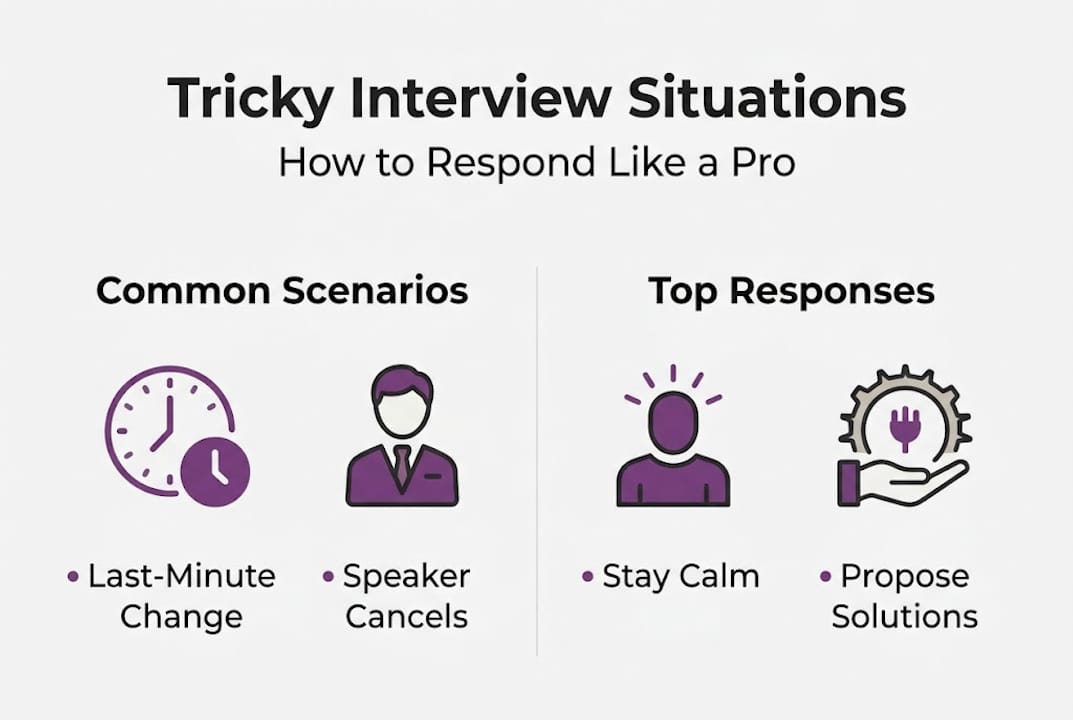
The tricky questions are not designed to trip you up. They’re designed to see how you think, not just what you know. The difference between a safe answer and a standout answer is whether you show value creation, not just damage control.
| Situation | Safe approach | Standout approach |
|---|---|---|
| Speaker cancels last minute | “I’d find a replacement quickly.” | “I maintain a backup speaker list. I’d contact two alternatives immediately, brief them on the agenda, and keep the audience engaged with a session reshuffling.” |
| Power failure mid-event | “I’d call the venue team.” | “I’d activate the backup generator plan, redirect guests to a holding area, and keep the client updated every five minutes.” |
| Low attendance | “I’d assess what went wrong.” | “During registration, I track RSVPs against targets. If numbers drop, I’d boost last-minute outreach via WhatsApp groups and partner channels.” |
For real Indian interview examples that mirror what candidates face in Mumbai, Bengaluru, and Delhi hiring rounds, it helps to read firsthand accounts of what questions actually come up.
When handling difficult client questions during interviews, draw on MICE event insights to show you understand why corporate clients have non-negotiable standards. Budget changes, last-minute scope creep, and protocol-heavy guest lists are all common realities in corporate MICE work.
Key emergency action points to memorise:
- Always have backup vendor contacts saved and ready to activate
- Know your venue’s generator and contingency protocols before any event
- Communicate proactively with clients during a crisis, never go silent
- Document every deviation from the plan so the post-event review is honest
- Frame every problem as a problem you anticipated, not one that caught you off guard
Pro Tip: In your answer, always end with how the situation made you better, not just how you survived it. Interviewers want to hire someone who grows from pressure, not someone who merely copes with it.
Why standing out matters more than ‘knowing the answers’
Here’s the uncomfortable truth we rarely say out loud: most candidates who fail event management interviews in India are not failing because they lack knowledge. They’re failing because they sound like everyone else.
Textbook answers about teamwork and time management are forgettable. What’s memorable is specificity. Think about the candidate who described how their college cultural fest lost its main stage audio system an hour before curtain. Instead of panicking, they reorganised the entire performance schedule, moved acoustic acts forward, and won the crowd over. That’s not a crisis story. That’s a leadership story dressed in a crisis costume.
Employers want reliability and fresh thinking, not perfection. They know you’re a fresher. They’re not expecting you to have managed a 5,000-person conference. They are expecting you to show how your brain works when things go sideways. Connect your experiences directly to their specific challenges as a company. Do they struggle with B2B client management? Tell them about the time you navigated a difficult college committee. Do they run large-scale outdoor events? Describe your experience managing outdoor logistics for a college sports day. Make yourself the obvious solution to their problems, not a generic candidate.
Ready to start your event management career journey?
If you’ve read this far, you’re already ahead of most. But reading is preparation, not transformation. To truly walk into that interview room with confidence, you need structured training, real event exposure, and the kind of industry connections that open doors before you even send a CV.
At teami.org, we’ve spent 24 years building exactly that. Our event management course gives you hands-on experience across live productions, not just classroom theory. Explore our online event management programme if you need flexibility without compromising on quality. And when you’re ready to turn learning into a career, our job placement support connects you directly with industry recruiters who are actively hiring.
Your first big role in event management is closer than you think. Let’s build you towards it.
Frequently asked questions
What are the most common event management interview questions in India?
Expect questions on past event experience, planning steps, MICE sector knowledge, and crisis management situations. Interviewers also probe soft skills like teamwork and adaptability under pressure.
How can I answer scenario-based questions as a fresher?
Use the STAR method to describe how you solved problems during college fests or internships, even if you lack formal job experience. Specificity matters far more than seniority.
What is the STAR method and why is it useful?
STAR stands for Situation, Task, Action, Result, and it helps you structure strong answers that are clear, specific, and compelling rather than vague or generic.
How much do certifications matter for first event management jobs?
Certifications strengthen your CV and signal genuine commitment, but transferable skills from internships and volunteering are equally valued by Indian recruiters at entry level.
How do I handle a question about a failed event or mistake?
Explain what went wrong honestly, then focus on how you adapted and what you changed going forward. Interviewers respect self-awareness and the ability to learn under pressure far more than a spotless record.
Recommended
- Ace your event management interview: 5 expert tips – team I
- Event management lifestyle: a practical guide for 2026 – team I
- Tips for Success as a New Event Management Professional – team I
- 8 Tips For A Successful Career In Event Management – team I
- Top 10 interview questions: answer confidently in 2026 | Pavone Academy
Thinking about a career in event management?
team I is Bangalore’s only EEMA-certified event management institute, running for 24 years, where students work on real live events with real budgets and real deadlines rather than classroom simulations. See the full range of event management courses in Bangalore, or go straight to the flagship Certificate Program in Event Management (CPEM).