TL;DR:
- Successful event management interviews test both soft skills and technical knowledge under pressure.
- Preparation involves researching the company, mapping skills to requirements, and practicing structured responses.
- Demonstrating a blend of operational expertise and effective communication makes candidates stand out.
Landing your first event management role is genuinely competitive. You’re not just up against other graduates with similar degrees. You’re competing against candidates who’ve run real events, built portfolios, and can talk logistics without flinching. The interview room is where all of that gets tested in real time. But here’s the thing: structured, targeted preparation can be the difference between walking out with a job offer and walking out with a lesson. This guide gives you the practical, battle-tested strategies you need to walk in confident, answer with clarity, and leave a lasting impression.
Table of Contents
- Understanding the event management industry interview landscape
- Essential preparation steps before your interview
- Showcasing your event management skills effectively
- What to do during and after the interview
- A fresh perspective: Why blending technical and soft skills is your superpower
- Take your event career further with expert support
- Frequently asked questions
Key Takeaways
| Point | Details |
|---|---|
| Balance your skills | Showcase both technical knowledge and soft skills during interviews to stand out. |
| Master the STAR method | Structure your answers around Situation, Task, Action, Result for clarity and impact. |
| Research and prepare | Understand the company, practise common questions, and bring a tailored portfolio. |
| Follow up professionally | Send thoughtful follow-ups to solidify your impression and display your professionalism. |
Understanding the event management industry interview landscape
Event management interviews are not your standard corporate sit-down. They’re dynamic, probing, and often deliberately unpredictable. Why? Because the industry itself is controlled chaos. Employers want to know how you think under pressure, not just what you’ve memorised from a textbook.
Most interviews in this field test two categories of ability simultaneously. First, your soft skills: communication, leadership, adaptability, and diplomacy. Second, your technical skills: logistics planning, vendor coordination, budget management, and familiarity with event software. Balancing technical and soft skills is not optional. Lean too far in either direction and you’ll come across as either a people-pleaser with no operational backbone or a logistics robot with zero charisma.
Here’s what event management interviewers typically assess:
- Problem-solving ability: How you handle last-minute vendor cancellations or venue changes
- Organisational thinking: Whether you can manage multiple moving parts without dropping the ball
- Communication style: How clearly you articulate plans to clients, teams, and suppliers
- Technical knowledge: Your grasp of event timelines, showflows, and planning tools
- Cultural fit: Whether your energy and values align with the company’s brand
Many employers use competency-based or behavioural interview formats. These questions sound like: “Tell me about a time you managed a crisis during an event.” The best way to answer them? Use the STAR method to structure your responses around Situation, Task, Action, and Result. It keeps your answers focused and demonstrates structured thinking.
| Interview format | What it tests | How to prepare |
|---|---|---|
| Competency-based questions | Past behaviour and decision-making | Practise STAR-structured answers |
| Scenario questions | Problem-solving under pressure | Rehearse real event challenges |
| Portfolio review | Practical experience and creativity | Organise clear, visual project examples |
| Technical questions | Industry knowledge and software skills | Review logistics, budgeting, and tools |
Pro Tip: Read up on event management career tips before your interview so you can speak confidently about industry trends and what it genuinely takes to succeed in event management.
Essential preparation steps before your interview
Having a clear understanding of what to expect, it’s time to take practical steps to ensure you enter your interview feeling organised and confident.
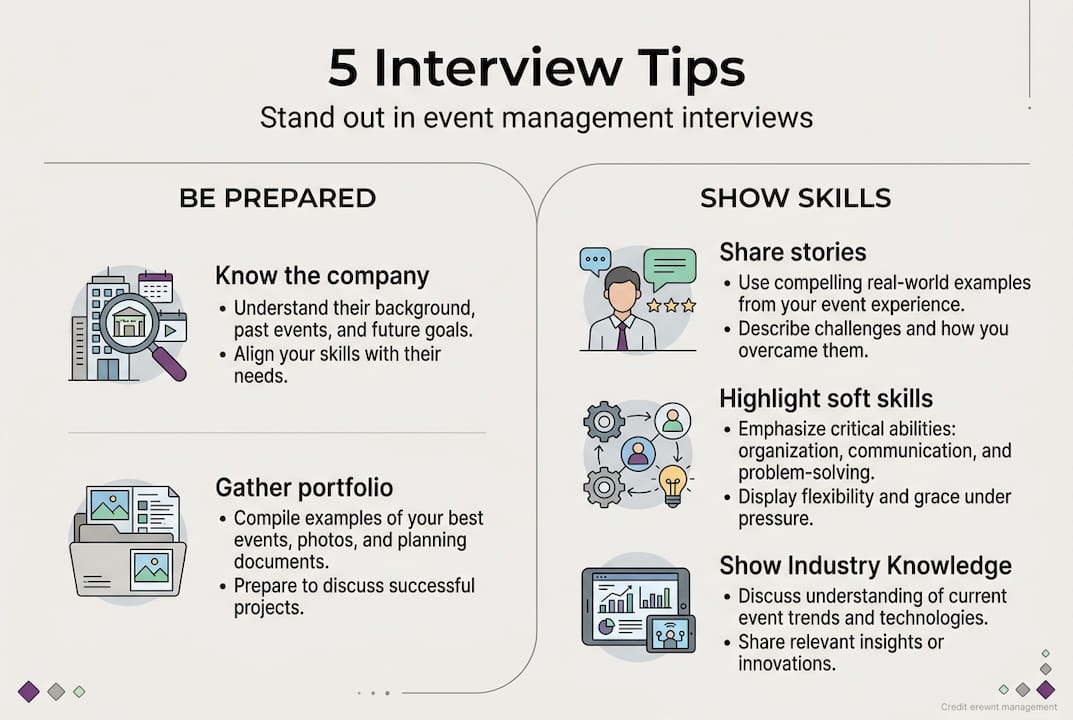
Preparation is not about memorising scripted answers. It’s about knowing yourself, knowing the company, and knowing how to connect the two. The candidates who impress interviewers are the ones who’ve clearly done their homework and can speak to specifics.
Research the company thoroughly: look at their recent events, client roster, brand values, and any press coverage. If they produced a major corporate summit last quarter, know about it. Reference it. Show that you care enough to pay attention.
Here’s a step-by-step preparation checklist:
- Map your skills to the job description: Go line by line. For every requirement listed, identify a real example from your experience that demonstrates it.
- Research the company’s event portfolio: Visit their website, social media, and any news coverage. Know their style, their clients, and their scale.
- Prepare 3 to 5 STAR-structured answers: Cover common themes like crisis management, teamwork, and logistics planning.
- Organise your portfolio: Gather event plans, photos, feedback, and any data showing outcomes. Even university projects count.
- Prepare smart questions for the interviewer: Ask about their upcoming projects, team structure, or how they measure event success.
- Test your technology: If it’s a virtual interview, check your camera, microphone, lighting, and internet connection the day before.
- Print extra copies of your CV: Bring at least three. It shows professionalism and readiness.
“The candidates who stand out are the ones who walk in knowing our last three events and asking where we’re headed next. That level of preparation signals genuine passion, not just job-hunting.”
Pro Tip: Review tips for new event managers and revisit your understanding of starting your event management career so your answers reflect real industry awareness.
Showcasing your event management skills effectively
Preparation means little if you can’t clearly showcase your abilities. Let’s look at how you can make your experience stand out during the interview.
You don’t need five years of experience to impress an interviewer. You need clarity. The ability to articulate what you did, why you did it, and what happened as a result is far more powerful than a long list of job titles.

For entry-level candidates, transferable skills from internships and volunteer work are gold. Organising a university cultural fest, managing a charity fundraiser, or coordinating a sports day all count. The key is framing these experiences with precision.
Here’s a comparison of weak versus strong skill presentation:
| Weak framing | Strong framing |
|---|---|
| “I helped organise a college event.” | “I coordinated a 400-person college fest, managing three vendors and a ₹50,000 budget within a two-week timeline.” |
| “I’m good at communication.” | “I negotiated a last-minute venue change by liaising with two suppliers and a client within 90 minutes.” |
| “I know event software.” | “I’ve used Eventbrite and Google Sheets to manage registrations and track RSVPs for events with 200+ attendees.” |
| “I work well under pressure.” | “When our AV team cancelled four hours before showtime, I sourced a replacement and briefed them in under an hour.” |
The skills that event employers value most include:
- Organisation and time management: Juggling multiple tasks without losing detail
- Communication and diplomacy: Keeping clients, vendors, and teams aligned
- Adaptability: Pivoting fast when things go sideways (and they always do)
- Problem-solving: Finding creative solutions under real pressure
- Technical proficiency: Budget tracking, logistics planning, and event software
Build a simple portfolio, even if it’s entirely from university or event work experience pathways. Include event briefs, run sheets, photos, and any measurable outcomes. A visual portfolio signals that you think like a professional. Explore creative event management careers to understand what skills employers in different specialisations are actively seeking.
What to do during and after the interview
With your skills presented and experience shared, it’s crucial to follow through during and after the interview for lasting impact.
The interview itself is a live event. Treat it like one. You’re the producer, and every answer is part of the show. Stay present, listen carefully, and resist the urge to fill silence with rambling. Concise, confident answers land harder than long, meandering ones.
Employers expect practical examples from your past experience, so anchor every answer in something real. If you’re asked how you handle difficult clients, don’t theorise. Tell them exactly what happened and what you did about it.
Here’s how to perform well during and after the interview:
- Listen to the full question before answering: Don’t jump in halfway. Pause, process, then respond.
- Use STAR for every competency question: Structure keeps your answers sharp and your thinking visible.
- Be specific, not vague: Numbers, timelines, and outcomes make your answers credible.
- Ask your prepared questions at the end: This signals genuine interest and forward thinking.
- Send a personalised thank-you email within 24 hours: Reference something specific from your conversation. It reinforces your interest and keeps you memorable.
- Reflect and make notes immediately after: Write down what went well and what you’d sharpen for next time.
Statistic to know: Studies show candidates who send a follow-up thank-you note after an interview are viewed more favourably by hiring managers, with many reporting it as a deciding factor between equally qualified candidates.
Review event management best practices to ensure your post-interview follow-up reflects the professionalism the industry demands.
A fresh perspective: Why blending technical and soft skills is your superpower
Here’s an uncomfortable truth the industry doesn’t say loudly enough: most candidates fail interviews not because they lack knowledge, but because they can’t demonstrate how their knowledge connects to real outcomes.
The debate between technical versus soft skills in event management interviews is genuinely old and genuinely exhausting. Some hiring managers obsess over whether you know how to build a showflow. Others care only about whether you can keep a panicking client calm at 9 PM on event night. The truth? The best candidates do both, and they show it in the same breath.
Think about it this way. You can know every logistics tool in existence, but if you can’t communicate a venue change to a stressed client with confidence, the event falls apart. Equally, charm and charisma without operational rigour produces beautiful disasters.
The candidates who genuinely stand out are the ones who tell stories where both skill sets collide. “I managed the run sheet while simultaneously calming a vendor dispute and briefing the MC.” That’s the sweet spot. That’s what event management tips from seasoned professionals always circle back to. Know your strengths, yes. But practise presenting them as two sides of the same coin.
Take your event career further with expert support
If you’re serious about cracking event management interviews and building a career that lasts, structured training makes a real difference. At teami.org, we’ve spent 24 years preparing graduates and young professionals for exactly this industry. Our programmes combine classroom learning with hands-on event experience, internships, and real industry exposure through our partnership with DNA Entertainment Networks.
Explore our event management course details to see how our curriculum maps directly to what employers are hiring for. If flexibility matters to you, our online event management courses let you build industry-ready skills on your own schedule. Your next interview could be the one that changes everything.
Frequently asked questions
What is the STAR method, and why is it important for event management interviews?
The STAR method helps you answer behavioural questions clearly by structuring your responses around Situation, Task, Action, and Result, showcasing your problem-solving and organisational skills. It turns vague answers into compelling, evidence-backed stories that interviewers remember.
What kind of portfolio should I bring to an event management interview?
Prepare a simple portfolio with event plans, photos, run sheets, and feedback from your academic, voluntary, or internship projects to showcase practical experience. Even university-based events demonstrate real planning ability when presented with clear outcomes.
How can I make a positive impression after the interview?
Send a personalised thank-you email within 24 hours, mentioning something specific from your interview, and follow up professionally if you haven’t heard back after the stated timeframe. It’s a small step that signals big professionalism.
What soft skills are most valued in event management interviews?
Employers value communication, adaptability, leadership, and teamwork skills, along with problem-solving ability and attention to detail. Balancing these with technical skills is what separates good candidates from great ones.
Recommended
- Tips for Success as a New Event Management Professional – team I
- 8 Tips For A Successful Career In Event Management – team I
- Event Management Best Practices for Career Success – team I
- Top Event Management Skills for Success in 2025 – team I
- How to schedule shifts efficiently: step-by-step guide
Thinking about a career in event management?
team I is Bangalore’s only EEMA-certified event management institute, running for 24 years, where students work on real live events with real budgets and real deadlines rather than classroom simulations. See the full range of event management courses in Bangalore, or go straight to the flagship Certificate Program in Event Management (CPEM).