
Facing the challenge of rapid industry change, aspiring event managers in Bangalore are realising that career growth depends on more than academic degrees and certifications. The evolving events sector increasingly rewards those who embrace lifelong learning, blending formal education, real-world experiences, and ongoing skill development. This article clarifies common misconceptions around lifelong learning, explaining how combining structured programmes with practical and experiential approaches can help you stay competitive and cultivate the adaptability employers value most.
Table of Contents
- Defining Lifelong Learning And Common Misconceptions
- Types Of Lifelong Learning In Event Management
- Key Features: Formal, Informal, Experiential
- How Lifelong Learning Drives Industry Adaptability
- Responsibilities, Risks, And Skill Gap Solutions
- Comparing Alternatives: One-Time Education Versus Continuous Growth
Key Takeaways
| Point | Details |
|---|---|
| Embrace Lifelong Learning | Continuous education is vital for personal and professional development in the dynamic event management sector. |
| Counter Misconceptions | Understanding that learning is a lifelong process can help professionals overcome barriers that hinder career growth. |
| Utilise Diverse Learning Modalities | Combining formal, non-formal, and informal learning strategies creates a robust skill set essential for adaptability. |
| Focus on Continuous Growth | Transitioning from one-time education to continuous skill development is crucial for sustained relevance and career success. |
Defining lifelong learning and common misconceptions
Lifelong learning represents a continuous journey of personal and professional development that extends far beyond traditional educational boundaries. Systematic research on learning approaches reveals it as an intentional process of acquiring knowledge, skills, and competencies throughout one’s lifetime.
Lifelong learning encompasses three fundamental types of educational engagement:
- Formal learning: Structured academic programmes and certified courses
- Non-formal learning: Professional workshops, training sessions, and skill development programmes
- Informal learning: Self-directed learning through experience, interactions, and personal exploration
Many event management professionals harbour misconceptions about lifelong learning that can hinder their career growth. These misunderstandings often stem from limited perspectives about learning’s scope and value.
Common Misconceptions About Lifelong Learning
Several prevalent myths prevent event managers from embracing continuous education:
- Learning stops after formal education
- Professional development is time-consuming
- Advanced skills are only for senior professionals
- Learning requires significant financial investment
Lifelong learning is not about collecting certificates, but continuously evolving your professional capabilities.
For event managers in India, understanding these nuances becomes crucial. The dynamic events landscape demands professionals who can adapt quickly and remain intellectually curious.
Pro tip: Allocate at least two hours weekly for structured learning activities that directly enhance your event management skills.
Types of lifelong learning in event management
In the dynamic world of event management, lifelong learning encompasses diverse approaches that go beyond traditional classroom education. Experiential learning techniques have emerged as a critical strategy for developing professional competencies in real-world event scenarios.
Lifelong learning in event management can be categorised into several key types:
- Formal learning: Structured academic programmes and professional certifications
- Professional workshops: Targeted skill development sessions
- Industry conferences: Networking and knowledge exchange platforms
- Online courses: Self-paced digital learning modules
- Mentorship programmes: Guided learning from experienced professionals
Each learning type offers unique benefits for event management professionals seeking continuous growth and skill enhancement. Understanding these approaches enables event managers to create personalised development strategies that align with their career objectives.
Exploring Learning Modalities
Event managers can leverage multiple learning approaches to stay competitive:
- Hands-on project participation
- Cross-departmental training
- International industry exposure
- Digital skill development platforms
Effective lifelong learning is about strategic skill acquisition, not just accumulating credentials.
The Indian event management landscape particularly values professionals who demonstrate adaptability and continuous learning mindset. By embracing diverse learning modalities, event managers can develop a comprehensive skill set that transcends traditional educational boundaries.
Pro tip: Create a personalised learning roadmap that integrates at least three different learning types to maximise professional development.
Key features: formal, informal, experiential
Understanding the nuanced landscape of lifelong learning requires a deep exploration of its primary learning approaches. Experiential learning cycle represents a critical methodology for event management professionals seeking comprehensive skill development.
Three primary learning approaches define the lifelong learning ecosystem for event managers:
- Formal Learning: Structured academic programmes with standardised curricula
- Non-Formal Learning: Targeted professional development outside traditional institutions
- Informal Learning: Unstructured knowledge acquisition through daily experiences
Detailed Learning Approach Breakdown
Each learning approach offers distinct advantages for event management professionals:
Formal Learning
- Provides recognised qualifications
- Offers systematic knowledge progression
- Ensures comprehensive theoretical foundations
Non-Formal Learning
- Flexible skill development
- Industry-specific training modules
- Short-term, targeted learning experiences
Informal Learning
- Real-world problem-solving skills
- Spontaneous knowledge acquisition
- Networking and practical insights
Effective learning transcends traditional boundaries, integrating multiple approaches for holistic professional growth.
The Indian event management landscape increasingly values professionals who can seamlessly blend these learning modalities, creating a dynamic and adaptable skill set that responds to rapidly changing industry demands.
Pro tip: Design a personalised learning strategy that intentionally combines all three learning approaches to maximise professional development potential.
The table below contrasts the benefits and limitations of formal, non-formal, and informal learning for event management professionals:
| Approach | Main Benefit | Key Limitation | Best Suited For |
|---|---|---|---|
| Formal Learning | Provides recognised qualifications | Less flexible and time-bound | Foundational knowledge seekers |
| Non-Formal Learning | Fast, targeted skill acquisition | Not always industry-accredited | Upskilling in niche competencies |
| Informal Learning | Real-world adaptability and insight | Lacks structured assessment | Networking and practice-focused |
How lifelong learning drives industry adaptability
In the rapidly evolving event management landscape, professional adaptability strategies have become crucial for sustained career success. Lifelong learning represents the primary mechanism through which event management professionals can navigate complex industry transformations and maintain their competitive edge.
Industry adaptability requires a multifaceted approach to continuous professional development:
- Staying current with technological innovations
- Understanding emerging market trends
- Developing flexible problem-solving skills
- Anticipating client expectation shifts
- Maintaining technological proficiency
Mechanisms of Professional Resilience
Event management professionals can leverage lifelong learning to drive industry adaptability through several strategic approaches:
Technology integration
- Master emerging digital event platforms
- Learn advanced digital communication tools
- Understand virtual and hybrid event technologies
Skills diversification
- Develop cross-disciplinary competencies
- Acquire complementary professional skills
- Explore emerging event management specialisations
Continuous knowledge acquisition
- Attend industry conferences
- Participate in professional workshops
- Engage with online learning resources
Adaptability is not about predicting the future, but preparing to navigate unknown challenges with confidence and expertise.
The Indian event management sector particularly demands professionals who can quickly pivot and respond to changing market dynamics. By embracing lifelong learning, event managers transform potential disruptions into opportunities for innovation and growth.

Pro tip: Allocate at least 10% of your annual professional development budget specifically towards emerging technology and skill adaptation training.
Here is a summary of how different lifelong learning strategies directly support industry adaptability in event management:
| Learning Strategy | Adaptability Outcome | Example Impact on Career |
|---|---|---|
| Technology Integration | Quicker response to digital trends | Smooth virtual event migrations |
| Skills Diversification | Enhanced multi-role versatility | Access to broader job roles |
| Continuous Acquisition | Up-to-date industry knowledge | Proactive response to innovation |
| Mentorship Engagement | Accelerated professional resilience | Gaining top-level perspectives |
Responsibilities, risks, and skill gap solutions
Lifelong learning demands a comprehensive understanding of organisational skill development strategies. Event management professionals must proactively address potential skill gaps and mitigate professional risks through strategic continuous learning approaches.
Professional responsibilities in lifelong learning encompass multiple critical dimensions:
- Personal skill assessment and development
- Continuous technological adaptation
- Proactive knowledge acquisition
- Industry trend monitoring
- Self-directed learning initiatives
Risk Mitigation Strategies
Event management professionals face several inherent risks in their professional journey:
Skill Obsolescence Risks
- Technological disruption
- Changing industry standards
- Emerging digital competencies
Professional Stagnation Challenges
- Limited career progression
- Reduced market competitiveness
- Diminished employability potential
Knowledge Gap Consequences
- Reduced problem-solving capabilities
- Limited innovation potential
- Decreased client trust
Professional development is not an option, but a critical survival strategy in the evolving event management landscape.
The Indian event management sector requires professionals who can anticipate and adapt to dynamic market challenges. By embracing continuous learning, event managers can transform potential vulnerabilities into opportunities for growth and innovation.
Pro tip: Conduct a quarterly skills audit to identify emerging competencies and design targeted learning interventions.
Comparing alternatives: one-time education versus continuous growth
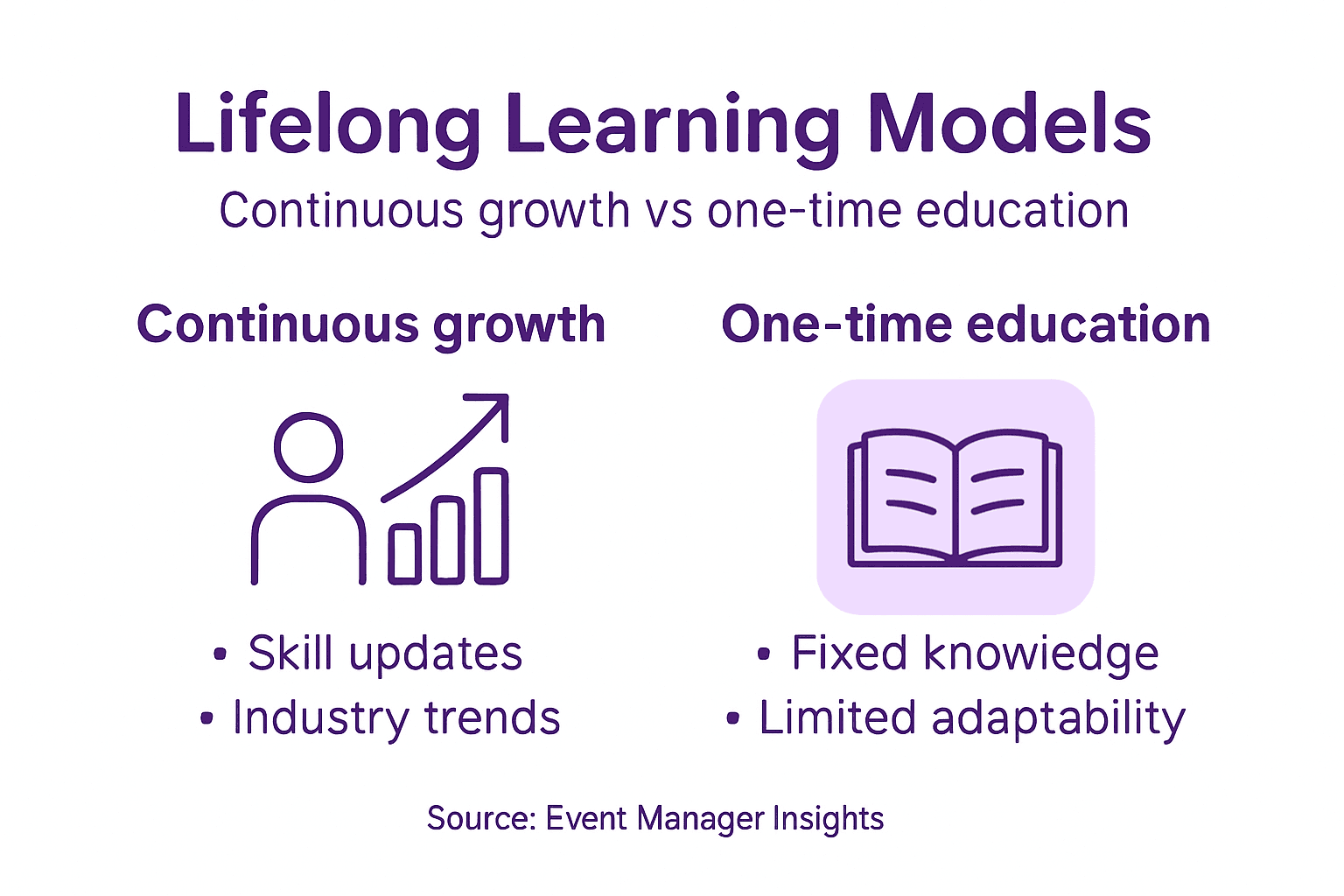
The event management profession increasingly demands a transformative approach to learning, moving beyond traditional training methodology paradigms. One-time education models are rapidly becoming obsolete in an industry characterised by constant technological and strategic evolution.
Learning approaches can be distinctly categorised into two fundamental models:
- One-time education: Static, time-bound knowledge acquisition
- Continuous growth: Dynamic, ongoing skill development
- Adaptive learning: Responsive, personalised skill enhancement
- Experiential learning: Practice-driven knowledge integration
- Network-based learning: Collaborative skill expansion
Comparative Analysis of Learning Models
Event management professionals must understand the critical differences between these learning approaches:
Knowledge Retention
- One-time education: Limited long-term knowledge retention
- Continuous growth: Sustained skill development
- Adaptive approach: Contextual learning adaptability
Professional Relevance
- Static learning: Quickly becoming outdated
- Continuous learning: Constantly updated skill sets
- Proactive learning: Anticipatory skill development
Career Progression
- Traditional education: Linear skill progression
- Continuous growth: Multidimensional career trajectories
- Networked learning: Expanded professional opportunities
Continuous learning is not just an option; it’s a professional survival strategy in the dynamic event management ecosystem.
The Indian event management landscape particularly rewards professionals who demonstrate flexibility, technological adaptability, and a commitment to ongoing personal development. By embracing continuous growth, event managers transform potential limitations into opportunities for innovation and career advancement.
Pro tip: Develop a personalised learning portfolio that documents your continuous skill acquisition and demonstrates your commitment to professional evolution.
Elevate Your Event Management Career with Lifelong Learning
Lifelong learning is the key to overcoming skill gaps and adapting to the fast-evolving event management industry. If you want to avoid professional stagnation and stay ahead with the latest industry trends, embracing continuous growth through practical, targeted education is essential. Concepts like formal, non-formal, and experiential learning highlighted in the article perfectly align with the comprehensive approach needed to thrive in today’s competitive landscape.
At teami.org, you can access specialised certification programmes that integrate hands-on projects, internships, and real event participation. With over 24 years of expertise and strong industry partnerships like DNA Entertainment Networks, our platform ensures your learning journey is practical, relevant, and career-focused. Do not wait for skill obsolescence or career setbacks—take control of your professional future now. Explore our courses designed specifically for aspiring and advancing event managers and transform your adaptability and expertise today.
Ready to commit to continuous learning and unlock new opportunities in event management Explore your personalised learning path by connecting with us at teami.org and start your journey towards professional excellence.
Frequently Asked Questions
What is lifelong learning in event management?
Lifelong learning in event management refers to the continuous process of acquiring new knowledge and skills throughout a professional’s career. It includes formal, non-formal, and informal learning methods to enhance personal and professional development.
Why is lifelong learning important for event managers?
Lifelong learning is crucial for event managers to adapt to changes in the industry, stay updated with technological advancements, and meet evolving client expectations. It ensures that professionals remain competitive and can effectively handle diverse challenges in their roles.
How can event managers incorporate lifelong learning into their routines?
Event managers can incorporate lifelong learning by allocating time for structured learning activities, participating in workshops and conferences, engaging in online courses, seeking mentorship, and embracing experiential learning opportunities.
What are the common misconceptions about lifelong learning for event managers?
Common misconceptions include the belief that learning stops after formal education, that professional development is overly time-consuming or expensive, and that advanced skills are only for senior professionals. These misunderstandings can hinder career growth in the event management field.